


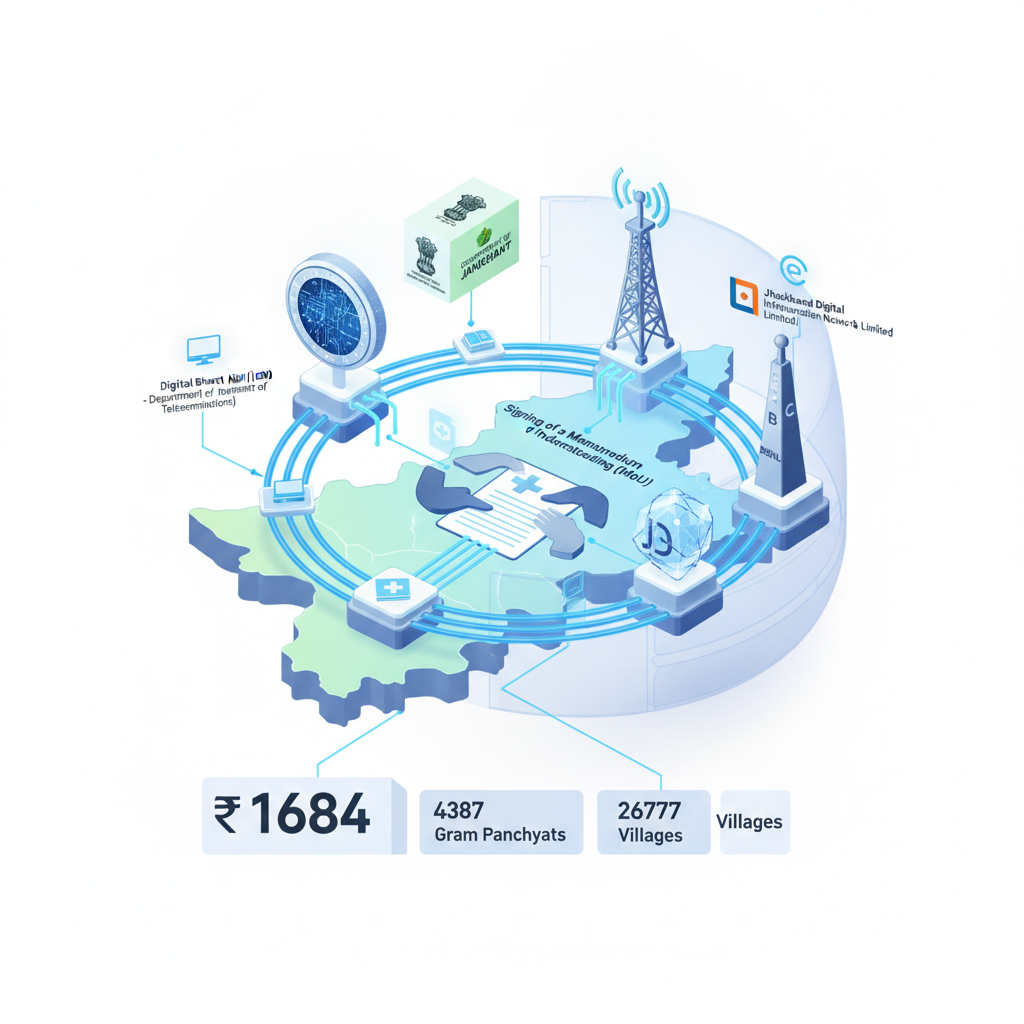
10 Sep झारखंड में संशोधित भारतनेट: DBN, BSNL और राज्य सरकार की 1,684 करोड़ रुपये की साझेदारी
✎ Digital Bharat Nidhi (DBN) is the successor to the Universal Service Obligation Fund (USOF), to promote universal access to telecommunication and digital services across rural and remote areas.
Subject Relevance — Where This Topic Fits
- GS Paper II — Governance, Constitution and Polity (Institutional Mechanisms for Digital Governance) | GS Paper III — Infrastructure (Digital Infrastructure, Broadband Connectivity, Public-Private Partnerships)
- Prelims: Digital Bharat Nidhi (DBN), BharatNet Phase-II, Universal Service Obligation Fund (USOF), Special Purpose Vehicle (SPV), Ring Topology, Fibre-to-the-Home (FTTH), Digital India Mission, E-governance, Telemedicine, Aspirational Districts Programme
- Essay: Digital Public Infrastructure: Catalyst for Inclusive Development, Role of State-Led Models in Accelerating Last-Mile Digital Connectivity
Quick Revision: Digital Bharat Nidhi (DBN) is the successor to the Universal Service Obligation Fund (USOF), to promote universal access to telecommunication and digital services across rural and remote areas.
Why is this in the news?
The signing of a Memorandum of Understanding (MoU) between the Digital Bharat Nidhi (DBN), Government of Jharkhand, Jharkhand Digital Infrastructure Corporation Limited (JDICL), Bharat Sanchar Nigam Limited (BSNL), and Jharkhand Communication Network Limited (JCNL) marks a significant governance intervention to expedite the implementation of the Revised BharatNet Programme in Jharkhand. The initiative, sanctioned with a financial outlay of ₹1,684 crore, aims to upgrade 4,387 Gram Panchayats to ring topology and extend on-demand broadband connectivity to 26,777 villages, thereby strengthening rural digital infrastructure and enabling inclusive digital services such as e-governance, telemedicine, and online education.
Background
- The Universal Service Obligation Fund (USOF) was established under the Indian Telegraph (Amendment) Act, to promote universal access to telecommunication services in rural and remote areas.
- The Revised BharatNet Programme was approved by the Union Cabinet on 4 August 2023 to modernise and expand the existing BharatNet network, ensuring future-ready broadband connectivity to all Gram Panchayats and villages on demand.
- BharatNet, a flagship initiative under the Digital India Mission, aims to provide high-speed broadband connectivity to over 6 lakh villages across India, thereby bridging the digital divide and enabling socio-economic development.
- Jharkhand, an aspirational state with significant rural population, faces challenges in last-mile connectivity and digital service delivery, necessitating targeted interventions under state-led models.
What is the Revised BharatNet Programme?
- The Revised BharatNet Programme is a centrally sponsored scheme designed to upgrade, strengthen, and expand the existing BharatNet network to ensure demand-driven, high-speed broadband connectivity to all Gram Panchayats and villages in India.
- Under the programme, network topology is upgraded from linear to ring topology in 4,387 Gram Panchayats in Jharkhand, enhancing redundancy, reliability, and resilience of the digital infrastructure.
- The programme includes 8 newly constituted Gram Panchayats, ensuring equitable coverage across administrative units in Jharkhand.
- On-demand broadband connectivity is extended to 26,777 villages in Jharkhand, enabling last-mile digital inclusion and supporting services such as e-governance, telemedicine, online education, and digital payments.
- The programme is implemented through a state-led model, leveraging the Jharkhand Digital Infrastructure Corporation Limited (JDICL), a Special Purpose Vehicle (SPV) established for this purpose.
- Financial assistance of ₹1,684 crore has been sanctioned by the Government of India under the Digital Bharat Nidhi (DBN) to fund the implementation of the programme in Jharkhand.
- The programme is expected to benefit over 4 lakh rural households in Jharkhand by providing Fibre-to-the-Home (FTTH) connectivity, thereby accelerating digital empowerment and socio-economic development in the state.
- The initiative aligns with the broader objectives of the Digital India Mission, aiming to create a digitally empowered society and knowledge economy through inclusive digital infrastructure.
Key Features
| Feature | Significance |
|---|---|
| Financial Allocation | A provision of ₹1,684 crore under the Digital Bharat Nidhi (DBN) to fund the Revised BharatNet Programme in Jharkhand, ensuring fiscal commitment to rural digital infrastructure development. |
| Geographical Coverage | Inclusion of 4,395 Gram Panchayats (with 4,387 upgraded to ring topology and 8 newly formed ones) and provision of on-demand connectivity to 26,777 villages, addressing last-mile connectivity gaps. |
| Implementation Model | State-led Special Purpose Vehicle (SPV) named Jharkhand Digital Infrastructure Corporation Limited (JDICL) to execute the project, ensuring state ownership and alignment with local governance structures. |
| Technological Upgrade | Transition from linear to ring topology in network architecture to enhance redundancy, reliability, and scalability of broadband connectivity in rural areas. |
| Stakeholder Collaboration | Multi-institutional partnership involving DBN (under DoT), Jharkhand Government, BSNL, and Jharkhand Communication Network Limited (JCNL) to leverage technical and administrative synergies. |
Why it Matters
Digital Infrastructure Development
- Strengthens rural broadband connectivity, a critical enabler for digital governance, education, healthcare, and financial inclusion in Jharkhand’s remote and underserved regions.
- Facilitates the establishment of over 4 lakh fiber-to-the-home (FTTH) connections, directly supporting the Digital India vision of ubiquitous digital access.
- Enhances the resilience of telecom networks through ring topology, reducing single-point failures and improving service continuity.
Governance and Service Delivery
- Supports the delivery of e-governance services, telemedicine, online education, and digital payments, thereby improving citizen-centric service accessibility in rural Jharkhand.
- Enables real-time data exchange and monitoring for government schemes, enhancing transparency and accountability in public service delivery.
- Lays the foundation for a knowledge-based economy in Jharkhand by ensuring high-speed internet access for economic activities and innovation.
Economic and Social Inclusion
- Promotes equitable development by bridging the digital divide between urban and rural areas, fostering inclusive growth and reducing regional disparities.
- Empowers local communities through digital literacy initiatives and access to online resources, contributing to socio-economic upliftment.
- Attracts investment in digital enterprises and startups by providing reliable connectivity, thereby stimulating local economic development.
Institutional and Policy Framework
- Demonstrates the efficacy of the Digital Bharat Nidhi (DBN) as a funding mechanism for universal service obligations, replacing the erstwhile Universal Service Obligation Fund (USOF).
- Showcases the role of state-led SPVs in implementing centrally sponsored schemes, ensuring contextualized and efficient project execution.
- Aligns with the National Digital Communications Policy (NDCP) 2018, which emphasizes broadband penetration, digital inclusion, and innovation-driven growth.
Challenges
1. Last-Mile Connectivity Challenges
- Geographical barriers such as hilly terrain, dense forests, and remote settlements in Jharkhand pose significant challenges to laying fiber-optic cables and ensuring reliable connectivity.
- High costs associated with rural infrastructure deployment, including logistics, labor, and maintenance, may delay project timelines and increase financial burden.
UPSC Link: GS-III: Infrastructure – Energy, Ports, Roads, Airports, Railways
2. Digital Divide and Literacy Gaps
- Low digital literacy among rural populations may limit the effective utilization of broadband services, necessitating concurrent capacity-building initiatives.
- Skewed access to digital devices and internet-enabled services in marginalized communities could exacerbate existing inequalities without targeted interventions.
UPSC Link: GS-II: Social Justice – Welfare Schemes for Vulnerable Sections
3. Operational and Maintenance Bottlenecks
- Ensuring timely maintenance and repair of network infrastructure in remote areas requires robust monitoring systems and local technical manpower.
- Dependence on multiple stakeholders (BSNL, JCNL, JDICL) for coordination and execution may lead to delays or misalignment in project implementation.
UPSC Link: GS-III: Science & Technology – Developments and their Applications
4. Sustainability and Financial Viability
- Long-term financial sustainability of the project hinges on user adoption, revenue generation models, and government subsidies, which may fluctuate with policy changes.
- Potential underutilization of infrastructure due to low demand in sparsely populated or economically inactive rural areas could impact cost recovery.
UPSC Link: GS-III: Economy – Mobilization of Resources
5. Regulatory and Compliance Hurdles
- Adherence to Right of Way (RoW) norms, environmental clearances, and land acquisition processes for laying cables may face delays due to bureaucratic or legal constraints.
- Ensuring compliance with data privacy and cybersecurity standards in rural networks requires proactive measures and capacity building.
UPSC Link: GS-II: Governance – Transparency & Accountability
6. Climate and Environmental Risks
- Extreme weather events, such as floods and landslides, threaten the integrity of telecom infrastructure, necessitating climate-resilient design and disaster management plans.
- Electromagnetic interference and vegetation growth may disrupt signal transmission, requiring regular maintenance and mitigation strategies.
UPSC Link: GS-III: Environment – Conservation & Climate Change
Challenges — UPSC Perspective
| Issue | Concern |
|---|---|
| Topographical Barriers | Hilly terrain and dense forests in Jharkhand complicate the laying of fiber-optic cables and increase deployment costs. |
| Low Digital Literacy | Limited awareness and skills among rural populations may hinder the adoption and effective use of broadband services. |
| Stakeholder Coordination | Multi-institutional involvement (DBN, Jharkhand Govt, BSNL, JCNL) risks delays due to misalignment in priorities or execution timelines. |
| Financial Sustainability | Dependence on government subsidies and uncertain revenue streams may challenge the long-term viability of the project. |
| Regulatory Delays | Right of Way (RoW) clearances and environmental approvals often face bureaucratic hurdles, delaying project rollout. |
| Climate Vulnerability | Extreme weather events pose risks to telecom infrastructure, necessitating resilient design and disaster preparedness. |
Government Initiatives — Must-Memorise for Prelims
- Digital Bharat Nidhi (DBN) – successor to the Universal Service Obligation Fund (USOF)
Way Forward
- Establish a dedicated monitoring cell under JDICL to track project milestones, address bottlenecks, and ensure timely execution of the Revised BharatNet Programme.
- Conduct concurrent digital literacy campaigns in collaboration with local NGOs, schools, and panchayats to enhance community adoption of broadband services.
- Develop a climate-resilient design framework for telecom infrastructure, incorporating disaster risk reduction strategies tailored to Jharkhand’s topography.
- Strengthen public-private partnerships (PPP) to leverage private sector expertise in network maintenance, last-mile connectivity, and service delivery.
- Formulate a revenue-sharing model for rural broadband services to ensure financial sustainability, including user charges, government subsidies, and cross-subsidization.
- Integrate the project with other state and central schemes (e.g., PM-WANI, e-Pathshala) to maximize synergies and avoid duplication of efforts.
- Enhance stakeholder coordination through regular review meetings and a shared digital dashboard for real-time progress tracking.
- Pilot innovative technologies such as satellite-based internet and low-earth orbit (LEO) constellations in remote areas to supplement fiber connectivity.
UPSC Value Addition
Keywords for Mains Answer-Writing
Digital India Fund (DBN) · Modified BharatNet Programme · Universal Service Obligation Fund (USOF) · Digital public infrastructure · Rural broadband connectivity · Digital Bharat Mission · Telecom Act 2023 · State-led implementation model · Public-Private Partnership (PPP) · Digital divide · Gram Panchayat connectivity · Fiber-to-the-home (FTTH) · E-governance · Telemedicine · Digital India Nidhi (DIN) · Jharkhand Digital Infrastructure Corporation Limited (JDICL) · Last-mile connectivity · Bharat Broadband Network Limited (BBNL) · Digital empowerment · Inclusive digital growth
Concept Flow
Central Government’s Digital India Mission → Revised BharatNet Programme (Cabinet approval, 2023) → Digital Bharat Nidhi (DBN) as funding mechanism → State-led SPV (JDICL) for implementation → Multi-stakeholder collaboration (DoT, Jharkhand Govt, BSNL, JCNL) → Infrastructure deployment (fiber-optic cables, ring topology) → Last-mile connectivity to 26,777 villages → Enhanced digital services (e-governance, telemedicine, education) → Socio-economic inclusion and knowledge economy development
Prelims Practice Questions
Q1. Consider the following statements regarding the Digital India Fund (DBN):
1. DBN was established under the Indian Telegraph (Amendment) Act, 2003.
2. DBN replaced the Universal Service Obligation Fund (USOF) as per the Telecom Act, 2023.
3. The primary objective of DBN is to promote the availability and distribution of telecom services in rural and remote areas only.
How many of the above statements are correct?
- Only one
- Only two
- All three
- None
Answer: Only two — Statement 1 is correct as DBN was established on 01.04.2002 under the Indian Telegraph (Amendment) Act, 2003. Statement 2 is correct as the Telecom Act, 2023 renamed USOF to DBN. Statement 3 is incorrect as DBN aims to promote telecom services in rural, remote, and urban areas to bridge the digital divide.
Q2. Assertion (A): The Modified BharatNet Programme aims to provide on-demand broadband connectivity to all Gram Panchayats and villages.
Reason (R): The programme is implemented through a state-led model to enhance last-mile connectivity and digital inclusion.
Options:
A. Both A and R are true, and R is the correct explanation of A.
B. Both A and R are true, but R is NOT the correct explanation of A.
C. A is true, but R is false.
D. A is false, but R is true.
Answer: ? — Assertion (A) is true as the Modified BharatNet Programme aims to provide on-demand broadband connectivity to all Gram Panchayats and villages. Reason (R) is also true and correctly explains A, as the programme is implemented through a state-led model to enhance last-mile connectivity and digital inclusion.
Q3. Match the following initiatives with their respective objectives:
Column I
1. Digital India Fund (DBN)
2. Modified BharatNet Programme
3. Telecom Act, 2023
4. Jharkhand Digital Infrastructure Corporation Limited (JDICL)
Column II
A. To promote telecom services in rural, remote, and urban areas
B. To provide on-demand broadband connectivity to Gram Panchayats and villages
C. To rename USOF and redefine its objectives
D. To implement state-led digital infrastructure projects
Options:
1. 1-A, 2-B, 3-C, 4-D
2. 1-B, 2-A, 3-C, 4-D
3. 1-C, 2-B, 3-A, 4-D
4. 1-A, 2-C, 3-B, 4-D
Answer: ? — 1-A: DBN promotes telecom services in rural, remote, and urban areas. 2-B: Modified BharatNet Programme provides on-demand broadband connectivity to Gram Panchayats and villages. 3-C: Telecom Act, 2023 renamed USOF to DBN. 4-D: JDICL implements state-led digital infrastructure projects.
Mains Practice Question
✍ The Modified BharatNet Programme represents a paradigm shift in India’s digital public infrastructure strategy. Critically examine its objectives, implementation model, and potential impact on rural broadband connectivity and digital inclusion. Also, analyse the role of the Digital India Fund (DBN) in this initiative. (15 Marks)
Approach: MODEL-ANSWER SKELETON:
1. **Introduction (2 marks)**
– Brief background of the Modified BharatNet Programme: launched to upgrade and expand the existing BharatNet network for on-demand broadband connectivity.
– Mention the approval by the Union Cabinet on 4 August 2023.
– Define key terms: BharatNet, Digital India Fund (DBN), Universal Service Obligation Fund (USOF), Gram Panchayat, last-mile connectivity.
2. **Objectives of the Modified BharatNet Programme (3 marks)**
– Provide on-demand broadband connectivity to all Gram Panchayats and villages.
– Upgrade network topology from linear to ring for 4,387 Gram Panchayats and include 8 newly formed Gram Panchayats.
– Strengthen last-mile connectivity for 26,777 villages in Jharkhand.
– Financial outlay: ₹1,684 crore approved for Jharkhand.
– Expected outcome: Fiber-to-the-home (FTTH) connections in over 4 lakh rural households.
3. **Implementation Model (3 marks)**
– State-led model: Jharkhand Digital Infrastructure Corporation Limited (JDICL) as the Special Purpose Vehicle (SPV).
– Partnership with BSNL, JCNL, and central government agencies.
– Role of DBN: Financial assistance and administrative oversight under the Department of Telecommunications (DoT).
– Governance structure: Collaboration between central and state governments, public and private entities.
4. **Role of Digital India Fund (DBN) (3 marks)**
– DBN replaced USOF under the Telecom Act, 2023.
– Objectives of DBN: Promote availability and distribution of telecom services in rural, remote, and urban areas.
– Financial mechanism: DBN provides ₹1,684 crore for Jharkhand’s Modified BharatNet Programme.
– Broader mandate: Supports universal service obligations and digital inclusion initiatives.
5. **Potential Impact and Challenges (4 marks)**
– **Positive impacts:**
– Enhanced last-mile connectivity and digital inclusion in rural Jharkhand.
– Support for e-governance, online education, telemedicine, digital payments, and citizen-centric services.
– Alignment with Digital India Mission and Sustainable Development Goals (SDGs).
– **Challenges:**
– Infrastructure gaps in remote and hilly terrains.
– Ensuring affordability and accessibility for marginalised communities.
– Coordination between multiple stakeholders (central, state, and private entities).
– Sustainability of the model beyond initial funding.
6. **Conclusion (2 marks)**
– The Modified BharatNet Programme, with DBN’s support, is a significant step toward bridging the digital divide.
– Emphasise the need for continuous monitoring, stakeholder collaboration, and adaptive strategies to ensure long-term success.
– Link to broader national goals: Digital empowerment, inclusive growth, and socio-economic development.
Source: PIB (Press Information Bureau)
Jharkhand PCS (JPSC) — State PCS Practice
Prelims: Which of the following entities is NOT a signatory to the tripartite agreement for the implementation of the Revised BharatNet program in Jharkhand under the Digital Bharat Nidhi (DBN)?
- Jharkhand State Electronics Development Corporation Limited (JSeDC)
- Bharat Sanchar Nigam Limited (BSNL)
- Jharkhand State Electricity Board (JSEB)
- Jharkhand State Wide Area Network Limited (JCNL)
Answer: Jharkhand State Electricity Board (JSEB) — The tripartite agreement for Jharkhand’s Revised BharatNet program involves Jharkhand government, JSeDC, BSNL, and JCNL; JSEB is not a signatory.
Mains: Discuss the significance of the tripartite agreement signed between the Jharkhand government, JSeDC, BSNL, and JCNL for the implementation of the Revised BharatNet program in Jharkhand. Highlight its potential impact on digital inclusion and rural connectivity in the state.
Generated by AanyaAi for educational purpose.
Related guides on our sites
- How to prepare for GS paper 1 for UPSC CSE mains exam
- Best UPSC coaching for IFOS exam
- Best mentorship programme for upsc
- UPSC+BA degree

- Gurugram’s groundwater extraction exceeds limit by 212%; HC seeks ban - October 4, 2026
- स्वतंत्रता सेनानी श्यामजी कृष्ण वर्मा की जन्म जयंती पर पीएम का श्रद्धांजलि - October 4, 2026
- KWML’s Feasibility Reports for Water Metro in 18 Cities: UPSC & PCS Insights - October 3, 2026

No Comments