


13 Aug झारखंड CM attacks Centre over Mines Bill: Key Polity Issue for UPSC
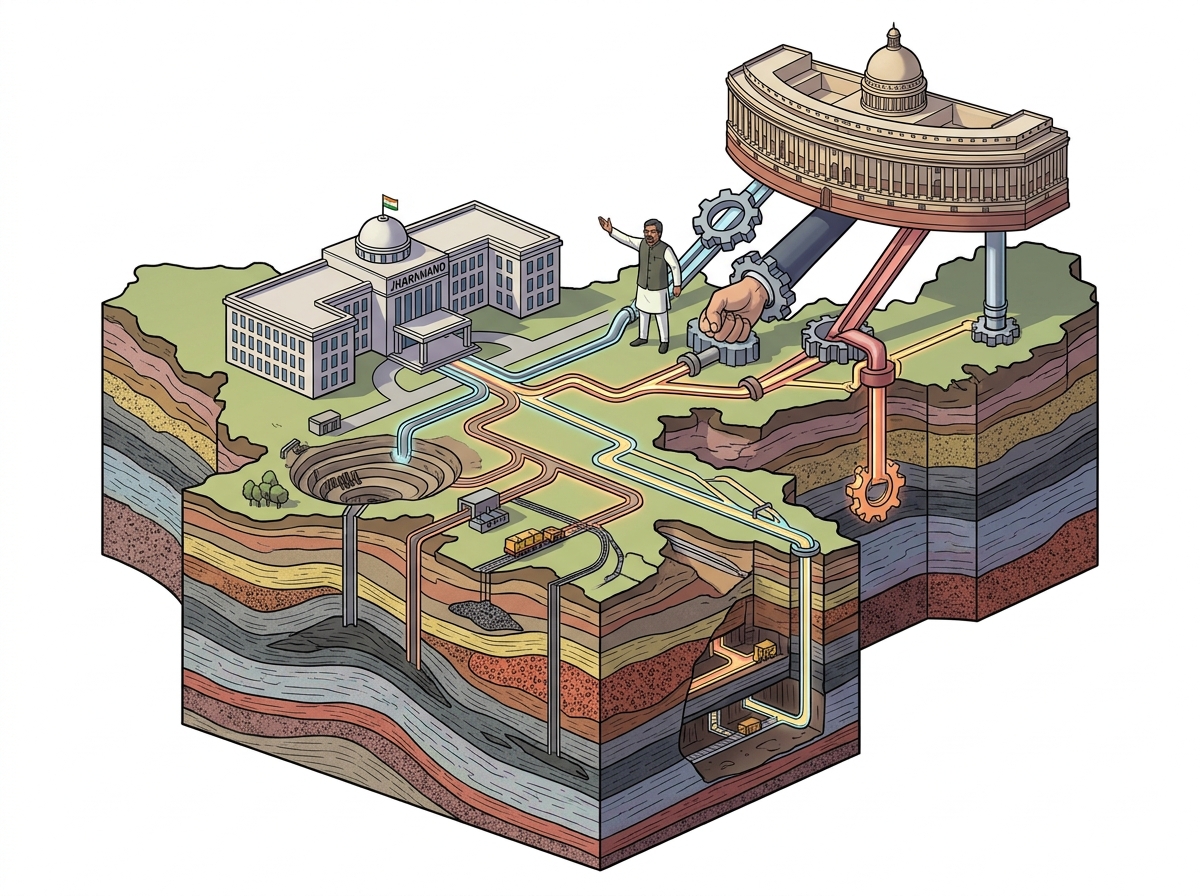
MMDR ActState ListMineral concessionsState governmentsRevenue streamsCooperative federalism✎ The Chief Minister of Jharkhand alleged that the Bill weakens state rights over mineral resources, threatens state revenue streams, and undermines cooperative federalism by centralising decision-making authority in mineral…
Subject Relevance — Where This Topic Fits
- GS Paper II — Functions and Responsibilities of the Union and the States, Cooperative and Competitive Federalism | GS Paper III — Mineral Resources, Environmental Governance, and Fiscal Federalism
- Prelims: Mines and Minerals (Development and Regulation) Act, 1957, Seventh Schedule of the Constitution (State List vs Concurrent List), Article 246 of the Constitution, Fiscal Federalism, Inter-State Water Disputes Act, 1956 (analogous framework), NITI Aayog’s role in inter-state resource disputes
- Essay: Federalism in India: Balancing Centre-State Relations in Resource Governance, Sustainable Development and Resource Nationalism: Challenges in India’s Mineral Sector
Why is this in the news?
The Chief Minister of Jharkhand alleged that the Bill weakens state rights over mineral resources, threatens state revenue streams, and undermines cooperative federalism by centralising decision-making authority in mineral resource regulation.
Background
- The Mines and Minerals (Development and Regulation) Act, 1957 (MMDR Act) is the primary legislation governing the regulation of mines and minerals in India, originally framed under Entry 54 of the State List (Seventh Schedule) of the Constitution.
- The 1957 Act vests the state governments with the authority to grant mineral concessions for minerals specified in the State List, subject to the provisions of the Act and rules framed thereunder.
- The MMDR Act was amended multiple times (e.g., in 2015 and 2021) to align with evolving economic and environmental priorities, including the introduction of auctions for mineral concessions and provisions for sustainable mining.
- The 2023 Amendment Bill introduced changes to the auction mechanism, royalty distribution, and institutional frameworks, which some states, including Jharkhand, argue dilute their constitutional rights over mineral resources.
- The protest by Jharkhand’s government highlights longstanding tensions between the Centre and states over resource governance, particularly in mineral-rich states where resource revenues constitute a significant portion of state finances.
- The issue intersects with broader debates on fiscal federalism, environmental governance, and the principle of subsidiarity in resource management.
What is the Mines and Minerals (Development and Regulation) Amendment Bill, 2023?
- Key provisions of the Bill include: (a) streamlining the grant of mineral concessions through a single-window clearance system; (b) revising the royalty rates for certain minerals; (c) empowering the Central Government to intervene in cases of inter-state disputes or lapses in state-level regulation; and (d) introducing provisions for the auction of mineral resources in areas where state governments fail to conduct auctions within stipulated timelines.
- The Bill introduces a ‘National Mineral Exploration Trust’ to fund mineral exploration activities, with contributions from mineral concession holders, aiming to enhance resource assessment and reduce dependence on state-led exploration.
- The Bill also proposes to amend the definition of ‘minor minerals’ to bring certain minerals under the purview of the Central Government, which some states argue could lead to centralisation of regulatory control.
- The Bill includes provisions for the establishment of a ‘National Mineral Index’ to guide royalty rates and auction processes, which critics argue could undermine state-level pricing mechanisms.
- The Bill has been framed in the context of India’s commitment to sustainable mining practices, including the promotion of responsible sourcing and the reduction of illegal mining, but its implementation has raised concerns about the balance between national objectives and state autonomy.
- The Bill’s passage has reignited debates on the constitutional division of powers under the Seventh Schedule, particularly Entry 54 (State List) versus Entry 23 (Concurrent List) concerning mineral resources.
Key Features
| Feature | Significance |
|---|---|
| Minerals and Mines (Development and Regulation) Amendment Bill, 2026 | Proposes amendments to the Mines and Minerals (Development and Regulation) Act, 1957, altering the regulatory framework for mineral resource governance in India. |
| State autonomy in mineral resource governance | Highlights the constitutional division of powers between the Union and States under the Seventh Schedule, particularly the State List (Entry 23). |
| Revenue implications for mineral-rich states | Potential reduction in state revenue from mineral royalties and other levies, impacting state finances and social welfare schemes. |
| Parliamentary procedure for bill passage | Demonstrates the legislative process, including the role of the Rajya Sabha and the need for majority approval in both Houses. |
| Public discourse and federalism debate | Reflects broader discussions on cooperative and competitive federalism, particularly in resource-rich states. |
Why it Matters
Economic
- The Bill may alter the financial autonomy of mineral-rich states like Jharkhand by centralising certain regulatory powers, potentially reducing their revenue from mineral royalties.
- Impact on state-led social welfare schemes, including those funded by mineral revenues, such as education, healthcare, and infrastructure development.
- Potential implications for foreign and domestic investment in the mining sector, depending on the regulatory changes introduced.
Constitutional and Legal
- The Bill engages with the constitutional division of powers under the Seventh Schedule, particularly Entry 23 (Land, that is to say, rights in or over land; land tenures including the relation of landlord and tenant; and the collection of rents) and Entry 50 (Industries subject to the provisions of Entry 52 of List I).
- Raises questions about the balance between Union and State legislative competence in matters of natural resource governance.
Federalism and Governance
- The controversy underscores tensions in India’s federal structure, particularly regarding resource-rich states’ claims to greater control over their natural endowments.
- Highlights the role of state governments in advocating for regional interests within the Union framework.
Policy and Administration
- The Bill may necessitate administrative reforms in state mineral resource departments to align with new regulatory frameworks.
- Potential for increased inter-state coordination and conflict resolution mechanisms in mineral governance.
Public Policy and Social Impact
- The Bill’s passage could influence public policy priorities, particularly in states dependent on mineral revenues for welfare schemes.
- May trigger public protests and political mobilisation, as seen in Jharkhand, reflecting broader societal concerns about resource nationalism.
Challenges
1. Federalism and Centre-State Relations
- Potential erosion of state autonomy in managing natural resources, a key pillar of cooperative federalism.
- Risk of policy incoherence if Union and State governments adopt divergent approaches to mineral governance.
- Legal disputes over the constitutional validity of the Bill’s provisions, particularly those encroaching on State List subjects.
UPSC Link: GS-II: Federalism
2. Revenue and Fiscal Federalism
- Possible reduction in state revenue from mineral royalties, impacting fiscal federalism and state autonomy in budgetary allocations.
- Challenge of compensating states for any loss of revenue while maintaining national economic goals.
UPSC Link: GS-III: Fiscal Federalism
3. Regulatory Uncertainty and Investment Climate
- Ambiguity in the regulatory framework may deter domestic and foreign investment in the mining sector.
- Risk of administrative delays and disputes in mineral leasing and extraction processes.
UPSC Link: GS-III: Investment Climate
4. Social and Political Mobilisation
- Protests and agitations by state governments and local communities against perceived centralisation of power.
- Potential for social unrest in mineral-rich regions if livelihoods and welfare schemes are adversely affected.
UPSC Link: GS-II: Governance and Social Justice
5. Environmental and Sustainability Concerns
- Risk of unregulated mining activities if state oversight is weakened, leading to environmental degradation.
- Challenge of balancing economic exploitation of minerals with sustainable development goals.
UPSC Link: GS-III: Environment and Sustainable Development
Challenges — UPSC Perspective
| Issue | Concern |
|---|---|
| Centralisation of mineral governance | Erosion of state autonomy and potential conflict with constitutional provisions. |
| Revenue loss for mineral-rich states | Impact on state finances and social welfare schemes funded by mineral royalties. |
| Regulatory ambiguity | Uncertainty for investors and administrative inefficiencies in mineral governance. |
| Public protests and political mobilisation | Risk of social unrest and governance challenges in resource-rich states. |
| Environmental degradation | Potential for unregulated mining activities leading to ecological harm. |
| Investment climate deterioration | Adverse effects on domestic and foreign investment in the mining sector. |
Way Forward
- Conduct a detailed analysis of the Bill’s provisions to assess their impact on state autonomy and revenue generation.
- Engage in inter-state consultations to address concerns of mineral-rich states and promote cooperative federalism.
- Strengthen state-level institutions for mineral governance to ensure alignment with national policies while preserving regional interests.
- Formulate a clear framework for compensating states for any revenue loss due to regulatory changes.
- Enhance transparency and stakeholder consultations in the legislative process to mitigate public discontent.
- Develop sustainable mining guidelines to balance economic exploitation with environmental conservation.
- Establish a grievance redressal mechanism for states and local communities affected by mineral governance policies.
- Monitor the implementation of the Bill to identify unintended consequences and take corrective measures.
UPSC Value Addition
Keywords for Mains Answer-Writing
Mines and Minerals (Development and Regulation) Act, 1957 · Concurrent List · State Subject · Fiscal Federalism · Mineral Royalties · Parliamentary Sovereignty · Constitutional Provisions on Centre-State Relations (Article 246) · Inter-State Water Disputes Act, 1956 · National Mineral Policy · Fiscal Federalism in India · Federalism vs. Parliamentary Sovereignty · Resource Curse in India · Jharkhand Mineral Wealth · Union-State Financial Relations · Constitutional Morality in Governance
Constitutional & Policy Linkages
- Article 246: Division of Legislative Powers (Seventh Schedule, Union List, State List, Concurrent List).
- Entry 23 of the State List: Land and land tenures, including mineral rights.
- Entry 50 of the State List: Industries subject to Union List Entry 52.
- Article 293: Borrowing powers of states, linked to fiscal autonomy in resource-rich regions.
Concept Flow
Mineral-rich states (e.g., Jharkhand) assert claims over natural resources under State List (Entry 23). → Union introduces the Mines and Minerals (Development and Regulation) Amendment Bill, 2026 in Parliament. → Bill proposes amendments that may centralise certain regulatory powers, reducing state autonomy. → State governments (e.g., Jharkhand) oppose the Bill, citing federalism and revenue concerns. → Parliament passes the Bill, triggering protests and legal challenges from affected states. → Potential reduction in state revenue from mineral royalties impacts social welfare schemes. → Broader debate on cooperative federalism and the balance of powers between Union and States.
Prelims Practice Questions
Q1. Consider the following statements regarding the Mines and Minerals (Development and Regulation) Act, 1957:
1. The Act vests the regulation of mines and minerals in the Union List under the Seventh Schedule of the Constitution.
2. State governments are empowered to grant mineral concessions for minerals specified in the State List.
3. The Act mandates that all mineral royalties accrue to the State exchequer.
4. The 2026 amendment bill seeks to centralise the power of mineral concession granting to the Union Government.
How many of the above statements are correct?
- Only one
- Only two
- Only three
- All four
Answer: Only three — Statement 1 is incorrect: Mines and minerals are part of the Concurrent List (Entry 23), not the Union List. Statement 2 is correct: State governments regulate minerals in the State List. Statement 3 is incorrect: Royalties are shared between Centre and States as per the Finance Commission. Statement 4 is correct: The 2026 amendment aims to centralise mineral concession granting.
Q2. Assertion (A): The Parliament of India can legislate on any matter in the Concurrent List even if it encroaches upon the legislative competence of the State Legislatures.
Reason (R): Article 246(2) of the Constitution empowers Parliament to make laws on matters in the Concurrent List, and Article 254(1) provides that such laws shall prevail over State laws in case of inconsistency.
In the context of the above two statements, which of the following is correct?
- Both A and R are true, and R is the correct explanation of A.
- Both A and R are true, but R is not the correct explanation of A.
- A is true, but R is false.
- A is false, but R is true.
Answer: Both A and R are true, but R is not the correct explanation of A. — Both the Assertion and Reason are correct. Article 246(2) grants Parliament concurrent legislative power, and Article 254(1) establishes the supremacy of Parliamentary law in case of inconsistency with State law, making R the correct explanation of A.
Q3. Match the following entries in the Seventh Schedule of the Constitution with their respective Lists:
Column I (Entry Number) Column II (List Name)
1. Entry 56 A. Union List
2. Entry 23 B. State List
3. Entry 14 C. Concurrent List
4. Entry 17A D. State List (Water)
Select the correct match using the codes below:
- 1-A, 2-C, 3-B, 4-D
- 1-B, 2-C, 3-A, 4-D
- 1-C, 2-A, 3-B, 4-D
- 1-A, 2-B, 3-C, 4-D
Answer: 1-A, 2-C, 3-B, 4-D — Entry 56 (Oilfields and mineral oils) is in the Union List. Entry 23 (Mines and minerals) is in the Concurrent List. Entry 14 (Agriculture) is in the State List. Entry 17A (Water, that is to say, water supplies, irrigation and canals) is in the State List.
Mains Practice Question
✍ The Parliament has recently passed the Mines and Minerals (Development and Regulation) Amendment Bill, 2026, which seeks to centralise the power of granting mineral concessions. Critically examine the constitutional validity and federal implications of such centralisation, with particular reference to the distribution of legislative and executive powers under the Seventh Schedule of the Constitution. Also, analyse the potential impact on fiscal federalism and resource governance in mineral-rich states like Jharkhand. (15 Marks)
Approach: MODEL-ANSWER SKELETON:
1. Constitutional Framework:
– Seventh Schedule: Concurrent List (Entry 23: Mines and minerals), Union List (Entry 56: Oilfields and mineral oils), State List (Entry 14: Agriculture).
– Article 246: Distribution of legislative powers between Parliament and State Legislatures.
– Article 254: Inconsistency between laws made by Parliament and State Legislatures.
2. Federalism and Parliamentary Sovereignty:
– Federal structure vs. Parliamentary sovereignty: Doctrine of federal supremacy in concurrent subjects.
– Judicial precedents: Union of India v. State of Rajasthan (1977) on concurrent legislative powers; State of West Bengal v. Union of India (1963) on federalism.
– Balance of powers: Need for cooperative federalism (NITI Aayog’s 7th Finance Commission recommendations on resource sharing).
3. Impact of Centralisation:
– Mineral Concession Granting: Current system (State governments grant concessions under MMDR Act, 1957). Proposed centralisation: Implications for State autonomy.
– Fiscal Federalism: Mineral royalties and taxes (Article 279A: GST Council recommendations; 14th Finance Commission recommendations on royalty sharing).
– Resource Curse: Jharkhand’s experience with mineral wealth and socio-economic disparities (e.g., displacement, environmental degradation).
4. Federal Implications:
– Erosion of State Autonomy: Potential conflict with the principle of subsidiarity.
– Inter-State Water Disputes Act, 1956: Precedent for Centre’s role in inter-state resource disputes.
– Constitutional Morality: Need to balance national interest with State rights (S.R. Bommai v. Union of India, 1994).
5. Conclusion:
– Centralisation may enhance efficiency but risks undermining federal principles.
– Recommendation: Strengthen institutional mechanisms for cooperative federalism (e.g., Inter-State Council) and ensure equitable resource governance.
Source: amarujala.com
Generated by AanyaAi for educational purpose.

- Gurugram’s groundwater extraction exceeds limit by 212%; HC seeks ban - October 4, 2026
- स्वतंत्रता सेनानी श्यामजी कृष्ण वर्मा की जन्म जयंती पर पीएम का श्रद्धांजलि - October 4, 2026
- KWML’s Feasibility Reports for Water Metro in 18 Cities: UPSC & PCS Insights - October 3, 2026

No Comments