


15 Jul दिव्य कला मेला: दिव्यांगजनों के सशक्तिकरण और आत्मनिर्भरता का राष्ट्रीय अभियान
Subject Relevance — Where This Topic Fits
- GS Paper I — Social Issues (Vulnerable Sections) | GS Paper II — Governance, Social Justice (Welfare Schemes, Mechanisms, Laws, Institutions for Vulnerable Sections) | GS Paper III — Inclusive Growth, Skill Development, Entrepreneurship
- Prelims: Divya Kala Mela, Ministry of Social Justice and Empowerment, Rights of Persons with Disabilities Act, 2016, Accessible India Campaign, National Overseas Scholarship Scheme for PwDs, NAMASTE Scheme, Inclusive Development, Atmanirbhar Bharat
- Essay: Empowering the Marginalised: A Pathway to Inclusive Nation-Building, From Welfare to Rights: The Evolving Landscape of Disability Inclusion in India
Quick Revision: Divya Kala Mela is a national platform by the Ministry of Social Justice and Empowerment, fostering self-reliance and dignity for Divyangjan artisans through market access, embodying India’s shift to a rights-based disability empowerment model.
Why is this in the news?
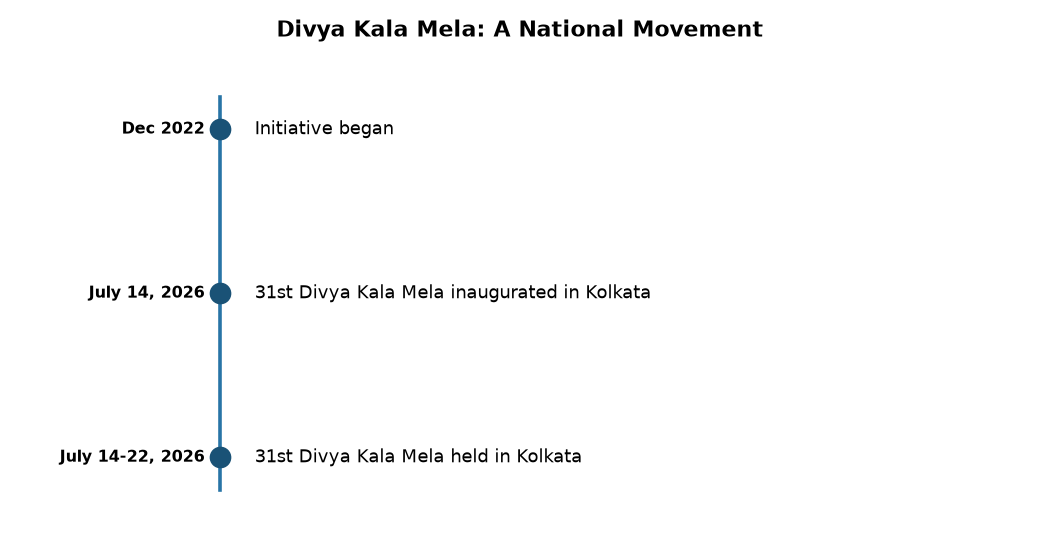
The 31st Divya Kala Mela was recently inaugurated in Kolkata by the Union Minister for Social Justice and Empowerment, Dr. Virendra Kumar. This edition is particularly significant as it marks the first joint initiative between the Government of India and the Government of West Bengal, underscoring a collaborative approach to fostering self-reliance and inclusive nation-building for Persons with Disabilities (PwDs). The event was hailed not merely as an exhibition but as a national movement aimed at transforming the confidence, creativity, and aspirations of PwDs into tangible livelihoods and self-sufficiency.
Background
- The Divya Kala Mela initiative commenced in December 2022, conceptualised as a dedicated national platform for Divyangjan artisans and entrepreneurs.
- It has since expanded its geographical footprint across India, reaching diverse cities from Srinagar to Thiruvananthapuram and Ahmedabad to Patna.
- The Mela provides a crucial marketplace for products crafted by PwDs, facilitating access to both domestic and international markets.
- The government’s overarching philosophy towards PwDs has transitioned from a welfare-based model to an empowerment-based, rights-centric approach.
- Significant financial assistance, approximately ₹1,462 crore, has been disbursed to 1.82 lakh Divyang beneficiaries since 2014 to promote self-employment and entrepreneurship.
- The event aligns with the Prime Minister’s vision of ‘Sabka Saath, Sabka Vikas, Sabka Vishwas, Sabka Prayas’, ensuring PwDs are equal partners in the Atmanirbhar Bharat journey.
What is Divya Kala Mela?
- The Divya Kala Mela is a national-level exhibition and marketplace organised by the Department of Empowerment of Persons with Disabilities (DEPwD) under the Ministry of Social Justice and Empowerment.
- Its primary objective is to provide a dedicated platform for Divyangjan (Persons with Disabilities) artisans, craftspersons, and entrepreneurs to showcase and sell their products.
- The Mela aims to foster economic independence, self-reliance, and dignity among PwDs by connecting them with wider markets and consumers.
- It serves as a catalyst for transforming the confidence and creativity of PwDs into sustainable livelihoods.
- The initiative promotes inclusive growth by integrating PwDs into the mainstream economic activities and entrepreneurial ecosystem.
- The Mela also acts as a public awareness campaign, highlighting the diverse talents and capabilities of PwDs, thereby challenging societal stereotypes.
- It embodies the shift from a charity-based approach to a rights-based empowerment model for disability inclusion.
- The event often includes the distribution of assistive devices and highlights other government schemes aimed at PwD welfare and empowerment.
Key Features
| Feature | Significance |
|---|---|
| National Platform for Divyangjan | Provides a dedicated, visible stage for PwD artisans and entrepreneurs, overcoming market access barriers. |
| Promotion of Self-Reliance | Directly supports economic independence by facilitating sales and entrepreneurial ventures, aligning with ‘Atmanirbhar Bharat’. |
| Market Access (Domestic & International) | Connects PwD products with a broader consumer base, enhancing income generation and business growth potential. |
| Confidence & Dignity Building | Showcasing talent fosters self-esteem and societal respect, moving beyond a welfare-centric narrative. |
| Collaborative Governance Model | Joint organisation by Central and State governments (e.g., Kolkata edition) exemplifies cooperative federalism in social justice. |
| Showcase of Diverse Products | Features a wide array of handicrafts, textiles, food items, and other products, demonstrating the varied skills of PwDs. |
Why it Matters
Socio-Economic Empowerment
- The Mela directly contributes to the economic upliftment of PwDs by providing a marketplace for their products, enabling them to earn a livelihood and become self-reliant.
- It fosters entrepreneurship among Divyangjan, transforming their creative skills into viable economic ventures and integrating them into the formal economy.
- By showcasing their talents, the Mela enhances their social standing and dignity, challenging stereotypes and promoting a more inclusive societal perception of PwDs.
Promotion of Inclusive Growth
- The initiative aligns with the principles of ‘Sabka Saath, Sabka Vikas, Sabka Vishwas, Sabka Prayas’, ensuring that PwDs are active and equal participants in India’s developmental journey.
- It contributes to the broader goal of inclusive growth by addressing the specific needs and aspirations of a vulnerable section of society, ensuring no one is left behind.
- The Mela encourages skill development and capacity building among PwDs, which are crucial for their long-term economic integration and contribution to the national economy.
Policy Shift and Awareness
- It symbolises the government’s transformative shift from a welfare-based approach to a rights-based empowerment model for disability, as enshrined in the Rights of Persons with Disabilities Act, 2016.
- The widespread organisation of the Mela across various cities raises public awareness about the capabilities of PwDs and the importance of an inclusive society.
- It facilitates better implementation and outreach of other government schemes and initiatives aimed at PwD welfare, such as the distribution of assistive devices and educational scholarships.
Challenges
1. Market Access and Sustainability
- Ensuring sustained market demand beyond the Mela duration for products made by PwDs.
- Developing robust supply chains and distribution networks to reach wider markets consistently.
UPSC Link: GS Paper III — Inclusive Growth; GS Paper II — Social Justice
2. Skill Development and Quality Control
- Providing continuous skill upgradation and training to PwDs to meet evolving market trends and consumer preferences.
- Maintaining consistent product quality and standardisation to compete effectively in mainstream markets.
UPSC Link: GS Paper III — Skill Development; GS Paper II — Social Justice
3. Accessibility and Infrastructure
- Ensuring physical accessibility of exhibition venues, workshops, and marketplaces for all types of disabilities.
- Providing accessible digital platforms for e-commerce and online promotion of Divyangjan products.
UPSC Link: GS Paper II — Social Justice (Accessibility); GS Paper I — Social Issues
4. Attitudinal Barriers and Social Stigma
- Overcoming ingrained societal prejudices and stereotypes that may affect the perception and acceptance of products made by PwDs.
- Promoting a mindset of ‘ability’ rather than ‘disability’ among the general public and potential consumers.
UPSC Link: GS Paper I — Social Issues; GS Paper II — Social Justice
5. Financial Inclusion and Credit Access
- Facilitating easier access to credit, loans, and financial assistance for PwD entrepreneurs to scale up their ventures.
- Ensuring financial literacy and management training for Divyangjan to sustain their businesses.
UPSC Link: GS Paper III — Inclusive Growth; GS Paper II — Social Justice
Challenges — UPSC Perspective
| Issue | Concern |
|---|---|
| Limited Market Reach | Products often struggle to penetrate mainstream markets beyond specific events, impacting sustained income. |
| Lack of Standardisation | Variations in product quality and design can hinder competitiveness against mass-produced goods. |
| Inadequate Infrastructure | Physical and digital barriers limit participation and outreach for many PwD artisans and entrepreneurs. |
| Funding Constraints | Difficulty in accessing capital for raw materials, equipment, and marketing, impeding business expansion. |
| Societal Bias | Preconceived notions about disability can affect consumer perception and willingness to purchase products. |
| Skill Gap | Need for continuous training in modern techniques, design, and business management to remain relevant. |
Government Initiatives — Must-Memorise for Prelims
- Rights of Persons with Disabilities Act, 2016
- Accessible India Campaign (Sugamya Bharat Abhiyan)
- National Overseas Scholarship Scheme for PwDs
- Assistance to Disabled Persons for Purchase/Fitting of Aids and Appliances (ADIP) Scheme
- Deendayal Disabled Rehabilitation Scheme (DDRS)
- National Action Plan for Skill Development of Persons with Disabilities
- Pradhan Mantri Jan Arogya Yojana (PMJAY) – Ayushman Bharat (includes PwDs)
- National Safai Karamcharis Finance & Development Corporation (NSKFDC) schemes (relevant for NAMASTE)
- NAMASTE Scheme (National Action for Mechanised Sanitation Ecosystem)
- Startup India (inclusive of PwD entrepreneurs)
Way Forward
- Establish permanent online and offline marketplaces for Divyangjan products, ensuring year-round visibility and sales opportunities.
- Integrate Divyangjan products into mainstream e-commerce platforms and retail chains through partnerships and preferential procurement policies.
- Invest in advanced skill development programs, design innovation, and quality control mechanisms tailored to the needs of PwD artisans.
- Strengthen financial inclusion by providing easier access to micro-credit, grants, and entrepreneurship development funds specifically for PwDs.
- Intensify public awareness campaigns to shift societal attitudes, celebrate the abilities of PwDs, and promote conscious consumption of their products.
- Ensure universal accessibility (physical and digital) across all aspects of the value chain, from production to market access.
- Foster greater collaboration between central, state governments, NGOs, and the private sector to create a comprehensive ecosystem for PwD empowerment.
- Leverage technology for marketing, training, and connecting PwD entrepreneurs with mentors and resources.
UPSC Value Addition
Keywords for Mains Answer-Writing
Divyangjan Empowerment · Inclusive Growth · Rights-Based Approach · Atmanirbhar Bharat · Social Justice · Entrepreneurship Development · Skill Enhancement · Market Access · Cooperative Federalism · Assistive Technology · Attitudinal Barriers · Sustainable Livelihoods
Constitutional & Policy Linkages
- Article 41: Right to work, to education and to public assistance in certain cases (DPSP)
- Article 46: Promotion of educational and economic interests of Scheduled Castes, Scheduled Tribes and other weaker sections (DPSP)
- Seventh Schedule: ‘Relief of the disabled and unemployable’ (State List)
- Rights of Persons with Disabilities Act, 2016: Statutory framework for PwD rights
- UN Convention on the Rights of Persons with Disabilities (UNCRPD): India is a signatory, guiding domestic policy.
Concept Flow
Divya Kala Mela provides national platform → Divyangjan showcase products & skills → Market access and consumer engagement increase → Economic independence & self-reliance fostered → Dignity & social inclusion enhanced → Contributes to inclusive nation-building
Prelims Practice Questions
Q1. Consider the following statements regarding the Divya Kala Mela:
1. It is organised by the Ministry of Culture to promote traditional Indian arts.
2. The initiative aims to provide a national platform for artisans with disabilities.
3. The NAMASTE Scheme, mentioned in the context of the Mela, primarily focuses on providing financial assistance for higher education to PwDs abroad.
- A. 1 and 2 only
- B. 2 only
- C. 2 and 3 only
- D. 1, 2 and 3
Answer: B. 2 only — Statement 1 is incorrect: Divya Kala Mela is organised by the Ministry of Social Justice and Empowerment, specifically the Department of Empowerment of Persons with Disabilities (DEPwD). Statement 2 is correct: Its primary objective is to provide a national platform for Divyangjan artisans and entrepreneurs. Statement 3 is incorrect: The NAMASTE Scheme (National Action for Mechanised Sanitation Ecosystem) focuses on promoting mechanised sanitation and ensuring the safety and dignity of sanitation workers, not primarily on foreign scholarships for PwDs.
Q2. Which of the following government initiatives are directly aimed at empowering Persons with Disabilities (PwDs) in India?
1. Accessible India Campaign
2. National Overseas Scholarship Scheme for PwDs
3. ADIP Scheme
4. Startup India
- A. 1, 2 and 3 only
- B. 2, 3 and 4 only
- C. 1, 3 and 4 only
- D. 1, 2, 3 and 4
Answer: D. 1, 2, 3 and 4 — All four initiatives listed are directly or indirectly aimed at empowering PwDs. The Accessible India Campaign focuses on creating a barrier-free environment. The National Overseas Scholarship Scheme provides financial aid for higher education abroad. The ADIP Scheme provides assistive devices. Startup India, while general, explicitly includes provisions and support for entrepreneurs from vulnerable sections, including PwDs, to foster an inclusive entrepreneurial ecosystem.
Mains Practice Question
✍ The Divya Kala Mela represents a significant shift in India’s approach to disability inclusion, moving from a welfare-centric model to a rights-based empowerment paradigm. Critically analyse this transformation, highlighting the key features and potential challenges in achieving true self-reliance and inclusive nation-building for Persons with Disabilities. (250 words)
Approach: Begin by defining the ‘welfare-centric’ versus ‘rights-based empowerment’ models in the context of disability. Introduce the Divya Kala Mela as a prime example of this paradigm shift, detailing its features in promoting economic independence and dignity. Subsequently, discuss the broader policy framework, such as the RPwD Act, 2016, that underpins this shift. Conclude by critically examining the persistent challenges, including market access, attitudinal barriers, and infrastructure gaps, that need to be addressed to fully realise the vision of self-reliance and inclusive nation-building for PwDs.
Source: PIB (Press Information Bureau)

- India-Australia AUSTRAHIND 2026 Exercise: Key Highlights for UPSC & State PCS - October 22, 2026
- एससीओ बैठक में भारत का आतंकवाद विरोध: क्षेत्रीय सहयोग पर जोर - October 22, 2026
- SEC Directs Strict SC Order Compliance for Andhra ULB Polls - October 22, 2026

No Comments