


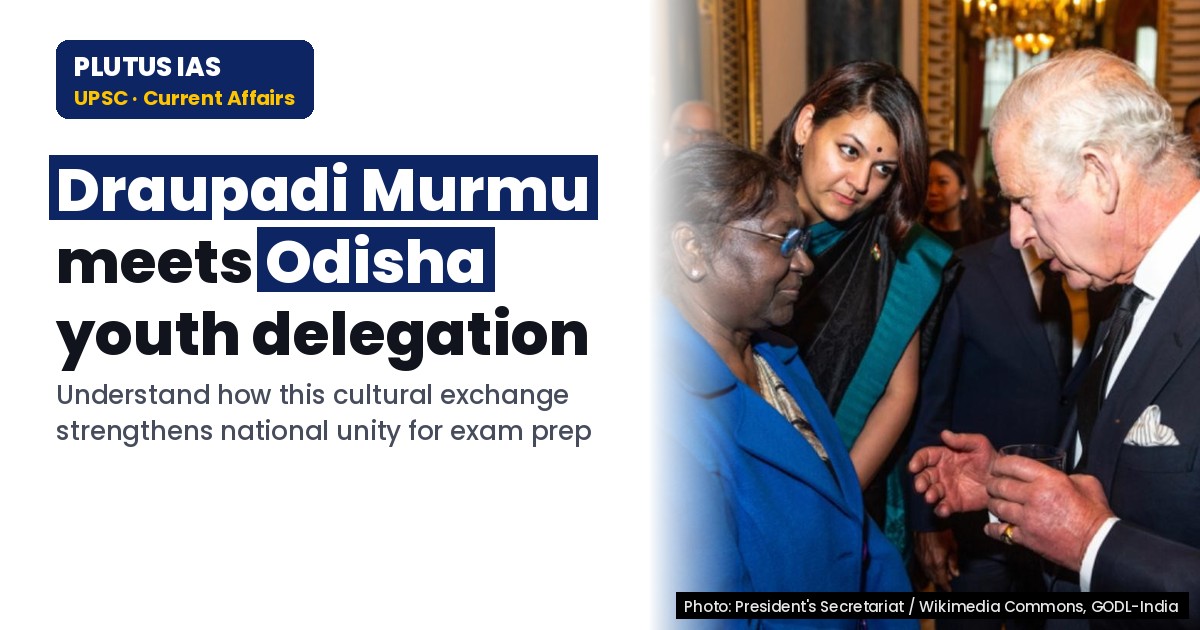
11 Oct युवा संगम: ओडिशा प्रतिनिधिमंडल ने राष्ट्रपति से मुलाकात की
✎ The ‘Ek Bharat Shreshtha Bharat’ programme, through its ‘Yuva Sangam’ component, institutionalises youth-led cultural diplomacy to strengthen national integration and celebrate India’s pluralistic heritage.
Subject Relevance — Where This Topic Fits
- GS Paper II — Polity and Governance: Constitutional Provisions on Cultural Integration | GS Paper IV — Ethics: Role of Youth in National Integration and Social Cohesion
- Prelims: Ek Bharat Shreshtha Bharat (EBSB), Yuva Sangam, Cultural diplomacy, National Integration Council, Article 51A (Fundamental Duties), Ministry of Education, Higher Education Department
- Essay: National Integration and Cultural Diversity: Pathways to a Unified India, Role of Youth in Shaping India’s Future: Challenges and Opportunities
Quick Revision: The ‘Ek Bharat Shreshtha Bharat’ programme, through its ‘Yuva Sangam’ component, institutionalises youth-led cultural diplomacy to strengthen national integration and celebrate India’s pluralistic heritage.
Why is this in the news?
The seventh phase of the ‘Yuva Sangam’ programme, a flagship initiative under the ‘Ek Bharat Shreshtha Bharat’ (EBSB) scheme, has gained prominence with a student delegation from Odisha interacting with the President of India, Smt. Droupadi Murmu, on 7 October 2026. This interaction, facilitated by the Ministry of Education, underscores the programme’s role in fostering inter-state cultural exchange and youth engagement as a means to strengthen national unity and social cohesion.
Background
- The ‘Ek Bharat Shreshtha Bharat’ (EBSB) initiative was launched by the Government of India in 2016 to promote cultural integration and emotional bonding among the diverse states and Union Territories of India.
- The programme aims to enhance mutual understanding through structured exchanges in education, art, literature, cuisine, festivals, and tourism.
- ‘Yuva Sangam’ is a sub-scheme under EBSB, designed to engage youth from higher educational institutions in cross-cultural learning and dialogue.
- The initiative aligns with the constitutional directive under Article 51A (Fundamental Duties), which enjoins citizens to promote harmony and the spirit of common brotherhood among all Indians.
- The Ministry of Education, through its Department of Higher Education, serves as the nodal authority for implementing EBSB and its associated programmes.
- The seventh phase of Yuva Sangam involves 20 state pairs, including Odisha and Himachal Pradesh, facilitating structured cultural and academic exchanges.
What is the ‘Ek Bharat Shreshtha Bharat’ Programme?
- Launched in 2016 by the Government of India to celebrate India’s diversity and promote national integration through cultural exchange.
- Operates under the aegis of the Ministry of Education, Department of Higher Education.
- Aims to create a framework for sustained interaction between states and UTs through thematic exchanges in education, art, literature, cuisine, and festivals.
- ‘Yuva Sangam’ is a youth-focused component that engages students from higher educational institutions in cross-cultural immersion programmes.
- The programme pairs states and UTs to design exchange programmes that highlight their unique cultural, academic, and developmental achievements.
- Institutional mechanisms include nodal agencies such as IIMs, NITs, and universities to coordinate and implement exchange activities.
- The initiative contributes to the constitutional vision of a united and harmonious India by fostering emotional bonds and mutual respect among citizens.
Key Features
| Feature | Significance |
|---|---|
| Inter-state youth exchange under ‘Yuva Sangam Phase VII’ | Facilitates direct cultural immersion and experiential learning among youth from diverse states, fostering mutual understanding and national integration. |
| Nodal institution leadership (IIM Sambalpur) | Ensures structured academic and administrative oversight, aligning the exchange with higher education objectives and institutional credibility. |
| Host institution role (NIT Hamirpur) | Provides logistical support, cultural exposure, and academic engagement, enabling participants to experience local traditions, educational ecosystems, and developmental initiatives. |
| Presidential interaction (President Droupadi Murmu) | Reinforces constitutional values of unity in diversity and serves as a symbolic endorsement of youth-centric nation-building initiatives. |
| Focus on ‘Ek Bharat Shreshtha Bharat’ (EBSB) objectives | Directly advances the national policy framework aimed at celebrating cultural heterogeneity while strengthening emotional bonds among citizens across regions. |
Why it Matters
Cultural and Social
- Promotes grassroots-level cultural diplomacy by exposing youth to regional languages, traditions, and lifestyles, thereby reducing stereotypes and fostering empathy.
- Encourages inter-generational transmission of indigenous knowledge systems and art forms through peer-to-peer interactions.
- Strengthens the emotional quotient of national integration by highlighting shared heritage beyond geographical or linguistic divides.
Educational and Institutional
- Provides a platform for higher education institutions to collaborate on academic exchanges, joint research, and co-curricular activities, enhancing institutional networks.
- Aligns with the National Education Policy (NEP) 2020’s emphasis on experiential learning, multidisciplinary exposure, and global citizenship education.
- Enhances the soft power of Indian educational institutions by showcasing their role in nation-building and cultural diplomacy.
Policy and Governance
- Operationalises the ‘Ek Bharat Shreshtha Bharat’ (EBSB) programme’s vision of fostering cultural unity while respecting diversity, as mandated by the Ministry of Education.
- Demonstrates a bottom-up approach to governance, where youth engagement is treated as a strategic tool for social cohesion and national development.
- Serves as a model for state-led cultural diplomacy, complementing the central government’s initiatives in promoting ‘Brand India’ globally.
Challenges
1. Sustainability of Engagement
- Risk of the exchange being perceived as a one-time event without long-term follow-up, limiting its impact on sustained cultural and academic collaboration.
- Potential challenge in ensuring equitable participation across socio-economic strata, as access to higher education institutions may be skewed.
- Need for structured post-exchange mentorship and digital platforms to maintain momentum in relationships formed during the programme.
UPSC Link: GS-II: Governance; GS-IV: Ethics
2. Logistical and Resource Constraints
- High operational costs associated with travel, accommodation, and cultural immersion activities, which may limit scalability.
- Coordinating between multiple stakeholders (central/state governments, nodal institutions, host institutions) can lead to administrative delays.
- Ensuring safety and security of participants, especially in remote or culturally distinct regions, requires robust planning.
UPSC Link: GS-III: Infrastructure
3. Cultural Sensitivity and Inclusivity
- Risk of marginalised communities (tribal, minority groups) being underrepresented in the exchange, leading to incomplete cultural representation.
- Need for culturally sensitive programming to avoid superficial engagement or appropriation of local traditions.
- Ensuring gender parity in participation and leadership roles within the exchange programme.
UPSC Link: GS-II: Social Justice
Challenges — UPSC Perspective
| Issue | Concern |
|---|---|
| Limited reach to non-urban youth | Excludes a significant demographic segment, reducing the programme’s inclusivity and representativeness. |
| Language barriers in cultural immersion | Hinders meaningful interaction, particularly in regions with distinct linguistic identities. |
| Post-exchange tracking mechanisms | Absence of structured follow-up may dilute the long-term impact of the initiative. |
| Balancing tradition with modernity | Risk of over-commercialising or diluting indigenous cultural practices for tourism or academic purposes. |
| Institutional capacity constraints | Host institutions may lack the resources or expertise to design comprehensive cultural programmes. |
Way Forward
- Establish a digital repository of cultural exchanges, including multimedia documentation of traditions, languages, and local innovations for future reference.
- Introduce a mentorship framework where alumni of the programme guide new participants, ensuring continuity and peer learning.
- Expand the programme to include non-academic youth (skilled artisans, entrepreneurs) to diversify participation and ground the initiative in local economies.
- Develop a standardised evaluation metric to assess the programme’s impact on participants’ cultural awareness, social empathy, and national integration.
- Strengthen partnerships with state governments to align the exchange with local cultural festivals, thereby enhancing authenticity and community engagement.
- Create a dedicated fund under the Ministry of Education to support scalable logistics, including travel stipends for economically disadvantaged participants.
- Integrate the exchange programme with existing schemes like ‘Ek Bharat Shreshtha Bharat’ and ‘National Service Scheme (NSS)’ for synergistic outcomes.
UPSC Value Addition
Keywords for Mains Answer-Writing
Ek Bharat Shreshtha Bharat · Yuva Sangam Phase VII · cultural exchange programme · Ministry of Education · President of India · National Integration · inter-state youth engagement · higher education institutions · One Nation One Culture · diversity and unity · cultural heritage · youth diplomacy · educational exchange · national unity · cultural diplomacy
Constitutional & Policy Linkages
- [‘Article 51A (Fundamental Duties): Emphasis on promoting harmony and the spirit of common brotherhood.’, ‘Article 51A(h)’]
- [‘Directive Principles of State Policy (Article 44): Encourages fostering of a united and integrated nation.’, ‘Article 44’]
- [‘Constitutional mandate for cultural preservation (Article 29, 30): Protects the right of communities to conserve their culture.’, ‘Articles 29-30’]
Concept Flow
Identification of ‘Yuva Sangam Phase VII’ as a flagship initiative under ‘Ek Bharat Shreshtha Bharat’ (EBSB) → → Selection of paired states (Odisha and Himachal Pradesh) based on cultural, geographical, and developmental diversity → → Mobilisation of youth participants from higher education institutions in both states → → Cultural immersion, academic exchange, and institutional collaboration during the programme → → Presidential interaction reinforcing constitutional values of unity and diversity → → Post-exchange dissemination of learnings and establishment of long-term networks → → Evaluation and scaling-up of the model for broader national application.
Prelims Practice Questions
Q1. Consider the following statements regarding the ‘Ek Bharat Shreshtha Bharat’ initiative:
1. It is an initiative of the Ministry of Education, Government of India.
2. The programme aims to promote cultural and emotional bonds among the youth of different states.
3. The initiative is implemented through pairs of states and higher educational institutions.
4. The President of India is the nodal authority for the implementation of this programme.
How many of the above statements are correct?
- Only one
- Only two
- Only three
- All four
Answer: Only three — Statements 1, 2, and 3 are correct. Statement 4 is incorrect as the nodal authority for the programme is not the President of India but the Ministry of Education and higher educational institutions.
Q2. Assertion (A): The ‘Yuva Sangam’ programme is designed to foster national integration through cultural exchange among youth.
Reason (R): The programme involves inter-state youth delegations visiting each other’s states to understand cultural heritage and traditions.
In the context of the above two statements, which one of the following is correct?
- Both A and R are true, and R is the correct explanation of A
- Both A and R are true, but R is not the correct explanation of A
- A is true, but R is false
- A is false, but R is true
Answer: Both A and R are true, and R is the correct explanation of A — Both the Assertion (A) and Reason (R) are true, and the Reason (R) correctly explains the Assertion (A). The Yuva Sangam programme is indeed aimed at fostering national integration through cultural exchange among youth.
Q3. Match the following pairs related to the ‘Ek Bharat Shreshtha Bharat’ initiative:
Column I (Component) | Column II (Description)
———————————————–|———————————————-
A. Yuva Sangam | 1. A programme to promote cultural exchange among youth
B. One Nation One Culture | 2. A slogan emphasizing national unity in diversity
C. Nodal Institution | 3. Higher educational institutions leading the programme
D. Cultural Heritage | 4. Shared traditions and practices across states
Select the correct match:
- A-1, B-2, C-3, D-4
- A-2, B-1, C-3, D-4
- A-1, B-3, C-2, D-4
- A-4, B-2, C-3, D-1
Answer: A-1, B-2, C-3, D-4 — The correct matches are: A-1 (Yuva Sangam is a programme to promote cultural exchange among youth), B-2 (One Nation One Culture is a slogan emphasizing national unity in diversity), C-3 (Nodal institutions are higher educational institutions leading the programme), and D-4 (Cultural Heritage refers to shared traditions and practices across states).
Mains Practice Question
✍ The ‘Ek Bharat Shreshtha Bharat’ initiative, through programmes like ‘Yuva Sangam’, seeks to strengthen national integration by fostering cultural and emotional bonds among the youth of different states. Critically examine the constitutional and policy framework underpinning this initiative. Also, assess its potential to achieve the stated objectives of national unity and cultural harmony in a diverse society like India. (15 Marks)
Approach: MODEL-ANSWER SKELETON:
1. **Constitutional and Policy Framework**:
– **Preamble and Fundamental Duties**: Highlight Articles 51A (Fundamental Duties) that emphasize promoting harmony and the spirit of common brotherhood amongst all Indians. Discuss how the initiative aligns with the constitutional vision of a united and diverse nation.
– **Directive Principles of State Policy**: Reference Article 48A (Protection and improvement of environment and safeguarding of forests and wildlife) and Article 39A (Equal justice and free legal aid) to underscore the state’s role in fostering social cohesion.
– **Policy Initiative**: Explain the ‘Ek Bharat Shreshtha Bharat’ programme launched by the Ministry of Education, Government of India, in 2016, aimed at promoting cultural exchange and national integration among youth.
2. **Mechanism and Implementation**:
– **Yuva Sangam Programme**: Describe the structure of the Yuva Sangam programme, including its phases, nodal institutions (e.g., IIM Sambalpur for Phase VII), and the role of higher educational institutions in facilitating inter-state exchanges.
– **Inter-State Pairing**: Explain how states are paired (e.g., Odisha and Himachal Pradesh in Phase VII) to enable youth delegations to experience diverse cultural, academic, and developmental landscapes.
3. **Potential and Challenges**:
– **Strengths**: Discuss the potential of the initiative to foster mutual understanding, break stereotypes, and promote national unity by exposing youth to India’s rich cultural and linguistic diversity.
– **Challenges**: Address potential challenges such as regional imbalances, logistical constraints, and the need for sustained engagement to ensure long-term impact.
– **Role of Institutions**: Highlight the role of institutions like the President of India in symbolically reinforcing the values of unity and diversity through interactions with youth delegations.
4. **Critical Assessment**:
– **Achievements**: Cite examples of successful cultural exchanges and their impact on participants (e.g., the Odisha delegation’s visit to Himachal Pradesh in October 2026).
– **Limitations**: Discuss whether short-term exchanges can translate into long-term cultural harmony and national integration, or if deeper structural changes are required.
– **Comparative Perspective**: Briefly compare the initiative with similar global programmes (e.g., Erasmus+ in the EU) to assess its effectiveness and scalability.
5. **Conclusion**:
– Summarize the initiative’s alignment with constitutional values and its potential to contribute to national unity. Emphasize the need for continuous evaluation and scaling up to ensure broader participation and impact.
Source: PIB (Press Information Bureau)
Odisha PCS (OPSC (OAS)) — State PCS Practice
Prelims: During the seventh phase of ‘Yuva Sangam’, the Odisha delegation met the President of India. Which of the following is NOT a key objective of the ‘Yuva Sangam’ initiative?
- A. Promoting cultural exchange among youth of different states
- B. Facilitating employment opportunities for youth through skill development
- C. Strengthening national integration by fostering youth interactions
- D. Providing financial assistance to startups in Odisha
Answer: D. Providing financial assistance to startups in Odisha — The ‘Yuva Sangam’ initiative focuses on cultural exchange, national integration, and youth interactions, not on providing financial assistance to startups.
Mains: Discuss the significance of the ‘Yuva Sangam’ initiative in strengthening inter-state youth engagement and its potential impact on Odisha’s socio-economic development. (250 words)
Generated by AanyaAi for educational purpose.

- India-Australia AUSTRAHIND 2026 Exercise: Key Highlights for UPSC & State PCS - October 22, 2026
- एससीओ बैठक में भारत का आतंकवाद विरोध: क्षेत्रीय सहयोग पर जोर - October 22, 2026
- SEC Directs Strict SC Order Compliance for Andhra ULB Polls - October 22, 2026

No Comments