


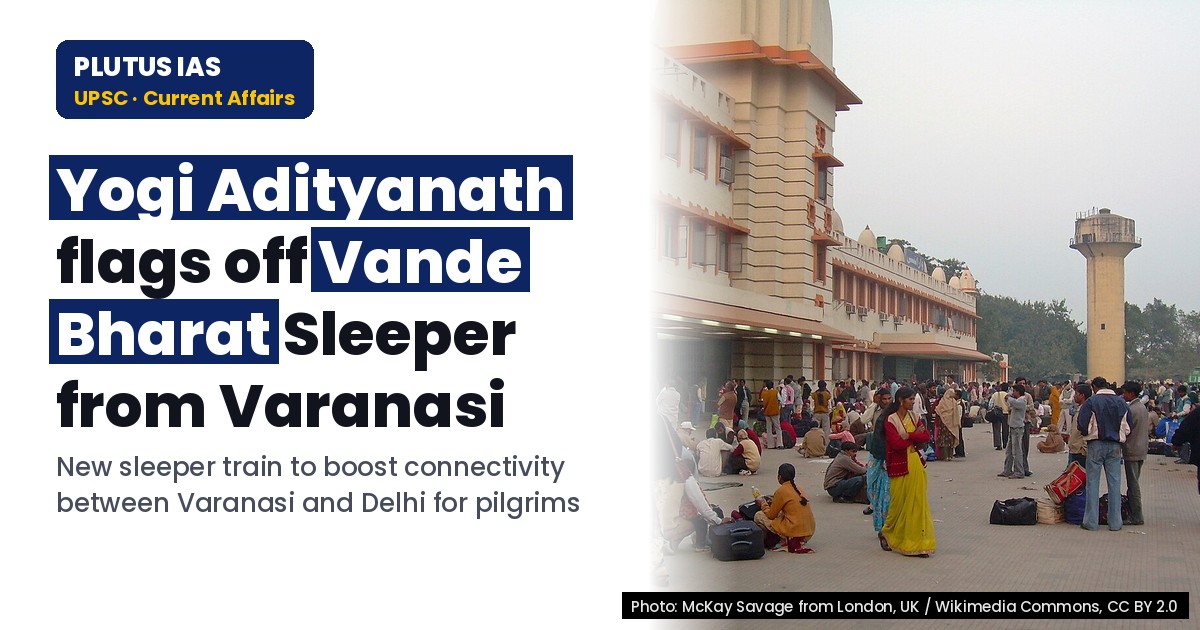
30 Oct वाराणसी-दिल्ली में शुरू होंगी वंदे भारत स्लीपर ट्रेनें: मुख्य तथ्य
✎ Vande Bharat Sleeper Express integrates regenerative braking, EN 15227-compliant stainless-steel coaches, and aerodynamic design to deliver safer, faster, and more comfortable overnight rail travel between Varanasi and New Delhi.
Subject Relevance — Where This Topic Fits
- GS Paper III — Infrastructure: Railways, Transport and Logistics | GS Paper III — Mobilisation of Resources
- Prelims: Vande Bharat Sleeper Express, Railway Budget, National Rail Plan 2030, Railway Safety Norms (EN 15227), Regenerative Braking System, Gati Shakti National Master Plan
- Essay: The Role of Technology in Transforming Public Transport in India, Balancing Speed, Comfort and Accessibility in India’s Infrastructure Development
Quick Revision: Vande Bharat Sleeper Express integrates regenerative braking, EN 15227-compliant stainless-steel coaches, and aerodynamic design to deliver safer, faster, and more comfortable overnight rail travel between Varanasi and New Delhi.
Why is this in the news?
The scheduled flag-off of new Vande Bharat Sleeper Express services between Varanasi and New Delhi on 31 October 2026 marks a significant expansion of India’s modern overnight rail network. This initiative aligns with the government’s broader strategy to enhance long-distance passenger connectivity, improve travel comfort, and integrate key religious, cultural, and administrative hubs through high-speed, technologically advanced rail services. The launch underscores the Union Government’s focus on utilising modern rolling stock to address the demand for reliable, time-efficient, and passenger-centric overnight travel options.
Background
- The Vande Bharat Sleeper Express is an evolution of the Vande Bharat Express platform, which was originally introduced as a semi-high-speed day train in 2019.
- The first Vande Bharat Sleeper services were launched on the Howrah–Guwahati corridor in January 2026, marking the introduction of sleeper-class variants in the Vande Bharat family.
- The expansion to the Varanasi–New Delhi route connects two critical urban centres: Varanasi, a major spiritual and cultural hub, and New Delhi, the national capital and administrative epicentre.
- The route traverses through key urban and industrial centres including Prayagraj, Kanpur Central, Aligarh, and Ghaziabad, thereby enhancing multi-modal connectivity across Uttar Pradesh.
- The service is designed to address the travel needs of diverse user groups including pilgrims, students, professionals, and administrative personnel.
- This initiative is part of the broader ‘Gati Shakti National Master Plan’ aimed at integrating infrastructure development and improving last-mile connectivity.
What is the Vande Bharat Sleeper Express?
- The Vande Bharat Sleeper Express is a modern, semi-high-speed overnight train designed for long-distance travel with enhanced passenger comfort and safety features.
- It is part of the Vande Bharat family of trains, which utilise indigenous technology and advanced engineering to deliver superior travel experiences.
- The train operates on dedicated or partially dedicated corridors, enabling higher speeds and reduced travel time compared to conventional express trains.
- Key technological features include regenerative braking systems for energy efficiency, aerodynamic design for reduced air resistance and noise, and advanced propulsion systems mounted under the coaches.
- The sleeper coaches are constructed using austenitic stainless steel, compliant with EN 15227 crashworthiness standards, ensuring structural integrity and passenger safety in the event of a collision.
- The train incorporates fully sealed flexible gangways with quick-release mechanisms, centralised single-leaf automatic sliding plug doors, and sensor-based intercommunication systems for enhanced accessibility and convenience.
- Onboard amenities include LED lighting (both direct and indirect), noise-reduction insulation, and ergonomically designed sleeping berths to optimise comfort during long overnight journeys.
- The service operates six days a week, with specific days of non-operation (Friday from Varanasi and Saturday from New Delhi) to facilitate maintenance and operational efficiency.
Key Features
| Feature | Significance |
|---|---|
| Regenerative braking system | Enhances energy efficiency by converting kinetic energy into electrical energy during deceleration, reducing overall energy consumption. |
| Aerodynamic design | Minimises air resistance, enabling smoother and faster travel while reducing fuel consumption and operational costs. |
| Sealed gangway with quick-release mechanism | Ensures passenger safety during emergencies by allowing rapid evacuation and maintaining compartmental integrity. |
| Automatic sliding plug doors | Centralised control improves security, reduces noise intrusion, and enhances passenger comfort during boarding and alighting. |
| Sensor-based intercom and LED lighting | Provides real-time communication with staff and optimises illumination, contributing to a safer and more comfortable journey. |
Why it Matters
Connectivity and Mobility
- Strengthens rail connectivity between Varanasi (a major spiritual and cultural hub) and New Delhi (the national capital), facilitating pilgrimage, tourism, education, and business travel.
- Reduces travel time by 55 minutes (Varanasi to New Delhi) and 35 minutes (New Delhi to Varanasi) compared to existing services like Shiv Ganga Express, enhancing efficiency for passengers.
- Provides a modern, comfortable, and reliable night-time travel option, aligning with the demand for high-speed rail services across critical urban corridors.
Economic Impact
- Boosts local economies in Uttar Pradesh and Delhi by increasing tourist footfall, business travel, and socio-cultural exchanges.
- Supports the hospitality, transport, and allied sectors in cities along the route (Allahabad, Kanpur, Aligarh, Ghaziabad) through improved accessibility.
- Encourages investment in rail infrastructure and allied services, contributing to job creation and regional development.
Technological Advancement
- Demonstrates the adoption of next-generation rail technology in India, including energy-efficient propulsion and enhanced passenger safety systems.
- Sets a benchmark for future sleeper-class high-speed trains, reinforcing India’s commitment to modernising its rail network.
- Promotes indigenous innovation in rail design, manufacturing, and operations, aligning with the ‘Make in India’ initiative.
Social Inclusion
- Provides an affordable and accessible travel option for diverse passenger groups, including pilgrims, students, professionals, and families.
- Facilitates seamless travel for socio-economically weaker sections by offering a cost-effective alternative to air travel or private transport.
- Enhances gender inclusivity by ensuring safe and comfortable night-time travel for women and other vulnerable groups.
Challenges
1. Operational Efficiency
- Ensuring punctuality and reliability of services, particularly during peak travel seasons or adverse weather conditions.
- Managing high passenger load while maintaining comfort, hygiene, and safety standards across long-distance routes.
UPSC Link: GS3: Infrastructure – Railways
2. Infrastructure Bottlenecks
- Addressing constraints in existing rail corridors, including track capacity, signalling systems, and station facilities along the Varanasi-New Delhi route.
- Ensuring seamless integration with other transport modes (e.g., metro, buses) at key junctions to enhance last-mile connectivity.
UPSC Link: GS2: Government Policies – Infrastructure Development
3. Passenger Safety and Security
- Implementing robust surveillance systems, emergency protocols, and staff training to mitigate risks during night-time travel.
- Ensuring compliance with fire safety, accident prevention, and accessibility standards (e.g., EN 15227) across all operational phases.
UPSC Link: GS3: Disaster Management – Safety Standards
4. Sustainability and Cost Management
- Balancing energy efficiency with operational costs, particularly in the context of high-speed rail services and regenerative braking systems.
- Optimising resource allocation to ensure the long-term financial viability of such premium services without overburdening public exchequer.
UPSC Link: GS3: Environment – Sustainable Transport
Challenges — UPSC Perspective
| Issue | Concern |
|---|---|
| Track congestion | Limited capacity on existing rail corridors may delay services, particularly during peak hours. |
| Station infrastructure | Inadequate platform length, poor lighting, or lack of amenities at intermediate stations could hinder smooth operations. |
| Passenger behaviour | Overcrowding, littering, or disregard for safety protocols may compromise the travel experience. |
| Maintenance costs | High operational and upkeep expenses for advanced rail systems could strain financial resources. |
| Regulatory compliance | Ensuring adherence to national and international safety standards across all operational phases. |
Way Forward
- Conduct regular audits of rail infrastructure along the Varanasi-New Delhi corridor to identify and address bottlenecks.
- Enhance passenger amenities at intermediate stations (e.g., Allahabad, Kanpur) to improve last-mile connectivity and user experience.
- Invest in advanced signalling and traffic management systems to optimise train scheduling and reduce delays.
- Expand the fleet of Vande Bharat Sleeper trains to additional high-demand routes, ensuring equitable access across regions.
- Strengthen emergency response protocols, including real-time monitoring and rapid evacuation mechanisms, for night-time services.
- Promote public-private partnerships to fund and maintain rail infrastructure, ensuring long-term sustainability.
- Launch awareness campaigns to educate passengers on safety, hygiene, and efficient utilisation of onboard facilities.
UPSC Value Addition
Keywords for Mains Answer-Writing
Vande Bharat Sleeper Express · railway connectivity · public transport infrastructure · regenerative braking system · railway safety standards · passenger amenities in railways · railway electrification · railway corridor development · urban-rural linkage · railway modernization · energy-efficient transport · railway accident safety norms · railway passenger experience
Concept Flow
Expansion of high-speed rail network → Increased connectivity between spiritual/cultural hubs and national capital → Enhanced mobility for pilgrims, students, and professionals. → Adoption of next-generation rail technology → Improved energy efficiency, safety, and passenger comfort → Long-term sustainability of rail services. → Strengthening of rail infrastructure → Reduced travel time and congestion → Economic growth in intermediate cities and regions. → Focus on social inclusion → Affordable and accessible travel options → Empowerment of marginalised and economically weaker sections. → Implementation of safety and regulatory standards → Compliance with national/international benchmarks → Enhanced public trust in rail services.
Prelims Practice Questions
Q1. Consider the following statements regarding the Vande Bharat Sleeper Express:
1. It operates on the Varanasi-New Delhi route with a single overnight journey.
2. The train uses regenerative braking to enhance energy efficiency.
3. The coaches are constructed from austenitic stainless steel compliant with EN 15227 safety standards.
4. The train operates daily without any exceptions.
How many of the above statements are correct?
- Only one
- Only two
- Only three
- All
Answer: Only three — Statements 1, 2, and 3 are correct. Statement 4 is incorrect as the service operates six days a week with specific days of non-operation on both routes.
Q2. Assertion (A): The Vande Bharat Sleeper Express is designed to reduce travel time between Varanasi and New Delhi compared to the existing Shiv Ganga Express.
Reason (R): The train incorporates advanced aerodynamic design and propulsion systems under the coaches.
In the context of the above statements, which of the following is correct?
- Both A and R are true, and R is the correct explanation of A
- Both A and R are true, but R is not the correct explanation of A
- A is true, but R is false
- A is false, but R is true
Answer: Both A and R are true, but R is not the correct explanation of A — Both the assertion and reason are true. The advanced design and propulsion system contribute to reduced travel time, making R the correct explanation for A.
Q3. Match the following features of the Vande Bharat Sleeper Express with their corresponding benefits:
Column I (Feature) | Column II (Benefit)
—————————————|—————————————
1. Regenerative braking system | A. Enhanced passenger comfort
2. Austenitic stainless steel coaches | B. Energy efficiency and sustainability
3. Sealed gangway with quick-release | C. Improved safety in case of accidents
4. Noise reduction and sound insulation | D. Ease of passenger movement and safety
Select the correct match:
- 1-B, 2-C, 3-D, 4-A
- 1-B, 2-C, 3-A, 4-D
- 1-A, 2-B, 3-C, 4-D
- 1-C, 2-B, 3-D, 4-A
Answer: 1-B, 2-C, 3-D, 4-A — 1-B (Regenerative braking enhances energy efficiency), 2-C (Austenitic stainless steel meets EN 15227 safety standards), 3-D (Sealed gangway ensures passenger safety and ease of movement), 4-A (Noise reduction improves passenger comfort).
Mains Practice Question
✍ ‘The introduction of the Vande Bharat Sleeper Express represents a paradigm shift in India’s long-distance night-time rail travel, integrating modern engineering with passenger-centric design.’ Critically analyse this statement with reference to the technological, operational, and socio-economic dimensions of the initiative. (15 Marks)
Approach: MODEL-ANSWER SKELETON:
1. **Technological Dimensions (5 points)**
– Regenerative braking system: Energy efficiency and sustainability in rail transport.
– Propulsion system under coaches: Enhanced aerodynamics and reduced friction for smoother travel.
– Austenitic stainless steel coaches: Compliance with EN 15227 accident safety norms, ensuring structural integrity.
– Sealed gangway with quick-release mechanism: Improved passenger safety and accessibility.
– Noise reduction and sound insulation: Enhanced comfort for overnight journeys.
2. **Operational Dimensions (5 points)**
– Reduced travel time: Comparison with existing Shiv Ganga Express (55 minutes saved Varanasi to New Delhi).
– Overnight connectivity: Departure at 20:50 from Varanasi, arrival at 06:10 next day; facilitates efficient time utilisation.
– Route coverage: Key urban centres (Prayagraj, Kanpur, Aligarh, Ghaziabad) enhancing regional connectivity.
– Frequency: Six-day operation with strategic non-operation days to manage maintenance and demand.
– Passenger amenities: Direct and indirect LED lighting, sensor-based intercom, and climate control systems.
3. **Socio-Economic Dimensions (5 points)**
– Religious and cultural tourism: Enhanced connectivity between Varanasi (a major pilgrimage site) and New Delhi.
– Educational and professional mobility: Facilitates students and working professionals travelling between Uttar Pradesh and the National Capital Region.
– Regional development: Strengthens economic linkages between eastern Uttar Pradesh and the national capital.
– Inclusivity: Provides modern travel options to diverse user groups, including pilgrims, tourists, and daily commuters.
– Long-term impact: Sets a benchmark for future rail infrastructure projects, promoting sustainable and efficient public transport.
Balance of views: While the initiative is transformative, challenges such as high initial costs, maintenance of advanced systems, and ensuring equitable access across socio-economic strata must be acknowledged.
Source: PIB (Press Information Bureau)
Uttar Pradesh PCS (UPPSC) — State PCS Practice
Prelims: With reference to Uttar Pradesh, what is the significance of the inauguration of new Vande Bharat Sleeper trains between Varanasi and New Delhi by the Chief Minister and Railway Minister?
- A. It will enhance connectivity between two major cultural and economic hubs of Uttar Pradesh, boosting tourism and trade.
- B. It will replace all existing train services between Varanasi and New Delhi, ensuring faster and more frequent travel.
- C. It will primarily benefit the industrial sector in western Uttar Pradesh by reducing travel time to Delhi.
- D. It will lead to the closure of all other train routes between Varanasi and New Delhi to prioritize Vande Bharat Sleeper trains.
Answer: A. It will enhance connectivity between two major cultural and economic hubs of Uttar Pradesh, boosting tourism and trade. — The inauguration of Vande Bharat Sleeper trains between Varanasi and New Delhi will enhance connectivity between two major cultural and economic hubs of Uttar Pradesh, thereby boosting tourism and trade in the state.
Mains: Discuss the potential socio-economic impacts of introducing Vande Bharat Sleeper trains between Varanasi and New Delhi from the perspective of Uttar Pradesh’s tourism, trade, and administrative efficiency. Highlight the role of such initiatives in achieving the state’s development goals under the ‘Uttar Pradesh Tourism Policy 2022’ and ‘One District, One Product’ scheme.
Generated by AanyaAi for educational purpose.
Related guides on our sites
- How to prepare for GS paper 1 for UPSC CSE mains exam
- Best UPSC coaching for IFOS exam
- Best mentorship programme for upsc
- UPSC+BA degree

- विशेष अभियान 6: पर्यावरण मंत्रालय ने ई-कचरा निपटान में रिकॉर्ड सफलता हासिल की - November 1, 2026
- CBN seizes 2,774 kg opium husk in MP: Key NDPS Act arrests - November 1, 2026
- नशामुक्त भारत अभियान: 96,700 युवाओं ने लिया राष्ट्रव्यापी साइक्लोथॉन और वॉकथॉन में भाग - November 1, 2026

No Comments