


29 Sep ‘सेवा ही संस्कृति’ अभियान: स्वच्छता, संस्कृति और जन-भागीदारी का राष्ट्रव्यापी संदेश
✎ ‘Seva Hi Sanskriti’ demonstrates how cultural institutions and public art can be harnessed to promote cleanliness, heritage awareness and citizen participation as concurrent pillars of nation-building.
Subject Relevance — Where This Topic Fits
- GS Paper I — Indian Heritage and Culture | GS Paper II — Governance, Transparency and Citizen Participation
- Prelims: Swachh Bharat Mission 2.0, National Mission on Cultural Mapping, Sangeet Natak Akademi, Lalit Kala Akademi, National School of Drama, Regional Cultural Centres, Jan Bhagidari, Nukkad Natak, Rangoli as cultural expression
- Essay: The Role of Citizen Participation in Nation-Building, Cultural Heritage as a Pillar of National Identity and Development
Quick Revision: ‘Seva Hi Sanskriti’ demonstrates how cultural institutions and public art can be harnessed to promote cleanliness, heritage awareness and citizen participation as concurrent pillars of nation-building.
Why is this in the news?
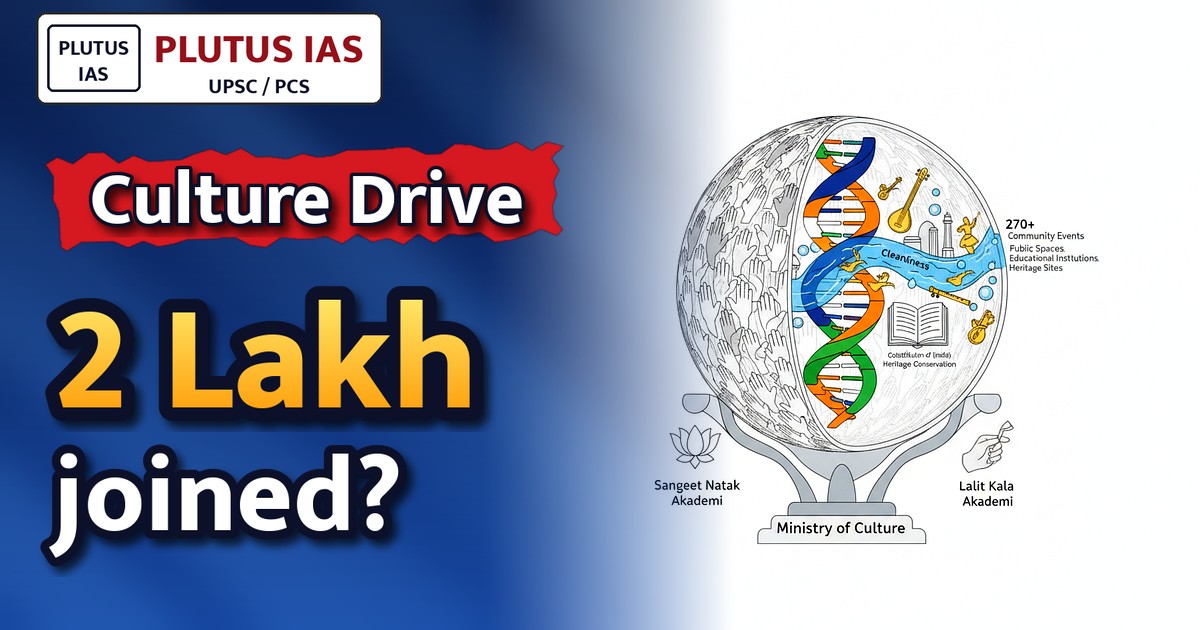
The Ministry of Culture’s week-long nationwide initiative ‘Seva Hi Sanskriti’ (17–24 September 2026) has brought together service, cleanliness and cultural awareness through 270+ community events, engaging over 2 lakh citizens across public spaces, educational institutions and heritage sites. This campaign, a component of ‘Seva Sankalp Abhiyan 2026’, exemplifies participatory governance by leveraging cultural expression to promote civic responsibility and heritage conservation, aligning with constitutional values of citizen duty and cultural preservation.
Background
- The Constitution of India, under Article 51A(f), enjoins citizens to value and preserve the rich heritage of the composite culture of India.
- Cultural institutions such as the Sangeet Natak Akademi, Lalit Kala Akademi, and National School of Drama function as autonomous bodies under the Ministry of Culture, mandated to promote performing and visual arts.
- India’s seven Regional Cultural Centres (RCCs) are nodal agencies for cultural outreach, located in Chandigarh, Dimapur, Kolkata, Udaipur, Thanjavur, Hyderabad, and Allahabad.
- Public art forms like ‘Nukkad Natak’ (street plays) and ‘Rangoli’ have historically served as mediums for social messaging and community mobilization.
What is the ‘Seva Hi Sanskriti’ Initiative?
- A seven-day nationwide campaign (17–24 September 2026) organised by the Ministry of Culture as part of ‘Seva Sankalp Abhiyan 2026’, focusing on service, cleanliness and cultural awareness.
- The initiative integrates cultural expression with civic responsibility, using art forms such as street plays, rangoli, choral singing and art exhibitions to convey messages of cleanliness and heritage preservation.
- Thematic focus areas included ‘Heritage and Development’ and ‘A New Narrative of Cleanliness’, linking cultural identity with sustainable public behaviour.
- Over 270 events were conducted across government office complexes, schools, colleges, parks, markets, temples, ghats and other public spaces, engaging more than 2 lakh participants.
- Key collaborators included the Sangeet Natak Akademi, Lalit Kala Akademi, National School of Drama, and all seven Regional Cultural Centres, ensuring pan-India cultural outreach and institutional support.
- Public participation was central, with citizens encouraged to join cleanliness drives at cultural sites, government premises and heritage locations, thereby operationalising the principle of ‘Jan Bhagidari’.
- The campaign leveraged indigenous art forms to foster social cohesion, ethical values and a sense of collective responsibility, particularly among youth and students.
- By situating cleanliness and heritage conservation within the broader framework of national service, the initiative underscored that cultural stewardship is an integral dimension of civic duty.
Key Features
| Feature | Significance |
|---|---|
| Multi-institutional collaboration | Involvement of autonomous bodies like Sangeet Natak Akademi, Lalit Kala Akademi, National School of Drama, and seven Zonal Cultural Centres ensured cultural authenticity and pan-India reach. |
| Thematic focus on heritage and sanitation | Activities centred on ‘Heritage and Development’ and ‘A New Story of Cleanliness’ integrated cultural preservation with public hygiene, aligning with constitutional values of Article 51A(f). |
| Grassroots participation | 2,00,000+ participants engaged through street plays, rangoli, group singing, and cleanliness drives, demonstrating bottom-up governance and civic responsibility. |
| Cultural education through art forms | Nukkad natak, art performances, and group singing conveyed ethical principles, national values, and the importance of cultural heritage in an accessible, community-driven format. |
| Spatial inclusivity | Events held across government offices, schools, colleges, parks, markets, temples, ghats, and public spaces, ensuring outreach to diverse socio-economic groups. |
Why it Matters
Cultural Governance
- Demonstrates the role of cultural institutions in public policy, particularly in preserving intangible heritage and promoting social cohesion through participatory initiatives.
- Highlights the institutional framework under the Ministry of Culture, including autonomous academies and zonal centres, as instruments of national integration.
Public Health and Civic Responsibility
- Reinforces the constitutional duty of citizens under Article 51A(g) to protect and improve the natural environment, including public spaces and cultural sites.
- Links sanitation with cultural pride, fostering long-term behavioural change by embedding hygiene practices within local traditions.
Youth Engagement and Nation-Building
- Targets students and youth through school/college events, aligning with the National Youth Policy (2014) emphasis on volunteerism and civic engagement.
- Uses performing arts to inculcate values of service, discipline, and collective responsibility, preparing young citizens for participatory democracy.
Policy Integration
- Serves as a model for integrating cultural policy with sanitation and education policies, showcasing how soft power initiatives can complement hard infrastructure goals.
- Aligns with the National Mission for Clean Ganga (NMCG) and Swachh Bharat Mission’s objectives by promoting cleanliness at heritage sites and public spaces.
Challenges
1. Sustaining Community Participation
- Ensuring long-term engagement beyond the campaign period requires institutional mechanisms for feedback, recognition, and follow-up activities.
- Addressing apathy or resistance in urban centres where public spaces are often misused or neglected.
UPSC Link: GS-II: Role of Civil Society
2. Resource Allocation for Cultural Initiatives
- Limited funding for grassroots cultural programmes may constrain scalability and reach, particularly in remote or tribal regions.
- Balancing top-down funding with local ownership to avoid bureaucratic inefficiencies.
UPSC Link: GS-III: Government Budgeting
3. Cultural Homogenisation vs. Diversity
- Risk of prioritising mainstream cultural narratives over local/indigenous traditions, potentially marginalising regional identities.
- Need for inclusive programming that respects linguistic, tribal, and folk cultural expressions.
UPSC Link: GS-I: Indian Culture
4. Monitoring and Impact Assessment
- Lack of standardised metrics to measure behavioural change, cultural awareness, or sanitation improvements post-campaign.
- Reliance on anecdotal reports without empirical data may limit policy replication.
UPSC Link: GS-IV: Ethics in Governance
Challenges — UPSC Perspective
| Issue | Concern |
|---|---|
| Urban-Rural Divide | Ensuring equitable participation and relevance across diverse socio-economic and geographical contexts. |
| Language Barriers | Effectively conveying messages in multilingual settings without diluting cultural authenticity. |
| Volunteer Fatigue | Preventing burnout among organisers and participants due to repetitive or unstructured engagement. |
| Institutional Coordination | Streamlining collaboration between central ministries, state governments, and local bodies for seamless execution. |
| Sustainability | Moving beyond one-time events to embed cultural and sanitation values in school curricula and community norms. |
Way Forward
- Establish a **National Cultural Volunteers Corps** under the Ministry of Culture to institutionalise community engagement and provide structured pathways for youth participation.
- Integrate ‘Seva Hi Sanskriti’ principles into **School Education Curriculum** (NEP 2020) through modules on civic responsibility, cultural heritage, and environmental stewardship.
- Develop a **Digital Repository** of cultural and sanitation best practices, curated by academic institutions and cultural bodies, for replication across districts.
- Launch **District-Level Cultural Sabhas** to decentralise decision-making and ensure local cultural expressions drive campaign themes.
- Partner with **Corporate Social Responsibility (CSR) initiatives** to fund long-term projects in heritage conservation and public hygiene.
- Conduct **Pre- and Post-Campaign Surveys** to quantify behavioural change, using data to refine future editions and policy recommendations.
- Create a **National Awards Scheme** to recognise outstanding contributions by individuals, NGOs, and institutions in cultural preservation and sanitation.
UPSC Value Addition
Keywords for Mains Answer-Writing
Service Culture initiative · Cultural Heritage Preservation · Public Participation in Governance · Swachh Bharat Mission integration · Art-based awareness campaigns · National Integration through Culture · Sangeet Natak Akademi · Regional Cultural Centres · Jan Bhagidari · Nukkad Natak as outreach tool
Constitutional & Policy Linkages
- Article 51A(f): Fundamental duty to value and preserve the rich heritage of our composite culture.
Concept Flow
Cultural institutions (autonomous academies, zonal centres) → Design of participatory campaign → Thematic activities (street plays, rangoli, cleanliness drives) → Mass participation (2,00,000+ people) → Reinforcement of civic duties (Article 51A) → Behavioural change and heritage conservation.
Prelims Practice Questions
Q1. Consider the following statements regarding the ‘Seva Hi Sanskriti’ initiative:
1. It was launched as part of the ‘Seva Sankalp Abhiyan 2026’.
2. The initiative was organised by the Ministry of Culture in collaboration with seven Regional Cultural Centres.
3. The activities included nukkad natak, rangoli competitions, and collective singing of ‘Vande Mataram’.
4. The initiative focused exclusively on urban areas to promote cleanliness and cultural awareness.
How many of the above statements are correct?
- Only one
- Only two
- Only three
- All four
Answer: Only three — Statements 1, 2, and 3 are correct. Statement 4 is incorrect as the initiative was organised across diverse public spaces including rural and urban areas.
Q2. Assertion (A): The ‘Seva Hi Sanskriti’ initiative integrated art forms like nukkad natak and rangoli to promote cultural awareness and cleanliness.
Reason (R): Art-based outreach is considered an effective tool for mass communication and behavioural change in governance initiatives.
Options:
A. Both A and R are true, and R is the correct explanation of A.
B. Both A and R are true, but R is not the correct explanation of A.
C. A is true, but R is false.
D. A is false, but R is true.
- A
- B
- C
- D
Answer: A — Both A and R are true, and R correctly explains why art-based outreach was used in the initiative.
Mains Practice Question
✍ The ‘Seva Hi Sanskriti’ initiative exemplifies the convergence of cultural heritage preservation, public participation, and civic responsibility. Critically examine the role of such culture-led governance initiatives in fostering social cohesion and behavioural transformation in contemporary India. (15 Marks)
Approach: MODEL-ANSWER SKELETON:
1. Define ‘culture-led governance initiatives’ and their constitutional/statutory basis (Article 49, Article 51A(f), National Culture Policy, 2024).
2. Analyse the ‘Seva Hi Sanskriti’ initiative: objectives, stakeholders (Ministry of Culture, Sangeet Natak Akademi, Regional Cultural Centres), and outreach mechanisms (nukkad natak, rangoli, collective singing).
3. Examine the theoretical underpinnings: social capital (Putnam), cultural nationalism (Anderson), and behavioural change models (COM-B framework).
4. Evaluate impact: quantitative (2 lakh participants) and qualitative (awareness generation, community ownership).
5. Challenges: scalability, regional disparities, sustainability post-campaign, and measurement of behavioural outcomes.
6. Comparative perspective: contrast with Swachh Bharat Mission’s top-down approach and Jan Andolan model.
7. Conclude with a balanced view: culture-led initiatives as complementary to formal governance tools, with emphasis on long-term institutionalisation.
Source: PIB (Press Information Bureau)
Generated by AanyaAi for educational purpose.
Related guides on our sites
- Best sociology optional coaching
- Best coaching for sociology optional
- Best sociology optional coaching online
- is sociology good optional

- एनएचएआई करेगा असामान्य बोली वाली परियोजनाओं की गुणवत्ता जाँच, जानिए कैसे - September 30, 2026
- Madras HC on Veeramani POCSO Case: Let SIT Work Without Interference - September 30, 2026
- पीएम मोदी और ट्रंप ने भारत-अमेरिका संबंधों पर चर्चा की - September 30, 2026

No Comments