


17 Aug स्वच्छ्ता उद्यमी योजना: संविदा कर्मचारियों के स्वरोजगार में क्रांतिकारी बदलाव
Sanitation workerSwachhta Udyami YojanaNAMASTE SchemeMechanised equipmentFinancial assistance✎ Swachhta Udyami Yojana (SUY) under NAMASTE provides financial assistance (loan + capital subsidy) to sanitation workers for purchasing mechanised sanitation equipment, enabling transition from contractual employment to…
Subject Relevance — Where This Topic Fits
- GS Paper II — Governance, Welfare Schemes for Vulnerable Sections | GS Paper III — Employment, Entrepreneurship and Skill Development
- Prelims: Swachhta Udyami Yojana (SUY), National Safai Karamchari Finance and Development Corporation (NSKFDC), NAMASTE Scheme, Sewer Suction Machine, Financial Inclusion, Skill Development, Livelihood Security
- Essay: Role of Government Schemes in Social Empowerment and Entrepreneurship Development, Transforming Informal Employment into Sustainable Livelihoods
Quick Revision: Swachhta Udyami Yojana (SUY) under NAMASTE provides financial assistance (loan + capital subsidy) to sanitation workers for purchasing mechanised sanitation equipment, enabling transition from contractual employment to self-employment and sustainable livelihoods.
Why is this in the news?
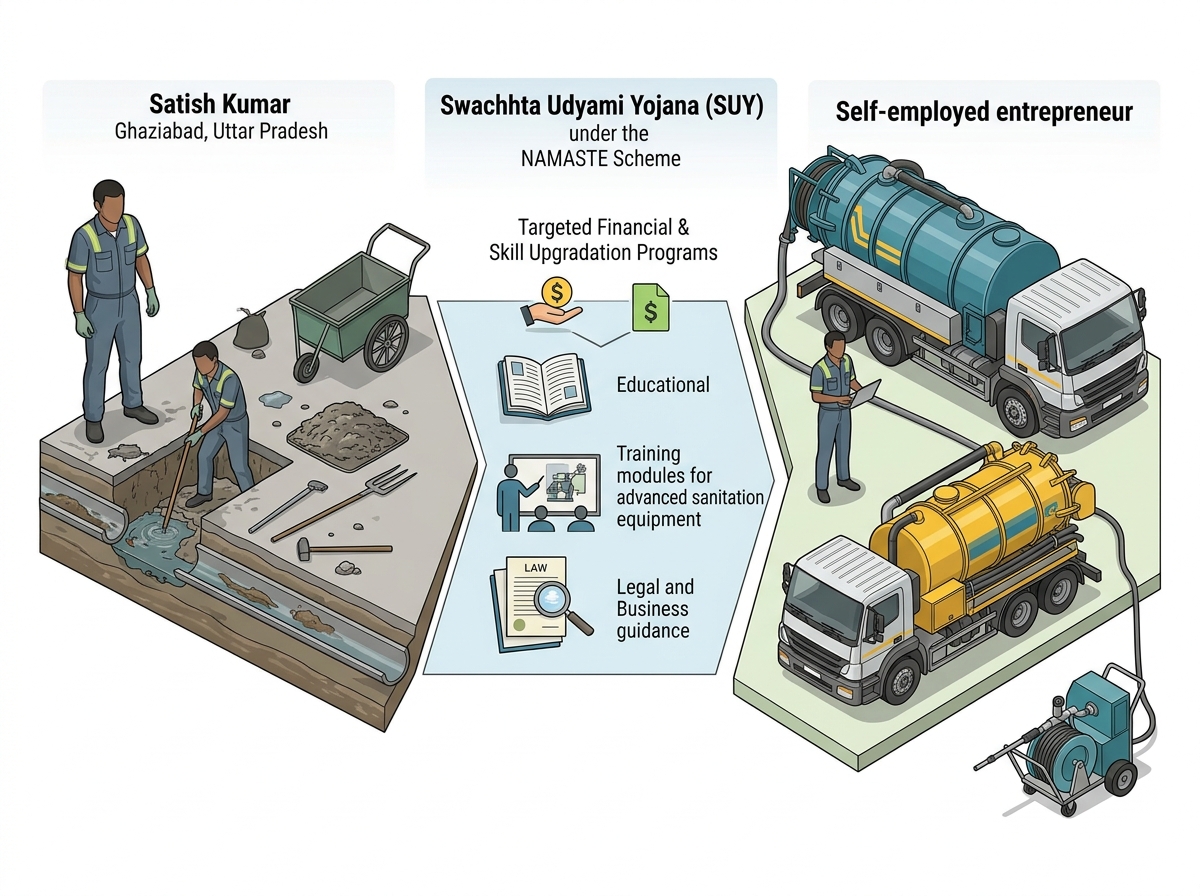
The case of Satish Kumar, a contractual sanitation worker from Ghaziabad, Uttar Pradesh, illustrates how the Swachhta Udyami Yojana (SUY) under the NAMASTE Scheme facilitated his transition from contractual employment to self-employment through financial assistance and mechanised sanitation equipment, thereby enhancing his income and livelihood security. This narrative underscores the efficacy of targeted welfare interventions in addressing structural vulnerabilities in the sanitation workforce.
Background
- The sanitation workforce in India, particularly those engaged in manual and contractual cleaning, faces systemic challenges including low and irregular incomes, lack of access to mechanised equipment, and limited avenues for skill upgradation.
- The NAMASTE Scheme (National Action for Mechanised Sanitation Ecosystem) aims to eliminate manual scavenging and promote mechanised sanitation solutions through a multi-pronged approach including awareness, skilling, and financial support.
- The Swachhta Udyami Yojana (SUY) is a component of NAMASTE that provides financial assistance to sanitation workers for purchasing mechanised sanitation equipment, thereby enabling entrepreneurship and sustainable livelihoods.
- The National Safai Karamchari Finance and Development Corporation (NSKFDC) plays a pivotal role in providing capital subsidies and facilitating credit linkages for beneficiaries under SUY.
- Contractual sanitation workers, despite their critical role in urban sanitation, often remain trapped in low-wage, insecure employment due to structural barriers such as limited access to finance and technology.
- The case of Satish Kumar exemplifies how targeted financial and technical support can break this cycle, transforming contractual workers into self-employed entrepreneurs with enhanced income security.
What is the Swachhta Udyami Yojana (SUY)?
- SUY is a sub-scheme under the NAMASTE initiative, designed to provide financial assistance to sanitation workers for the purchase of mechanised sanitation equipment such as sewer suction machines, jetting machines, and other mechanised cleaning devices.
- The primary objective is to enable sanitation workers to transition from contractual employment to self-employment, thereby improving their income security and livelihood sustainability.
- Financial support under SUY is provided in the form of bank loans and capital subsidies, with the NSKFDC acting as the nodal agency for disbursement and monitoring.
- The scheme targets sanitation workers, including those engaged in manual scavenging, contractual cleaning, and allied sanitation services, who face barriers to mechanisation due to financial constraints.
- The scheme also includes skill development components to ensure that beneficiaries are trained in the operation and maintenance of mechanised equipment, thereby enhancing their employability and entrepreneurial capacity.
- SUY is aligned with the broader goals of the NAMASTE Scheme, which seeks to eliminate manual scavenging, promote mechanised sanitation, and ensure dignity and safety for sanitation workers.
- The scheme is implemented through partnerships between the Ministry of Social Justice and Empowerment, NSKFDC, and participating banks, with a focus on last-mile delivery and beneficiary-centric implementation.
Key Features
| Feature | Significance |
|---|---|
| Financial Assistance (Loan + Subsidy) | Provides capital for acquiring mechanised sanitation equipment, reducing liquidity constraints for beneficiaries. |
| Subsidy Component (NSKFDC) | Reduces the effective cost burden on the beneficiary, enhancing affordability and repayment capacity. |
| Awareness Camps (NULM/Namaste) | Facilitates outreach to marginalised sanitation workers, ensuring equitable access to scheme benefits. |
| Mechanised Equipment (Sewer Suction Machine) | Enables transition from manual to mechanised sanitation services, improving efficiency and income potential. |
| Entrepreneurial Support | Encourages self-employment, fostering long-term economic stability and asset ownership. |
Why it Matters
Economic Empowerment of Marginalised Workers
- Converts contractual employment into sustainable self-employment, enhancing income stability for sanitation workers.
- Demonstrates the role of targeted financial inclusion in breaking intergenerational poverty cycles.
- Provides a replicable model for integrating mechanisation with livelihood enhancement in informal sectors.
Urban Governance and Service Delivery
- Strengthens municipal sanitation infrastructure through private-sector participation in sewer maintenance.
- Reduces the burden on municipal resources by outsourcing mechanised sanitation services to trained entrepreneurs.
- Enhances the quality and efficiency of urban sanitation services through standardised equipment and training.
Social Inclusion and Welfare Policy
- Addresses structural barriers faced by sanitation workers, including limited access to credit and mechanisation.
- Aligns with the constitutional directive of Article 41 (Right to Work) by facilitating dignified livelihoods.
- Supports the objectives of the Prohibition of Employment as Manual Scavengers and their Rehabilitation Act, 2013.
Challenges
1. Limited Access to Mechanised Equipment
- High upfront costs deter individual sanitation workers from investing in mechanised tools.
- Dependence on contractual employment restricts income growth and asset accumulation.
UPSC Link: GS-II: Welfare schemes for vulnerable sections
2. Credit Constraints and High Interest Burden
- Sanitation workers often lack collateral, making formal credit inaccessible without subsidies.
- Repayment obligations post-loan disbursal can strain nascent entrepreneurs if income generation lags.
UPSC Link: GS-III: Inclusive growth and financial inclusion
3. Skill Gaps in Entrepreneurship
- Transition from labour to business ownership requires managerial and financial literacy.
- Inadequate training in equipment maintenance and service delivery can limit operational efficiency.
UPSC Link: GS-II: Skill development and entrepreneurship
4. Stigma and Social Barriers
- Historical marginalisation of sanitation workers creates psychological barriers to self-employment.
- Lack of awareness about government schemes perpetuates dependency on informal labour.
UPSC Link: GS-II: Social empowerment and inclusion
Challenges — UPSC Perspective
| Issue | Concern |
|---|---|
| High Equipment Costs | Limits individual purchasing power despite long-term benefits. |
| Collateral Requirements | Excludes low-income workers from formal credit markets. |
| Repayment Pressure | May undermine financial stability if income generation is delayed. |
| Training Deficits | Reduces operational efficiency and service quality post-acquisition. |
| Social Stigma | Discourages beneficiaries from leveraging scheme benefits due to perceived inferiority. |
Government Initiatives — Must-Memorise for Prelims
- Prohibition of Employment as Manual Scavengers and their Rehabilitation Act, 2013 (linked via beneficiary inclusion)
Way Forward
- Expand awareness campaigns in municipal bodies to reach all eligible sanitation workers.
- Enhance subsidy quantum under NSKFDC to reduce loan dependency for marginalised groups.
- Integrate skill development modules with financial assistance to improve entrepreneurial sustainability.
- Strengthen monitoring mechanisms to track post-loan income growth and repayment trends.
- Collaborate with equipment manufacturers to reduce costs through bulk procurement.
- Establish mentorship programmes pairing successful beneficiaries with new entrepreneurs.
- Promote public-private partnerships to create demand for mechanised sanitation services in urban areas.
UPSC Value Addition
Keywords for Mains Answer-Writing
Swachhta Udyami Yojana (SUY) · NAMASTE Scheme · National Safai Karamchari Financial and Development Corporation (NSKFDC) · Mechanised sanitation equipment · Contractual sanitation workers · Self-employment for sanitation workers · Financial inclusion for marginalised sections · Skill development and entrepreneurship · Urban sanitation infrastructure · Social empowerment through economic independence
Constitutional & Policy Linkages
- Article 41 – Right to Work and Public Assistance in certain cases (Directive Principles of State Policy).
Concept Flow
Contractual Sanitation Work → Limited Income & No Asset Ownership → Financial Constraints → Awareness of SUY via NULM/Namaste Camps → Application for Loan + NSKFDC Subsidy → Approval of Credit Facility → Acquisition of Mechanised Equipment (Sewer Suction Machine) → Transition to Self-Employment → Increased Income (₹50,000/month) → Debt Servicing & Savings (₹25,000/month) → Economic Stability & Asset Ownership → Enhanced Social Mobility & Dignified Livelihood → Replication of Model for Others
Prelims Practice Questions
Q1. Consider the following statements regarding the Swachhta Udyami Yojana (SUY):
1. It is a component of the NAMASTE Scheme.
2. It provides financial assistance to contractual sanitation workers for purchasing mechanised sanitation equipment.
3. The scheme is implemented by the Ministry of Housing and Urban Affairs.
4. The National Safai Karamchari Financial and Development Corporation (NSKFDC) provides capital subsidy under this scheme.
How many of the above statements are correct?
- Only one
- Only two
- Only three
- All four
Answer: All four — Statements 1, 2, and 4 are correct. Statement 3 is incorrect as the scheme is implemented by the Ministry of Social Justice and Empowerment, not the Ministry of Housing and Urban Affairs.
Q2. Assertion (A): The Swachhta Udyami Yojana (SUY) aims to transition contractual sanitation workers from employment to entrepreneurship.
Reason (R): The scheme provides financial assistance for purchasing mechanised sanitation equipment, enabling self-employment.
Options:
A. Both A and R are true, and R is the correct explanation of A.
B. Both A and R are true, but R is not the correct explanation of A.
C. A is true, but R is false.
D. A is false, but R is true.
- A
- B
- C
- D
Answer: A — Both the assertion and reason are true. The scheme’s financial assistance for mechanised equipment directly facilitates the transition from contractual employment to self-employment, making R the correct explanation of A.
Mains Practice Question
✍ The Swachhta Udyami Yojana (SUY) under the NAMASTE Scheme exemplifies how targeted financial inclusion and skill development can transform the livelihoods of marginalised sections of society. Critically examine the significance of SUY in achieving socio-economic empowerment for contractual sanitation workers in urban India. (15 Marks)
Approach: MODEL-ANSWER SKELETON:
1. **Introduction (2 Marks)**: Define SUY and its linkage to the NAMASTE Scheme. State its objective: providing financial assistance to contractual sanitation workers for purchasing mechanised sanitation equipment to transition to self-employment.
2. **Mechanism of SUY (3 Marks)**:
– Eligibility: Contractual sanitation workers and their dependents.
– Financial support: Bank loans (e.g., Canara Bank) and capital subsidy from NSKFDC (up to 50% of project cost).
– Target beneficiaries: Workers like Satish Kumar, enabling ownership of mechanised equipment (e.g., sewer suction machines).
– Implementation: Awareness camps, application process, and post-disbursement support.
3. **Socio-Economic Impact (4 Marks)**:
– **Economic Empowerment**: Transition from contractual employment (Rs. 13,000–15,000/month) to self-employment (Rs. 50,000/month with savings of Rs. 25,000/month).
– **Social Mobility**: Breaking the cycle of poverty and improving household financial security.
– **Entrepreneurship**: Creation of micro-enterprises in urban sanitation, addressing unmet demand for mechanised cleaning services.
– **Gender and Inclusion**: Potential to benefit women sanitation workers, though data on gender-wise beneficiaries is not specified.
4. **Challenges and Limitations (3 Marks)**:
– **Access Barriers**: Limited awareness among target groups, bureaucratic hurdles in loan disbursement, and dependence on local municipal bodies for implementation.
– **Sustainability**: Need for continuous upskilling, maintenance of equipment, and market linkages for sustained income.
– **Scalability**: Limited coverage to urban areas; rural sanitation workers may remain excluded without similar schemes.
5. **Comparative Perspective (2 Marks)**:
– Contrast with traditional welfare measures (e.g., MGNREGA) which provide wage employment but not entrepreneurship.
– SUY aligns with global best practices like the ‘Swachh Bharat Mission’s focus on mechanisation and private sector participation in sanitation.
6. **Conclusion (1 Mark)**: SUY is a transformative scheme that bridges the gap between welfare and entrepreneurship, offering a model for empowering marginalised communities through targeted financial inclusion and skill development. Its success hinges on effective implementation, scalability, and addressing systemic barriers.
Source: PIB (Press Information Bureau)
Generated by AanyaAi for educational purpose.

- Gurugram’s groundwater extraction exceeds limit by 212%; HC seeks ban - October 4, 2026
- स्वतंत्रता सेनानी श्यामजी कृष्ण वर्मा की जन्म जयंती पर पीएम का श्रद्धांजलि - October 4, 2026
- KWML’s Feasibility Reports for Water Metro in 18 Cities: UPSC & PCS Insights - October 3, 2026

No Comments