


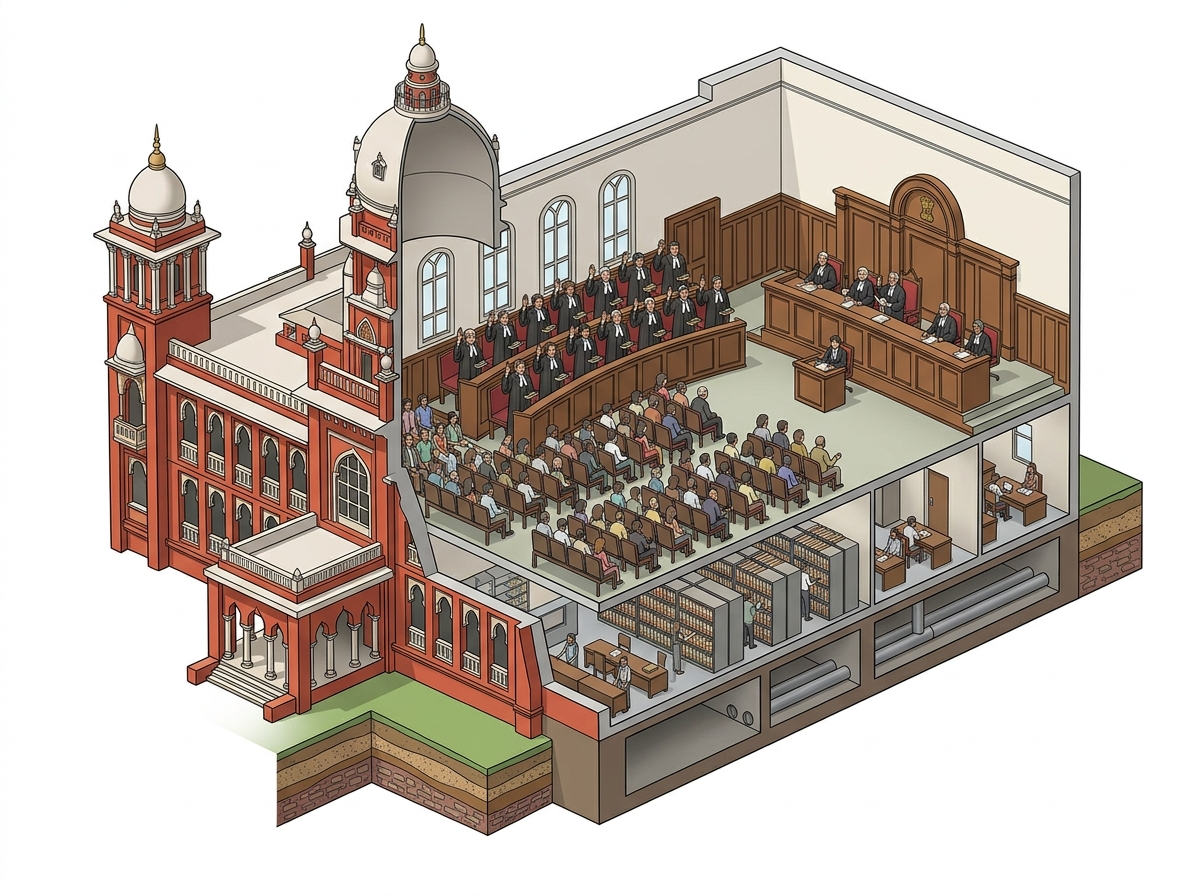
09 Aug 15 New Judges Sworn In: Madras HC Strength Rises to 66
✎ The appointment of High Court judges in India is governed by Article 217, with the Collegium System ensuring judicial independence, while additional judges are appointed under Article 224 to address temporary vacancies.
Subject Relevance — Where This Topic Fits
- GS Paper II — Polity and Governance — Judiciary | GS Paper IV — Ethics, Integrity and Aptitude — Judicial Ethics and Impartiality
- Prelims: Judicial Appointments Commission, Collegium System, High Court Strength, Article 217, Judicial Vacancies, Additional Judges, Permanent Judges, Advocate General, Directorate of Enforcement (ED), Special Public Prosecutor, Geographical Indication (GI), Madurai Bench of Madras High Court
- Essay: Judicial Independence and Accountability: Balancing Efficiency and Integrity in Appointments, The Role of Higher Judiciary in Upholding Constitutional Values and Public Trust
Quick Revision: The appointment of High Court judges in India is governed by Article 217, with the Collegium System ensuring judicial independence, while additional judges are appointed under Article 224 to address temporary vacancies.
Why is this in the news?
The swearing-in of fifteen new judges to the Madras High Court on August 9, 2026, marks a significant step in addressing the judicial vacancy crisis in one of India’s oldest and most significant High Courts. With the working strength increasing to 66 against a sanctioned strength of 75, this appointment underscores the judiciary’s efforts to enhance judicial capacity and reduce pendency. The elevation of advocates with diverse expertise—ranging from intellectual property and indirect taxation to enforcement and geographical indications—also highlights the evolving demands of the legal system and the judiciary’s responsiveness to contemporary legal challenges.
Background
- The Madras High Court, established in 1862, is one of the oldest High Courts in India and serves as a judicial hub for Tamil Nadu and Puducherry, with a sanctioned strength of 75 judges.
- The Collegium System, as evolved through judicial precedents (e.g., *Second and Third Judges Cases*), governs the appointment of High Court judges, emphasizing seniority, merit, and suitability for judicial office.
- The appointment of additional judges for fixed tenures is a transitional mechanism under Article 224 of the Constitution, often used to assess performance before conferring permanent status.
- The elevation of advocates with prior experience in specialized domains such as intellectual property, indirect taxation, and enforcement reflects the judiciary’s need for domain expertise in complex legal matters.
Appointment of High Court Judges in India: Constitutional Framework and Process
- **Constitutional Provisions**: Article 217 of the Constitution of India governs the appointment of High Court judges, requiring consultation with the Chief Justice of India (CJI) and the Governor of the State.
- The **Collegium System**, developed through judicial interpretations (e.g., *S.P. Gupta v. Union of India*, 1981; *Supreme Court Advocates-on-Record Association v. Union of India*, 1993), empowers the Supreme Court collegium to recommend judicial appointments, prioritizing seniority, merit, and integrity.
- Appointment of **Additional Judges**: Under Article 224, the President can appoint additional judges for a fixed tenure (up to two years) to address temporary vacancies or workload, with the possibility of elevation to permanent status based on performance.
- Appointment of **Permanent Judges**: Permanent judges are appointed after a period of service as additional judges, subject to the collegium’s assessment of their judicial acumen, temperament, and contribution to the legal system.
- Role of the **Advocate General**: The Advocate General, as the chief legal advisor to the state government, plays a key role in the appointment process by providing inputs on the suitability of candidates for judicial office.
- **Judicial Vacancies and Pendency**: High judicial vacancies, such as those in the Madras High Court, contribute to case pendency and delayed justice delivery, necessitating timely appointments to enhance judicial capacity.
- **Specialized Expertise**: The appointment of judges with expertise in domains like intellectual property, indirect taxation, and enforcement reflects the judiciary’s adaptation to the growing complexity of legal issues in a modern economy.
- The **Madurai Bench of the Madras High Court**, inaugurated in 2004, serves as a critical judicial center for southern Tamil Nadu, addressing regional legal needs and reducing the burden on the principal bench in Chennai.
Key Features
| Feature | Significance |
|---|---|
| Appointment of 15 new judges | Increases the working strength of the Madras High Court to 66 against a sanctioned strength of 75, enhancing judicial capacity for case disposal. |
| Diverse professional backgrounds | Includes advocates from the Bar, former Special Public Prosecutors, and judicial officers, ensuring varied expertise in legal domains such as indirect taxation, intellectual property, and civil/criminal matters. |
| Direct and additional appointments | Eight elevated from the Bar were appointed directly as permanent judges, while others were appointed as additional judges for a fixed tenure, reflecting a balanced approach to judicial appointments. |
| Specialisation in niche legal domains | Several appointees have expertise in intellectual property law, indirect taxation, and geographical indications, addressing specialized judicial needs. |
| Geographical representation | Appointees hail from diverse regions within Tamil Nadu and Puducherry, ensuring regional inclusivity in the judiciary. |
Why it Matters
Judicial Efficiency
- Reduces pendency of cases by increasing the judge-to-case ratio, particularly in the Madras High Court, which handles a significant volume of litigation.
- Enhances the capacity of the High Court to address complex legal issues, including those related to economic offences, intellectual property, and constitutional matters.
- Facilitates faster disposal of cases, thereby improving access to justice for litigants.
Legal Expertise
- Broadens the judicial bench’s expertise in specialized areas such as indirect taxation, intellectual property, and geographical indications, which are critical for economic and commercial governance.
- Strengthens the judiciary’s ability to adjudicate on matters involving enforcement agencies like the Directorate of Enforcement (ED).
Institutional Strengthening
- Increases the working strength of the High Court closer to its sanctioned strength, addressing long-standing vacancies and reducing the burden on existing judges.
- Promotes diversity in judicial appointments, including first-generation lawyers and those with international legal education, enriching the judiciary’s perspective.
Challenges
1. Judicial Vacancy Persistence
- Despite the increase in working strength, the High Court remains understaffed, with 9 vacancies against a sanctioned strength of 75 judges.
- Delays in filling vacancies due to procedural bottlenecks in the appointment process, including the requirement for consultation with the Chief Justice of India and the Governor.
UPSC Link: GS-II: Judiciary – Appointment and Transfer of Judges
2. Case Pendency and Backlog
- The Madras High Court, like other High Courts, faces significant backlog, with thousands of pending cases awaiting adjudication.
- Increased judicial strength alone may not suffice without systemic reforms in case management and procedural efficiency.
UPSC Link: GS-II: Judiciary – Judicial Reforms and Case Management
3. Specialisation Gaps in Judiciary
- Limited expertise in niche areas such as intellectual property, indirect taxation, and geographical indications among the existing bench, necessitating targeted appointments.
- Dependence on additional judges with fixed tenures may not provide long-term stability in specialized domains.
UPSC Link: GS-II: Judiciary – Role of Specialized Benches
4. Regional Representation and Inclusivity
- Ensuring equitable representation from all regions of Tamil Nadu and Puducherry remains a challenge, particularly for districts with lower judicial representation.
- Balancing meritocracy with regional inclusivity in judicial appointments requires deliberate policy measures.
UPSC Link: GS-II: Judiciary – Representation and Inclusivity
5. Judicial Accountability and Transparency
- The appointment process, particularly for advocates elevated directly to the bench, may face scrutiny regarding transparency and merit-based selection criteria.
- Need for robust mechanisms to ensure that judicial appointments are free from external influences and adhere to constitutional principles.
UPSC Link: GS-II: Judiciary – Judicial Appointments Commission
Challenges — UPSC Perspective
| Issue | Concern |
|---|---|
| Understaffing | 9 vacancies remain despite the appointment of 15 new judges, indicating systemic delays in filling sanctioned positions. |
| Case Backlog | Thousands of pending cases in the Madras High Court highlight the need for structural reforms in case management and judicial efficiency. |
| Specialisation Deficits | Limited expertise in areas like intellectual property and indirect taxation among existing judges necessitates targeted appointments. |
| Regional Imbalance | Uneven geographical representation in judicial appointments may exclude certain districts from equitable access to justice. |
| Appointment Transparency | Potential concerns regarding the transparency and meritocracy of direct elevations from the Bar to the bench. |
| Judicial Tenure Constraints | Additional judges with fixed tenures may not provide the stability required for specialized judicial functions. |
Way Forward
- Constitute a High-Powered Committee to expedite the appointment of the remaining 9 judges to the Madras High Court, ensuring adherence to constitutional timelines.
- Introduce mandatory judicial training programs for newly appointed judges, particularly in specialized domains such as intellectual property and economic offences.
- Establish specialized benches within the Madras High Court to address backlog in specific domains like indirect taxation and intellectual property rights.
- Implement a region-wise mapping of judicial vacancies to ensure equitable representation and inclusivity in future appointments.
- Strengthen the role of the Collegium in ensuring transparency and meritocracy in judicial appointments, with clear criteria for elevation from the Bar.
- Promote the use of technology-driven case management systems to streamline judicial processes and reduce pendency.
- Encourage the appointment of additional judges with longer tenures or permanent status in specialized domains to ensure stability and expertise.
- Conduct periodic reviews of judicial appointments to assess the impact on case disposal rates and judicial efficiency.
UPSC Value Addition
Keywords for Mains Answer-Writing
Judicial Appointments in India · High Court Judges · Constitutional Provisions for Judicial Appointments (Article 217 & 224) · Collegium System · Madras High Court · Judicial Vacancies and Strength · Appointment of Additional Judges · Judicial Independence · Appointment of Advocates as Judges · Judicial Reforms · Judicial Vacancy Trends · Appointment Process for High Court Judges · Judicial Appointments Commission (JAC) · Judicial Accountability · Constitutional Morality in Judicial Appointments
Constitutional & Policy Linkages
- {‘Article 217’: ‘Appointment of High Court judges’}
- {‘Article 224’: ‘Appointment of additional judges’}
- {‘Article 224A’: ‘Appointment of retired judges’}
Concept Flow
Appointment of judges under Article 217 and Article 224 → Increase in judicial strength → Reduction in case pendency and backlog → Enhanced judicial efficiency → Improved access to justice → Strengthening of constitutional governance. → Elevation of advocates from the Bar to the bench → Diversification of judicial expertise → Addressing specialization gaps → Enhanced adjudication in niche legal domains → Strengthening of commercial and economic governance. → Appointment of additional judges → Temporary increase in judicial capacity → Addressing immediate backlog → Potential for permanent elevation → Long-term stability in specialized benches. → Geographical representation in judicial appointments → Equitable access to justice → Inclusivity in judicial decision-making → Strengthening of federalism and regional representation. → Transparency in judicial appointments → Meritocracy and accountability → Public trust in the judiciary → Strengthening of constitutional democracy.
Prelims Practice Questions
Q1. Consider the following statements regarding the appointment of judges to the High Courts in India:
1. The appointment of a judge to a High Court can be made by the President after consultation with the Governor of the State.
2. The Collegium System for judicial appointments was established by a constitutional amendment.
3. Additional judges can be appointed to a High Court for a fixed tenure under Article 224 of the Constitution.
4. The President of India administers the oath of office to the judges of the High Courts.
How many of the above statements are correct?
- Only one
- Only two
- Only three
- All
Answer: Only three — Statements 1 and 3 are correct. Statement 1 is correct as per Article 217(1) of the Constitution. Statement 3 is correct as per Article 224 which allows the appointment of additional judges. Statements 2 and 4 are incorrect. The Collegium System is a judicial innovation, not established by a constitutional amendment, and the oath is administered by the Chief Justice of the High Court or the Governor, not the President.
Q2. Assertion (A): The appointment of judges to the High Courts in India is governed by the Collegium System.
Reason (R): The Collegium System was introduced to ensure judicial independence and transparency in judicial appointments.
In the context of the above two statements, which one of the following is correct?
- Both A and R are true and R is the correct explanation of A
- Both A and R are true but R is not the correct explanation of A
- A is true but R is false
- A is false but R is true
Answer: A is true but R is false — The Collegium System is indeed the mechanism for judicial appointments in India, making Assertion (A) true. However, the Reason (R) is not the correct explanation of (A) because the Collegium System was not introduced to ensure transparency (as it is often criticized for lack of transparency), but rather to insulate the judiciary from executive interference to protect judicial independence.
Q3. Match the following provisions of the Constitution of India with their respective articles:
Column I (Provision)
A. Appointment of judges to the Supreme Court and High Courts
B. Appointment of additional judges to a High Court
C. Oath or affirmation by judges of High Courts
D. Transfer of a judge from one High Court to another
Column II (Article Number)
1. Article 222
2. Article 219
3. Article 224
4. Article 217
Select the correct match:
- A-4, B-3, C-2, D-1
- A-1, B-2, C-3, D-4
- A-4, B-2, C-3, D-1
- A-1, B-3, C-2, D-4
Answer: A-4, B-3, C-2, D-1 — The correct matches are: A-4 (Article 217 governs the appointment of judges to the Supreme Court and High Courts), B-3 (Article 224 governs the appointment of additional judges to a High Court), C-2 (Article 219 governs the oath or affirmation by judges of High Courts), and D-1 (Article 222 governs the transfer of a judge from one High Court to another).
Mains Practice Question
✍ The recent swearing-in of fifteen new judges to the Madras High Court, including both permanent and additional judges, highlights the persistent challenge of judicial vacancies in India’s High Courts. In this context, critically examine the constitutional framework governing judicial appointments to High Courts, with particular reference to the role of the Collegium System, Article 217, and Article 224. Also, analyse the implications of appointing advocates directly as permanent judges versus additional judges for a fixed tenure. (15 Marks)
Approach: 1. Constitutional Framework:
– Article 217: Appointment of High Court judges (consultation with CJI, Governor, and Chief Justice of the High Court).
– Article 224: Appointment of additional judges for a fixed tenure (up to 2 years, extendable).
– Role of the President: Formal authority to appoint judges.
2. Collegium System:
– Evolution: Post-Second and Third Judges Cases (1993, 1998) establishing the Collegium System.
– Composition: Supreme Court Collegium and High Court Collegium.
– Criticisms: Lack of transparency, executive-judicial tussle, delays in appointments.
3. Direct Appointment vs. Additional Judges:
– Direct Appointment: Advocates with 10+ years of practice can be appointed as permanent judges (e.g., first five judges in the Madras High Court case).
– Additional Judges: Appointed for a fixed tenure to address immediate vacancies (e.g., remaining ten judges in the case).
– Implications: Temporary relief vs. long-term judicial strength; impact on judicial independence and accountability.
4. Judicial Vacancies and Strength:
– Current status: Working strength of Madras High Court (66) vs. sanctioned strength (75).
– Broader issue: High judicial vacancies across High Courts (average vacancy rate ~25%).
– Consequences: Delayed justice, pendency of cases, erosion of public trust.
5. Way Forward:
– Judicial Appointments Commission (JAC) Bill: Proposed to replace Collegium System (pending legislative approval).
– Time-bound appointments: Recommendations for reducing delays.
– Transparency measures: Public disclosure of reasons for appointments/rejections.
Source: The Hindu
Generated by AanyaAi for educational purpose.

- मद्रास उच्च न्यायालय में 15 नए न्यायाधीशों ने ली शपथ, कार्यबल बढ़कर 66 हुआ - August 9, 2026
- 15 New Judges Sworn In: Madras HC Strength Rises to 66 - August 9, 2026
- एआई से भारत में स्वास्थ्य सेवाओं की कमी दूर करने की संभावना: रिपोर्ट - August 9, 2026

No Comments