


20 Aug 17 Lakh Annapurna Yojana Applications Rejected in Bengal: Reapply Now
Aadhaar-seedingBank accountsBeneficiary databaseDBT schemesGrievance redressal✎ Annapurna Yojana in West Bengal exemplifies the challenges and administrative rigour involved in Direct Benefit Transfer schemes, where Aadhaar-seeding, eligibility verification, and grievance redressal mechanisms are critical to…
Subject Relevance — Where This Topic Fits
- GS Paper II — Governance, Welfare Schemes for Vulnerable Sections | GS Paper III — Direct Benefit Transfers, Public Distribution System Reforms
- Prelims: Annapurna Yojana, Direct Benefit Transfer (DBT), Aadhaar-seeding, Social Register, Exclusion criteria in welfare schemes, District Magistrate’s role in welfare delivery
- Essay: The efficacy of direct benefit transfer mechanisms in India: balancing inclusion and exclusion errors, Administrative challenges in welfare delivery: lessons from state-level implementation
Quick Revision: Annapurna Yojana in West Bengal exemplifies the challenges and administrative rigour involved in Direct Benefit Transfer schemes, where Aadhaar-seeding, eligibility verification, and grievance redressal mechanisms are critical to minimising inclusion and exclusion errors.
Why is this in the news?
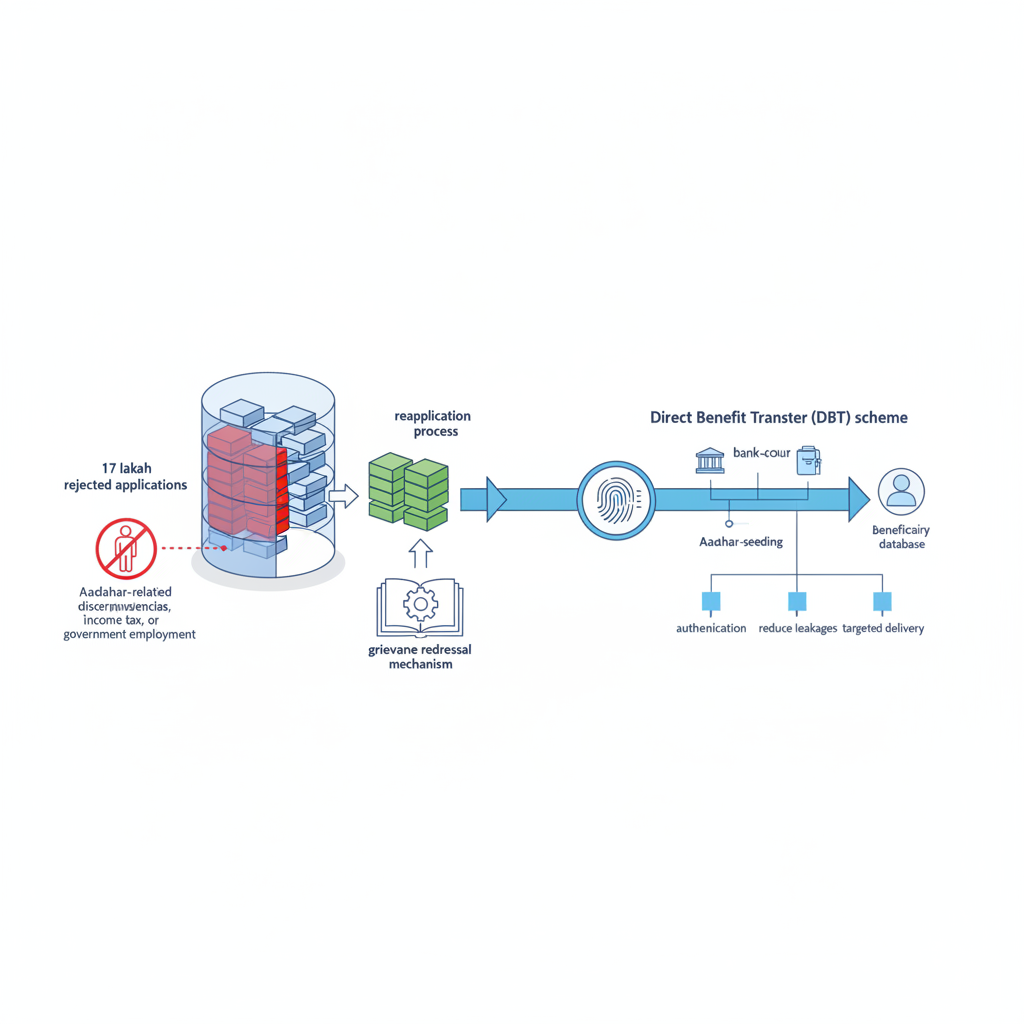
The Government of West Bengal recently announced the rejection of approximately 17 lakh applications under the Annapurna Yojana due to Aadhaar-related discrepancies, income tax filing, or government employment of applicants or their family members. This development underscores the administrative rigour required in direct benefit transfer (DBT) schemes to prevent inclusion and exclusion errors, while also highlighting the procedural recourse available to rejected applicants through a reapplication window and grievance redressal mechanism.
Background
- Direct Benefit Transfer (DBT) schemes in India utilise Aadhaar-seeding to authenticate beneficiaries, reduce leakages, and ensure targeted delivery of welfare benefits.
- Aadhaar-seeding involves linking Aadhaar numbers with bank accounts and other beneficiary databases to enable seamless and transparent fund disbursement.
- Inclusion and exclusion errors are persistent challenges in welfare schemes, often arising from data mismatches, incorrect documentation, or non-compliance with eligibility criteria.
- The Government of West Bengal has allocated ₹4,350 crore for the third tranche of the Annapurna Yojana, targeting 1.45 crore beneficiaries out of 1.62 crore applicants.
- The scheme excludes individuals employed in government services (including statutory bodies and local bodies), pensioners above 60 years of age, income tax filers with annual income exceeding ₹12 lakh, and women earning more than ₹10,000 per month.
What is the Annapurna Yojana?
- The scheme operates under the broader framework of Direct Benefit Transfer (DBT) mechanisms, which aim to transfer welfare benefits directly into the bank accounts of beneficiaries to minimise leakages and ensure transparency.
- The scheme disburses financial assistance in tranches, with the third tranche allocated ₹4,350 crore for distribution to 1.45 crore beneficiaries.
- Aadhaar-seeding is a critical component of the scheme, as it enables the authentication of beneficiaries and ensures that funds are transferred only to verified accounts linked with Aadhaar.
- The scheme excludes certain categories of individuals, including government employees (and their families), pensioners above 60 years of age, income tax filers with annual income exceeding ₹12 lakh, and women earning more than ₹10,000 per month.
- Rejected applicants are provided a reapplication window and a grievance redressal mechanism to address discrepancies in documentation or eligibility criteria.
- The administrative verification process involves coordination between Block Development Officers (BDOs), bank authorities, and the District Magistrate’s office to resolve issues such as Aadhaar-bank account linking or income verification.
Key Features
| Feature | Significance |
|---|---|
| Direct Benefit Transfer (DBT) Mechanism | Ensures transparent and leak-proof transfer of financial assistance directly to beneficiaries’ bank accounts, reducing intermediaries and enhancing efficiency. |
| Aadhaar-Bank Account Linking Requirement | Mandates biometric authentication to prevent duplication and ensure only eligible beneficiaries receive benefits, aligning with JAM Trinity (Jan Dhan-Aadhaar-Mobile) infrastructure. |
| Social Register for Renewal | Provides a digital platform for rejected applicants to reapply and verify documents, streamlining the grievance redressal process. |
| District Magistrate (DM) Office Verification | Institutionalizes local-level scrutiny to validate eligibility criteria, ensuring accuracy in beneficiary identification. |
| Grievance Redressal Portal | Facilitates transparent and accessible mechanisms for beneficiaries to lodge objections against rejections, promoting accountability. |
Why it Matters
Economic Implications
- The scheme aims to provide direct cash transfers to economically vulnerable women, enhancing their financial autonomy and reducing poverty through targeted welfare interventions.
- Rejection of 17 lakh applicants highlights the challenges in targeting beneficiaries accurately, necessitating robust verification systems to prevent exclusion errors.
- The disbursal of ₹4,350 crore to 1.45 crore beneficiaries reflects the scale of the welfare initiative, contributing to aggregate demand and local economic activity.
Administrative Reforms
- The requirement of Aadhaar-bank account linkage underscores the government’s push for digital governance and financial inclusion, leveraging the JAM Trinity for efficient service delivery.
- The reapplication process, including special camps and DM office verification, demonstrates adaptive administrative measures to address procedural bottlenecks.
- The exclusion of government employees, income tax payers, and high-income families aligns with the principle of targeting welfare benefits to the most needy segments.
Social Welfare Policy
- The Annapurna Yojana represents a state-level initiative to address gender-specific economic disparities by providing direct financial support to women, fostering inclusive growth.
- The scheme’s eligibility criteria, including income thresholds and exclusion of government employees, reflect a structured approach to prioritizing marginalized sections of society.
- The verification process and grievance redressal mechanisms ensure that the welfare benefits reach the intended beneficiaries, minimizing inclusion and exclusion errors.
Challenges
1. Digital Divide and Aadhaar Linking
- A significant portion of rejections (10 lakh) stem from non-linking of Aadhaar with bank accounts, highlighting the digital divide and challenges in accessing Aadhaar services in rural and remote areas.
- Lack of awareness among beneficiaries about the Aadhaar-bank account linkage process exacerbates the issue, necessitating targeted awareness campaigns.
UPSC Link: GS2: Welfare Schemes
2. Verification and Exclusion Errors
- Rejections due to government employment or income tax payment of family members indicate systemic challenges in verifying eligibility, risking exclusion of deserving beneficiaries.
- The need for re-verification at the DM office underscores the administrative burden and potential delays in benefit disbursal.
UPSC Link: GS2: Governance
3. Grievance Redressal and Timely Redress
- The reliance on a digital portal for grievance redressal may disadvantage beneficiaries without internet access, particularly in rural areas, necessitating offline alternatives.
- Ensuring timely resolution of grievances within the stipulated window (till September 30) is critical to maintain public trust in the scheme.
UPSC Link: GS2: Transparency
4. Scalability and Administrative Capacity
- The large-scale verification process (17 lakh rejections) tests the administrative capacity of district-level offices, requiring adequate staffing and resource allocation.
- Coordination between BDOs, bank authorities, and DM offices is essential to streamline the reapplication process and prevent bottlenecks.
UPSC Link: GS2: Public Administration
5. Targeting Accuracy and Inclusion-Exclusion Trade-offs
- The exclusion of high-income families and government employees is a policy choice aimed at targeting welfare, but it risks excluding deserving beneficiaries who fall outside these criteria due to data inaccuracies.
- The need for periodic data updates (e.g., income tax records) to reflect current eligibility status is a persistent challenge.
UPSC Link: GS3: Inclusive Growth
Challenges — UPSC Perspective
| Issue | Concern |
|---|---|
| Aadhaar-Bank Account Linking | High rejection rate due to non-compliance with Aadhaar linkage requirements, reflecting digital divide and awareness gaps. |
| Verification of Eligibility | Risk of exclusion errors due to reliance on static data (e.g., government employment, income tax records) that may not reflect current status. |
| Grievance Redressal | Potential delays and accessibility issues in resolving grievances, particularly for beneficiaries in remote areas. |
| Administrative Capacity | Strain on district-level offices to handle large-scale verification and reapplication processes within tight timelines. |
| Targeting Accuracy | Difficulty in balancing inclusion of deserving beneficiaries with exclusion of ineligible ones, leading to trade-offs in welfare delivery. |
| Awareness and Outreach | Limited awareness among beneficiaries about the reapplication process and eligibility criteria, necessitating targeted communication strategies. |
Government Initiatives — Must-Memorise for Prelims
- Annapurna Yojana (West Bengal)
- JAM Trinity (Jan Dhan-Aadhaar-Mobile) Initiative
Way Forward
- Conduct targeted awareness campaigns in rural and remote areas to educate beneficiaries on Aadhaar-bank account linking and reapplication processes.
- Strengthen coordination between BDOs, bank authorities, and DM offices to expedite verification and reduce bottlenecks in the reapplication process.
- Expand offline grievance redressal mechanisms (e.g., helplines, local offices) to ensure accessibility for beneficiaries without internet access.
- Implement periodic data audits to update eligibility records (e.g., income tax, government employment status) and minimize exclusion errors.
- Enhance digital infrastructure in rural areas to improve access to Aadhaar services and reduce dependence on manual verification.
- Introduce a grievance tracking system with real-time updates to improve transparency and accountability in the redressal process.
- Collaborate with civil society organizations to conduct field-level verification and assist beneficiaries in navigating the reapplication process.
- Establish a dedicated helpline for beneficiaries to address queries related to eligibility, documentation, and grievances.
UPSC Value Addition
Keywords for Mains Answer-Writing
Direct Benefit Transfer (DBT) · Aadhaar-enabled Payment System (AePS) · Biometric authentication · Exclusion errors in welfare schemes · Aadhaar-seeding of bank accounts · Social Register · Direct cash transfer schemes for women · Verification mechanisms in welfare delivery · Government employment exclusion criteria · Income tax filers exclusion criteria · District Magistrate’s role in welfare administration · Block Development Officer (BDO) functions · Financial inclusion and welfare delivery · Public distribution system (PDS) and Aadhaar linkage · Transparency in welfare governance
Concept Flow
State government announces Annapurna Yojana to provide direct cash transfers to economically vulnerable women. → Eligibility criteria are defined, including income thresholds and exclusion of government employees and high-income families. → Beneficiaries are required to link Aadhaar with bank accounts for biometric authentication and direct benefit transfer. → Verification process identifies 17 lakh applicants for rejection due to Aadhaar-bank account linkage issues, government employment, or income tax payment. → Rejected applicants are notified and provided a reapplication window via the Social Register portal, with DM office verification. → Grievance redressal mechanisms are activated to address objections and ensure transparency in the process. → Final disbursal of funds to 1.45 crore verified beneficiaries, with ongoing verification and grievance resolution till September 30.
Prelims Practice Questions
Q1. Consider the following statements regarding the Annapurna Yojana in West Bengal:
1. The scheme involves direct cash transfers to women beneficiaries.
2. Aadhaar-seeding of bank accounts is mandatory for inclusion in the scheme.
3. Government employees and income tax filers are excluded from the scheme.
4. The scheme is implemented by the Ministry of Women and Child Development, Government of India.
How many of the above statements are correct?
- Only one
- Only two
- Only three
- All four
Answer: Only three — Statements 1, 2, and 3 are correct as per the scheme’s design and exclusions. Statement 4 is incorrect as the scheme is a state-level initiative in West Bengal.
Q2. Assertion (A): The rejection of 17 lakh names in the Annapurna Yojana was primarily due to non-linking of Aadhaar with bank accounts.
Reason (R): Aadhaar-enabled Payment System (AePS) is a prerequisite for Direct Benefit Transfer (DBT) under the scheme.
Options:
A. Both A and R are true, and R is the correct explanation of A.
B. Both A and R are true, but R is not the correct explanation of A.
C. A is true, but R is false.
D. A is false, but R is true.
Answer: ? — Both Assertion (A) and Reason (R) are true. The rejection was primarily due to Aadhaar-bank account linkage issues, and AePS is indeed a prerequisite for DBT under the scheme.
Q3. Match the following exclusions under the Annapurna Yojana with their respective criteria:
Column I (Exclusion Criteria)
A. Government employment
B. Income tax filers
C. Pensioners above 60 years
D. Women earning more than Rs 10,000 per month
Column II (Threshold/Description)
1. Annual family income exceeding Rs 12 lakh
2. Permanent employment in government or government-aided institutions
3. Monthly income exceeding Rs 10,000
4. Excluded regardless of income or employment status
Options:
A. A-2, B-1, C-4, D-3
B. A-1, B-2, C-3, D-4
C. A-3, B-4, C-1, D-2
D. A-4, B-3, C-2, D-1
Answer: ? — Correct matching: A-2 (Government employment), B-1 (Income tax filers with income > Rs 12 lakh), C-4 (Pensioners above 60 years excluded regardless of income), D-3 (Women earning > Rs 10,000 per month).
Mains Practice Question
✍ Direct Benefit Transfer (DBT) schemes in India aim to enhance welfare delivery by reducing leakages and ensuring targeted benefits. In the context of West Bengal’s Annapurna Yojana, critically examine the role of Aadhaar and biometric authentication in achieving these objectives. Also, discuss the challenges posed by exclusion errors and suggest measures to mitigate them. (15 Marks)
Approach: MODEL-ANSWER SKELETON:
1. **Introduction (2 marks)**: Define DBT and its objectives; briefly introduce Annapurna Yojana as a state-level DBT scheme for women.
2. **Role of Aadhaar and Biometric Authentication (5 marks)**:
– Explain Aadhaar-enabled Payment System (AePS) and its integration with DBT.
– Discuss how Aadhaar-seeding of bank accounts ensures financial inclusion and reduces identity fraud.
– Highlight the role of biometric authentication in preventing duplicate/ghost beneficiaries.
– Cite the Supreme Court’s judgment in *Justice K.S. Puttaswamy v. Union of India* (2017) on privacy and Aadhaar linkage.
3. **Exclusion Errors and Challenges (5 marks)**:
– Define exclusion errors and their impact on welfare delivery (cite NITI Aayog or World Bank reports on exclusion errors in PDS/Aadhaar-linked schemes).
– Discuss reasons for exclusion: Aadhaar-bank account linkage failures, biometric authentication issues (e.g., fingerprint mismatches), and data discrepancies.
– Highlight socio-economic factors (e.g., elderly beneficiaries, manual labourers) facing challenges in biometric authentication.
4. **Mitigation Measures (3 marks)**:
– Suggest multi-modal authentication (OTP + biometrics) for inclusivity.
– Strengthen grievance redressal mechanisms (e.g., Social Register portal, District Magistrate-led verification).
– Improve last-mile connectivity and digital literacy campaigns.
5. **Conclusion (2 marks)**: Balance between efficiency and inclusivity; emphasize the need for periodic reviews and adaptive governance.
Source: The Indian Express
Generated by AanyaAi for educational purpose.

- Odisha’s Godabarisha Yojana: Laptop Aid for Plus II Pass-outs - November 3, 2026
- पुणे मेट्रो का विस्तार: शहरी विकास और ईज ऑफ लिविंग में मील का पत्थर - November 3, 2026
- INS Sahyadri Concludes India-ROK Naval Exercise - November 3, 2026

No Comments