


16 Jul 20 महत्वपूर्ण खनिज ब्लॉकों की नीलामी का 8वां चरण शुरू: भारत की खनिज सुरक्षा को बढ़ावा
Subject Relevance — Where This Topic Fits
- GS Paper I — Geography (Distribution of Key Natural Resources) | GS Paper II — Government Policies and Interventions for Development in various sectors | GS Paper III — Indian Economy and Issues Relating to Planning, Mobilization of Resources, Growth, Development and Employment; Infrastructure; Investment Models; Science and Technology- Developments and their applications and effects in everyday life; Indigenization of technology and developing new technology; Awareness in the fields of IT, Space, Computers, Robotics, Nanotechnology, Bio-technology and issues relating to Intellectual Property Rights; Environmental Impact Assessment; Disaster Management
- Prelims: Critical Minerals, Strategic Minerals, E-auction, Mineral Security, Clean Energy Transition, Mining Sector Reforms, Mineral (Auction) Rules, Rare Earth Elements (REE), Lithium, Molybdenum
- Essay: Mineral Security: A Cornerstone of India’s ‘Developed Nation’ Vision, Balancing Economic Growth and Environmental Sustainability in India’s Mining Sector
Quick Revision: The 8th tranche auction of critical and strategic mineral blocks is a pivotal move to bolster India’s mineral security, reduce import dependence, and fuel its clean energy transition and ‘Developed Nation’ aspirations through transparent, reformed mining practices.
Why is this in the news?
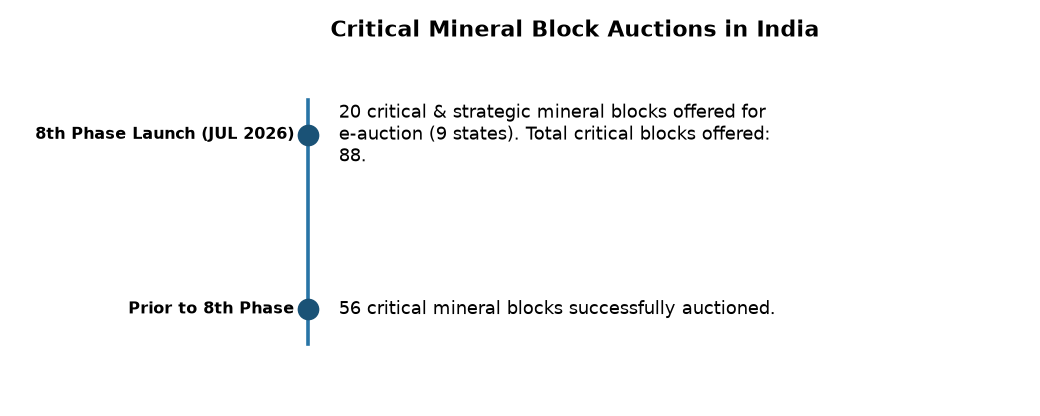
The Ministry of Mines, Government of India, launched the 8th tranche of e-auction for 20 critical and strategic mineral blocks during the ‘India Mining Week 2026’ curtain-raiser event. This initiative underscores the government’s commitment to bolstering India’s mineral security, reducing import dependence, and establishing a robust supply chain for minerals crucial to clean energy, advanced manufacturing, defense, and aerospace sectors.
Background
- Critical minerals are essential for economic development and national security, often having no viable substitutes and facing high supply chain risks.
- India currently relies heavily on imports for many critical minerals, making its industrial growth and strategic autonomy vulnerable to global supply disruptions and price volatility.
- The Mines and Minerals (Development and Regulation) Act, 1957 (MMDR Act), was amended in 2023 to facilitate the auction of critical and strategic minerals, moving away from the previous system of captive mining and promoting transparency.
- The government has identified 30 critical minerals, including Lithium, REE, Molybdenum, Tungsten, and Vanadium, which are vital for emerging technologies and India’s energy transition goals.
- Previous tranches of auctions have already seen 56 critical mineral blocks successfully auctioned, demonstrating growing industry confidence in India’s reform-based mining sector.
- The ‘India Mining Week’ is envisioned as an annual global platform to showcase India’s mining potential, foster technology adoption, and strengthen partnerships among governments, industry, and investors.
Critical and Strategic Minerals: Defining India’s Future
- Critical minerals are those that are essential for the economy and national security, whose supply chains are vulnerable to disruption, and for which there are no easy substitutes.
- Strategic minerals are a subset of critical minerals, specifically vital for defense, space, and atomic energy applications, often subject to stricter controls due to their sensitive nature.
- These minerals are indispensable for the manufacturing of advanced technologies like electric vehicles (EVs), renewable energy components (solar panels, wind turbines), semiconductors, defense equipment, and telecommunications infrastructure.
- Examples include Lithium (for EV batteries), Rare Earth Elements (for magnets in wind turbines and electronics), Cobalt (for batteries), Nickel (for batteries and stainless steel), Graphite (for batteries and refractories), and Vanadium (for steel alloys and grid-scale batteries).
- India’s list of 30 critical minerals was formulated based on recommendations from the Critical Minerals Strategy, 2023, by the Ministry of Mines.
- The auction mechanism, particularly the ‘ascending forward auction’ process, aims to ensure transparency, fair value realization, and encourage private sector participation.
- The current 8th tranche includes a diverse portfolio of minerals such as Molybdenum, Graphite, Glauconite, Vanadium, Gallium, Titanium, REE, Bauxite, Alumina Laterite, Phosphorite, Limestone, Potash, Halite, Tungsten, and rare metals like Lithium, Caesium, and Rubidium.
- The blocks are spread across nine states: Andhra Pradesh, Bihar, Chhattisgarh, Maharashtra, Odisha, Punjab, Rajasthan, Telangana, and West Bengal, indicating a pan-Indian approach to mineral exploration and exploitation.
Key Features
| Feature | Significance |
|---|---|
| 8th Tranche Auction | Adds 20 new critical and strategic mineral blocks, bringing the total offered to 88, accelerating domestic supply. |
| Diverse Mineral Portfolio | Includes Lithium, REE, Molybdenum, Vanadium, etc., crucial for clean energy, defense, and advanced manufacturing. |
| Pan-India Distribution | Blocks in 9 states (AP, Bihar, Chhattisgarh, Maharashtra, Odisha, Punjab, Rajasthan, Telangana, WB) ensure broad-based regional development and resource diversification. |
| Transparent E-Auction | Utilizes a two-stage ‘ascending forward auction’ process, promoting fairness, competition, and optimal revenue generation. |
| India Mining Week 2026 | Serves as a global platform to attract investment, showcase potential, and foster technological adoption in the mining sector. |
| Policy Reforms (MMDR Act amendments) | Enables private sector participation and commercial mining of critical minerals, reducing government’s role as an operator. |
Why it Matters
Enhancing Mineral Security and Reducing Import Dependence
- Domestic extraction and processing of critical minerals will significantly reduce India’s reliance on imports, mitigating geopolitical risks and supply chain vulnerabilities.
- A secure supply of these minerals is paramount for India’s strategic autonomy in defense, space, and atomic energy sectors, ensuring self-reliance in critical technologies.
- Diversifying sources of critical minerals, both domestically and through international partnerships, strengthens India’s position in global supply chains.
Driving Economic Growth and Industrial Development
- The auction will attract substantial investment in exploration, mining, and downstream processing industries, creating employment opportunities across the value chain.
- A robust supply of critical minerals is foundational for the ‘Make in India’ initiative, particularly in sectors like electric vehicles, renewable energy, electronics, and advanced manufacturing.
- Increased domestic production will foster innovation, technology transfer, and the development of indigenous capabilities in mineral extraction and processing.
Facilitating Clean Energy Transition and ‘Developed India’ Vision
- Critical minerals are the backbone of clean energy technologies, and their availability is crucial for India to achieve its ambitious renewable energy targets and net-zero commitments.
- The auction supports the development of a sustainable and future-ready mining ecosystem, aligning with India’s vision of becoming a ‘Developed Nation’ by 2047.
- By securing these resources, India can accelerate its transition to a green economy, reducing carbon emissions and promoting environmental sustainability.
Promoting Transparency and Sustainable Mining Practices
- The transparent e-auction mechanism ensures fair competition and minimizes discretion, enhancing investor confidence and governance in the mining sector.
- Reforms emphasize sustainable mining practices, including environmental impact assessments and rehabilitation, ensuring that mining benefits local communities and contributes to their development.
- The ‘India Mining Week’ platform will facilitate knowledge sharing and adoption of best practices in responsible mining, aligning with global environmental, social, and governance (ESG) standards.
Challenges
1. Exploration and Resource Assessment
- Despite geological potential, India’s exploration efforts for critical minerals have historically been limited, leading to insufficient data on reserves and resources.
- Advanced exploration technologies and skilled manpower are needed to accurately identify and quantify critical mineral deposits, especially deep-seated ones.
UPSC Link: GS Paper I — Distribution of Key Natural Resources; GS Paper III — Indigenization of Technology
2. Environmental and Social Concerns
- Mining activities, especially for rare earths and other critical minerals, can have significant environmental impacts (deforestation, water pollution, biodiversity loss).
- Resettlement and rehabilitation of local communities, particularly indigenous populations, often pose challenges and require sensitive handling to ensure equitable benefits.
UPSC Link: GS Paper III — Environmental Impact Assessment; Disaster Management; GS Paper II — Government Policies and Interventions
3. Technological and Processing Gaps
- India lacks advanced processing and refining capabilities for many critical minerals, necessitating reliance on foreign expertise and infrastructure.
- Developing indigenous technologies for extraction, beneficiation, and refining of complex ores is crucial but requires substantial R&D investment.
UPSC Link: GS Paper III — Science and Technology; Indigenization of Technology
4. Investment and Infrastructure
- Mining critical minerals is capital-intensive and requires significant long-term investment, which can be deterred by policy uncertainties or bureaucratic hurdles.
- Adequate infrastructure (transportation, power, water) in remote mining areas is often lacking, increasing operational costs and project timelines.
UPSC Link: GS Paper III — Investment Models; Infrastructure
5. Regulatory and Policy Framework Implementation
- While reforms have been introduced, consistent and efficient implementation of policies, including environmental clearances and land acquisition, remains a challenge.
- Ensuring a stable and predictable regulatory environment is vital to attract and retain large-scale private sector investment in the long run.
UPSC Link: GS Paper II — Government Policies and Interventions; GS Paper III — Mobilization of Resources
Challenges — UPSC Perspective
| Issue | Concern |
|---|---|
| Limited Domestic Exploration | Insufficient geological data and identified reserves for many critical minerals. |
| Environmental Impact | Potential for deforestation, water contamination, and biodiversity loss from mining operations. |
| Technological Deficiencies | Lack of advanced processing and refining infrastructure for complex critical mineral ores. |
| Social Displacement | Challenges in resettlement and rehabilitation of local communities affected by mining projects. |
| Capital Intensity | High upfront investment and long gestation periods deterring private sector participation. |
| Global Supply Chain Volatility | Geopolitical tensions and monopolistic control by a few nations impact prices and availability. |
Government Initiatives — Must-Memorise for Prelims
- National Mineral Policy (2019)
- Mines and Minerals (Development and Regulation) Act, 1957 (as amended)
- National Exploration Policy (2016)
- Production Linked Incentive (PLI) Scheme (for related manufacturing sectors)
- Scheme for Financial Assistance to State Governments for Critical Mineral Exploration
- District Mineral Foundation (DMF)
- Pradhan Mantri Khanij Kshetra Kalyan Yojana (PMKKKY)
- Accelerated Exploration and Mining (AEM) Scheme
- National Geoscience Data Repository (NGDR)
- Critical Minerals Strategy for India (2023)
Way Forward
- Intensify and modernize exploration efforts using advanced technologies (e.g., airborne geophysical surveys, AI/ML-based data analytics) to rapidly identify and delineate critical mineral deposits.
- Invest heavily in R&D for indigenous processing and refining technologies, establishing pilot plants and skill development centers to bridge technological gaps.
- Streamline environmental clearance processes while ensuring robust environmental impact assessments and adherence to international best practices for sustainable mining.
- Develop a comprehensive ‘Critical Minerals Mission’ with clear targets, timelines, and inter-ministerial coordination to drive the entire value chain from exploration to end-use.
- Foster international collaborations for technology transfer, joint exploration ventures, and securing critical mineral supplies from friendly nations.
- Enhance infrastructure development in mining regions, including transportation networks, power supply, and water management systems, to support efficient operations.
- Implement robust social impact assessments and ensure equitable benefit-sharing mechanisms, including effective utilization of DMF funds, for local communities.
- Provide fiscal incentives, tax holidays, and risk-sharing mechanisms to attract private and foreign investment into the capital-intensive critical mineral sector.
UPSC Value Addition
Keywords for Mains Answer-Writing
Mineral Security · Critical Minerals · Strategic Autonomy · Clean Energy Transition · Import Dependence · Value Chain Integration · Sustainable Mining · Resource Nationalism · Geopolitical Leverage · Circular Economy · Technological Self-Reliance · Green Economy
Constitutional & Policy Linkages
- Seventh Schedule (Union List, State List, Concurrent List) — Entry 54 of Union List (Regulation of mines and mineral development)
- Article 246 — Distribution of legislative powers
- Mines and Minerals (Development and Regulation) Act, 1957 — Primary legislation governing mining in India
- Environmental (Protection) Act, 1986 — Framework for environmental safeguards
- Forest (Conservation) Act, 1980 — Regulates diversion of forest land for non-forest purposes
- Panchayats (Extension to Scheduled Areas) Act (PESA), 1996 — Gram Sabha consent for mining in tribal areas
Concept Flow
Global Demand for Critical Minerals Surges → India’s High Import Dependence & Vulnerability → Government Policy Reforms (MMDR Act, Auctions) → Increased Domestic Exploration & Extraction → Enhanced Mineral Security & Reduced Imports → Accelerated Clean Energy Transition & Industrial Growth → Realization of ‘Developed India’ Vision
Prelims Practice Questions
Q1. Which of the following statements regarding Critical and Strategic Minerals in India is/are correct?
1. Critical minerals are exclusively used in defense and aerospace sectors.
2. The Mines and Minerals (Development and Regulation) Act, 1957, was amended to facilitate the auction of critical and strategic minerals.
3. India aims to reduce import dependence for critical minerals to achieve its clean energy transition goals.
Select the correct answer using the code given below:
- A. 1 and 2 only
- B. 2 and 3 only
- C. 3 only
- D. 1, 2 and 3
Answer: B. 2 and 3 only — Statement 1 is incorrect: Critical minerals are essential for economic development and national security across various sectors, not exclusively defense and aerospace. Strategic minerals are a subset often linked to these sensitive sectors. Statement 2 is correct: Amendments to the MMDR Act were crucial for enabling the transparent auction of these minerals. Statement 3 is correct: Reducing import dependence is a primary objective to secure supplies for clean energy technologies like EVs and renewables.
Q2. Consider the following pairs of critical minerals and their primary applications:
1. Lithium: Electric Vehicle Batteries
2. Rare Earth Elements (REE): Magnets in Wind Turbines
3. Molybdenum: Steel Alloys
Which of the pairs given above is/are correctly matched?
- A. 1 only
- B. 1 and 2 only
- C. 2 and 3 only
- D. 1, 2 and 3
Answer: D. 1, 2 and 3 — All three pairs are correctly matched. Lithium is a key component of EV batteries. Rare Earth Elements, particularly Neodymium and Dysprosium, are vital for high-performance magnets used in wind turbines and various electronics. Molybdenum is widely used as an alloying agent in steel to enhance strength, hardness, and corrosion resistance.
Mains Practice Question
✍ The recent auction of critical and strategic mineral blocks marks a significant step towards India’s mineral security and economic self-reliance. Discuss the strategic importance of these minerals for India’s ‘Developed Nation’ vision and analyze the challenges in their domestic extraction and processing. Suggest a comprehensive way forward to overcome these challenges. (250 words)
Approach: Begin by defining critical and strategic minerals and briefly mentioning the context of the recent auction. In the first part, elaborate on their strategic importance for India’s economic growth, clean energy transition, defense capabilities, and overall ‘Developed Nation’ vision. In the second part, critically analyze the challenges, such as limited exploration, technological gaps, environmental concerns, and investment hurdles. Conclude by suggesting a comprehensive way forward, focusing on enhanced exploration, indigenous R&D, streamlined regulations, international collaboration, and sustainable mining practices.
Source: PIB (Press Information Bureau)

- UPSC Alert: 40-Day ‘Khet Bachao Abhiyan’ Launch by Union Minister - October 22, 2026
- भारत ने बताया UN रिपोर्ट में दाऊद इब्राहिम को ‘भारत-आधारित’ बताना ‘गलत’ - October 22, 2026
- GRAP Stage I activated in Delhi-NCR amid rising AQI: Key actions for aspirants - October 22, 2026

No Comments