


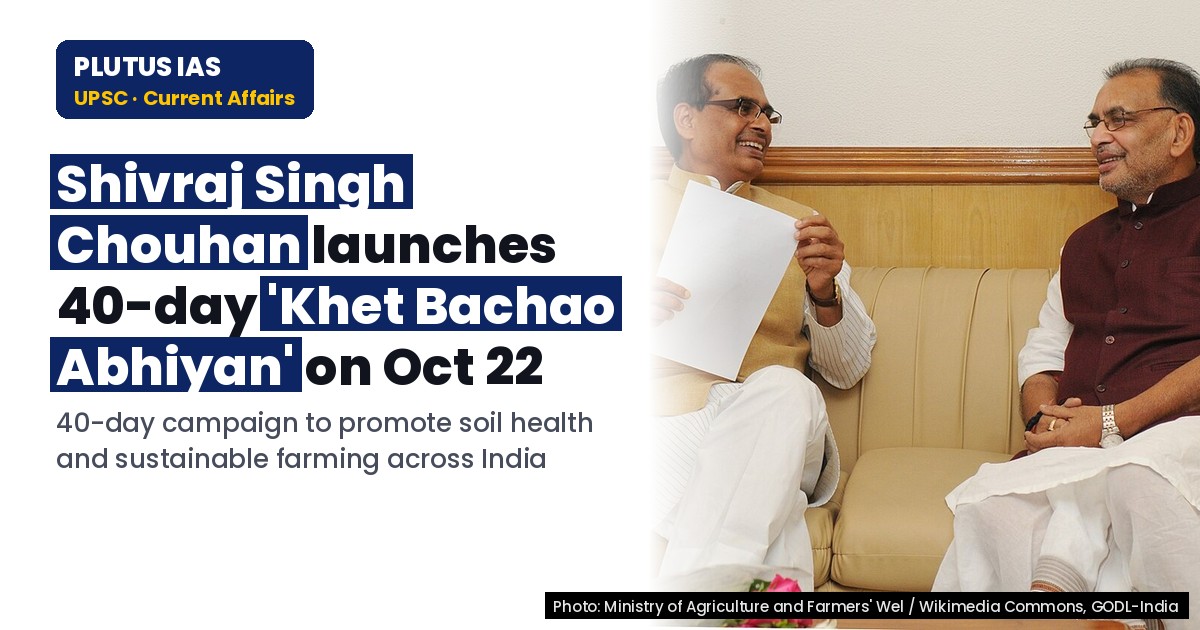
22 Oct UPSC Alert: 40-Day ‘Khet Bachao Abhiyan’ Launch by Union Minister
✎ The ‘खेत बचाओ अभियान’ is a 40-day national drive to enhance soil health, reduce agricultural costs, and promote sustainable farming through soil testing, balanced fertilization, crop rotation, and residue management, targeting…
Subject Relevance — Where This Topic Fits
- GS Paper III — Agriculture, Environment and Sustainable Development
- Prelims: Soil Health Card Scheme, Crop Residue Management, Natural Farming, PM-KISAN, Fasal Bima Yojana, Kisan Credit Card (KCC), ATMA Scheme, KVKs
- Essay: Agricultural Transformation and Farmer Prosperity: Pathways to Sustainable Growth, Balancing Economic Growth with Environmental Conservation in India
Quick Revision: The ‘खेत बचाओ अभियान’ is a 40-day national drive to enhance soil health, reduce agricultural costs, and promote sustainable farming through soil testing, balanced fertilization, crop rotation, and residue management, targeting one crore farmers via KVKs and ATMA teams.
Why is this in the news?
The Union Minister of Agriculture and Farmers’ Welfare and Rural Development, Shri Shivraj Singh Chouhan, is set to launch the nationwide ‘खेत बचाओ अभियान’ (Save the Farm Campaign) on 22 October 2026 from Karnal, Haryana. This 40-day initiative, aligned with the Prime Minister’s vision for sustainable agriculture, aims to enhance soil health, reduce agricultural costs, and promote balanced nutrient use, crop rotation, and residue management. The campaign seeks to engage over one crore farmers through direct field interactions, training, and demonstrations, emphasizing the interdependence of soil health and farmer prosperity.
Background
- The National Mission for Sustainable Agriculture (NMSA) under the Ministry of Agriculture and Farmers’ Welfare prioritizes soil health, water use efficiency, and climate-resilient agriculture.
- The Soil Health Card Scheme (launched 2015) provides farmers with soil nutrient status and recommendations for balanced fertilizer use, reducing input costs and environmental degradation.
- Stubble burning in Punjab, Haryana, and Uttar Pradesh contributes to air pollution, necessitating alternative residue management practices such as in-situ incorporation or bio-decomposer use.
- The Pradhan Mantri Kisan Samman Nidhi (PM-KISAN) and Fasal Bima Yojana (PMFBY) aim to enhance farmer income security and risk mitigation, aligning with the campaign’s outreach goals.
- The Agricultural Technology Management Agency (ATMA) and Krishi Vigyan Kendras (KVKs) serve as nodal institutions for technology dissemination and farmer training across districts.
- India’s agricultural sector employs over 40% of the workforce but faces challenges of declining soil fertility, water scarcity, and high input costs, threatening long-term food security.
What is the ‘खेत बचाओ अभियान’?
- A 40-day national campaign (22 October–30 November 2026) launched by the Ministry of Agriculture and Farmers’ Welfare to promote sustainable farming practices and soil health restoration.
- The campaign is structured around four core farmer commitments: conducting soil tests, adopting balanced fertilizer use, practicing crop rotation (including pulses, oilseeds, and horticulture), and managing crop residue through in-situ incorporation.
- It emphasizes natural farming techniques, leveraging schemes like PM-KISAN, PMFBY, and Kisan Credit Card (KCC) to maximize farmer benefits and reduce input costs.
- Field-level implementation involves 4,150 joint teams of KVKs and ATMA, comprising over 12,000 agricultural scientists and officials, who will conduct farmer interactions (chaupal discussions), demonstrations, and training at the gram panchayat level.
- The campaign aims to reach one crore farmers, fostering a mass movement for sustainable agriculture while aligning with the Prime Minister’s guidance on climate-resilient and cost-effective farming.
- Key environmental goals include reducing stubble burning, improving soil organic carbon, and mitigating air pollution through residue management practices.
- The initiative integrates policy instruments (e.g., Soil Health Card Scheme) with grassroots extension services to ensure last-mile delivery of agricultural innovations.
- The launch event in Karnal, Haryana, will feature direct farmer interactions, tree plantation drives, and a state-level ceremony with participation from central and state agriculture officials.
Key Features
| Feature | Significance |
|---|---|
| Duration and Scope | A 40-day nationwide campaign (22 Oct–30 Nov 2026) to promote sustainable agriculture, improve soil health, and reduce farming costs across India. |
| Launch Event | Inaugurated by the Union Minister of Agriculture at Taravdi, Karnal (Haryana), featuring direct farmer interactions (chaupal discussions) and tree plantation for environmental conservation. |
| Target Audience | Aims to reach approximately 1 crore farmers through 4,150 joint teams of KVKs and ATMA, comprising 12,000+ agricultural scientists and officials. |
| Core Objectives | Promote balanced fertilizer use, crop rotation (beyond rice-wheat), crop residue management (stubble incorporation), and adoption of natural farming practices. |
| Implementation Mechanism | Field-level activities include soil testing, farmer training, demonstration plots, and awareness campaigns to ensure practical adoption of recommended practices. |
Why it Matters
Agricultural Productivity
- Enhances soil fertility and long-term agricultural productivity by emphasizing balanced fertilizer use and organic residue management.
- Reduces input costs for farmers through judicious use of agrochemicals and adoption of low-cost natural farming techniques.
- Promotes crop diversification (pulses, oilseeds, horticulture) to break monoculture dependence and improve farm income resilience.
Environmental Sustainability
- Mitigates air pollution by discouraging stubble burning and promoting in-situ residue management, aligning with the National Clean Air Programme (NCAP).
- Supports climate-resilient agriculture by integrating natural farming practices, reducing carbon footprint, and enhancing soil carbon sequestration.
- Contributes to the Sustainable Development Goals (SDGs), particularly SDG 2 (Zero Hunger), SDG 13 (Climate Action), and SDG 15 (Life on Land).
Government Policy Integration
- Operationalises the National Mission for Sustainable Agriculture (NMSA) and the Soil Health Card Scheme by providing on-ground implementation support.
- Strengthens convergence with existing schemes such as PM-KISAN, PMFBY (crop insurance), and Kisan Credit Card (KCC) to maximize farmer benefits.
- Aligns with the Prime Minister’s vision of ‘Doubling Farmers’ Income’ by 2022–2027 through sustainable and remunerative agricultural practices.
Institutional Capacity Building
- Leverages the institutional framework of KVKs and ATMA for grassroots-level extension services, ensuring science-backed interventions reach farmers directly.
- Facilitates real-time feedback loops between farmers and agricultural scientists, enabling adaptive and context-specific solutions.
- Enhances the credibility of agricultural extension services by demonstrating tangible outcomes through field demonstrations and success stories.
Challenges
1. Farmer Adoption and Behavioural Change
- Overcoming entrenched practices such as stubble burning, excessive chemical fertilizer use, and monoculture cropping systems.
- Addressing skepticism among farmers regarding the efficacy and profitability of natural farming and alternative practices.
- Ensuring equitable participation across diverse agro-climatic zones, particularly small and marginal farmers with limited resources.
UPSC Link: GS-III: Agricultural Extension
2. Logistical and Infrastructure Constraints
- Limited availability of soil testing laboratories and certified organic inputs in remote rural areas.
- Inadequate storage and processing facilities for alternative crops (pulses, oilseeds) to support diversification efforts.
- Transportation challenges in disseminating scientific inputs and conducting field demonstrations in geographically dispersed regions.
UPSC Link: GS-III: Rural Development
3. Climate Variability and Resource Scarcity
- Increasing frequency of extreme weather events (droughts, floods) disrupting crop cycles and reducing soil moisture retention.
- Depleting groundwater levels in states like Punjab and Haryana, necessitating water-efficient cropping patterns.
- Rising temperatures and erratic rainfall patterns impacting soil health and pest dynamics, requiring adaptive agricultural strategies.
UPSC Link: GS-III: Disaster Management
4. Policy Implementation Gaps
- Fragmented implementation of central schemes at the state level due to administrative and financial bottlenecks.
- Lack of real-time monitoring and evaluation mechanisms to assess the impact of extension activities and farmer adoption rates.
- Insufficient convergence between agricultural policies and allied sectors (e.g., water management, energy) leading to suboptimal outcomes.
UPSC Link: GS-II: Centre-State Relations
5.
- Low market prices for alternative crops (pulses, oilseeds) disincentivizing diversification from high-yielding but input-intensive crops.
- High initial costs of transitioning to natural farming, including certification, training, and input procurement.
- Limited access to formal credit and insurance mechanisms for farmers adopting unconventional practices.
UPSC Link: GS-III: Farm Subsidies & MSP
Challenges — UPSC Perspective
| Issue | Concern |
|---|---|
| Stubborn Farming Practices | Resistance to abandon traditional methods like stubble burning and chemical-intensive farming despite awareness campaigns. |
| Soil Degradation | Declining soil organic carbon and micronutrient deficiencies due to imbalanced fertilizer use and over-extraction. |
| Water Scarcity | Intensive irrigation for rice-wheat systems leading to groundwater depletion in North-West India. |
| Market Linkages | Inadequate post-harvest infrastructure and price volatility discouraging crop diversification. |
| Extension Service Gaps | Shortage of trained agricultural extension workers and limited reach of KVKs in tribal and remote areas. |
| Climate Change Impact | Increasing pest attacks, heat stress, and erratic monsoons reducing crop yields and farm incomes. |
Government Initiatives — Must-Memorise for Prelims
- National Mission for Sustainable Agriculture (NMSA)
- Soil Health Card Scheme
- Paramparagat Krishi Vikas Yojana (PKVY)
- Pradhan Mantri Kisan Samman Nidhi (PM-KISAN)
- Pradhan Mantri Fasal Bima Yojana (PMFBY)
- Kisan Credit Card (KCC) Scheme
Way Forward
- Strengthen soil testing infrastructure at block and panchayat levels to enable real-time nutrient analysis and fertilizer recommendations.
- Expand the network of Custom Hiring Centres (CHCs) for farm machinery to promote mechanized stubble management and reduce burning.
- Integrate weather-based agro-advisories with farmer outreach programs to enhance climate-resilient decision-making.
- Establish Farmer Producer Organisations (FPOs) to aggregate produce, improve market access, and stabilize prices for alternative crops.
- Launch region-specific demonstration plots showcasing successful models of crop diversification, natural farming, and residue management.
- Enhance convergence between KVKs, ATMA, and state agricultural universities to standardize extension services and training modules.
- Introduce incentive-based schemes for farmers adopting natural farming, including certification support and premium market linkages.
- Develop a robust monitoring and evaluation framework with GIS-based mapping to track adoption rates, soil health improvements, and environmental outcomes.
UPSC Value Addition
Keywords for Mains Answer-Writing
Sustainable agriculture · Soil health management · Balanced fertilizer use · Crop rotation · Stubble management · Natural farming · PM-KISAN scheme · Crop insurance · Kisan Credit Card (KCC) · Krishi Vigyan Kendra (KVK) · ATMA scheme · Agricultural extension services · Farmers’ welfare · Agri-input subsidy · Parali management · Zero-budget natural farming
Concept Flow
Declining soil health and unsustainable farming practices → Reduced agricultural productivity and farmer income → Policy response via NMSA and Soil Health Card Scheme → National Mission for Sustainable Agriculture (NMSA) → Need for grassroots implementation → Launch of ‘Khet Bachao Abhiyan’ as a mass campaign → ‘Khet Bachao Abhiyan’ → Farmer outreach via KVKs and ATMA → Adoption of balanced fertilizer use, crop rotation, and residue management → Adoption of sustainable practices → Improved soil fertility and reduced input costs → Enhanced farm profitability and climate resilience → Climate-resilient agriculture → Reduced carbon footprint and air pollution → Alignment with SDGs and national climate commitments → Sustainable agriculture → Doubling farmers’ income → Contribution to inclusive rural development and food security
Prelims Practice Questions
Q1. Consider the following statements regarding the ‘Khet Bachao Abhiyan’ launched by the Government of India:
1. The campaign is a 40-day nationwide initiative aimed at promoting sustainable agriculture and improving soil health.
2. It mandates the use of balanced fertilizers based on soil testing and discourages stubble burning.
3. The campaign is exclusively focused on promoting organic farming practices.
4. It includes components of PM-KISAN, crop insurance, and Kisan Credit Card schemes to benefit farmers.
How many of the above statements are correct?
- Only one
- Only two
- Only three
- All
Answer: Only three — Statements 1, 2, and 4 are correct as per the campaign’s objectives. Statement 3 is incorrect because the campaign promotes both natural farming and balanced fertilizer use, not exclusively organic farming.
Q2. Assertion (A): The ‘Khet Bachao Abhiyan’ emphasizes the adoption of crop rotation practices to enhance soil fertility and reduce agricultural costs.
Reason (R): Crop rotation helps in breaking pest and disease cycles, improves soil structure, and reduces the need for chemical inputs.
Options:
A. Both A and R are true, and R is the correct explanation of A.
B. Both A and R are true, but R is not the correct explanation of A.
C. A is true, but R is false.
D. A is false, but R is true.
Answer: ? — Both the assertion and reason are factually correct. The campaign explicitly promotes crop rotation (A), and the reason (R) correctly explains the agronomic benefits of crop rotation.
Q3. Match the following initiatives with their respective objectives:
Column I (Initiative)
A. Khet Bachao Abhiyan
B. PM-KISAN
C. Crop Insurance Scheme
D. Kisan Credit Card (KCC)
Column II (Objective)
1. Providing direct income support to farmers
2. Facilitating short-term agricultural credit
3. Promoting sustainable agriculture and soil health
4. Protecting farmers against crop loss due to natural calamities
Options:
A-3, B-1, C-4, D-2
A-1, B-2, C-3, D-4
A-2, B-3, C-1, D-4
A-4, B-1, C-2, D-3
- A-3, B-1, C-4, D-2
- A-1, B-2, C-3, D-4
- A-2, B-3, C-1, D-4
- A-4, B-1, C-2, D-3
Answer: A-3, B-1, C-4, D-2 — The correct matches are: A (Khet Bachao Abhiyan) with 3 (Promoting sustainable agriculture), B (PM-KISAN) with 1 (Direct income support), C (Crop Insurance Scheme) with 4 (Protection against crop loss), and D (KCC) with 2 (Short-term agricultural credit).
Mains Practice Question
✍ Critically examine the role of the ‘Khet Bachao Abhiyan’ in addressing the twin challenges of soil degradation and farmer distress in India. How far does the campaign integrate scientific, economic, and institutional mechanisms to achieve its objectives? (15 Marks)
Approach: MODEL-ANSWER SKELETON:
1. **Context and Objectives** (2 marks):
– Briefly introduce soil degradation and farmer distress in India (e.g., declining soil organic carbon, stubble burning, rising input costs).
– State the objectives of the ‘Khet Bachao Abhiyan’: promoting sustainable agriculture, improving soil health, reducing agricultural costs, and enhancing farmer welfare.
2. **Scientific Mechanisms** (3 marks):
– **Soil Health Management**: Emphasis on soil testing and balanced fertilizer use; link to Soil Health Card Scheme.
– **Crop Rotation**: Integration of pulses, oilseeds, and horticulture to break monoculture cycles and improve soil fertility.
– **Stubble Management**: Promotion of in-situ management (e.g., Happy Seeders) and ex-situ utilization to reduce air pollution.
– **Natural Farming**: Encouragement of zero-budget natural farming and organic inputs.
3. **Economic Mechanisms** (3 marks):
– **Cost Reduction**: Promotion of balanced fertilizers and natural farming to reduce input costs.
– **Income Support**: Integration with PM-KISAN for direct benefit transfer.
– **Risk Mitigation**: Linkage with Pradhan Mantri Fasal Bima Yojana (PMFBY) for crop insurance.
– **Credit Access**: Facilitation of Kisan Credit Card (KCC) to ensure timely and affordable credit.
4. **Institutional Mechanisms** (3 marks):
– **Extension Services**: Role of Krishi Vigyan Kendras (KVKs) and Agricultural Technology Management Agency (ATMA) in farmer outreach.
– **Inter-Ministerial Coordination**: Collaboration between Ministry of Agriculture, Ministry of Environment, and state governments.
– **Grassroots Engagement**: Use of farmer collectives (e.g., FPOs) and community-level discussions (Chaupal Charcha).
5. **Challenges and Limitations** (2 marks):
– **Scalability**: Ensuring reach to 1 crore farmers across diverse agro-climatic zones.
– **Behavioral Change**: Overcoming resistance to adoption of new practices (e.g., stubble management, natural farming).
– **Monitoring and Evaluation**: Ensuring real-time tracking of soil health and farmer outcomes.
6. **Conclusion** (2 marks):
– Assess the campaign’s potential to address soil degradation and farmer distress.
– Highlight the need for sustained policy support, technological innovation, and community participation for long-term success.
Source: PIB (Press Information Bureau)
Haryana PCS (HPSC / HCS) — State PCS Practice
Prelims: Which of the following initiatives was announced by Union Minister Shri Shivraj Singh Chouhan during his Haryana visit on 22nd October, aimed at boosting agricultural productivity in the state?
- Launch of ‘Kisan Samriddhi Yojana’ for small and marginal farmers
- Inauguration of a dedicated ‘Agri-Export Hub’ in Karnal district
- Distribution of high-yielding seed varieties under the ‘Haryana Beej Kranti’ scheme
- Introduction of a new subsidy scheme for solar-powered irrigation pumps
Answer: Distribution of high-yielding seed varieties under the ‘Haryana Beej Kranti’ scheme — During his visit, Shri Shivraj Singh Chouhan emphasized the distribution of high-yielding seed varieties under the ‘Haryana Beej Kranti’ scheme to enhance agricultural productivity in Haryana.
Mains: Discuss the significance of the ‘Haryana Beej Kranti’ scheme in the context of doubling farmers’ income in Haryana. Analyze how this initiative aligns with the broader agricultural policies of the central government.
Generated by AanyaAi for educational purpose.
Related guides on our sites
- How to prepare for GS paper 1 for UPSC CSE mains exam
- Best UPSC coaching for IFOS exam
- Best agriculture optional coaching
- Best mentorship programme for upsc

- UPSC Alert: 40-Day ‘Khet Bachao Abhiyan’ Launch by Union Minister - October 22, 2026
- भारत ने बताया UN रिपोर्ट में दाऊद इब्राहिम को ‘भारत-आधारित’ बताना ‘गलत’ - October 22, 2026
- GRAP Stage I activated in Delhi-NCR amid rising AQI: Key actions for aspirants - October 22, 2026

No Comments