


23 Sep 5 Crore Indian Schoolchildren Still Lack Sanitation: UN Report 2025
✎ India must prioritise hygiene service coverage in schools, as 20 million children lack access—a critical gap for SDG 4.2 and 6.2, despite progress in sanitation and drinking water under SBM and SVA.
Subject Relevance — Where This Topic Fits
- GS Paper II — International Relations (Sustainable Development Goals) | GS Paper II — Governance, Transparency and Accountability (Monitoring and Evaluation of Public Services) | GS Paper III — Environment and Ecology (Water and Sanitation Infrastructure) | GS Paper IV — Ethics and Governance (Equity in Public Service Delivery)
- Prelims: Swachh Vidyalaya Abhiyan, SDG 4 (Quality Education), SDG 6 (Clean Water and Sanitation), Joint Monitoring Programme (JMP) for WASH, Rashtriya Madhyamik Shiksha Abhiyan (RMSA), School Sanitation and Hygiene Education (SSHE), UNICEF-WHO WASH in Schools, NITI Aayog SDG India Index
- Essay: The Role of Public Infrastructure in Nation-Building: Lessons from India’s WASH Initiatives, Equity in Education: Bridging the Rural-Urban Divide in School Facilities
Quick Revision: India must prioritise hygiene service coverage in schools, as 20 million children lack access—a critical gap for SDG 4.2 and 6.2, despite progress in sanitation and drinking water under SBM and SVA.
Why is this in the news?
A United Nations report titled ‘Progress on drinking water, sanitation and hygiene in schools 2015-2025’ highlights India’s persistent challenges in ensuring universal access to sanitation and hygiene services in schools, despite progress under the Swachh Bharat Mission. The report underscores that 50 million Indian children lack sanitation services, the highest globally, while also noting data gaps and disparities in service coverage, particularly in hygiene and drinking water access, which remain critical for achieving SDG 2030 targets.
Background
- India launched the Swachh Bharat Mission (SBM) on 2 October 2014, with a dedicated component, Swachh Vidyalaya Abhiyan (SVA), to ensure functional toilets, clean drinking water, and handwashing facilities in all government schools.
- The Joint Monitoring Programme (JMP) for Water Supply, Sanitation and Hygiene (WASH), a collaboration between WHO and UNICEF, tracks global progress toward SDG 6.2, including in educational institutions.
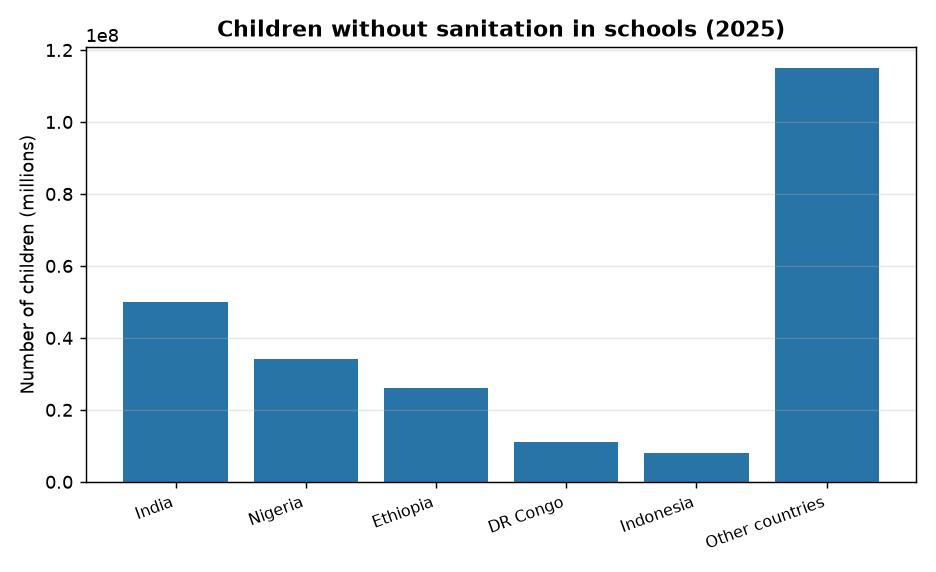
- As of 2025, 244 million children worldwide lack sanitation services in schools, with India accounting for 50 million (20.5%), followed by Nigeria (34 million) and Ethiopia (26 million).
- Globally, 362 million children lack hygiene services in schools, including 20 million in India, highlighting a critical gap in health and education outcomes.
- India is among 28 countries on track to achieve universal coverage of basic drinking water in schools by 2030, but disparities persist between school levels and rural-urban areas in other nations.
What is School WASH (Water, Sanitation, and Hygiene)?
- WASH in schools refers to the provision of safe drinking water, functional toilets, handwashing facilities, and menstrual hygiene management (MHM) infrastructure within educational institutions.
- The framework is designed to ensure a safe, healthy, and dignified learning environment, reducing absenteeism, particularly among girls, and improving educational outcomes.
- Key components include: (a) Basic drinking water (functional source within 500 meters), (b) Basic sanitation (functional toilets segregated by gender), (c) Basic hygiene (handwashing stations with soap and water), and (d) Menstrual hygiene management (private spaces, disposal facilities, and awareness).
- The Swachh Vidyalaya Abhiyan (SVA), launched in 2014, is India’s flagship programme under SBM to achieve 100% coverage of WASH facilities in government schools.
- SVA operates through convergence between the Ministry of Education, Ministry of Drinking Water and Sanitation (now part of Jal Shakti), and state governments.
- Monitoring mechanisms include the Unified District Information System for Education (UDISE+), Swachh Vidyalaya Puraskar, and third-party audits to assess functionality and usage of facilities.
- Challenges include: (i) Maintenance and sustainability of infrastructure, (ii) Behavioral change for proper usage, (iii) Data gaps in hygiene services, and (iv) Rural-urban and regional disparities in coverage.
- Global benchmarks are set by the JMP’s WASH in Schools Tracking Tool, which classifies countries into tiers based on progress toward SDG 2030 targets.
Key Features
| Feature | Significance |
|---|---|
| Sanitation coverage in schools (2015-2025) | India reduced the proportion of schools without sanitation services by 14%, yet 5 crore children remain without access, highlighting persistent infrastructure gaps despite progress. |
| Hygiene services in schools (2025) | 20 million Indian children lack hygiene services in schools, with global data gaps in Central and Southern Asia, including India, limiting trend analysis beyond 2024. |
| Drinking water coverage in schools (2025) | India is among 28 countries on track to achieve universal basic drinking water coverage by 2030, with 12 million children still lacking access, reflecting uneven progress across regions. |
| Rural-urban disparity in WASH services | While gaps persist globally between school levels and rural-urban areas, India, Cambodia, and Fiji show no such disparity, indicating targeted policy interventions. |
| Swachh Bharat Mission (SBM) impact | The 14% reduction in schools without sanitation services aligns with SBM’s broader sanitation goals, demonstrating the mission’s role in improving school infrastructure. |
Why it Matters
Public Health
- Inadequate sanitation and hygiene in schools increase the risk of waterborne diseases, particularly affecting children’s health and school attendance.
- Improved WASH services reduce absenteeism and improve cognitive development, contributing to better learning outcomes.
- Universal access to WASH in schools is a critical component of SDG 4 (Quality Education) and SDG 6 (Clean Water and Sanitation).
Gender Equity
- Lack of sanitation disproportionately affects adolescent girls, leading to school dropout and reinforcing gender disparities in education.
- Functional toilets and hygiene facilities enable girls to manage menstrual health, promoting gender-inclusive education.
- Addressing WASH gaps aligns with SDG 5 (Gender Equality) by ensuring safe and equitable learning environments.
Economic Implications
- Long-term economic costs arise from lost productivity due to poor health and reduced educational attainment.
- Investments in school WASH infrastructure yield high returns by improving human capital development and workforce readiness.
- Reducing disparities in WASH services can bridge urban-rural divides, fostering inclusive growth.
Institutional Capacity
- Data gaps in tracking WASH progress in Central and Southern Asia, including India, hinder evidence-based policymaking.
- Strengthening monitoring mechanisms under the Joint Monitoring Programme (JMP) is essential for accurate assessment and targeted interventions.
- Collaboration between central and state governments is critical to ensure uniform implementation of WASH policies.
Challenges
1. Persistent Infrastructure Gaps
- Despite progress, 5 crore children lack sanitation services, indicating systemic delays in scaling infrastructure.
- Rural schools face disproportionate challenges due to lower resource allocation and logistical constraints.
- Maintenance of existing facilities remains a critical issue, with many toilets becoming non-functional over time.
UPSC Link: GS2: SDG 4.7, SDG 6.2
2. Data Deficiencies and Monitoring
- Insufficient recent data for Central and Southern Asia limits trend analysis beyond 2024, obscuring true progress.
- Discrepancies between reported and actual WASH coverage hinder accurate policy responses.
- Strengthening the JMP framework is necessary to ensure reliable, disaggregated data for all regions.
UPSC Link: GS2: SDG 17.18
3. Behavioral and Cultural Barriers
- Low awareness about hygiene practices among students and communities undermines the effectiveness of WASH infrastructure.
- Cultural taboos, particularly around menstrual hygiene, require targeted behavioral change campaigns.
- Engaging parents and local communities is essential to sustain improvements in WASH practices.
UPSC Link: GS1: Social Issues
4. Funding and Resource Allocation
- Inconsistent funding across states leads to uneven implementation of WASH programs.
- Public-private partnerships and community contributions can supplement government efforts but require robust frameworks.
- Ensuring equitable distribution of resources remains a challenge, particularly in remote and underserved areas.
UPSC Link: GS3: Resource Mobilization
5. Policy Implementation Gaps
- Fragmented implementation across multiple agencies (e.g., education, health, rural development) delays progress.
- Lack of convergence between national schemes (e.g., SBM, Samagra Shiksha) and state-level initiatives creates duplication or gaps.
- Weak enforcement of WASH standards in school construction and maintenance exacerbates the problem.
UPSC Link: GS2: Governance
Challenges — UPSC Perspective
| Issue | Concern |
|---|---|
| Sanitation infrastructure | 5 crore children lack access, with rural schools disproportionately affected. |
| Hygiene services | 20 million children lack hygiene facilities, with data gaps limiting trend analysis. |
| Drinking water coverage | 12 million children still lack access, despite progress toward universal coverage. |
| Maintenance of facilities | Non-functional toilets and water systems reduce the impact of infrastructure investments. |
| Behavioral change | Low awareness about hygiene practices undermines the effectiveness of WASH programs. |
| Funding disparities | Inconsistent resource allocation across states delays universal coverage. |
Government Initiatives — Must-Memorise for Prelims
- {‘name’: ‘Swachh Vidyalaya Abhiyan (SVA)’, ‘description’: ‘A sub-mission under Swachh Bharat Mission focusing on providing separate toilets for girls and boys, clean drinking water, and hygiene education in schools.’}
- {‘name’: ‘Samagra Shiksha Abhiyan (SSA)’, ‘description’: ‘A centrally sponsored scheme integrating school education from pre-primary to senior secondary levels, including provisions for WASH infrastructure.’}
- {‘name’: ‘National Rural Drinking Water Programme (NRDWP)’, ‘description’: ‘A scheme aimed at providing safe and adequate drinking water to rural areas, including schools, through community-based approaches.’}
Way Forward
- Strengthen data collection and monitoring under the Joint Monitoring Programme (JMP) to ensure accurate and disaggregated WASH coverage data.
- Accelerate infrastructure development in rural and underserved schools, prioritizing maintenance and functionality of existing facilities.
- Launch targeted behavioral change campaigns to promote hygiene practices, with a focus on menstrual health management for adolescent girls.
- Enhance inter-departmental convergence between education, health, and rural development ministries to streamline WASH program implementation.
- Increase funding for WASH programs, with a focus on equitable distribution across states and districts.
- Promote public-private partnerships and community engagement to supplement government efforts in scaling WASH services.
- Integrate WASH education into school curricula to foster long-term behavioral change and sustainability.
- Conduct periodic audits of school WASH facilities to identify gaps and ensure compliance with national standards.
UPSC Value Addition
Keywords for Mains Answer-Writing
Sustainable Development Goals (SDG) 4 · Water, Sanitation and Hygiene (WASH) in Schools · Swachh Bharat Mission (SBM) · Joint Monitoring Programme (JMP) for WASH · SDG 6 · Right to Education (RTE) Act, 2009 · UNICEF-WHO Global Report on WASH in Schools · School Infrastructure Development · Rural-Urban Divide in Education · Equity in Education · SDG 2030 Agenda · Functional School Sanitation Facilities
Constitutional & Policy Linkages
- {‘article’: ‘Article 21A’, ‘note’: ‘Right to Education’}
- {‘article’: ‘Article 45 (DPSP)’, ‘note’: ‘Provision for early childhood care’}
Concept Flow
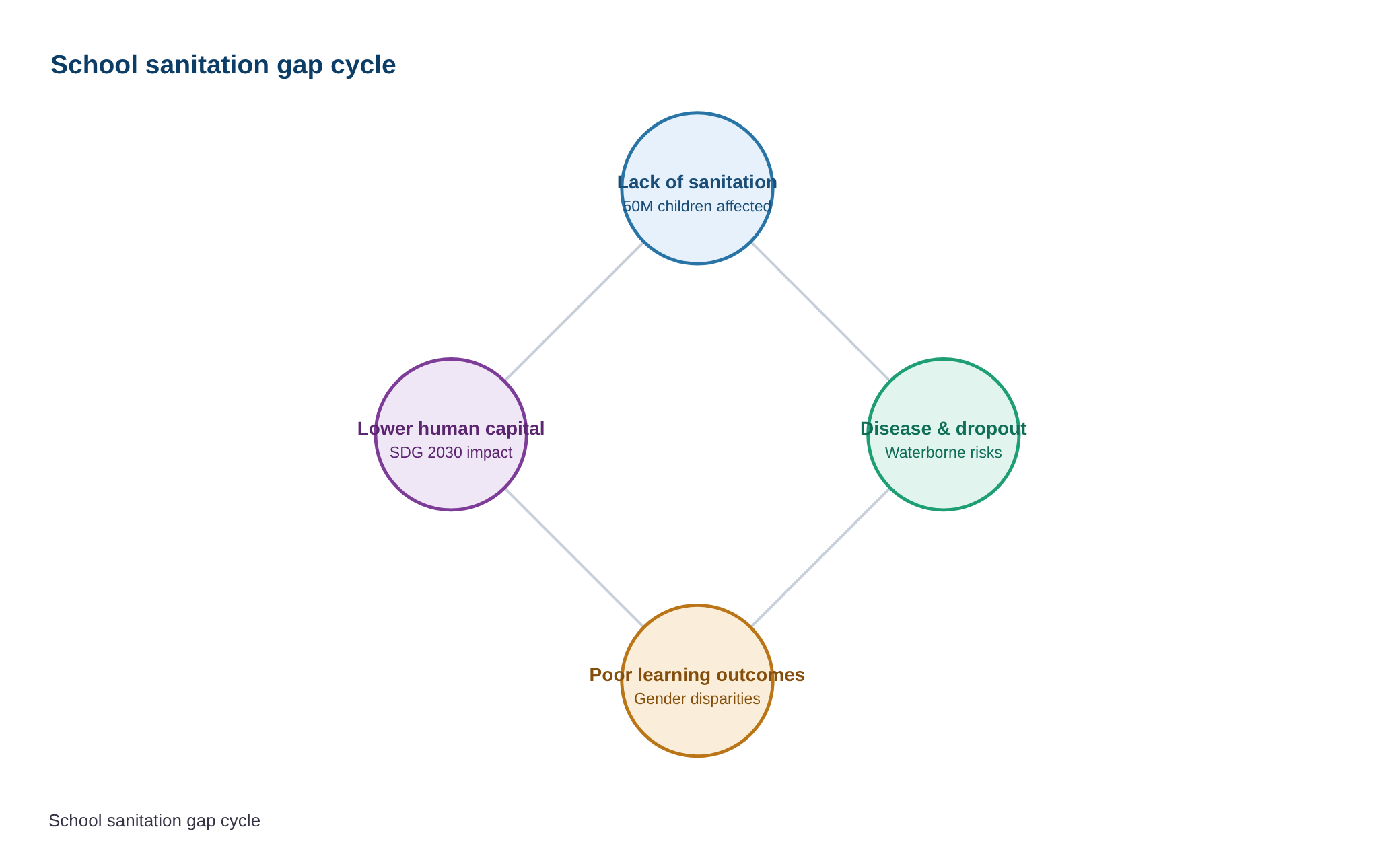
Inadequate sanitation and hygiene in schools → Increased risk of waterborne diseases and absenteeism → Poor learning outcomes and gender disparities → Lower human capital development → Swachh Bharat Mission (2014) → Focus on school sanitation (Swachh Vidyalaya Abhiyan) → 14% reduction in schools without sanitation services → Persistent gaps in rural areas → Joint Monitoring Programme (JMP) data gaps → Limited trend analysis beyond 2024 → Hinders evidence-based policymaking → Need for robust monitoring mechanisms → Behavioral barriers (e.g., menstrual hygiene) → Low awareness and cultural taboos → Undermines infrastructure investments → Requires targeted awareness campaigns → Inconsistent funding and resource allocation → Uneven implementation across states → Delays in achieving universal WASH coverage → Need for equitable funding frameworks → Policy fragmentation (education, health, rural development) → Delays in convergence and implementation → Weak enforcement of WASH standards → Requires inter-departmental coordination → Improved WASH services → Reduced absenteeism and better health → Enhanced cognitive development and gender equity → Contributes to SDG 4 and SDG 6
Prelims Practice Questions
Q1. Consider the following statements regarding the ‘Progress on drinking water, sanitation and hygiene in schools 2015-2025’ report:
1. India is among the 28 out of 62 countries on track to achieve universal coverage of basic drinking water in schools by 2030.
2. As of 2025, 50 million Indian children lacked access to sanitation services in schools.
3. The report highlights that India has made a 14% reduction in schools with no sanitation service since 2015.
4. The report is jointly published by UNICEF and WHO under the Joint Monitoring Programme (JMP) for Water Supply, Sanitation and Hygiene (WASH).
How many of the above statements are correct?
- Only one
- Only two
- Only three
- All four
Answer: All four — Statements 1, 2, and 3 are correct. Statement 4 is also correct as the report is indeed published by UNICEF and WHO under the JMP for WASH. Thus, all four statements are correct.
Q2. Assertion (A): The Swachh Bharat Mission (SBM) has contributed significantly to reducing the number of schools without sanitation services in India.
Reason (R): The SBM was launched in 2014 with a focus on improving sanitation infrastructure, including in schools, and has achieved a 14% reduction in schools with no sanitation service by 2025.
Options:
A. Both A and R are true, and R is the correct explanation of A.
B. Both A and R are true, but R is not the correct explanation of A.
C. A is true, but R is false.
D. A is false, but R is true.
Answer: ? — Both Assertion (A) and Reason (R) are true. The SBM was launched in 2014 with a focus on sanitation infrastructure, including in schools, and the report explicitly cites a 14% reduction in schools without sanitation services. Therefore, R correctly explains A.
Q3. Match the following columns related to the Sustainable Development Goals (SDGs) and their targets:
Column I (SDG Goals)
A. SDG 4
B. SDG 6
C. SDG 3
D. SDG 1
Column II (Targets)
1. Ensure availability and sustainable management of water and sanitation for all
2. Ensure inclusive and equitable quality education and promote lifelong learning opportunities for all
3. End poverty in all its forms everywhere
4. Ensure healthy lives and promote well-being for all at all ages
Options:
A. A-2, B-1, C-4, D-3
B. A-1, B-2, C-3, D-4
C. A-3, B-4, C-1, D-2
D. A-4, B-3, C-2, D-1
Answer: ? — The correct matches are: A (SDG 4) – 2 (Quality education), B (SDG 6) – 1 (Water and sanitation), C (SDG 3) – 4 (Good health and well-being), D (SDG 1) – 3 (No poverty).
Mains Practice Question
✍ The absence of adequate sanitation and hygiene facilities in schools undermines the fundamental right to education and exacerbates inequalities in access to quality schooling. Critically examine the challenges in achieving the WASH in Schools targets under SDG 4 in India, with reference to the Swachh Bharat Mission and the Right to Education Act, 2009. Also, assess the implications of these gaps for educational equity and public health. (15 Marks)
Approach: MODEL-ANSWER SKELETON:
1. **Introduction (2 Marks)**
– Define WASH in Schools and its linkage to SDG 4 (Quality Education) and SDG 6 (Clean Water and Sanitation).
– Cite the UN report data: 50 million Indian children lack sanitation services; 20 million lack hygiene services (WHO/UNICEF JMP 2025).
– State the constitutional and statutory framework: Article 21A (Right to Education), RTE Act, 2009 (Sections 19-20 on school infrastructure), and SBM (2014) as a policy intervention.
2. **Challenges in Achieving WASH Targets (5 Marks)**
– **Infrastructure Gaps**: Rural-urban divide, lack of functional toilets, water supply issues, and maintenance deficits. Reference the report’s finding on persistent gaps despite progress.
– **Data and Monitoring Deficits**: Insufficient recent data for Central and Southern Asia (including India) beyond 2024, as highlighted by the WHO/UNICEF report.
– **Equity Concerns**: Marginalised groups (girls, children with disabilities, tribal communities) face disproportionate exclusion due to cultural, economic, and geographic barriers.
– **Policy Implementation Gaps**: Delays in fund disbursement under SBM, lack of convergence between education and sanitation departments, and inadequate teacher training on WASH practices.
– **Behavioural and Cultural Factors**: Low awareness, resistance to change, and inadequate menstrual hygiene management (MHM) facilities in schools.
3. **Role of Swachh Bharat Mission and RTE Act (4 Marks)**
– **SBM**: Highlight its achievements (14% reduction in schools without sanitation) and limitations (focus on construction over maintenance, lack of community ownership).
– **RTE Act, 2009**: Sections 19 (school infrastructure) and 20 (maintenance of norms) as legal safeguards; but weak enforcement and monitoring mechanisms.
– **Intersectionality**: Link WASH gaps to broader educational inequities (e.g., dropout rates among girls, health risks like diarrhoea and stunting).
4. **Implications for Educational Equity and Public Health (3 Marks)**
– **Educational Equity**: Sanitation and hygiene directly impact attendance, retention, and learning outcomes, particularly for girls (e.g., lack of MHM facilities).
– **Public Health**: Poor WASH facilities contribute to waterborne diseases, malnutrition, and absenteeism, exacerbating the burden on rural health systems.
– **Long-term Consequences**: Perpetuation of poverty cycles, reduced human capital formation, and violation of the Right to Health (Article 21).
5. **Way Forward (1 Mark)**
– Strengthen data systems for real-time monitoring (e.g., GIS mapping of school WASH facilities).
– Integrate WASH education into the school curriculum (e.g., through NCERT modules on hygiene).
– Enhance convergence between SBM, RTE, and Ayushman Bharat (health) schemes for holistic interventions.
– Promote community participation and gender-sensitive design in school sanitation infrastructure.
Source: The Hindu
Generated by AanyaAi for educational purpose.
Related guides on our sites
- Best schools in India
- Best economics services coaching
- Anthropology VS PSIR
- Best PSIR optional coaching

- बिहार सरकार का बड़ा फैसला: कारोबार शुरू करने में होगी आसानी, जानिए कैसे मिलेगा फायदा - September 23, 2026
- Bihar Launches Single Window Portal for 62 Business Services: UPSC & PCS Guide - September 23, 2026
- ग्रीनलैंड समझौता: अमेरिका को मिले अतिरिक्त रक्षा क्षेत्र, जानिए पूरा मामला - September 23, 2026

No Comments