


08 Aug 60 Tunnels in Bilaspur-Manali-Leh Rail Line: Key Survey Insights for UPSC
✎ The Bilaspur-Manali-Leh Railway Line is a strategic Broad Gauge project aimed at providing all-weather connectivity to Ladakh, featuring approximately 60 tunnels and requiring advanced engineering solutions to overcome Himalayan…
Subject Relevance — Where This Topic Fits
- GS Paper II — Government Policies and Interventions for Development in various sectors and Issues arising out thereof | GS Paper III — Infrastructure: Energy, Ports, Roads, Airports, Railways | GS Paper III — Disaster Management
- Prelims: Broad Gauge Railway, Strategic Railway Lines, National Rail Plan, Himalayan Tunnels, Border Infrastructure, Geological Survey of India, Border Roads Organisation, Leh-Ladakh, Himachal Pradesh Geography
- Essay: India’s Infrastructure Development: Balancing Economic Growth and Environmental Sustainability, Strategic Connectivity and National Security in Border Regions
Quick Revision: The Bilaspur-Manali-Leh Railway Line is a strategic Broad Gauge project aimed at providing all-weather connectivity to Ladakh, featuring approximately 60 tunnels and requiring advanced engineering solutions to overcome Himalayan terrain challenges.
Why is this in the news?
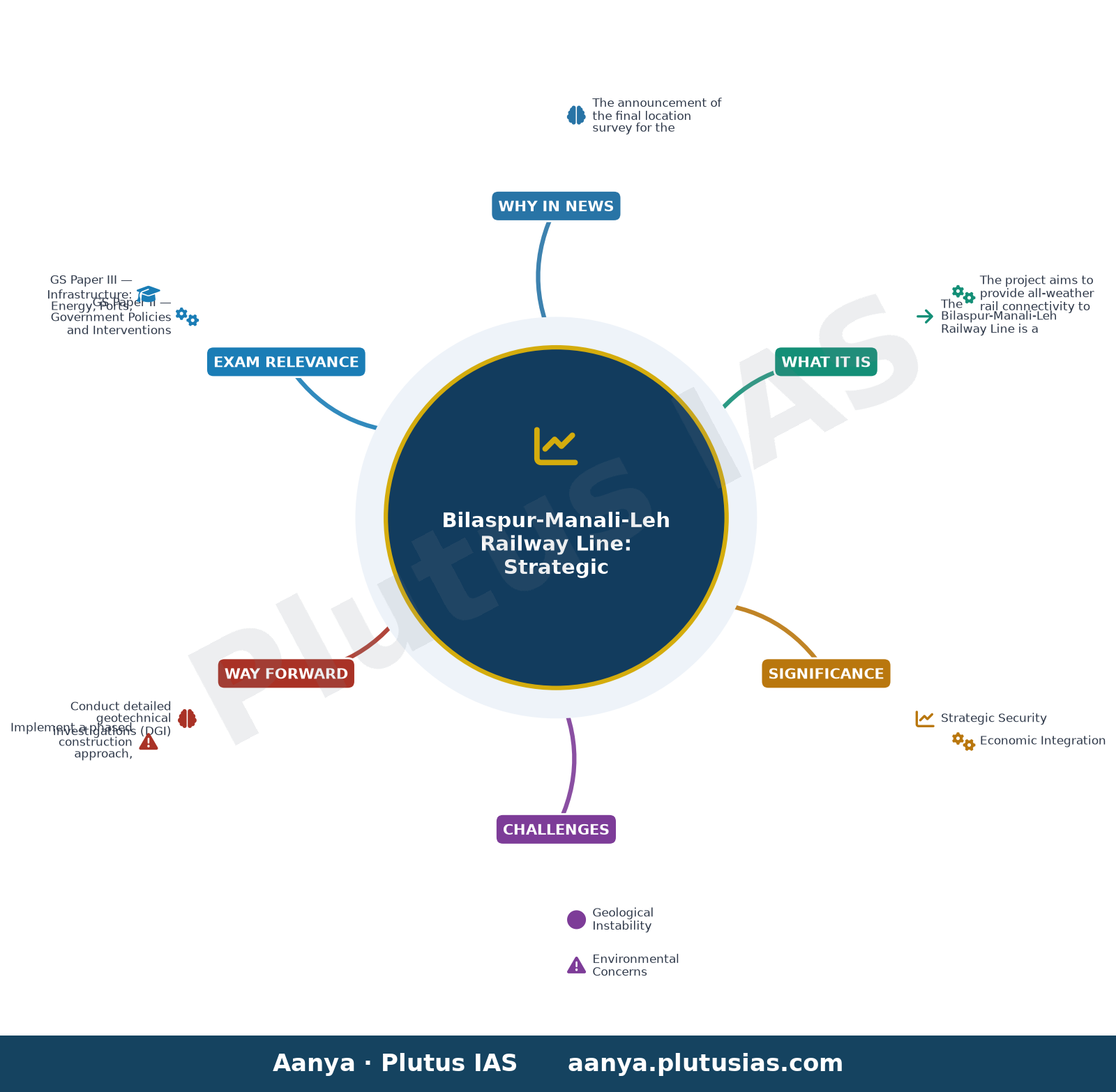
The announcement of the final location survey for the Bilaspur-Manali-Leh Broad Gauge Railway Line, involving the construction of approximately 60 tunnels between Salapar and Sarchu, underscores the project’s scale, technical complexity, and strategic importance. This development is significant as it represents a critical step toward establishing all-weather rail connectivity to Ladakh, enhancing military logistics, and fostering economic integration in the Himalayan region. The project also highlights the challenges posed by the Himalayan terrain, necessitating advanced tunnelling techniques and robust disaster resilience measures.
Background
- The Bilaspur-Manali-Leh Railway Line is part of India’s broader strategic infrastructure push to improve connectivity in the Himalayan and border regions, particularly in Ladakh and Himachal Pradesh.
- Himalayan railway projects, such as the Kalka-Shimla and Darjeeling Himalayan Railways, have historically demonstrated the engineering challenges and environmental sensitivities of such undertakings.
- The region’s geopolitical significance has been accentuated by recent border tensions, necessitating reliable all-weather connectivity for military mobility and logistics.
- The Himalayas are prone to natural disasters such as landslides, avalanches, and seismic activity, which pose significant risks to infrastructure development in the region.
What is the Bilaspur-Manali-Leh Railway Line?
- The Bilaspur-Manali-Leh Railway Line is a proposed 475-kilometre Broad Gauge (BG) railway project connecting Bilaspur in Himachal Pradesh to Leh in Ladakh, traversing through Manali.
- The project aims to provide all-weather rail connectivity to Ladakh, a strategically vital border region, thereby enhancing military logistics, tourism, and socio-economic development.
- The alignment includes approximately 60 tunnels, designed to navigate the rugged Himalayan terrain while minimising environmental impact.
- The route passes through ecologically sensitive zones, necessitating the adoption of advanced tunnelling technologies used in similar Himalayan projects, such as those in Uttarakhand.
- The project involves extensive geological surveys to assess rock stability, seismic activity, and potential landslide-prone areas, ensuring structural integrity and disaster resilience.
- The final location survey, currently underway between Salapar and Sarchu, is a critical phase that will determine the precise alignment, tunnel specifications, and engineering solutions for the project.
- The railway line is expected to integrate with the existing Indian Railways network at Bilaspur.
Key Features
| Feature | Significance |
|---|---|
| 60 tunnels along 475 km alignment | Enables rail connectivity through the rugged Himalayan terrain, minimising land acquisition and ecological disruption while ensuring year-round operational resilience. |
| Salapar to Sarchu segment survey | Critical for finalising tunnel alignment, geological stability assessment, and infrastructure feasibility in the high-altitude zone (3,000–4,500 m ASL). |
| Use of Uttarakhand hill railway technology | Leverages proven techniques from projects like the Kalka-Shimla and Jammu-Udhampur lines, including reinforced tunnel linings and snow-load-resistant designs. |
| 40-day survey timeline | Ensures rapid yet comprehensive data collection for alignment, geotechnical risks, and environmental impact mitigation before project execution. |
| Strategic rail link to Ladakh | Integrates with the broader Border Infrastructure Initiative, enhancing military logistics, tourism, and socio-economic integration in the trans-Himalayan region. |
Why it Matters
Strategic Security
- Provides all-weather rail connectivity to Ladakh, reducing dependence on road routes vulnerable to landslides and avalanches.
- Strengthens India’s military logistics in the northern theatre, complementing the Udhampur-Srinagar-Baramulla Rail Link (USBRL) and Srinagar-Kargil-Leh road.
- Facilitates rapid troop and equipment mobilisation in high-altitude border areas, enhancing operational readiness.
Economic Integration
- Connects Himachal Pradesh’s hill districts (Bilaspur, Mandi, Kullu) to Ladakh, unlocking tourism potential in Rohtang Pass, Spiti Valley, and Pangong Tso.
- Reduces freight costs for essential goods to Ladakh, currently transported via Manali-Leh Highway (NH-3), which is seasonal and prone to closures.
- Stimulates local economies through rail-linked tourism, horticulture exports, and mineral transport from Spiti and Lahaul.
Geopolitical Implications
- Enhances India’s strategic depth in the Himalayas, countering China’s infrastructure expansion in Aksai Chin and the Karakoram corridor.
- Supports India’s Act East Policy by improving connectivity to the Tibetan Plateau via Ladakh.
- Deters adversarial pressure by ensuring uninterrupted access to forward areas during geopolitical tensions.
Technological Innovation
- Demonstrates advanced tunnelling techniques in fragile Himalayan geology, setting a precedent for future Himalayan rail projects.
- Incorporates climate-resilient designs for snow load, permafrost, and seismic activity, aligning with global best practices.
- Integrates renewable energy solutions (e.g., solar-powered stations) for sustainable operations in high-altitude regions.
Challenges
1. Geological Instability
- Himalayan terrain is seismically active (Zone IV-V) and prone to landslides, requiring extensive geotechnical surveys and stabilisation measures.
- Permafrost and glacial moraines in Spiti-Lahaul segment may cause tunnel deformation and drainage issues.
- High altitude (>3,000 m) complicates blasting operations and increases health risks for labourers (HAPE, frostbite).
UPSC Link: Geological Survey of India (GSI) reports on Himalayan hazards
2. Environmental Concerns
- Risk of habitat fragmentation in ecologically sensitive zones (Great Himalayan National Park, Pin Valley NP).
- Potential disruption to glacier-fed river systems (e.g., Chandra-Bhaga) due to tunnelling-induced groundwater changes.
- Need for strict adherence to Forest (Conservation) Act, 1980, and Wildlife (Protection) Act, 1972, during land acquisition.
UPSC Link: Environmental Impact Assessment (EIA) Notification 2006
3. Engineering and Logistics
- Tunnelling in high-altitude regions requires specialised equipment (e.g., tunnel boring machines with oxygen enrichment systems).
- Limited access to construction sites due to extreme weather and road closures restricts material transport.
- High construction costs (estimated ₹1.5–2 lakh crore) necessitate public-private partnerships (PPP) and viability gap funding.
UPSC Link: National High Speed Rail Corporation Ltd. (NHSRCL) cost management
4. Social and Cultural Impact
- Risk of displacing indigenous communities (e.g., Gaddi, Kinnauri) and altering traditional livelihoods (transhumance, agriculture).
- Potential for cultural erosion in Ladakh’s Buddhist and Muslim-majority regions due to mass tourism influx.
- Need for community consultations under the Right to Fair Compensation and Transparency in Land Acquisition Act, 2013.
UPSC Link: Scheduled Tribes and Other Traditional Forest Dwellers (Recognition of Forest Rights) Act, 2006
5. Operational Challenges
- Snow accumulation and avalanches may block tracks, requiring dedicated snow-clearing infrastructure.
- Limited power supply in remote stretches necessitates off-grid renewable energy solutions.
- Maintenance of tracks in permafrost zones demands continuous monitoring for settlement and deformation.
UPSC Link: Indian Railways’ Winter Operations Manual
Challenges — UPSC Perspective
| Issue | Concern |
|---|---|
| Seismic Activity | Risk of tunnel collapse and landslides in Zone IV-V regions. |
| Permafrost Thaw | Structural instability in tunnels due to melting ice lenses. |
| Wildlife Corridors | Fragmentation of habitats for snow leopard, Himalayan tahr, and migratory birds. |
| Land Acquisition | Delays due to disputes with local communities and forest land encroachments. |
| Climate Change | Increased frequency of extreme weather events disrupting construction schedules. |
| Cost Overruns | Inflation in material and labour costs due to remote location and specialised requirements. |
Way Forward
- Conduct detailed geotechnical investigations (DGI) in collaboration with GSI and CSIR-CBRI to assess tunnel stability.
- Implement a phased construction approach, prioritising low-risk segments (e.g., Bilaspur-Manali) before high-altitude sections.
- Establish a dedicated High-Altitude Construction Authority (HACA) for regulatory oversight and labour welfare.
- Integrate climate resilience into design, including snow galleries, avalanche protection structures, and drainage tunnels.
- Engage local stakeholders through Gram Sabhas and eco-sensitive zone consultations to mitigate social resistance.
- Leverage PPP models for financing, with viability gap funding from the Ministry of Railways and state governments.
- Develop a multi-modal logistics hub at Manali to integrate rail, road, and air transport for Ladakh-bound cargo.
- Pilot renewable energy integration (solar/wind) for station operations and signalling systems in high-altitude zones.
UPSC Value Addition
Keywords for Mains Answer-Writing
Bilaspur-Manali-Leh railway line · Himalayan railway infrastructure · geological challenges in railway construction · strategic rail connectivity in border regions · tunnel construction technology in India · final location survey · geological survey and alignment · border infrastructure projects · Himachal Pradesh rail connectivity · Ladakh rail link · geological stability in Himalayan terrain · railway alignment in seismic zones · strategic infrastructure development · geotechnical engineering in railways · environmental considerations in railway projects
Constitutional & Policy Linkages
- [‘Article 297’, ‘State ownership of minerals in land acquired for the project.’]
- [‘Seventh Schedule’, ‘Concurrent jurisdiction over railways and environment.’]
- [‘Article 21’, ‘Right to life includes environmental protection and livelihood security.’]
Concept Flow
Himalayan terrain and strategic vulnerability → Need for all-weather connectivity → Proposal for Bilaspur-Manali-Leh rail line → Feasibility studies and geotechnical surveys → Final location survey (Salapar-Sarchu) → Tunnel alignment optimisation → Tunnelling technology adoption (Uttarakhand models) → Environmental and social impact assessments → Land acquisition under RFCTLARR Act → Project approval and funding (PPP/viability gap) → Phased construction with climate-resilient design → Operational integration with USBRL → Enhanced military logistics → Boosted tourism and trade → Socio-economic development in Ladakh and Himachal Pradesh → Strengthened geopolitical positioning → Countering China’s infrastructure in Aksai Chin → Reinforced Act East Policy
Prelims Practice Questions
Q1. Consider the following statements regarding the Bilaspur-Manali-Leh railway line project:
1. The project involves the construction of approximately 60 tunnels.
2. The final location survey is being conducted by a private company.
3. The railway line will directly connect Ladakh to the Indian railway network.
4. The project is being implemented under the aegis of the Ministry of Road Transport and Highways.
How many of the above statements are correct?
- Only one
- Only two
- Only three
- All four
Answer: Only three — Statements 1, 2, and 3 are correct. Statement 4 is incorrect as the project is implemented by the Ministry of Railways, not the Ministry of Road Transport and Highways.
Q2. Assertion (A): The Bilaspur-Manali-Leh railway line project is designed to enhance strategic connectivity in border regions.
Reason (R): The project includes the construction of multiple tunnels to navigate the rugged Himalayan terrain, ensuring year-round operability despite adverse weather conditions.
Options:
A. Both A and R are true, and R is the correct explanation of A.
B. Both A and R are true, but R is NOT the correct explanation of A.
C. A is true, but R is false.
D. A is false, but R is true.
Answer: ? — Both the assertion and reason are true. The project is strategically significant for border connectivity, and the use of tunnels is a key feature to ensure operability in challenging terrain.
Q3. Match the following pairs related to railway infrastructure projects in India with their respective locations:
Column I (Project) Column II (Location)
1. Bilaspur-Manali-Leh Railway Line A. Uttarakhand
2. Chenab Bridge B. Himachal Pradesh
3. Konkan Railway C. Jammu & Kashmir
4. Pir Panjal Railway Tunnel D. Maharashtra
Options:
A. 1-A, 2-B, 3-C, 4-D
B. 1-B, 2-C, 3-D, 4-A
C. 1-C, 2-A, 3-D, 4-B
D. 1-D, 2-B, 3-A, 4-C
Answer: ? — 1-B: Bilaspur-Manali-Leh Railway Line is in Himachal Pradesh. 2-C: Chenab Bridge is in Jammu & Kashmir. 3-D: Konkan Railway is in Maharashtra. 4-A: Pir Panjal Railway Tunnel is in Uttarakhand.
Mains Practice Question
✍ The Himalayan terrain presents formidable challenges to railway construction, yet the proposed Bilaspur-Manali-Leh railway line exemplifies India’s commitment to strategic infrastructure development. Critically examine the geotechnical, environmental, and strategic considerations involved in this project. Also, assess the role of advanced tunnel construction technologies in ensuring the feasibility of such high-altitude railway lines. (15 Marks)
Approach: MODEL-ANSWER SKELETON:
1. **Geotechnical Challenges (4 Marks)**
– High seismic activity in the Himalayas (mention the Himalayan Seismic Zone and past earthquakes like the 2005 Kashmir earthquake).
– Unstable geological formations: soft soil, loose rock, and potential for landslides.
– Permafrost and glacial moraines in higher altitudes affecting foundation stability.
– Need for detailed geological surveys (e.g., geophysical investigations, borehole logging) to identify fault lines and weak zones.
2. **Environmental Considerations (4 Marks)**
– Fragile ecosystems: the project passes through ecologically sensitive zones like the Great Himalayan National Park and cold deserts of Ladakh.
– Mitigation measures: use of tunnels to minimize land disturbance, afforestation, and wildlife corridors.
– Compliance with environmental laws (Forest Conservation Act, 1980; Wildlife Protection Act, 1972; and EIA Notification, 2006).
– Carbon footprint and energy efficiency in construction and operation.
3. **Strategic Significance (3 Marks)**
– Enhancing connectivity to Ladakh, a strategically vital border region (mention the 1962 war context and ongoing border tensions).
– Facilitating all-weather troop movement and logistics for the Indian Army (reference the Doklam standoff and China’s infrastructure push in Tibet).
– Boosting tourism and local economies in Himachal Pradesh and Ladakh.
– Reducing dependence on road transport (e.g., Manali-Leh Highway) vulnerable to landslides and snowstorms.
4. **Role of Advanced Tunnel Technologies (4 Marks)**
– Use of Tunnel Boring Machines (TBMs) for precision and speed in construction (cite examples from Uttarakhand’s Char Dham Railway project).
– Adoption of New Austrian Tunnelling Method (NATM) for unstable rock conditions.
– Implementation of drainage systems, ventilation, and fire safety measures in high-altitude tunnels.
– Geotechnical monitoring systems (e.g., real-time sensors for deformation, seismic activity) to ensure structural integrity.
– Lessons from international projects (e.g., Gotthard Base Tunnel in Switzerland, under-construction tunnels in the Alps).
Balance of Views:
– Critics argue that such projects may disrupt fragile Himalayan ecosystems and increase disaster risks (cite reports by the Wildlife Institute of India).
– Proponents highlight the necessity of strategic infrastructure for national security and economic development (reference the Atmanirbhar Bharat vision).
Concluding Remarks:
– The project exemplifies India’s push for strategic infrastructure while balancing environmental and geotechnical constraints.
– Success hinges on rigorous pre-construction surveys, adaptive engineering, and robust environmental safeguards.
Source: amarujala.com
Generated by AanyaAi for educational purpose.

- Gurugram’s groundwater extraction exceeds limit by 212%; HC seeks ban - October 4, 2026
- स्वतंत्रता सेनानी श्यामजी कृष्ण वर्मा की जन्म जयंती पर पीएम का श्रद्धांजलि - October 4, 2026
- KWML’s Feasibility Reports for Water Metro in 18 Cities: UPSC & PCS Insights - October 3, 2026

No Comments