


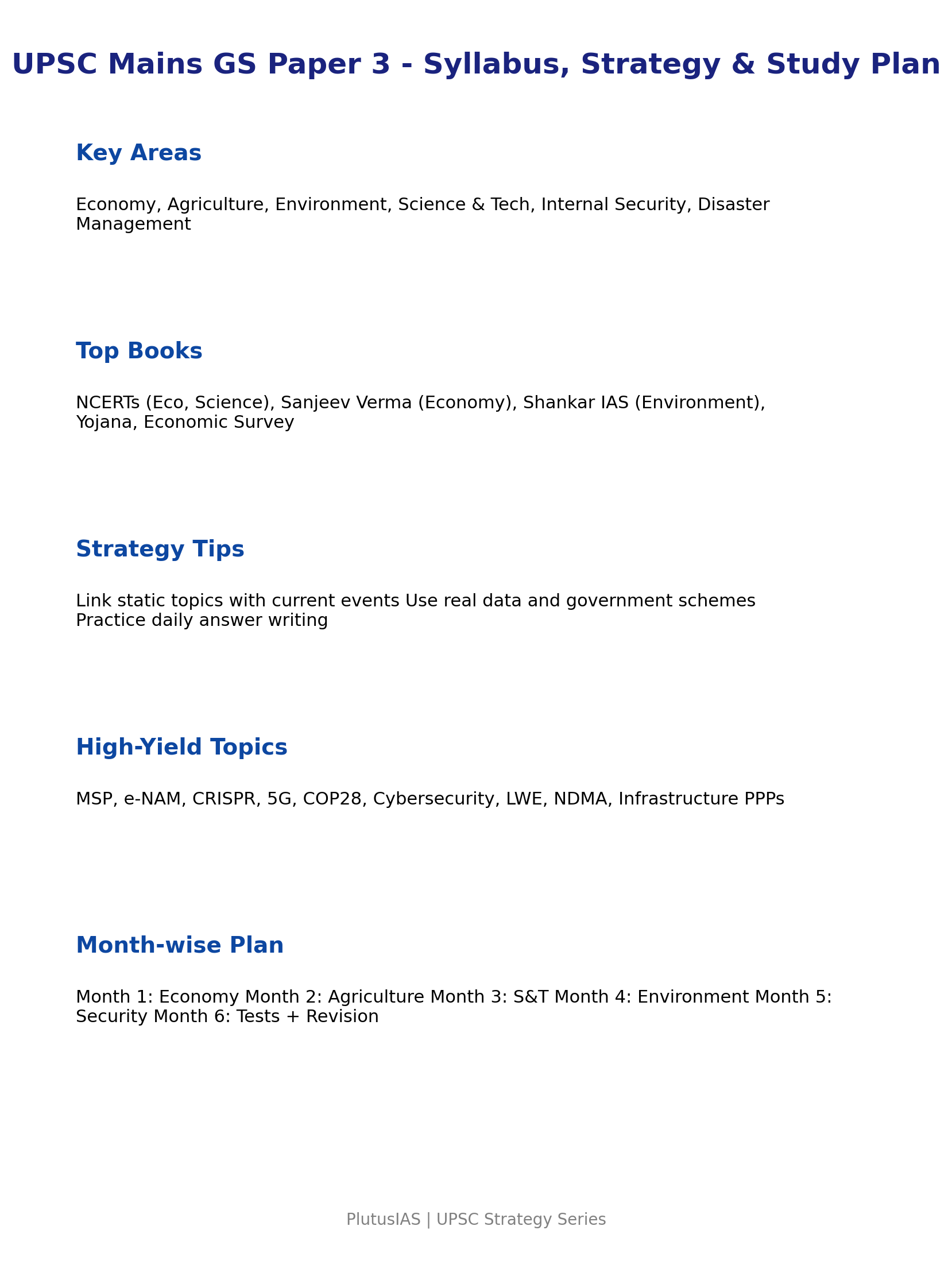
20 May UPSC Mains General Studies Paper 3 Syllabus, Strategy & Study Plan
UPSC Mains General Studies Paper 3 Syllabus, Strategy & Study Plan
UPSC Mains General Studies Paper 3 (GS Paper 3) is one of the most dynamic papers in the Civil Services Examination. It covers a wide array of subjects such as Economy, Agriculture, Environment, Disaster Management, Internal Security, and Technology. Scoring well in GS Paper 3 requires not only conceptual clarity but also a good grasp of current affairs. This article covers the full syllabus, preparation strategy, and a practical study plan to help aspirants crack GS Paper 3 confidently.
? General Studies Paper 3: Syllabus Overview
The GS Paper 3 syllabus is structured around the following broad areas:
- Indian Economy and related issues
- Inclusive growth and associated issues
- Agriculture and food processing
- Science and Technology (S&T)
- Environment and Disaster Management
- Infrastructure (energy, roads, airports, railways, etc.)
- Investment models and PPP
- Land reforms in India
- Internal Security challenges and their management
- Role of external state and non-state actors
- Cyber security and social media misuse
- Security forces and their mandate
Detailed Topic-wise Breakdown
1. Economy
- Budgeting, Planning, and Mobilization of Resources
- Inclusive Growth, Banking, and Financial Inclusion
- Infrastructure – Energy, Ports, Roads, Airports, Railways
- Investment Models – PPP, FDI, Disinvestment
2. Agriculture
- Major cropping patterns in different parts of the country
- Irrigation techniques, e-technology in farming
- Food processing and related industries
- Agri-export and allied sectors like Animal Husbandry and Fisheries
3. Science and Technology
- Developments and their applications in daily life
- Achievements of Indians in S&T
- IT, Space, Nanotechnology, Robotics, Biotech
4. Environment & Disaster Management
- Conservation, Pollution and EIA
- Environmental treaties, Biodiversity Acts
- Disaster types, disaster management bodies and mechanisms
5. Security
- Internal Security challenges – insurgency, terrorism
- Role of state and non-state actors
- Cyber threats, Money laundering, Social Media misuse
- Security agencies and coordination mechanisms
? GS Paper 3 Preparation Strategy
1. Understand the Interdisciplinary Nature
GS Paper 3 is where current affairs, government schemes, reports, and real-time data play a huge role. Static concepts must be supported with dynamic examples.
2. Start with the Indian Economy
- Read NCERTs (Class 11 and 12 Economics)
- Follow Budget and Economic Survey in detail
- Use sources like PIB, PRSIndia, and Livemint
3. Agriculture Needs Focused Preparation
Topics like MSP, APMC reforms, e-NAM, Kisan Credit Card, and Agritech are frequently asked. Refer to:
- Reports from NITI Aayog and Ministry of Agriculture
- Yojana & Kurukshetra for rural/agri insights
4. Tackle S&T with Simplicity
- Focus on understanding the application of technologies
- Read science-based current affairs from newspapers
- Topics like 5G, CRISPR, Artificial Intelligence, ISRO launches are important
5. Environmental Topics Are Scoring
Use diagrams and current examples like COP summits, Climate change news, or recent pollution control initiatives. Refer to:
- Shankar IAS Environment book
- UNEP reports, IPCC summaries
6. Approach Security Logically
For Internal Security, link challenges with government actions. Use case studies like Naxalism control, cyber cell success, or local law enforcement reforms.
7. Integrate Answer Writing
- Practice 2–3 answers every day from GS3 topics
- Use facts, data, reports, flowcharts
- Keep answers solution-oriented
? 6-Month Study Plan for GS Paper 3
Month 1: Economy
- NCERTs, Budget, Economic Survey
- Cover key policies (FDI, GST, banking reforms)
- Start making micro-notes topic-wise
Month 2: Agriculture
- Cover MSP, agri subsidies, agri marketing reforms
- Food processing and storage infrastructure
- Relevant schemes: PM-KISAN, Soil Health Card
Month 3: Science and Tech
- Applications of S&T in health, space, IT
- Cybersecurity and innovations
- Use examples from ISRO, DRDO, CSIR
Month 4: Environment and Disaster Management
- Prepare Shankar IAS notes
- Revise India’s major acts like EPA, Forest Act
- Types of disasters and management framework (NDMA, SDRF)
Month 5: Internal Security
- Cover LWE, terrorism, border issues
- Role of CAPFs, NSG, NIA, IB
- Security and cyber issues in news
Month 6: Test Series and Revision
- Join a good GS3 test series (PlutusIAS, ForumIAS, VisionIAS)
- Revise all notes
- Write at least 10 full-length GS3 mock papers
? Best Books and Resources for GS Paper 3
- NCERTs (Economics, Geography, Science)
- Indian Economy by Sanjeev Verma / Ramesh Singh
- Shankar IAS Environment Book
- Yojana, Kurukshetra, Economic Survey, PIB
- India Year Book – selective reading
? Answer Writing Tips for GS Paper 3
- Use data and statistics to substantiate arguments (NITI Aayog, Economic Survey)
- Add flowcharts and diagrams in S&T, Economy, Disaster Management
- Quote schemes and examples regularly
- Try to balance theoretical and application-based approaches
✅ Final Checklist for GS Paper 3
- ✔ Economy + Agriculture: Covered and noted
- ✔ Environment + Disaster: Diagrams & acts ready
- ✔ Security: Agencies + Challenges linked to events
- ✔ Practice: 10+ Test papers with feedback
- ✔ Current affairs integration in all answers
Conclusion
UPSC Mains GS Paper 3 is high-scoring if approached with a practical and integrated strategy. It rewards those who can combine static knowledge with dynamic developments. Use this detailed plan to build a strong foundation and practice extensively to enhance answer quality. Focus on issues that matter to governance and national security, and back your points with real-time examples. With regular revisions and test practice, you can easily cross the 100+ mark in GS Paper 3.
Stay consistent, stay analytical. Best wishes from the team at PlutusIAS!


No Comments