


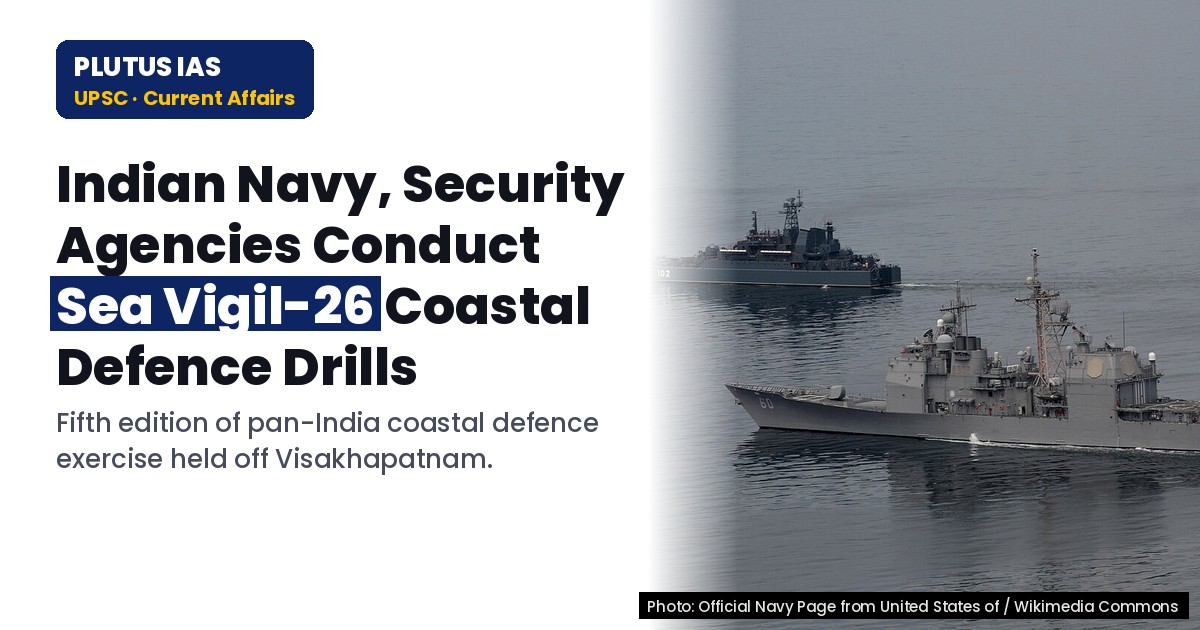
14 Nov Sea Vigil-26: Coastal Defence Drills Off Visakhapatnam
✎ Exercise Sea Vigil is a biennial, pan-India coastal defence exercise led by the Indian Navy, designed to validate and strengthen the nation's multi-agency coastal security architecture post-26/11.
Subject Relevance — Where This Topic Fits
- GS Paper III — Security Challenges and their Management in Border Areas; Organised Crime and Terrorism | GS Paper III — Various Security Forces and Agencies and their Mandate
- Prelims: Exercise Sea Vigil, Coastal security architecture, Indian Navy, Indian Coast Guard, Marine Police, Exclusive Economic Zone (EEZ), 26/11 Mumbai attacks, Joint Operations Centre
- Essay: Coastal Security and National Resilience, Multi-Agency Coordination for Comprehensive National Security
Quick Revision: Exercise Sea Vigil is a biennial, pan-India coastal defence exercise led by the Indian Navy, designed to validate and strengthen the nation’s multi-agency coastal security architecture post-26/11.
Why is this in the news?
The Indian Navy, in conjunction with various security agencies, recently conducted a series of coastal security drills off Visakhapatnam as part of ‘Exercise Sea Vigil-26’. This pan-India coastal defence exercise, now in its fifth edition, aims to validate and enhance the efficacy of measures implemented to bolster coastal security across the nation, particularly in the aftermath of the 26/11 Mumbai terror attacks.
Background
- The 26/11 Mumbai terror attacks in 2008 exposed significant vulnerabilities in India’s coastal security apparatus, leading to a comprehensive overhaul of the system.
- Post-26/11, a multi-tiered coastal security architecture was established, involving various central and state agencies, with the Indian Navy designated as the lead agency for overall maritime security, including coastal defence.
- Exercise Sea Vigil was conceptualised in 2018 as a biennial, pan-India coastal defence exercise to assess the preparedness and coordination among all stakeholders involved in coastal security.
- The exercise spans India’s entire coastline and its Exclusive Economic Zone (EEZ), involving all coastal States and Union Territories.
- The operational area for the Eastern Naval Command, as highlighted during the exercise, encompasses a vast coastline from West Bengal to Tamil Nadu, including Puducherry, with numerous major and minor ports requiring constant surveillance.
- Surveillance and security responsibilities are delineated in three layers: State Marine Police up to five nautical miles, Indian Coast Guard up to 12 nautical miles, and the Indian Navy beyond 12 nautical miles.
- The exercise includes a Coastal Defence and Security Readiness Evaluation (CDSRE) phase, involving audits of critical infrastructure like ports, fish landing centres, lighthouses, and marine police stations to identify and address potential security gaps.
- Community interaction programmes are also integral to the exercise, fostering awareness among coastal populations regarding their role in national security.
- Key agencies involved in coastal security drills include the Indian Navy (including Marine Commandos – MARCOS and Sagar Prahari Bal), Indian Coast Guard, Marine Police, Customs, and the Central Industrial Security Force (CISF).
What is Exercise Sea Vigil?
- Exercise Sea Vigil is a comprehensive pan-India coastal defence exercise conducted by the Indian Navy as the lead agency, in collaboration with all coastal States, Union Territories, and other maritime stakeholders.
- It is a biennial exercise, conceptualised in 2018, designed to validate and strengthen the coastal security measures implemented following the 26/11 Mumbai terror attacks.
- The exercise encompasses India’s entire coastline and its Exclusive Economic Zone (EEZ), making it one of the largest coastal defence drills globally.
- Its primary objective is to assess the operational readiness, coordination, and effectiveness of the multi-agency coastal security architecture against potential maritime threats.
- The exercise involves various phases, including a Coastal Defence and Security Readiness Evaluation (CDSRE) phase for auditing infrastructure and a ‘Sea Phase’ for tactical drills and simulations.
- Participants include the Indian Navy, Indian Coast Guard, Marine Police, Customs, CISF, port authorities, and other central and state security agencies.
- Drills typically include joint patrolling, mock boarding operations on suspicious vessels, investigation of fishing vessels, slithering operations by special forces, and coastal surveillance.
- The exercise also focuses on community engagement and awareness programmes to involve coastal populations in reporting suspicious activities.
- It serves as a critical mechanism for identifying gaps in the existing coastal security framework and implementing corrective measures to enhance overall maritime defence preparedness.
Key Features
| Feature | Significance |
|---|---|
| Exercise Sea Vigil-26 | Pan-India coastal defence exercise, validating post-26/11 security enhancements. |
| Multi-agency Participation | Involvement of Indian Navy, Coast Guard, Marine Police, Customs, CISF, and other security agencies ensures comprehensive coastal security. |
| Layered Surveillance System | Defined operational zones for State Marine Police (0-5 nm), Coast Guard (5-12 nm), and Navy (beyond 12 nm) for effective maritime domain awareness. |
| Coastal Defence and Security Readiness Evaluation (CDSRE) | Systematic audit of ports, fish landing centres, lighthouses, and marine police stations to identify and address security vulnerabilities. |
| Community Interaction Programmes | Engaging coastal communities to foster security awareness and gather intelligence, recognizing their vital role in coastal defence. |
| Tactical Drills | Mock boarding operations, suspicious vessel investigations, and slithering operations by Marine Commandos (MARCOS) enhance operational readiness and inter-agency coordination. |
Why it Matters
National Security
- Enhances the preparedness of coastal security agencies against maritime threats, including terrorism, infiltration, and illegal activities.
- Validates and refines standard operating procedures (SOPs) for multi-agency response to various contingencies in the maritime domain.
- Strengthens the overall coastal defence architecture, crucial for safeguarding India’s extensive coastline and Exclusive Economic Zone (EEZ).
Strategic Importance
- Projects India’s commitment to securing its maritime interests and maintaining stability in the Indian Ocean Region.
- Reinforces the Indian Navy’s role as the lead agency for coastal defence, ensuring coordinated efforts among various stakeholders.
- Contributes to maritime domain awareness (MDA) by integrating surveillance efforts across different layers and agencies.
Governance and Administration
- Facilitates the identification of gaps in coastal security infrastructure and operational protocols, leading to targeted improvements.
- Promotes inter-agency synergy and information sharing, essential for effective governance of maritime borders.
- Engages local communities, fostering a sense of shared responsibility for coastal security and leveraging local intelligence.
Challenges
1. Coordination and Integration
- Ensuring seamless coordination among numerous central and state agencies with overlapping jurisdictions and varying capabilities.
- Standardizing communication protocols and information sharing mechanisms across diverse organizations to avoid delays and misinterpretations.
UPSC Link: Internal Security; Border Management
2. Technological Gaps
- Modernizing surveillance equipment, communication networks, and rapid response vessels across all coastal security agencies.
- Integrating disparate technological systems to create a unified and real-time maritime domain awareness picture.
UPSC Link: Science and Technology; Internal Security
3. Human Resource Development
- Training and capacity building for personnel across all agencies to handle evolving maritime threats and operate advanced equipment.
- Addressing attrition rates and ensuring adequate staffing levels, particularly for specialized units like Marine Police and Sagar Prahari Bal.
UPSC Link: Internal Security; Human Resources
4. Community Engagement
- Sustaining active participation and trust among fishing communities and coastal residents, who are critical eyes and ears.
- Educating and empowering local populations to report suspicious activities without fear or intimidation.
UPSC Link: Internal Security; Social Empowerment
5. Infrastructure Development
- Upgrading and maintaining critical coastal infrastructure, including ports, jetties, lighthouses, and marine police stations.
- Ensuring adequate logistical support and maintenance facilities for vessels and equipment deployed along the coastline.
UPSC Link: Infrastructure; Internal Security
Challenges — UPSC Perspective
| Issue | Concern |
|---|---|
| Jurisdictional Overlap | Potential for ambiguity in roles and responsibilities among multiple agencies operating in coastal areas. |
| Information Silos | Lack of real-time, integrated information sharing hindering comprehensive maritime domain awareness. |
| Resource Disparity | Uneven distribution of modern equipment, training, and manpower across various state and central agencies. |
| Vast Coastline | Difficulty in maintaining continuous surveillance and rapid response capabilities across India’s extensive and diverse coastline. |
| Coastal Population Integration | Challenges in effectively integrating and sensitizing local fishing communities into the security framework. |
| Evolving Threats | Adaptation to new and asymmetric threats, including drone attacks, narco-terrorism, and sophisticated infiltration attempts. |
Way Forward
- Establish a unified command and control structure for coastal security, ensuring seamless inter-agency coordination and rapid decision-making.
- Invest in advanced surveillance technologies, including integrated radar networks, satellite imagery, and underwater sensors, to enhance maritime domain awareness.
- Regularly conduct joint training exercises and workshops to foster interoperability and refine standard operating procedures among all coastal security agencies.
- Strengthen the capacity of coastal police forces through enhanced training, modern equipment, and adequate staffing to improve their operational effectiveness.
- Implement robust community engagement programs to build trust with coastal populations and leverage their local knowledge for intelligence gathering.
- Develop a comprehensive national maritime security policy that clearly delineates roles, responsibilities, and resource allocation for all stakeholders.
- Conduct periodic audits and vulnerability assessments of critical coastal infrastructure to identify and mitigate potential security gaps.
- Promote indigenous development and manufacturing of coastal security equipment to reduce dependence on foreign suppliers and ensure timely upgrades.
UPSC Value Addition
Keywords for Mains Answer-Writing
Coastal Security · Maritime Domain Awareness · Multi-agency Coordination · Coastal Defence Exercises · Exclusive Economic Zone · Indian Navy · Coastal Security Scheme · 26/11 Mumbai Attacks · Sagar Prahari Bal · Marine Police · Critical Infrastructure Protection · National Maritime Security Coordinator
Concept Flow
26/11 Mumbai attacks expose coastal security gaps. → Government initiates measures to strengthen coastal defence. → Exercise Sea Vigil conceptualized to validate these measures. → Multi-agency drills conducted across India’s coastline. → Gaps identified, operational procedures refined. → Enhanced coastal security and maritime domain awareness achieved.
Prelims Practice Questions
Q1. Consider the following statements regarding India’s coastal security framework:
1. The Indian Navy is the lead agency for coastal defence and security in India.
2. The State Marine Police are responsible for surveillance up to 12 nautical miles from the coast.
3. Exercise ‘Sea Vigil’ is a pan-India coastal defence exercise conceptualised after the 26/11 Mumbai terror attacks.
How many of the above statements are correct?
- Only one
- Only two
- Only three
- None
Answer: Only one — Statement 1 is correct: The Indian Navy is designated as the lead agency for overall coastal defence and security. Statement 2 is incorrect: The State Marine Police are responsible from the coast up to five nautical miles, while the Coast Guard is responsible up to 12 nautical miles. Statement 3 is correct: Exercise ‘Sea Vigil’ was conceptualised in 2018 to validate measures put in place after the 26/11 Mumbai terror attacks.
Q2. Match the following agencies with their primary area of responsibility in India’s coastal security framework:
List I (Agency)
A. State Marine Police
B. Indian Coast Guard
C. Indian Navy
List II (Area of Responsibility)
1. Beyond 12 nautical miles
2. Up to 5 nautical miles
3. Up to 12 nautical miles
Select the correct matching using the codes given below:
- A-1, B-2, C-3
- A-2, B-3, C-1
- A-3, B-1, C-2
- A-2, B-1, C-3
Answer: A-2, B-3, C-1 — The State Marine Police are responsible from the coast up to five nautical miles. The Indian Coast Guard is responsible up to 12 nautical miles. The Indian Navy is responsible for surveillance and defence beyond 12 nautical miles, covering the Exclusive Economic Zone.
Mains Practice Question
✍ Critically examine the multi-layered approach adopted by India for coastal security. Discuss the challenges encountered in ensuring comprehensive maritime domain awareness across the nation’s extensive coastline. (15 Marks)
Approach: INTRODUCTION: Briefly define India’s coastal security imperative, referencing the post-26/11 context and the ‘Sea Vigil’ exercise.
BODY 1: Multi-layered Approach:
– Detail the three layers of surveillance: State Marine Police (0-5 nm), Indian Coast Guard (5-12 nm), Indian Navy (beyond 12 nm, including EEZ).
– Mention the roles of other agencies: Customs, CISF, Sagar Prahari Bal, Marine Commandos (MARCOS).
– Highlight the ‘lead agency’ concept (Indian Navy).
– Refer to the Coastal Defence and Security Readiness Evaluation (CDSRE) phase and community interaction programmes.
BODY 2: Challenges in Maritime Domain Awareness (MDA):
– Vast coastline (approx. 7,516 km) and numerous islands.
– Porous nature of the coastline, making infiltration difficult to prevent.
– Large number of fishing vessels (approx. 2.5 lakh), making identification of suspicious activity challenging.
– Integration and interoperability issues among diverse agencies (Navy, Coast Guard, Marine Police, Customs, Port Authorities, Intelligence agencies).
– Technological gaps in surveillance equipment, sensors, and communication networks.
– Human resource challenges: training, capacity building, and motivation of personnel, especially at the State Marine Police level.
– Infrastructure deficits: inadequate jetties, patrol boats, and operational bases for coastal police.
– Information sharing bottlenecks and lack of a unified real-time data fusion centre.
– Funding constraints for modernisation and maintenance of assets.
CONCLUSION: Summarise the importance of robust coastal security for national interests. Emphasise the need for continuous technological upgrades, enhanced inter-agency synergy, and community participation to overcome challenges and strengthen MDA.
Source: The Hindu
Andhra Pradesh PCS (APPSC) — State PCS Practice
Prelims: The recent coastal defence drills conducted off Visakhapatnam involved which of the following entities?
- A. Indian Army and Indian Coast Guard
- B. Indian Navy and Indian Air Force
- C. Indian Navy and various security agencies
- D. Indian Coast Guard and State Police only
Answer: C. Indian Navy and various security agencies — The drills off Visakhapatnam specifically involved the Navy and various security agencies, as per the topic.
Mains: Discuss the significance of coastal defence drills conducted off Visakhapatnam for the security of Andhra Pradesh and the broader Eastern Seaboard, considering the roles of the Indian Navy and other security agencies.
Generated by AanyaAi for educational purpose.
Related guides on our sites
- How to prepare for GS paper 1 for UPSC CSE mains exam
- Best UPSC coaching for IFOS exam
- Best mentorship programme for upsc
- UPSC+BA degree

- NAMASTE Scheme: Enhancing Sanitation Workers’ Livelihoods & Safety - November 14, 2026
- एमएसएमई का विशेष अभियान 6.0: स्वच्छता और लंबित मामलों का निपटारा - November 14, 2026
- Sea Vigil-26: Coastal Defence Drills Off Visakhapatnam - November 14, 2026

No Comments