Building Farm-to-Market Efficiency: The Vision of the ICCVAI Scheme

Building Farm-to-Market Efficiency: The Vision of the ICCVAI Scheme

This article covers “Daily Current Affairs” and From  Building Farm-to-Market Efficiency: The Vision of the ICCVAI Scheme

SYLLABUS MAPPING 

GS-3 – Food Processing and Related Industries-Building Farm-to-Market Efficiency: The Vision of the ICCVAI Scheme

FOR PRELIMS

What is food irradiation?

FOR MAINS

What are the key challenges in expanding irradiation infrastructure in India?

Why in the News?

Food processing has been in the news due to renewed focus on modernising India’s agri-food sector, promoting value addition, and reducing post-harvest losses. Recent government initiatives, rising investments, and technological innovations—such as automation, cold-chain expansion, and 3D food printing—are transforming the sector rapidly. Additionally, discussions around food safety, nutrition enhancement, and India’s aim to become a global food processing hub have highlighted the importance of advanced processing techniques like pasteurisation, sterilisation, fermentation, and irradiation. The sector is also gaining attention for its role in boosting farmers’ incomes, supporting MSMEs, creating jobs, and ensuring year-round availability of safe, nutritious, and affordable foods for consumers.
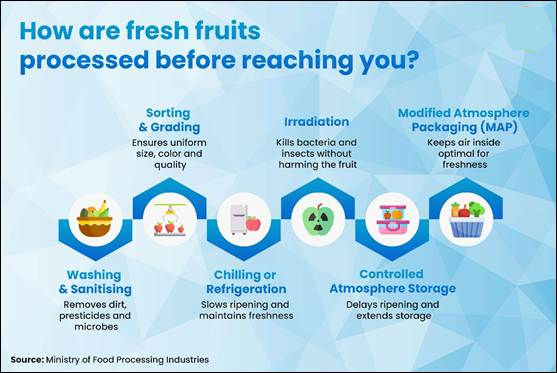
What is Food Irradiation?

Exposing fruits to a controlled dose of ionising radiation that kills bacteria, mould, and insects, and extends shelf life without making the fruit ‘radioactive’ or unsafe.

Among the various methods of food processing, food irradiation has emerged as an important technique due to its strong scientific validation and proven safety record. Foods processed by radiation have undergone thorough assessment in national and international laboratories, with studies showing no toxicological, nutritional, or microbiological issues. Its safety has also been endorsed by several reputed scientific bodies and associations, including the American Medical Association, the American Gastroenterological Association, the American Dietetic Association, and the Institute of Food Technologists.

In India, food irradiation is used to preserve and process commodities such as potatoes, onions, spices, mangoes, cereals, pulses, and oilseeds. This technique offers several benefits, including:
a. Preventing sprouting in potatoes, onions, and other tubers
b. Increasing the shelf life of fruits and vegetables
c. Eliminating insect infestations
d. Reducing microbial contamination
e. Fulfilling quarantine and export requirements

In food irradiation, three types of radiation sources are used depending on the application:
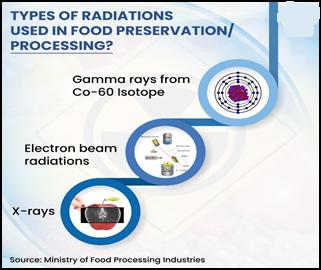
Gamma rays: Generated from radioactive forms of Cobalt-60. In India, the Board of Radiation and Isotope Technology (BRIT) under the Department of Atomic Energy supplies Cobalt-60 for food irradiation. An MoU or agreement with BRIT is a prerequisite for obtaining this source.
X-rays: Produced by reflecting a high-energy stream of electrons off a target substance (usually one of the heavy metals) into food, are also commonly used in medicine and industry.
Electron beams (e-beam): A stream of high-energy electrons from an accelerator directed onto food, provides rapid processing

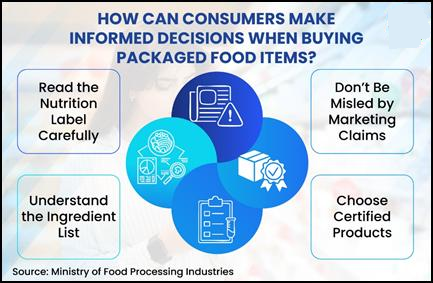
Irradiation serves as one of the important tools for consumers to make informed decisions when buying packaged food items. Consumers should choose certified products by looking for the FSSAI license number, Organic or fortification logos (e.g., fortified with iron, vitamin D), Quality Certification (HACCP, ISO 22000, FSSC), and other certifications with logos like Agmark, BIS, Vegan, and Irradiated products.

In addition to certifications, consumers should carefully examine the nutrition label, focusing on per-serving values, including calories, fat, sugar, sodium, added sugars, saturated fats, fiber, and protein. Reviewing the ingredient list is equally important to identify hidden sugars, artificial additives, and other components. Consumers should also be cautious of marketing phrases like “low-fat,” “sugar-free,” “home-made,” or “natural,” as these terms can be misleading and do not necessarily reflect a healthy product.

Overall, food irradiation provides an additional, dependable layer of safety and quality assurance, helping ensure that food reaching consumers is fresher, cleaner, and has a longer shelf life. Moreover, government support is available for establishing irradiation infrastructure under the Integrated Cold Chain and Value Addition Infrastructure (ICCVAI) component.

Scheme Supporting Food Irradiation – ICCVAI

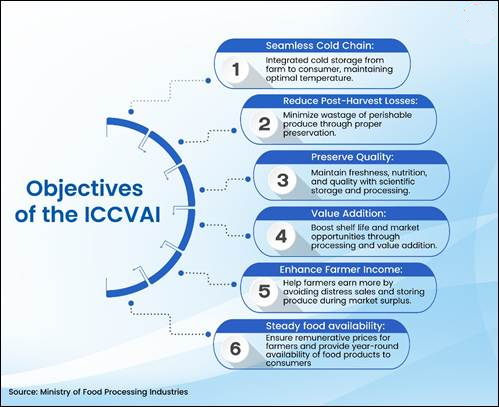
The Ministry of Food Processing Industries (MoFPI) supports the establishment of multiproduct food irradiation facilities under the Integrated Cold Chain & Value Addition Infrastructure (ICCVAI) scheme of PMKSY. These facilities help extend the shelf life of perishable produce and reduce post-harvest losses.
Originally launched to address high wastage in perishables like fruits, vegetables, dairy, meat, and fish, the scheme aims to build an uninterrupted cold chain from farm gate to retail. It was restructured and brought under PMKSY in 2016-17, which acts as an umbrella programme for developing modern food processing infrastructure.
By integrating farmers, processors, and markets, the ICCVAI scheme helps minimise wastage, improve farmer incomes, create jobs, and enhance the efficiency and competitiveness of India’s perishable goods sector.

How the Scheme (ICCVAI) Supports?

Grants-in-aid/Subsidy is provided @35% of eligible project cost for projects in General Areas and @50% of eligible project cost for projects in Difficult Areas as well as for projects of SC/ST, FPOs and SHGs, subject to the maximum of ₹10 crore per project.
Difficult Areas include North-Eastern States (including Sikkim), Uttarakhand, Himachal Pradesh, Jammu & Kashmir, Ladakh, Integrated Tribal Development Programme (ITDP) areas, and Islands.

ELIGIBILITY CRITERIA:
Eligible entities include Individuals and organizations, such as FPOs, FPCs, SHGs, NGOs, PSUs, firms, and companies, etc.
Minimum 1 acre of land is required for setting up of both standalone and an integrated food irradiation unit.
LATEST NOTIFICATION:
Vide notification, dated 27 May 2025, MOFPI has invited proposals from eligible entities from across the country under component scheme ICCVAI- setting up of multi-product Food Irradiation Units. The entities are required to submit their proposals online at https://sampada-mofpi.gov.in/

Major Components driving ICCVAI

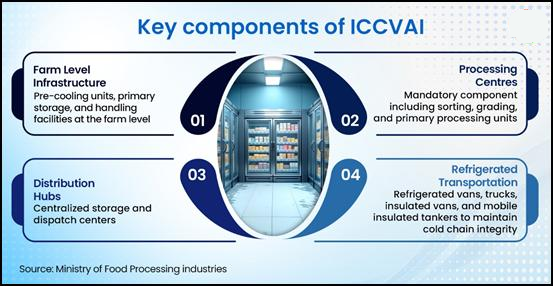
The scheme supports the development of facilities across the entire supply chain, with a strong emphasis on facilities at the farm level. To receive financial assistance under the general cold chain scheme, applicants must establish Farm Level Infrastructure (FLI) and ensure its linkage to a Distribution Hub (DH) and/or refrigerated or insulated transport.

Progress Overview and Milestones achieved

Expanded Financial Outlay: In July 2025, the government approved an additional outlay of ₹1,920 crore for the PMKSY, raising the total allocation to ₹6,520 crore for the 15th Finance Commission cycle (up to March 31, 2026). This approval includes ₹1,000 crore to support the setting up of:
50 Multi-Product Food Irradiation Units under Integrated Cold Chain and Value Addition Infrastructure (ICCVAI).
100 NABL-accredited Food Testing Labs (FTLs) under Food Safety and Quality Assurance Infrastructure (FSQAI).
This significant increase reflects the government’s strong commitment to expanding the impact of cold chain infrastructure. The proposed 50 multi-product food irradiation units are expected to create a total preservation capacity of 20-30 lakh Metric Tonnes (LMT) per annum, depending on the type of food products irradiated.

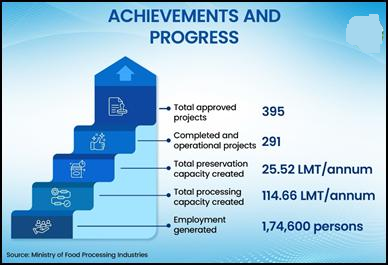
Progress of Cold Chain Projects: As of June 2025, a total of 395 integrated cold chain projects have been approved under the Cold Chain Scheme since its launch in 2008. Out of these, 291 projects have been completed and are operational, creating a preservation capacity of 25.52 lakh metric tonnes (LMT) per year and a processing capacity of 114.66 LMT per year. The completed and operationalised projects have generated 1,74,600 jobs across the country.

Substantial progress has been achieved since 2016–17. Since 2016-17, an amount of ₹1,535.63 crore has been released against approved grants-in-aid/subsidy of ₹2,066.33 crore for implementing 269 approved projects. During this period, 169 cold chain projects have been completed and operationalised across the country.

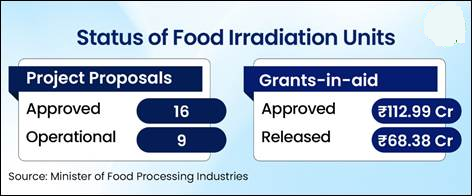
Status of Multi-Product Food Irradiation Units: As of August 2025, MoFPI has approved 16 project proposals for setting up of multi-product food irradiation units across the country. Out of these, 9 have been completed or are operational, while 7 are still under implementation. The total amount of Grants-in-aid of ₹112.99 Crore has been approved of which ₹68.38 Crore has been released.

Conclusion 

Food irradiation is emerging as a powerful solution to one of India’s biggest challenges, preserving the quality of perishable produce from farm to consumer. Enhancing safety, extending shelf life, and reducing post-harvest losses strengthens confidence for farmers, processors, and consumers. With increasing government support and expanding irradiation infrastructure, India is advancing towards a more resilient, modern, and efficient food ecosystem that delivers fresher, safer, and higher-quality food reaches every household

Prelims question:

Q. With reference to food irradiation in India, consider the following statements:

1. Food irradiation makes food radioactive and is therefore restricted for use only in non-edible items.
2. In India, Cobalt-60 used for irradiation facilities is supplied by the Board of Radiation and Isotope Technology (BRIT).
3. Under the ICCVAI component of PMKSY, financial assistance is available for establishing multiproduct food irradiation units.
4. Food irradiation is mandatory for all export-oriented agricultural commodities.
Which of the statements given above are correct?
(a) 2 and 3 only
(b) 1 and 4 only
(c) 1, 2 and 4 only
(d) 1, 2 and 3

Answer: A

Mains Question:

Q.  Discuss the significance of food irradiation in India and evaluate the role of the ICCVAI scheme under PMKSY in expanding irradiation infrastructure for reducing post-harvest losses.

                                                                                                                                                                                                                                                                                                                                                                                                                                                                                                                                                                                                                                                                                       (250 words)

No Comments

Post A Comment