


05 Jan Designing the Future: India’s Semiconductor Ambitions and the Strategic Role of the Design Linked Incentive (DLI) Scheme
This article covers “Daily Current Affairs” and From Designing the Future: India’s Semiconductor Ambitions and the Strategic Role of the Design Linked Incentive (DLI) Scheme
SYLLABUS MAPPING
GS-3- Science & Technology- Designing the Future: India’s Semiconductor Ambitions and the Strategic Role of the Design Linked Incentive (DLI) Scheme
FOR PRELIMS
What is the Design Linked Incentive (DLI) Scheme?
FOR MAINS
What challenges does India face in commercialising indigenous semiconductor designs?
Why in the News?
Semiconductors are critical enablers of the digital economy, supporting sectors such as healthcare, telecommunications, defence, space, AI, and digital public infrastructure. With rapid digitalisation and AI-driven growth, global demand for chips is rising sharply, even as production and advanced design remain concentrated in a few countries, making supply chains fragile and geopolitically vulnerable. Against this backdrop, India has strengthened its semiconductor strategy under the Semicon India Programme and the India Semiconductor Mission (ISM). The Design Linked Incentive (DLI) Scheme has gained prominence for focusing on fabless chip design and intellectual property creation, the most value-intensive segment of the semiconductor value chain. By boosting indigenous design capabilities, India aims to reduce import dependence, enhance supply-chain resilience, and advance technological sovereignty.
Semiconductors as Strategic Infrastructure: Global and Indian Context
Global Supply Chain Vulnerabilities
1. Over 75% of advanced semiconductor manufacturing is concentrated in East Asia.
2. Geopolitical tensions, export controls, pandemics, and natural disasters have exposed the fragility of “just-in-time” semiconductor supply chains.
3. Countries are now prioritizing friend-shoring and diversification, creating strategic space for India.
India’s Opportunity
1. Rapid growth in electronics manufacturing, digital public infrastructure (DPI), EVs, defence electronics, and telecom networks.
2. Large domestic market combined with geopolitical trust.
3. Strong IT and embedded-systems talent base.
4. Policy clarity through long-term incentive frameworks.
Why Fabless Chip Design is the Core of Semiconductor Power
In the semiconductor value chain, fabless design companies capture the highest strategic and economic value:
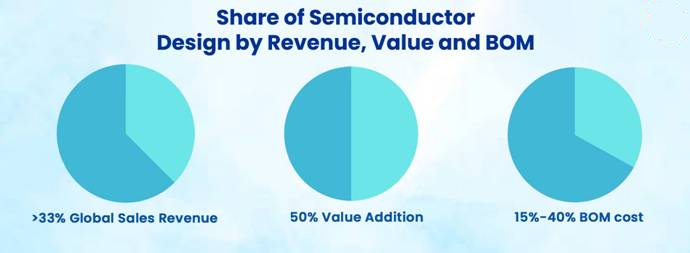
1. More than 50% of semiconductor value lies in design, architecture, and IP—not fabrication.
2. Fabless models require lower capital expenditure compared to fabs, but generate high value addition.
3. Control over design equals control over performance, security, energy efficiency, and system intelligence.
Without indigenous fabless capability, a country remains dependent on imported core technologies—even if chips are fabricated or assembled domestically. Hence, building a strong design ecosystem is essential for:
1. Technological sovereignty
2. IP ownership3
3. Import substitution
4. Attracting downstream manufacturing
5. Long-term innovation leadership
Design Linked Incentive (DLI) Scheme: Objectives and Architecture
The DLI Scheme, implemented by MeitY under the Semicon India Programme, aims to create a self-sustaining, innovation-driven semiconductor design ecosystem.
Core Objectives
1. Promote indigenous semiconductor design and IP creation.
2. Reduce India’s dependence on imported chips and IP cores.
3. Enable startups and MSMEs to move from concept to silicon.
4. Strengthen supply-chain resilience and domestic value addition.
Eligibility Framework
The scheme supports:
1. Startups (as per DPIIT norms).
2. MSMEs (as per MSME Ministry notification).
3. Domestic companies owned by resident Indian citizens.
4. t covers the entire design lifecycle, including:
Integrated Circuits (ICs)
1. Systems-on-Chip (SoCs)
2. Chipsets
3. Systems & semiconductor-linked designs
4. IP cores
Financial and Infrastructure Support under DLI
| Component | Sub-Category | Key Provisions | Purpose / Significance |
|---|---|---|---|
| Financial Support | Product Design Linked Incentive (PDLI) | • Reimbursement of up to 50% of eligible design expenditure • Cap: ₹15 crore per application |
Reduces high upfront cost of chip design and encourages fabless startups |
| Deployment Linked Incentive (DLI) | • 4–6% incentive on net sales turnover • Valid for 5 years • Cap: ₹30 crore per application |
Promotes commercialization and market deployment of designed chips | |
| Design Infrastructure Support | ChipIN Centre (C-DAC) | Central implementation agency for design infrastructure support | Provides an end-to-end design ecosystem in India |
| National EDA Tool Grid | Remote access to advanced Electronic Design Automation (EDA) tools | Democratizes access to costly design software | |
| IP Core Repository | Reusable IP blocks for SoC development | Speeds up design cycles and reduces duplication | |
| MPW Prototyping Support | Subsidized fabrication through global foundries | Enables low-cost prototyping and testing | |
| Post-Silicon Validation | Testing, validation, and silicon bring-up support | Improves reliability and readiness for commercial deployment |
Q. Fabless chip design lies at the core of semiconductor power and technological sovereignty.” In this context, examine the objectives, design architecture, and significance of India’s Design Linked Incentive (DLI) Scheme. Also discuss the key challenges in translating design capabilities into large-scale manufacturing and global competitiveness.
(250 words)

- RBI’s Shrinking Real-Rate Cushion Amid Rising Inflation and Strong Demand - September 21, 2026
- India’s NGOs at a New Funding Crossroads - September 21, 2026
- Deep-Sea Discovery, Environmental Responsibility - September 19, 2026

No Comments