


24 Apr Measured Diplomacy : Why India Isn’t Reacting much to US Provocations
This article covers “Daily Current Affairs”
SYLLABUS MAPPING : GS-2 : International Relations
FOR PRELIMS : India-USA bilateral treaties, trade figures, Investment data, Related Organizations.
FOR MAINS : “India’s restrained response to provocative statements from the United States reflects strategic maturity rather than diplomatic weakness.” Critically examine.
Context:
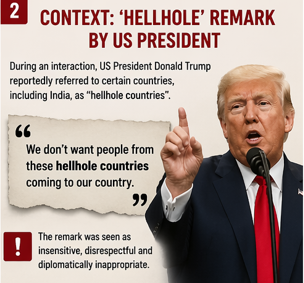
The controversy began after Donald Trump shared a post referring to India as a “hellhole.” India officially termed the remark “uninformed, inappropriate, and in poor taste.” However, the response from the Ministry of External Affairs remained measured and restrained, avoiding escalation. The US attempted damage control, reiterating that India is a “great country” and an important partner.
📉 Indo–US Relations under Trump 2.0
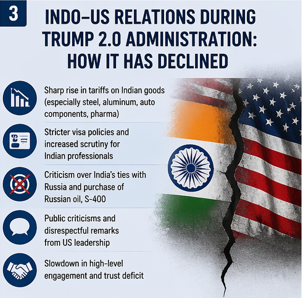
1. Trade and Tariff Issues : The US imposed tariffs and penalties on India (e.g., due to defense purchases from Russia). Trade disputes have slowed progress toward a comprehensive trade agreement.
2. Strategic Autonomy vs US Expectations : India continues to pursue multi-alignment (e.g., ties with Russia), while the US expects alignment against China. This creates friction in foreign policy expectations.
3. Diplomatic Differences : Disagreement over claims of US mediation in India–Pakistan issues. Differences in approach to global conflicts and sanctions regimes.
4. Rhetorical Volatility : Statements like the “hellhole” remark reflect unpredictable leadership rhetoric, affecting diplomatic optic.
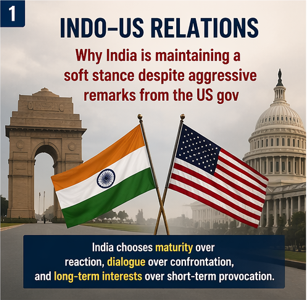
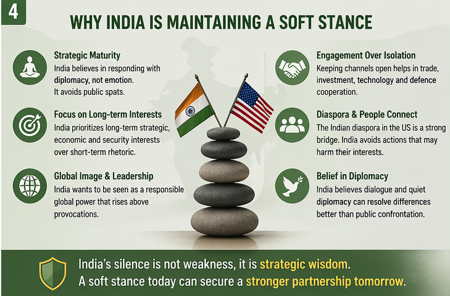
Despite provocations, India has avoided strong retaliation.
This is strategic, not weak diplomacy:
1. Long-term Strategic Interests : Indo-US ties are described as a “defining partnership of the 21st century.” India avoids reacting to episodic rhetoric to protect long-term gains.
2. China Factor (Indo-Pacific Strategy) : The US is crucial in balancing China in the Indo-Pacific region. India benefits from US support in regional security architecture.
3. Economic and Technological Dependence : Bilateral trade crossed $130+ billion (2024-25). Cooperation in AI, semiconductors, defense tech, and energy is critical.
4. Diaspora and People-to-People Ties : Large Indian diaspora in the US acts as a bridge of influence and soft power.
5. Diplomatic Maturity : India follows a “non-reactive, calibrated diplomacy” approach:
- Avoid escalation
- Issue formal objection
- Move forward pragmatically
🌍 Importance of Indo–US Relations
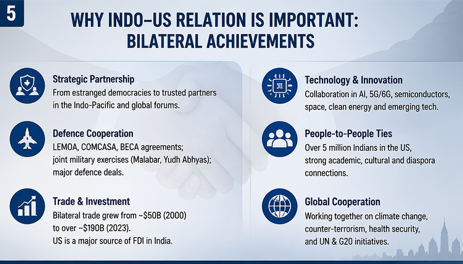
1. Strategic & Security Cooperation : Defense agreements, joint exercises (e.g., QUAD cooperation), Intelligence sharing and counter-terrorism collaboration
2. Economic Partnership : Trade: ~$131.8 billion , Investments, supply chains, and digital economy cooperation
3. Technology & Innovation Collaboration in: Space (NASA–ISRO) ,AI and semiconductors’ Critical emerging technologies
4. Global Governance Cooperation in: Climate change, Indo-Pacific stability, Multilateral institutions
5. Shared Democratic Values : Both are large democracies, enabling ideological convergence.
Key Bilateral Achievements
- Civil Nuclear Agreement (2008) – Strategic breakthrough
- Foundational Defence Agreements (LEMOA, COMCASA, BECA)
- QUAD Revival (India–US–Japan–Australia cooperation)
- iCET Initiative (Initiative on Critical and Emerging Technology)
- Growing defense trade (India designated Major Defense Partner)
🔮 Way Forward
1. Institutionalize Relations : Reduce dependence on personalities (like Trump–Modi optics) , Strengthen bureaucratic and institutional mechanisms
2. Resolve Trade Disputes : Fast-track a bilateral trade agreement , Address tariff and market access issues
3. Balance Strategic Autonomy : India must maintain independence while aligning on core interests
4. Manage Rhetorical Disruptions : Separate political rhetoric from policy continuity
5. Expand Cooperation Areas : Cybersecurity , Climate tech , Supply chain resilience
Prelims Question
Q. With reference to India–US relations in recent years, consider the following statements:
- India has been designated as a Major Defense Partner by the United States.
- The BECA Agreement allows India access to geospatial intelligence from the US.
- India is a formal treaty ally of the United States under NATO-like arrangements.
- The iCET initiative focuses on cooperation in critical and emerging technologies.
Which of the statements given above are correct?
(a) 1, 2 and 4 only
(b) 2 and 3 only
(c) 1 and 3 only
(d) 1, 2, 3 and 4
Answer: (a) 1, 2 and 4 only
Explanation:
Statement 1 – Correct: India was granted Major Defense Partner status, facilitating high-end defense technology sharing.
Statement 2 – Correct: The Basic Exchange and Cooperation Agreement (BECA) enables sharing of geospatial intelligence, improving missile and drone accuracy.
Statement 3 – Incorrect: India is not a treaty ally of the US and maintains strategic autonomy.
Statement 4 – Correct: The Initiative on Critical and Emerging Technology (iCET) focuses on AI, semiconductors, quantum computing, etc.
Mains Questions:
Highlight the significance of India–US relations in the context of the Indo-Pacific region. How can both countries ensure stability in ties despite leadership-level rhetoric and policy divergences? (250 words)

- India’s Youth Unemployment and Education Crisis - August 5, 2026
- India’s Sports Infrastructure and the 2036 Olympics Ambition - August 5, 2026
- Critical Minerals: The Foundation of Strategic Power - August 4, 2026

No Comments