


13 May “Rubber Stamp Selection?”: LOP Slams CBI Chief Appointment Process
This article covers “Daily Current Affairs”
SYLLABUS MAPPING : GS Paper 2 : Polity
FOR PRELIMS : CBI , Appointment , Landmark Judgments
FOR MAINS : “The CBI has been called a ‘caged parrot speaking in its master’s voice’ and has had its general consent withdrawn by multiple state governments. These two developments — judicial criticism and state defiance — together signal a crisis of legitimacy for India’s premier investigative agency.” Analyse the roots of this legitimacy crisis and suggest institutional reforms that would make the CBI genuinely independent, professionally credible, and constitutionally accountable. (15 M)
Why in News?
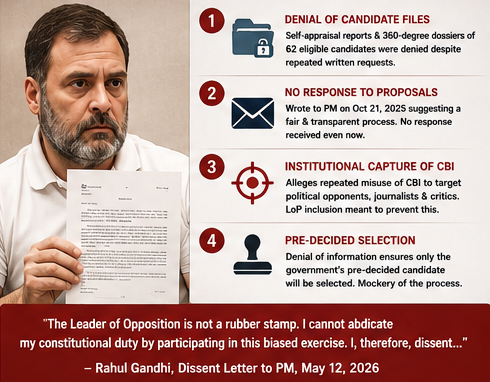
On Tuesday, May 12, 2026, the PM-led three-member Selection Committee met at 7, Lok Kalyan Marg, New Delhi to decide the successor to CBI Director Praveen Sood, whose two-year term — extended by one year in 2025 — is set to end on May 24, 2026. The committee comprises Prime Minister Narendra Modi (Chairperson), Chief Justice of India Surya Kant, and Leader of the Opposition in Lok Sabha Rahul Gandhi. Even before the meeting, Rahul Gandhi wrote a strongly worded dissent letter to PM Modi, stating he “will not participate in a biased exercise”, alleging he was denied self-appraisal reports and 360-degree performance files of the 62 eligible candidates, and accusing the government of reducing the selection process to a “mere formality” in which the Leader of Opposition is treated as a “rubber stamp”. Gandhi further alleged the government had “repeatedly misused the CBI to target political opponents, journalists, and critics” — and that the LoP’s inclusion in the Selection Committee was specifically meant to prevent such institutional capture.
CBI — Institutional Profile
Origin and Mandate
The Central Bureau of Investigation (CBI) is India’s premier domestic investigative agency, tracing its origins to the Special Police Establishment (SPE) set up in 1941 by the British Government to investigate bribery and corruption in war-related procurement. The SPE was formalised through the Delhi Special Police Establishment (DSPE) Act, 1946 — the statute that continues to govern the CBI today. In 1963, the agency was formally renamed the CBI and given expanded jurisdiction over corruption, economic offences, and sensitive cases referred to it by state governments or the Supreme Court.
Crucially, the CBI is not a statutory body created by an Act of Parliament in its own right — it derives all its powers from the DSPE Act. It operates under the Ministry of Personnel, Public Grievances and Pensions — a portfolio normally held by the Prime Minister personally — a structural arrangement that has repeatedly invited criticism of executive proximity.
- CBI is exempt from the Right to Information (RTI) Act — it cannot be questioned about its cases or functioning under RTI; a major accountability gap
- CBI has jurisdiction over corruption cases involving central government employees (under Prevention of Corruption Act), multi-state organised crime, and cases referred by courts or state governments
- CBI requires “general consent” from state governments to operate within their territory; several non-BJP states have withdrawn general consent — Rajasthan (2020), West Bengal (2018), Kerala (2020), Maharashtra (2020), Mizoram, Chhattisgarh
- The Supreme Court has described CBI as a “caged parrot speaking in its master’s voice” — a phrase from the coal scam case (2013) — reflecting persistent concerns about executive influence over investigations
- The CBI is India’s single point of contact (SPOC) with INTERPOL; launched Bharatpol platform (January 2025) to streamline INTERPOL notice communication with local law enforcement
Legal Framework for CBI Director’s Appointment
Governing Statutes — A Three-Layer Architecture
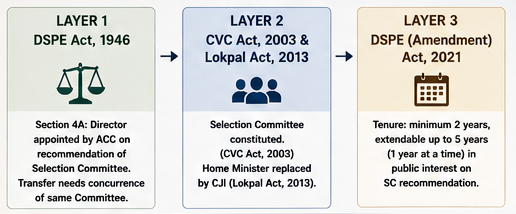
The appointment of the CBI Director is governed by three interlocking statutes, amended progressively to strengthen the insulation of the selection process from executive unilateralism:
Section 4A (inserted by the CVC Act, 2003 and further amended by the Lokpal Act, 2013) provides the mechanism for CBI Director appointment. The Director shall be appointed by the Appointments Committee of the Cabinet on the recommendation of the Selection Committee. The Director shall not be transferred without the concurrence of the same Selection Committee.
Section 4 of the CVC Act first created the three-member Selection Committee: (1) Prime Minister (Chairperson), (2) Home Minister, (3) Leader of the Opposition in the Lok Sabha. The Lokpal and Lokayuktas Act, 2013 later replaced the Home Minister with the Chief Justice of India — a significant upgrade to insulate the process from the executive, substituting a minister with the head of India’s judiciary.
Parliament amended the DSPE Act in December 2021 to allow the CBI Director’s tenure to be extendedbeyond the initial two years, up to a maximum of five years. Extensions are permitted“in public interest”— up toone year at a time— on the recommendation of the Selection Committee. This amendment was used to extend Director Praveen Sood’s tenure by one year in May 2025.
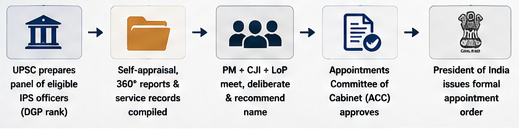
The Selection Process — Step by Step
| Step | Action | Who is responsible |
|---|---|---|
| 1 | Union Public Service Commission prepares a panel of eligible IPS officers (DGP rank) with a minimum of 2 years of service left | UPSC Secretariat |
| 2 | Self-appraisal reports, 360-degree feedback dossiers, and service records of all eligible officers are compiled and shared with Selection Committee members | Department of Personnel and Training (DoPT) / Ministry of Personnel |
| 3 | Selection Committee (PM + CJI + LoP) meets, reviews the files, deliberates, and recommends a name | Selection Committee |
| 4 | Appointments Committee of the Cabinet (ACC) formally approves the recommended name | ACC (PM + Home Minister) |
| 5 | President of India issues the formal appointment order | President of India |
Rahul Gandhi’s Dissent — Objections in Full
Rahul Gandhi’s dissent letter — submitted via letter to PM Modi before the May 12 meeting, and reiterated in a separate post on X (formerly Twitter) — makes four distinct constitutional and procedural objections. Each goes to the heart of whether the Selection Committee serves as a genuine check on executive power or a procedural fig leaf:
Gandhi states he was never provided self-appraisal reports or 360-degree performance dossiers of the 62 eligible candidates, despite “repeated written requests.” The appraisal records of sixty-nine candidates were denied to him outright at the Committee meeting. Without these records, evaluating any candidate’s history and performance is impossible
Gandhi wrote to PM Modi on October 21, 2025 — over six months before the meeting — suggesting a fair and transparent selection process. He states he has received no response to this letter even now. This procedural non-engagement, he argues, signals that the government never intended the LoP to play a meaningful role
Gandhi states: “Your government has repeatedly misused CBI to target political opponents, journalists, and critics.” He argues the LoP’s inclusion in the committee was specifically designed to prevent institutional capture — but the government has “continued to deny me any meaningful role in the process”, defeating this constitutional purpose
Gandhi alleges that “without any legal basis, denial of this information makes a mockery of the selection process and ensures that only your pre-decided candidate is selected.” This is a direct accusation that the committee is rigged to rubber-stamp a candidate already chosen by the executive — the precise outcome the three-member structure was designed to prevent
The Role of the Leader of Opposition — Constitutional Significance
The inclusion of the Leader of Opposition (LoP) in the CBI Director selection committee — first via the CVC Act 2003 and entrenched by the Lokpal Act 2013 — reflects a constitutional philosophy: that appointments to sensitive investigative institutions must not be the sole prerogative of the executive. This principle is deeply rooted in the idea of checks and balances in parliamentary democracy.
- The CBI is the executive’s most powerful investigative tool — it can arrest, investigate, and prosecute any individual or institution; if the Director is appointed entirely at the executive’s discretion, this power is vulnerable to political weaponisation
- The LoP represents the political opposition — the section of polity most directly exposed to politically-motivated CBI misuse; their presence in the selection committee creates a structural deterrent against appointing a partisan Director
- A tripartite selection structure (PM + CJI + LoP) balances the executive, the judiciary, and the opposition — no single branch can alone determine the CBI chief
- The same model is used for the Lokpal appointment (PM + Speaker + CJI + LoP + eminent jurist) and the Election Commission appointment (PM + LoP + a Cabinet Minister since 2023) — reflecting Parliament’s consistent intention to insulate sensitive institutional appointments from executive monopoly
- When the LoP is denied access to candidate files, the tripartite structure is hollowed out — the form of inclusion is maintained while the substance of check is removed; this is precisely Gandhi’s core objection
Landmark Judgments — How Courts Shaped CBI Appointment Rules
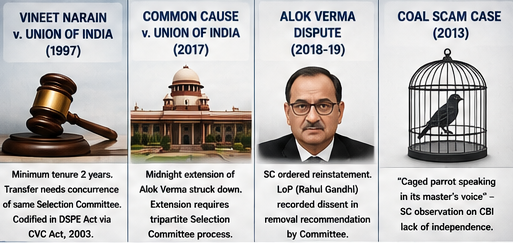
In this landmark hawala diaries case, the Supreme Court established that the CBI Director must have a minimum tenure of two years — insulating the Director from mid-tenure transfers that could be used to derail sensitive investigations. The court held that the CBI Director’s transfer requires the concurrence of the same Selection Committee that appointed them. This judgment was later codified into the DSPE Act via the CVC Act 2003. It remains the constitutional bedrock of CBI Director security of tenure.
The Supreme Court struck down the midnight extension granted to CBI Director Alok Verma by the Appointments Committee of the Cabinet, without the concurrence of the Selection Committee. The court held that any extension of the CBI Director’s tenure requires the same tripartite Selection Committee process — not a unilateral executive decision. This set a critical precedent that the 2021 DSPE Amendment (formalising extensions) subsequently codified.
CBI Director Alok Verma was unceremoniously sent on leave by the government in October 2018 amid a public feud with his Special Director Rakesh Asthana. The Supreme Court ordered his reinstatement. The Selection Committee then met and recommended his removal — with Rahul Gandhi dissenting and recording a separate view. This case was a live demonstration of the Selection Committee process under stress, and showed both the potential and the limitations of the LoP’s role.
A Supreme Court bench observed that the CBI was functioning like a “caged parrot speaking in its master’s voice”, after noting that the CBI had shared sensitive case information with the government (the very party under investigation). While not directly about Director appointment, this observation cemented the judicial consensus that CBI independence — including in appointments — is a matter of constitutional concern.
Broader Significance — CBI Independence and Democratic Governance
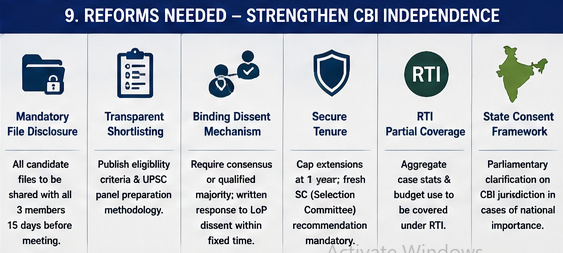
| Dimension | Current concern | Reform needed |
|---|---|---|
| File access for LoP | Rahul Gandhi was allegedly denied access to 360-degree reports and self-appraisals of all 62 candidates, making meaningful evaluation difficult | Statutory rule mandating disclosure of all candidate files to all three Selection Committee members at least 15 days before the meeting |
| Transparency in shortlisting | Union Public Service Commission panel preparation process is opaque; criteria for inclusion/exclusion of officers is not publicly disclosed | Published eligibility criteria; UPSC panel methodology shared with Committee members |
| Dissent mechanism | LoP dissent is legally recorded but has no binding effect — appointment can proceed despite objection | Require consensus or qualified majority for appointment; at minimum, mandate a written response to LoP dissent from the PM within a fixed period |
| Security of tenure | 2021 extension amendment (up to 5 years total) could allegedly be misused to retain a favoured Director in office | Cap extensions at one year only; require fresh Selection Committee recommendation for each extension, with binding LoP vote |
| RTI exemption | Central Bureau of Investigation is exempt from RTI, limiting public accountability for investigations and finances | Partial RTI coverage — at minimum, aggregate case statistics and budget utilisation should be RTI-accessible |
| State consent withdrawal | Multiple non-BJP states have withdrawn general consent, fragmenting CBI’s national jurisdiction | Parliamentary framework clarifying CBI jurisdiction in cases of genuine national importance, independent of state-level political consent |
Prelims Question
1. The CBI Director is selected by a three-member committee comprising the Prime Minister (Chairperson), the Chief Justice of India, and the Leader of the Opposition in Lok Sabha, as provided under the Lokpal and Lokayuktas Act, 2013.
2. Under the DSPE (Amendment) Act, 2021, the CBI Director can serve a maximum tenure of five years — an initial two-year term extendable up to three additional years, one year at a time, in public interest.
3. The Supreme Court’s judgment in Vineet Narain v. Union of India (1997) held that the minimum tenure of the CBI Director shall be two years and transfer before completion of this tenure requires the concurrence of the Selection Committee.
4. The CBI operates under the Ministry of Home Affairs and its Director is appointed by the Home Minister on the recommendation of the Prime Minister’s Office.
Which of the statements given above are correct?
Statement 1 is CORRECT. The Lokpal and Lokayuktas Act, 2013 amended the CVC Act framework to constitute the Selection Committee for CBI Director as: PM (Chairperson), the Leader of Opposition in Lok Sabha (or leader of the single largest opposition party if no recognised LoP exists), and the Chief Justice of India or a Supreme Court judge nominated by the CJI. This replaced the earlier Home Minister with the CJI — a significant reform to insulate the process from executive control by bringing in the judiciary.
Statement 2 is CORRECT. The DSPE (Amendment) Act, 2021 — passed in Parliament on December 14, 2021 and assented to by the President on December 18, 2021 — extended the maximum possible tenure of the CBI Director to five years: an initial two-year term, extendable by up to three more years, one year at a time, in public interest on the recommendation of the Selection Committee. This provision was used to extend Director Praveen Sood’s tenure by one year in May 2025.
Statement 3 is CORRECT. The Supreme Court’s landmark 1997 Vineet Narain v. Union of India judgment — arising from the hawala diaries case — directed that the CBI Director shall have a minimum two-year tenure and that any transfer before completion of this minimum tenure requires the concurrence of the Selection Committee. This judicial direction was subsequently codified into the DSPE Act through the CVC Act 2003, making it a statutory rather than merely a judge-made rule.
Statement 4 is INCORRECT. The CBI operates under the Ministry of Personnel, Public Grievances and Pensions — not the Ministry of Home Affairs. The Ministry of Personnel is generally held by the Prime Minister personally, which creates a structural proximity between the CBI and the PMO. The Director is appointed by the Appointments Committee of the Cabinet on the recommendation of the three-member Selection Committee — not by the Home Minister on the PM’s recommendation.
Mains Questions

- India’s Youth Unemployment and Education Crisis - August 5, 2026
- India’s Sports Infrastructure and the 2036 Olympics Ambition - August 5, 2026
- Critical Minerals: The Foundation of Strategic Power - August 4, 2026

No Comments