


24 Apr Growth Story, Worker Struggles : India’s Employment Paradox
This article covers “Daily Current Affairs”
SYLLABUS MAPPING : GS- 2&3 : Governance and Economy
FOR PRELIMS : Employment Data, Minimum Wages Rules and Regulations, Labour Codes.
FOR MAINS : Critically examine the effectiveness of minimum wage policies in India in ensuring a living wage. What structural and administrative challenges limit their impact?
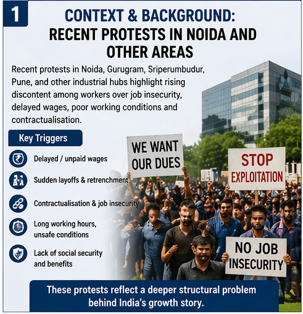
Context :
Recent protests in industrial clusters such as Noida, Gurugram, and Sriperumbudur signal growing worker dissatisfaction. Key triggers include:
- Wage delays and non-payment of dues
- Increasing contractualisation of labour
- Poor occupational safety and lack of social security
These protests reflect deeper structural issues rather than isolated incidents, pointing toward a widening gap between growth and equity.
Deunionization in the Post-1991 Era
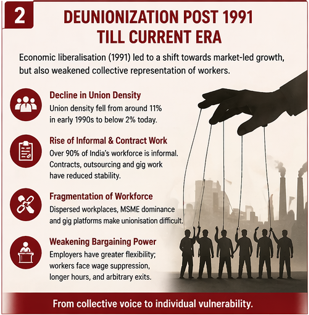
The 1991 Indian economic liberalisation marked a shift towards liberalization, privatization, and globalization (LPG). While it enhanced efficiency and growth, it also altered labour relations:
Key Trends:
Decline of trade unions due to rise of private sector dominance
Informalisation of workforce: Over 90% of workers remain outside formal contracts
Expansion of gig economy and platform work, limiting traditional union models
Implications:
- Weakening of collective bargaining power
- Greater vulnerability to arbitrary layoffs and wage suppression
- Shift from “job security” to “job flexibility”
Minimum Wages: Policy vs Reality
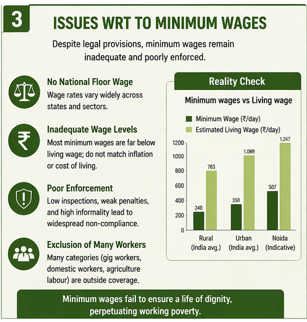
Although India has a statutory minimum wage framework, challenges persist: Key Issues are:
- Multiplicity of wage rates across states and sectors leads to fragmentation
- Absence of a universally enforced national floor wage
- Poor enforcement mechanisms, especially in informal sectors
- Real wages often lag behind inflation, reducing purchasing power
Labour Codes: Reform or Dilution?
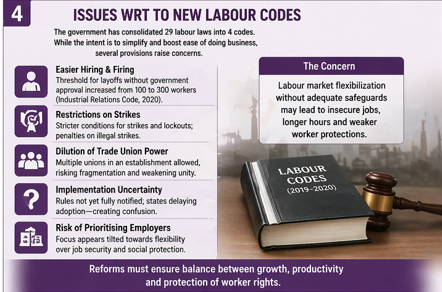
The consolidation of 29 labour laws into 4 codes—such as the Code on Wages, 2019, Industrial Relations Code, 2020, Social Security Code, and Occupational Safety Code—aims to simplify compliance and boost investment.
Potential Benefits:
- Streamlined regulatory framework
- Improved ease of doing business
- Expansion of social security provisions (in principle)
Concerns:
- Increased threshold for layoffs without government approval (from 100 to 300 workers)
- Restrictions on strikes and union activities
- Ambiguity in implementation and delays by states
- Risk of prioritizing employer flexibility over worker protection
Thus, the reforms raise concerns of “labour market flexibilization without adequate safety nets.”
Structural Nature of the Employment Paradox
India’s paradox stems from:
- Jobless growth in capital-intensive sectors
- Low productivity in agriculture absorbing surplus labour
- Skilling gaps limiting transition to high-value sectors
- Weak labour institutions and enforcement
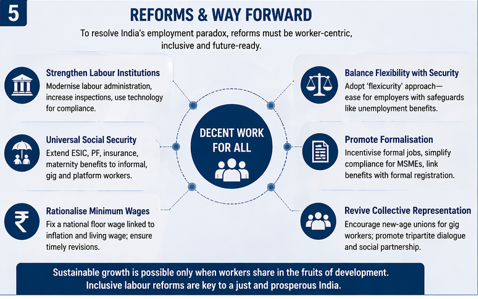
Reforms and Way Forward
Strengthening Labour Institutions : Strengthen labour inspection systems using digital tools
Universal Social Security : Extend benefits (ESI, PF, insurance) to informal and gig worker. Create a portable social security framework
Rationalizing Minimum Wages : Implement a national floor wage linked to inflation. Reduce inter-state disparities
Balancing Flexibility with Security : Adopt a “flexicurity” model (as seen in Nordic countries). Provide unemployment benefits alongside labour flexibility
Promoting Formalisation : Incentivize MSMEs to formalize employment. Simplify compliance while ensuring worker safeguards
Revitalizing Collective Representation: Encourage new-age unions for gig and platform workers. Institutionalize tripartite consultations
Conclusion
India’s growth trajectory must evolve from being merely GDP-centric to worker-centric. Sustainable development requires aligning economic expansion with social justice. Bridging this paradox is essential not only for equity but also for maintaining long-term economic stability and social cohesion.
Prelims Question
With reference to labour reforms and employment trends in India, consider the following statements:
- The Code on Wages, 2019 provides for a statutory national floor wage that is legally binding on all states.
- The Industrial Relations Code, 2020 increased the threshold for prior government approval for layoffs, retrenchment, and closure of establishments.
- Informal sector workers in India are fully covered under the Social Security Code, 2020 through mandatory employer contributions.
Which of the statements given above is/are correct?
(a) 1 and 2 only
(b) 2 only
(c) 2 and 3 only
(d) 1, 2 and 3
👉 Answer: (b)
👉 Explanation:
- Statement 1 is incorrect: Floor wage is advisory, not binding.
- Statement 2 is correct: Threshold increased from 100 to 300 workers.
- Statement 3 is incorrect: Coverage exists in principle but not universal or fully enforced.
Mains Questions
“India’s post-1991 growth has been accompanied by a weakening of labour institutions.”
Discuss in the context of deunionization, informalisation, and the rise of gig economy. Suggest measures to strengthen collective bargaining in the modern economy.

- India’s Youth Unemployment and Education Crisis - August 5, 2026
- India’s Sports Infrastructure and the 2036 Olympics Ambition - August 5, 2026
- Critical Minerals: The Foundation of Strategic Power - August 4, 2026

No Comments