25 Apr Is the Anti-Defection Law Undermining Representative Democracy?
Posted at 25 Apr 2026
in
Current Affairs
by Ayush Ranjan
This article covers “Daily Current Affairs”
SYLLABUS MAPPING : GS – 2&4 : Polity , Governance and Ethics
FOR PRELIMS : 52nd CAA, Provisions of Anti Defection Law, Exceptions, Supreme Court Judgements
FOR MAINS : The recent merger of seven AAP MPs with the BJP, structured around the two-thirds merger rule in the Tenth Schedule, has reignited debate on the adequacy of India’s Anti-Defection Law. Analyse the legal provisions that made this defection possible and discuss whether the merger exception serves its original constitutional purpose
Why in News?
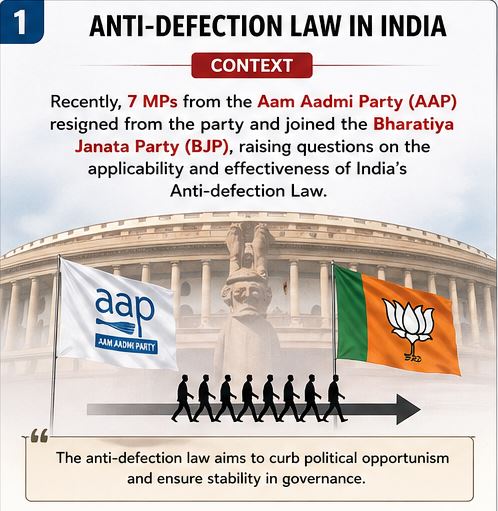
Rajya Sabha MP Raghav Chadha announced that 7 of AAP’s 10 Rajya Sabha MPs— including himself, Harbhajan Singh, Rajinder Gupta, Vikramjit Singh Sahney, and Swati Maliwal — are leaving AAP and merging with BJP. A signed letter was submitted to the Rajya Sabha Chairman.
Anti Defection Law in India
Why was it enacted?
The “Aaya Ram, Gaya Ram” syndrome
In 1967, Haryana MLA Gaya Lal switched parties three times in a single day, coining this phrase. Post-1967 elections, multiple state governments collapsed as MLAs traded loyalties for personal gain — ministerial berths, financial incentives.
Constitutional basis
1967–1985: Political instability era : Frequent defections destabilise state governments. Parliament feels the urgent need for a legal check on floor-crossing.
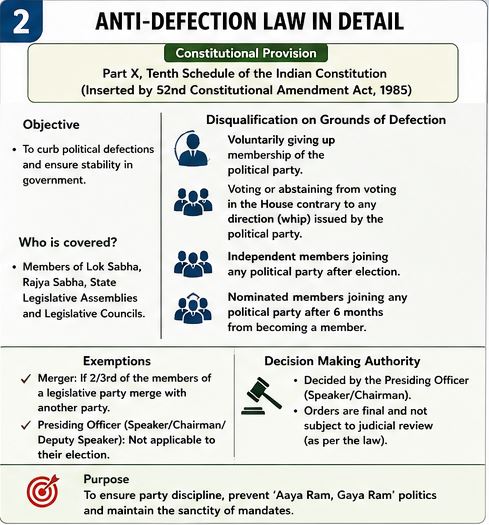
52nd Constitutional Amendment Act, 1985 : Adds the Tenth Schedule to the Constitution. Introduces disqualification for defection. Originally allowed splits if 1/3rd of members agreed.
Kihoto Hollohan v. Zachillhu (1992) : Supreme Court upholds the constitutional validity of the Tenth Schedule. Rules that Speaker’s decisions are subject to judicial review.
91st Constitutional Amendment Act, 2003 : Scraps the 1/3rd split provision. Now only mergers with at least 2/3rd of members are protected. Also caps Council of Ministers at 15% of House strength.
Keisham Meghachandra Singh v. Speaker Manipur (2020) : SC directs Speakers to decide disqualification petitions within 3 months. Suggests an independent tribunal to replace the Speaker.
Padi Kaushik Reddy v. State of Telangana (2025) : SC again urges Parliament to reform the Speaker’s role and ensure timely, fair adjudication of defection cases.
Structure of the Tenth Schedule
The schedule has 8 paragraphs covering disqualification grounds, exceptions, and enforcement machinery.
1
Interpretation — defines “legislature party”, “original political party”, and related terms.
2
Disqualification grounds — the core provision. A member is disqualified if they: (i) voluntarily give up party membership, or (ii) vote/abstain contrary to party direction without prior permission or within 15 days of condonation.
3
Independent members — disqualified if they join any political party after election.
4
Merger exception — no disqualification when at least 2/3rd of a legislative party agrees to merge with another party.
5
Exemptions — Speaker, Chairman, Deputy Chairman can resign from party and rejoin after demitting office.
6
Decision authority — the Speaker/Chairman of the House is the sole deciding authority on disqualification.
7
Bar on courts — original provision barred courts; modified by Kihoto Hollohan to allow judicial review post-decision.
8
Rules — Speaker/Chairman empowered to frame rules for disqualification proceedings.
When is a member disqualified?
Yes — Disqualified
- Individual MP/MLA quits party and joins another
- Votes against party whip without permission
- Independent member joins a party post-election
- Nominated member joins a party after 6 months of taking seat
No — Protected
- Merger with 2/3rd of legislative party members
- Speaker resigning from party for neutrality
- Voting against whip if party condones in 15 Days
- Presidential/Rajya Sabha elections (no whip applicable)
Penalty for defection
Disqualified member loses their parliamentary/assembly seat for the remaining term. They are also barred from holding any ministerial or paid political post until re-elected.
AAP Case
Explains the core arithmetic — 7 out of 10 MPs = 70%, which crosses the 2/3rd (66.7%) merger threshold under Paragraph 4. The merger was deliberately structured to stay within constitutional protection, mirroring the Goa 2019 precedent exactly.
Key structural flaws
Challenge 1
Speaker as judge — conflict of interest
The Speaker, elected by the ruling party, decides disqualification cases — including against members of the ruling party’s rivals. The Tenth Schedule grants finality to the Speaker’s order, creating an inherent conflict. The 170th Law Commission Report (1999) flagged this. SC noted the problem in Kihoto Hollohan (1992) (dissenting opinion) and again in Keisham Meghachandra Singh (2020).
Challenge 2
No timeline for decisions
The Tenth Schedule is silent on the maximum time for deciding disqualification petitions. Speakers have allowed defectors to retain their seats for months — even years — while cases pend. The SC set a 3-month guideline in Keisham (2020), but it is not legally binding.
Challenge 3
The 2/3rd merger loophole
The very provision meant to allow genuine party splits has become the primary vehicle for engineering defections. Parties with enough money or political muscle can target 2/3rd of a smaller legislative party, effectively buying a merger and rendering the Anti-Defection Law toothless.
Challenge 4
Curbs legislative conscience
The law effectively forces legislators to vote the party line on every issue — even matters of local constituency interest or personal conscience. Healthy parliamentary dissent is chilled. The SC itself noted in multiple cases that this creates a “democratic deficit”.
Challenge 5
Opacity of party whips
Internal party whips are often communicated informally or without proper documentation. There is no legal requirement for whips to be made public, making it difficult to determine whether a member actually received notice before voting against the party.
Challenge 6
Unequal application across houses
The Anti-Defection Law applies equally to Rajya Sabha MPs even though the Upper House has no role in deciding the government’s fate (no confidence motion lies only in Lok Sabha). The rationale for the same stringency in Rajya Sabha is questionable.
Recommendations from official bodies
Law Commission (170th Report, 1999)
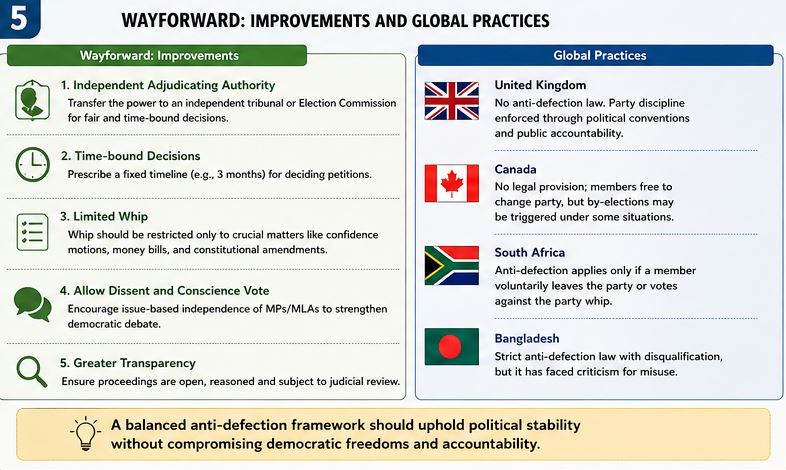
Recommended that the power to decide disqualification be vested in the President/Governor on the advice of the Election Commission of India.
2nd Administrative Reforms Commission
Reiterated the ECI-based model. Argued the Speaker cannot be both a party member and an impartial adjudicator simultaneously.
Supreme Court (Keisham, 2020)
Recommended Parliament consider replacing the Speaker with a permanent, independent tribunal headed by a retired Supreme Court judge or similar authority.
SC (Padi Kaushik Reddy, 2025)
Urgently asked Parliament to review the Speaker’s role and ensure anti-defection adjudication is timely and structurally fair.
Global practices
United Kingdom
No explicit anti-defection law. Defectors face internal party discipline, possible de-whipping, and constituency recall pressure. The Speaker’s office is constitutionally protected from political interference — the Speaker severs party ties upon election, does not vote except to break ties, and receives a peerage on retirement. India inherited the Speaker’s office but not these conventions.
United States
No anti-defection law exists. Party switching, though rare, is legally permitted. Members’ accountability runs directly to their constituency through regular elections rather than party discipline mechanisms.
South Africa
Anti-defection provisions in its constitution but tied explicitly to floor-crossing windows — designated periods during which party-switching is permitted, providing a structured release valve absent from India’s law.
Prelims Question
Consider the following statements regarding the Tenth Schedule of the Indian Constitution:
1. A nominated member of Rajya Sabha who joins a political party within six months of taking their seat is not disqualified under the Anti-Defection Law.
2. The Anti-Defection Law applies to elections to the office of the President of India.
3. If a Speaker votes against a party whip, the disqualification petition is decided by the Deputy Speaker.
4. The 91st Constitutional Amendment eliminated both the split provision and imposed a cap on the size of the Council of Ministers.
Which of the statements given above are correct?
(a)1 and 4 only
(b)2 and 3 only
(c)1, 3 and 4 only
(d)1 and 3 only
Correct answer: (a) 1 and 4 only
Explanation
Statement 1 — Correct: Nominated members have a 6-month window to join a party; joining within that window is explicitly permitted under the Tenth Schedule. Disqualification kicks in only if they join after 6 months.
Statement 2 — Incorrect: The Election Commission of India has clarified that the Anti-Defection Law does not apply to Presidential elections. Parties cannot issue a whip for Presidential votes; MPs and MLAs are free to vote for any candidate.
Statement 3 — Incorrect: The Speaker enjoys a personal exemption under Paragraph 5 — they can resign from their party and rejoin after demitting office. The Speaker does not face disqualification proceedings in the first place. Disqualification petitions against other members are decided by the Speaker themselves, not the Deputy Speaker.
Statement 4 — Correct: The 91st Amendment (2003) did two things: (i) removed the 1/3rd split provision, replacing it with a 2/3rd merger requirement, and (ii) capped the Central Council of Ministers at 15% of Lok Sabha strength and State Cabinets at 15% of Assembly strength (minimum 12 ministers).
Mains questions
GS Paper II — Polity | 15 marks
“The Anti-Defection Law, enacted to bring stability to Indian democracy, has paradoxically created a new set of democratic deficits.” Critically examine this statement in light of recent political developments, and suggest constitutional reforms to make the law more effective without undermining legislative independence.
Latest posts by Ayush Ranjan
(see all)





No Comments