


02 May Sikkim’s Paperless Judiciary: India’s First Digital Court Revolution
This article covers “Daily Current Affairs”
SYLLABUS MAPPING : GS Paper 2 (Governance, Judiciary, e-Governance), GS Paper 3 (Technology, Digital India)
FOR PRELIMS : E Court Mission, E Governance, Etc.
FOR MAINS : “The integration of Artificial Intelligence into India’s judiciary holds transformative potential but also poses serious risks to natural justice and judicial independence. In the context of the eCourts Phase III and Sikkim’s paperless judiciary model, analyse the opportunities and ethical concerns of AI-enabled courts.”
Why in News?
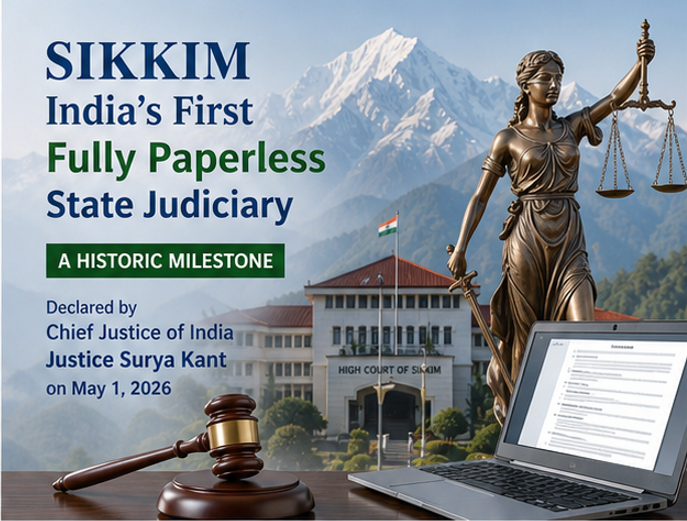
On May 1, 2026, Chief Justice of India (CJI) Justice Surya Kant officially declared Sikkim as the first fully paperless state judiciary in India, during the National Conclave on Technology and Judicial Education held at Chintan Bhawan, Gangtok. The declaration coincides with Sikkim’s 50th Statehood Anniversary, adding constitutional significance and institutional symbolism to the milestone.
KEY DETAILS OF THE EVENT
- Who declared: Chief Justice of India, Justice Surya Kant.
- Where: National Conclave on Technology and Judicial Education, Chintan Bhawan, Gangtok, Sikkim.
- When: May 1, 2026 (Day 1 of the two-day conclave held May 1–2, 2026).
- Organised by: High Court of Sikkim in collaboration with the eCommittee, Supreme Court of India.
- Theme of Conclave: “Technology and Judicial Education”.
Key Statements Made at the Event
- CJI Surya Kant said: “Access to justice in remote and difficult terrains is undergoing a fundamental transformation through technology. For litigants in the past, distance was measured not in kilometres but in days of travel, uncertainty, and hardship.”
- He emphasised that digitisation promotes institutional accountability, strengthens transparency, and aligns with the broader objectives of judicial reforms under the eCourts project.
- Justice J.K. Maheshwari said a paperless judiciary does not replace human judgment but removes barriers such as misplaced files, physical distance, and procedural inconvenience.
- Chief Minister Prem Singh Tamang called it a “historic transformation” aimed at making the legal system faster, more transparent, and accessible, cautioning that no citizen should be left behind due to lack of access or digital literacy.
WHAT IS A PAPERLESS JUDICIARY?
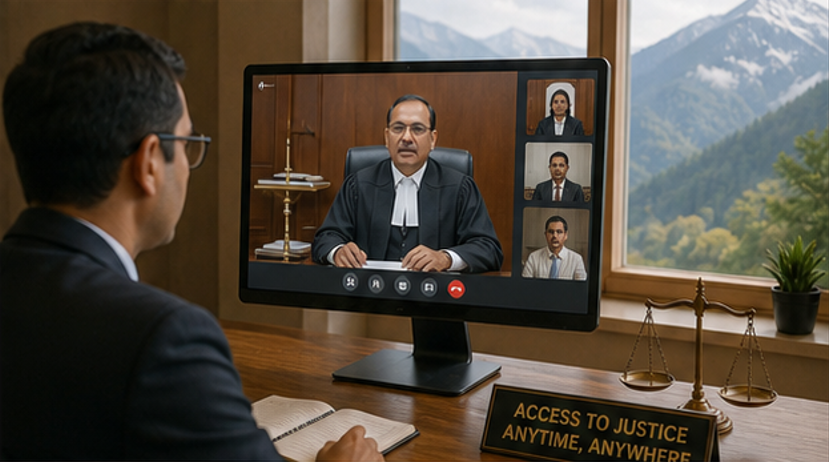
A fully paperless judiciary is a system in which all legal processes are conducted electronically rather than through physical paper. It involves:
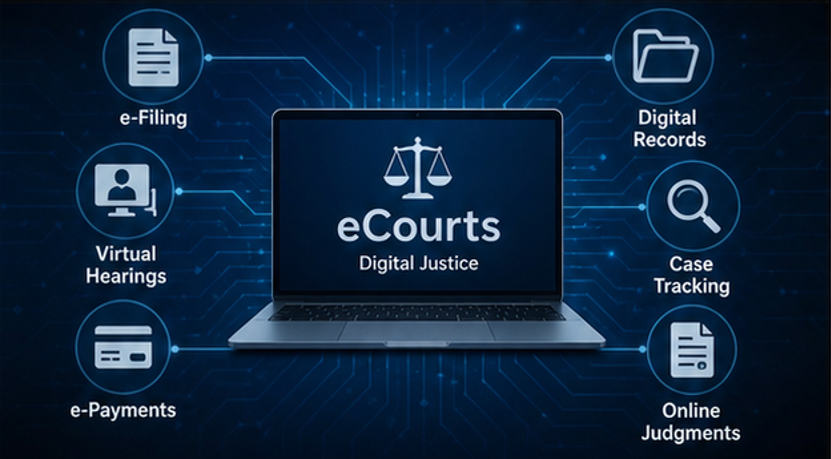
- Digital case filing (e-Filing): All petitions, plaints, and documents submitted electronically.
- Digital case records: All case files, orders, judgments stored and accessed digitally.
- Online hearings / Virtual courts: Hearings conducted remotely via video conferencing.
- Digital cause lists: Daily court schedules published and accessed online.
- E-Payment systems: Court fees, fines, and deposits paid electronically.
- Electronic summons and notices: All communication to parties/advocates sent digitally.
- Online certified copies: Certified copies of judgments and orders available for download.
- Digital evidence management: Evidence stored and presented electronically.
- Real-time case tracking: Litigants and lawyers track case status, hearing dates, and orders online.
THE eCOURTS PROJECT
Sikkim’s achievement is built on India’s larger eCourts Mission Mode Project — the national digital infrastructure for India’s judiciary.
Origins
- Conceptualised based on the “National Policy and Action Plan for ICT in the Indian Judiciary – 2005”, submitted by the eCommittee, Supreme Court of India.
- Implemented by the Department of Justice, Ministry of Law and Justice, in coordination with the eCommittee, Supreme Court of India.
- Formally launched as part of the National eGovernance Plan in 2007.
Three Phases of the eCourts Project
Phase I (2011–2015) — Hardware Foundation
-
- Financial outlay: ₹935 crore (actual expenditure: ₹639.41 crore).
- 14,249 district and subordinate courts computerised.
- Basic infrastructure: computer hardware, internet connectivity, eCourts platform operationalised.
Phase II (2015–2023) — Citizen Services and ICT Enablement
-
- Financial outlay: ₹1,670 crore (expenditure: ₹1,668.43 crore).
- 18,735 courts computerised by 2023.
- National Judicial Data Grid (NJDG) expanded — database of over 27.64 crore orders, judgments, and cases made publicly accessible.
- Wide Area Network (WAN) connected 99.4% of all court complexes across India with 10–100 Mbps bandwidth.
- Virtual Courts operationalised in 21 states and UTs — processed over 6 crore traffic challan cases, collecting over ₹649 crore in online fines.
- e-Sewa Kendras (digital service centres) set up in 48 High Courts and 2,283 district courts — providing e-filing, virtual hearings, and support to digitally challenged litigants.
- Mobile apps, SMS services (4 lakh+ daily), email alerts (6 lakh+ daily), and an eCourts portal (35 lakh daily hits) deployed.
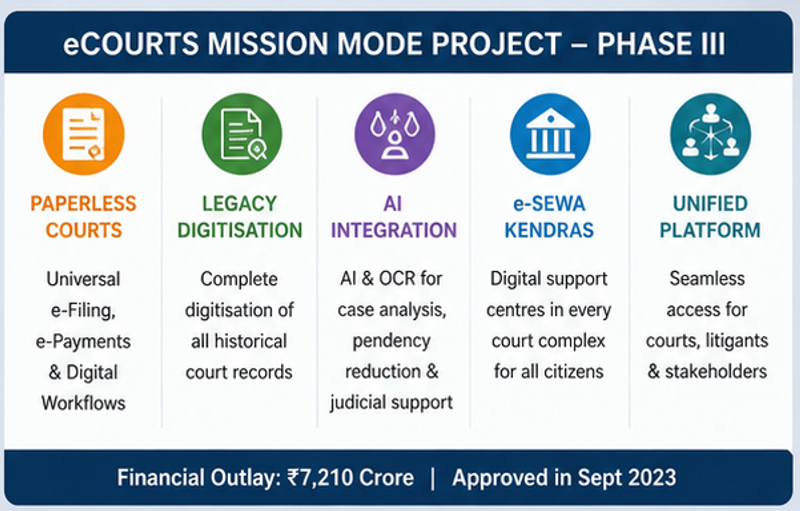
Phase III (2023 onwards) — Paperless Courts and AI Integration
-
- Approved by Union Cabinet on September 13, 2023.
- Financial outlay: ₹7,210 crore for 4 years.
- Objectives:
- Digitisation of all legacy records — complete historical court records to be made digital.
- Universal e-Filing and e-Payment — saturation of all court complexes.
- e-Sewa Kendras in every court complex — ensuring no citizen is excluded due to digital illiteracy.
- AI and OCR integration — for case pendency analysis, sentencing pattern recognition, bail decision consistency, and future litigation forecasting.
- Unified technology platform — seamless, paperless interface between courts, litigants, and all stakeholders.
- Interoperability among courts, prisons, police, and legal aid authorities.
Key Digital Tools in the eCourts Ecosystem
-
- Case Information System (CIS): Core software running inside court complexes (Version 3.2 for District Courts, Version 1.0 for High Courts).
- National Judicial Data Grid (NJDG): Public dashboard — aggregates pendency, disposal rates, and case data from all computerised courts in real time.
- eCourts Services Portal & Mobile App: Citizens check case status, download orders, and view cause lists.
- Judgment Search Portal: Public search of decided matters by bench, case type, judge name, section, full text, etc.
- Video Conferencing Platform: Enables virtual hearings across courts.
- Justice Clock: LED display boards in courts showing real-time judicial data to the public.
SIGNIFICANCE OF SIKKIM’S ACHIEVEMENT
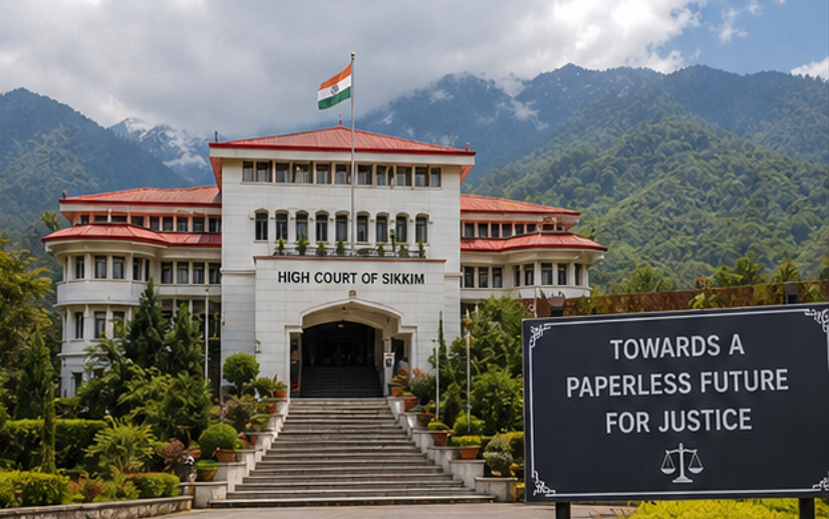
A. Model for Other States : The Sikkim model is expected to serve as a benchmark for replication across other states as India’s judiciary accelerates its digital transformation. It demonstrates that complete paperlessness is achievable — not just aspirational — within the existing eCourts Phase III framework.
B. Access to Justice in Remote Terrains : For Sikkim’s citizens living in geographically isolated areas, the paperless system eliminates the need for physical travel to courts — a fundamental barrier to justice for decades. Directly advances the constitutional principle of equal and effective access to justice (Article 21 — Right to Life and Personal Liberty includes right to speedy trial and access to justice).
C. Reducing Case Pendency : India has over 5 crore pending cases across all courts (as of 2025). The paperless system is expected to reduce pendency through expedited hearings, minimised administrative inefficiencies, and real-time access to case files for all parties. Eliminates delays caused by misplaced files, physical distance, and procedural bottlenecks.
D. Transparency and Accountability : Real-time, remote access to case files for litigants, the Bar, and judicial officers strengthens open justice and procedural due process. Reduces opportunities for manipulation of physical records — a long-standing concern in Indian courts.
E. Environmental Sustainability : A paperless judiciary reduces the massive paper consumption of the judicial system — court files in India run to millions of physical pages annually. Aligns with India’s environmental commitments and broader green governance goals.
F. Symbolic Importance — 50th Statehood Anniversary : Sikkim merged with India on May 16, 1975 — making 2025–26 its Golden Jubilee of Statehood. Becoming India’s first paperless judiciary during this milestone year carries deep constitutional and institutional symbolism — a small Himalayan state setting a national precedent.
G. International Visibility : The presence of the Chief Justice of the Supreme Court of Seychelles and a judge of the Supreme Court of Sri Lanka at the conclave signals that Sikkim’s model is attracting international attention as a case study in judicial digitalisation.
CHALLENGES AND CONCERNS IN SCALING UP
A. Digital Divide : The CJI himself acknowledged the risk of the digital divide becoming a barrier to justice. Litigants in poor, rural, or elderly demographics may lack devices, internet access, or digital literacy.48 e-Sewa Kendras in High Courts and 2,283 in district courts exist nationally — but coverage must be universal, not patchy.
B. Cybersecurity and Data Privacy : Digital court records contain highly sensitive personal, financial, and criminal data. Inadequate cybersecurity could expose litigants and witnesses to privacy violations and data breaches. India does not yet have a fully operational, comprehensive data protection regime specifically covering judicial data.
C. Legacy Record Digitisation : Converting decades of physical records (legacy cases) into digital formats is time-consuming, expensive, and error-prone. Incomplete digitisation of legacy records creates a two-tier system — some cases digital, others still paper-based.
D. Infrastructure Reliability in Remote Areas : Paperless courts depend entirely on stable internet connectivity. Power outages, poor bandwidth, or network failures in remote areas could bring court proceedings to a halt. Sikkim, with its terrain and weather challenges (landslides, heavy monsoons), faces real infrastructure reliability risks.
E. Uneven Implementation Across States : What works in small Sikkim (one High Court, limited district courts) faces enormous scaling challenges in states like Uttar Pradesh (which has over 1 crore pending cases), Bihar, or Maharashtra with hundreds of court complexes.
F. Judicial Education Gap : As the CJI noted, judges must move beyond basic digital literacy to understand algorithmic systems and their interaction with natural justice principles. The risk of over-reliance on AI tools in judicial decision-making — bail, sentencing — without adequate human oversight is a significant jurisprudential concern.
PRELIMS QUESTION
Q. Consider the following statements regarding the eCourts Mission Mode Project in India:
- The eCourts Project was conceptualised based on the National Policy and Action Plan for ICT in the Indian Judiciary, 2005, submitted by the eCommittee, Supreme Court of India.
- The National Judicial Data Grid (NJDG) provides public access to case status and orders only from High Courts, not district courts.
- eCourts Phase III, approved in 2023, has a financial outlay of ₹7,210 crore and focuses on paperless courts and AI integration.
- Sikkim was declared India’s first fully paperless state judiciary by CJI Justice Surya Kant on May 1, 2026.
Which of the above statements are correct?
(a) 1 and 3 only
(b) 1, 3 and 4 only
(c) 2, 3 and 4 only
(d) 1, 2, 3 and 4
Answer: (b) — 1, 3 and 4 only
Explanation:
- Statement 1 — Correct: The eCourts Project was indeed conceived based on the 2005 National Policy document prepared by the eCommittee, Supreme Court of India.
- Statement 2 — INCORRECT: The NJDG provides public access to data from both district/subordinate courts AND High Courts — it is a national-level data warehouse of all computerised courts, not limited to High Courts.
- Statement 3 — Correct: eCourts Phase III was approved by the Union Cabinet in September 2023 with a budget of ₹7,210 crore, with its main focus on paperless courts, legacy digitisation, universal e-filing, and AI integration.
- Statement 4 — Correct: CJI Justice Surya Kant made the formal declaration at the National Conclave on Technology and Judicial Education in Gangtok on May 1, 2026.
MAINS QUESTIONS
“Sikkim’s achievement as India’s first fully paperless state judiciary is a landmark in judicial reform, but it also exposes the uneven pace of India’s digital justice delivery. Critically examine the significance of this development and the challenges in replicating it nationally.” (15 M)

- India’s Youth Unemployment and Education Crisis - August 5, 2026
- India’s Sports Infrastructure and the 2036 Olympics Ambition - August 5, 2026
- Critical Minerals: The Foundation of Strategic Power - August 4, 2026

No Comments