


06 May Cabinet Clears Expansion of Supreme Court Bench to 37 Judges
This article covers “Daily Current Affairs”
SYLLABUS MAPPING : GS Paper 2 : Polity and Governance
FOR PRELIMS : Constitutional Basis of the topic, Important Articles, Historical Evolution.
FOR MAINS : The judge-to-population ratio in India is among the lowest in major democracies, yet simply increasing the number of judges may not resolve the structural crisis of pendency. Analyse the systemic causes of judicial delay in India and evaluate the adequacy of existing reforms in addressing them.
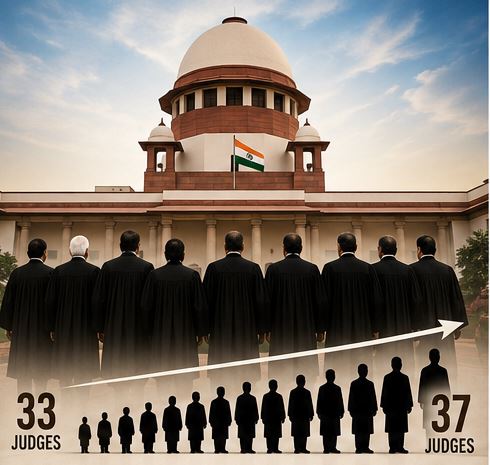
Why in News?
On May 5, 2026, the Union Cabinet chaired by Prime Minister Narendra Modi approved the introduction of the Supreme Court (Number of Judges) Amendment Bill, 2026 in Parliament. The bill seeks to amend the Supreme Court (Number of Judges) Act, 1956 by increasing the sanctioned strength of Supreme Court judges from 33 to 37 (excluding the Chief Justice of India), adding 4 new positions to the highest court of the land.
Constitutional and Legal Background
The Constitutional Basis
- Article 124(1) of the Constitution of India originally provided: “There shall be a Supreme Court of India consisting of a Chief Justice of India and, until Parliament by law prescribes a larger number, of not more than seven other Judges.”
- This means the original strength of the Supreme Court at inception (1950) was 1 CJI + 7 Judges = 8 Judges in total.
- The Constitution itself empowers Parliament — not the executive alone — to prescribe a larger number of judges through legislation. This reflects the framers’ wisdom in keeping judicial strength a flexible, dynamic figure.
The Governing Legislation
- The Supreme Court (Number of Judges) Act, 1956 was the first statutory exercise of this constitutional power.
- All subsequent expansions have been made by amending this Act through Parliament.
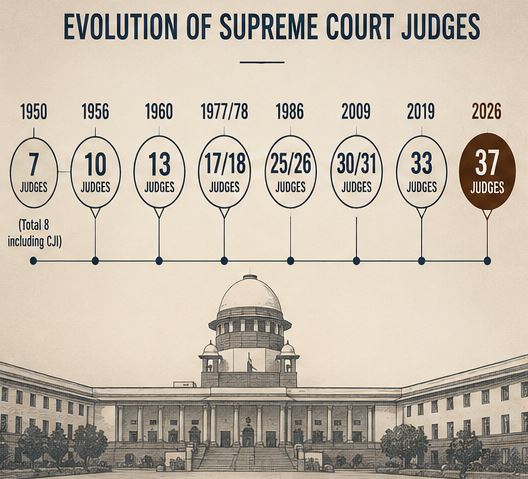
Historical Evolution of Supreme Court Judge Strength
The following table captures the complete legislative journey of Supreme Court bench strength (excluding the Chief Justice of India)
| Year | Legislation | Sanctioned Strength (Excl. CJI) |
|---|---|---|
| 1950 | Constitution of India (Art. 124) | 7 |
| 1956 | Supreme Court (Number of Judges) Act, 1956 | 10 |
| 1960 | Amendment Act, 1960 | 13 |
| 1977 | Amendment Act, 1977 | 17 |
| 1979 | Cabinet restriction lifted (at CJI’s request) | Working strength back to 17 |
| 1986 | Amendment Act, 1986 | 25 |
| 2008 | Amendment Act, 2008 | 30 |
| 2019 | Amendment Act, 2019 | 33 |
| 2026 (Proposed) | Amendment Bill, 2026 | 37 |
Notable Fact: In the late 1970s, the Cabinet had administratively restricted the working strength to 15 judges even though the sanctioned number was 17. This restriction was lifted in 1979 at the request of the then Chief Justice of India — highlighting that sanctioned strength and actual working strength can differ due to executive discretion or vacancies.
The Process of Increasing the Number of Judges
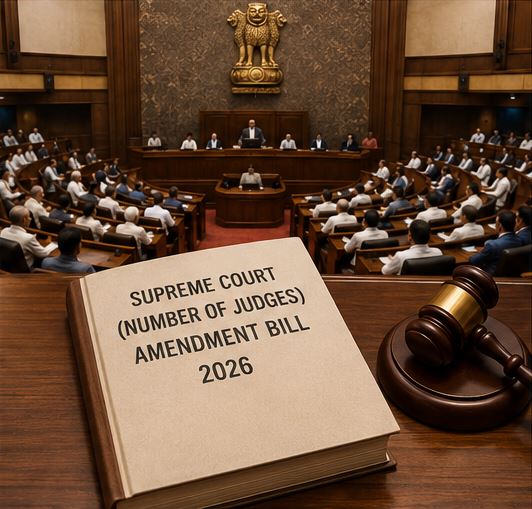
Step 1: Executive Proposal / Cabinet Approval : The process begins with a proposal from the Law Ministry or the Supreme Court collegium highlighting the need for additional judges. The Union Cabinet approves the proposal to introduce an Amendment Bill in Parliament.
Step 2: Legislative Amendment : Since the judge strength is governed by an Act of Parliament (not directly by the Constitution), any increase requires a simple majority in both Houses — Lok Sabha and Rajya Sabha. The Bill is introduced, debated, and passed as an ordinary bill (not a constitutional amendment requiring special majority).
Step 3: Presidential Assent : After both Houses pass the Bill, it is sent to the President of India for assent under Article 111.
Step 4: Actual Appointment of Judges
- Increasing the sanctioned strength only creates vacancies on paper. Filling those vacancies is a separate, often slower, process.
- Judges are appointed by the President of India on the recommendation of the Supreme Court Collegium (comprising the CJI and the four senior-most judges of the Supreme Court).
- This process, governed by the Second and Third Judges Cases (1993, 1998), can be time-consuming due to the back-and-forth between the collegium and the government.
Why Was This Done? Reasons and Rationale
Mounting Case Pendency
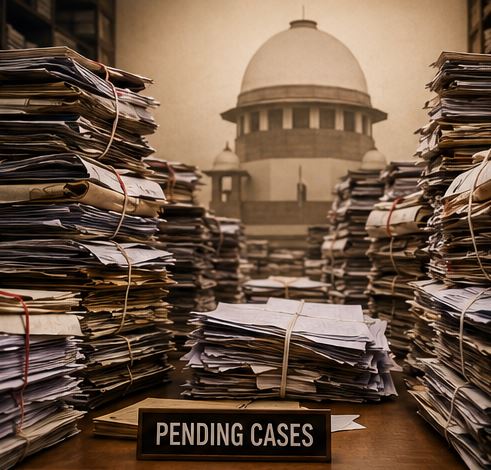
- As of March 2026, the total number of pending cases across all levels of Indian judiciary has crossed 55.8 million, including over 1,80,000 cases pending for more than 30 years.
- At the Supreme Court level, over 90,000 cases are currently pending, spanning constitutional disputes, criminal appeals, civil matters, and Public Interest Litigations (PILs).
- In some months, fresh filings have outpaced disposal rates — for instance, in August 2025, filings (7,080) exceeded disposals (5,667), worsening the backlog further.
Low Judge-to-Population Ratio
- India has approximately 14.4 judges per million population (2022 data), a figure that has barely changed from 13.2 in 2016.
- By contrast, Europe has ~210 judges per million and the United States has ~150 judges per million population.
- India’s ratio is amongst the lowest in major democracies, a structural gap that constrains the system’s capacity to deliver timely justice.
Increased Complexity and Volume of Litigation
- Growing awareness of legal rights, expansion of commercial activity, population growth, and rising digital disputes have substantially increased the volume and complexity of litigation.
- The Supreme Court is increasingly burdened not just by volume but by constitutionally significant questions that demand the attention of larger, Constitution Benches.
Need for More Constitution Benches
- Several landmark constitutional questions relating to federalism, fundamental rights, electoral laws, and personal liberty have been awaiting hearing before Constitution Benches (5 or more judges).
- A higher sanctioned strength allows the court to simultaneously constitute more benches, including larger ones for complex matters, without compromising its day-to-day functioning.
Rule of Law Implications
- The World Justice Project’s Rule of Law Index 2025 ranked India 114 out of 143 countries in civil justice and 89 out of 143 in criminal justice — indicating serious systemic shortcomings.
- Judicial delays cost India an estimated more than 2% of GDP annually through inefficiencies in contract enforcement, property disputes, and investor uncertainty.

Significance of the Decision
- Direct Impact on Judicial Efficiency – Additional judges mean the court can constitute more simultaneous benches, increasing daily case disposal capacity. Urgent matters — bail hearings, habeas corpus petitions, time-sensitive PIL hearings — will be listed and heard more promptly.
- Constitutional Significance – Expanding bench strength reinforces the Supreme Court’s role as the guardian of the Constitution by ensuring that landmark constitutional questions do not remain unheard for years due to capacity constraints.
- Economic Dimension – Faster resolution of commercial disputes, land acquisition matters, and contractual litigation will improve India’s ease of doing business ranking and enhance investor confidence.
- Access to Justice – Speedy justice is a facet of Article 21 (Right to Life and Personal Liberty). Expansion of bench strength is, in effect, an expansion of the practical exercise of this fundamental right.
- Financial Implications – The additional expenditure on judges’ salaries, support staff, and facilities will be met from the Consolidated Fund of India — signalling a formal fiscal commitment to judicial reform.
Prelims Question
Q. With reference to the increase in the number of judges in the Supreme Court of India, consider the following statements:
- The original Constitution of India provided for a maximum of 7 judges in the Supreme Court, excluding the Chief Justice.
- The number of Supreme Court judges can be increased only through a Constitutional Amendment requiring a special majority.
- As per the proposed Supreme Court (Number of Judges) Amendment Bill, 2026, the sanctioned strength will be 37 judges excluding the Chief Justice of India.
Which of the statements given above is/are correct?
(a) 1 and 2 only
(b) 1 and 3 only
(c) 2 and 3 only
(d) 1, 2 and 3
Correct Answer: (b) 1 and 3 only
Explanation:
- Statement 1 is CORRECT. Article 124(1) originally limited the number of judges (excluding CJI) to 7, with Parliament authorised to prescribe a larger number by law.
- Statement 2 is INCORRECT. The number of judges is governed by an ordinary Act of Parliament — the Supreme Court (Number of Judges) Act, 1956. It requires only a simple majority in both Houses, not the special majority required for a Constitutional Amendment under Article 368.
- Statement 3 is CORRECT. The 2026 Bill proposes increasing the strength from 33 to 37, excluding the Chief Justice of India.
Mains Question:
“Expanding the sanctioned strength of the Supreme Court is a necessary but not sufficient step towards addressing India’s justice delivery crisis.” Critically examine this statement in light of the recent Cabinet decision to increase Supreme Court bench strength from 33 to 37 judges, and suggest a holistic reform agenda for the Indian judiciary.

- India’s Youth Unemployment and Education Crisis - August 5, 2026
- India’s Sports Infrastructure and the 2036 Olympics Ambition - August 5, 2026
- Critical Minerals: The Foundation of Strategic Power - August 4, 2026

No Comments