


09 May Operation Sindoor — First Anniversary
This article covers “Daily Current Affairs”
SYLLABUS MAPPING : GS Paper 2,3 : IR, Security.
FOR PRELIMS : Weapons and Systems , India’s New Security Doctrine , Intelligence & Space Assets
FOR MAINS : “Operation Sindoor and the continued suspension of the Indus Waters Treaty signal that India has permanently redrawn the rules of engagement with Pakistan — treating cross-border terrorism as an act of war rather than a law-and-order problem.” Critically evaluate the diplomatic, legal, and strategic implications of this shift for India-Pakistan relations, India’s international standing, and South Asian stability. (15 M)
Why in News?
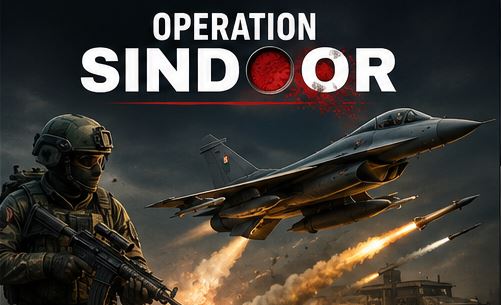
India on May 7, 2026 commemorated the first anniversary of Operation Sindoor — one of the most significant and daring cross-border military operations since the 1971 Bangladesh Liberation War. Launched exactly one year ago in the early hours of May 7, 2025, in direct response to the Pahalgam massacre of April 22, 2025 — in which 26 civilians were killed by Pakistan-backed terrorists — the operation struck nine terror infrastructure sites across Pakistan and Pakistan-occupied Kashmir (PoK) using precision air strikes, cruise missiles, and loitering munitions. On the anniversary, PM Narendra Modi paid tribute to the armed forces, and the MEA reaffirmed that the Indus Waters Treaty (IWT) would remain in abeyance until Pakistan “credibly and irrevocably” ends its support for cross-border terrorism — signalling that India’s post-Sindoor posture is now a permanent new normal, not a temporary measure.
The Trigger — Pahalgam Massacre, April 22, 2025
The immediate trigger for Operation Sindoor was one of the deadliest terror attacks on Indian civilians in recent years. On April 22, 2025, Pakistan-backed gunmen stormed the Baisaran meadow near Pahalgam in Jammu and Kashmir — a popular tourist destination — and systematically identified and executed victims on the basis of their religion, killing 26 civilians including one Nepali national. The attack was widely condemned internationally and described as a calculated act designed not merely to kill, but to incite communal violence and divide India from within.
The attack was attributed to The Resistance Front (TRF), a shadow outfit of Pakistan-backed Lashkar-e-Taiba (LeT). India’s government immediately initiated a multi-pronged diplomatic and strategic response, even before the military operation was launched.
- Indus Waters Treaty (1960) suspended— put “in abeyance” by the Government of India; Baglihar Dam gates on the Chenab River shut
- Diplomatic ties downgraded— Pakistan’s top diplomats declared persona non grata; Indian diplomats recalled
- Attari–Wagah border sealed— cross-border movement and trade halted
- Pakistani nationals’ visas suspended— most visa categories revoked
- Parliamentary delegations dispatched— bipartisan all-party delegations sent to multiple countries to present India’s position and evidence of Pakistan’s culpability.
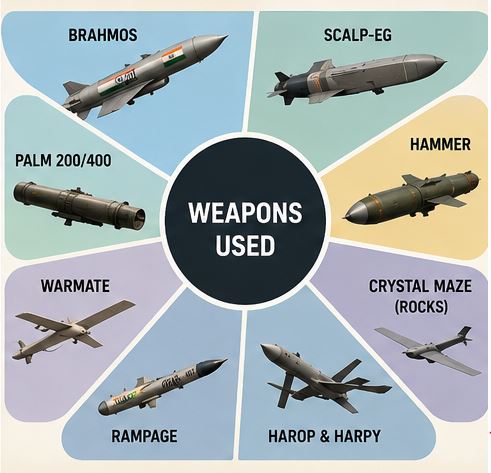
Weapons and Systems — Technology of Operation Sindoor
Offensive Systems Used
| System | Type | Origin | Role in Operation Sindoor |
|---|---|---|---|
| BrahMos | Supersonic cruise missile | India–Russia (joint) | Struck JeM HQ in Bahawalpur; fired from Su-30MKI; most feared offensive system deployed |
| SCALP-EG | Subsonic cruise missile (air-launched) | France | Fired from Rafale jets; struck Bahawalpur and Muridke; ~6 used on JeM bunkers; deep penetration capability |
| HAMMER | Precision-guided modular bomb | France | Fired from Rafale; precision strikes on terror infrastructure |
| Crystal Maze (ROCKS) | Stand-off air-to-surface missile | Israel | Used against Muridke LeT facility alongside SCALP |
| Harop & Harpy | Loitering munitions (kamikaze drones) | Israel | Struck Pakistani air-defence radar stations and missile systems on May 9 |
| Rampage | Supersonic air-to-ground missile | Israel | Used in the decisive May 10 strike waves against hardened targets |
| Warmate | Loitering munition | Poland / India | Supplementary strike on terror camps |
| PALM 200/400 | Precision loitering munition | Israel | Anti-radiation loitering munition; targeted radar infrastructure |
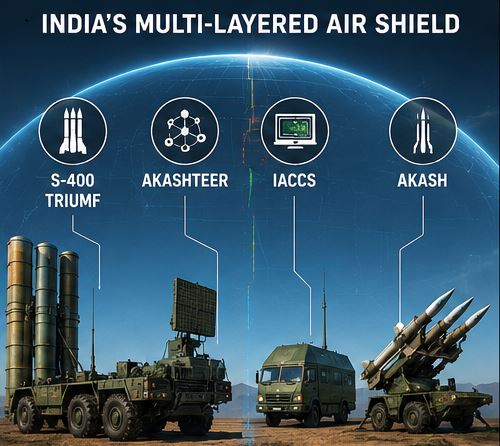
Defensive Systems — India’s Multi-Layered Air Shield
| System | Type | Origin | Performance in Operation Sindoor |
|---|---|---|---|
| S-400 Triumf | Long-range surface-to-air missile | Russia | Combat debut in Indian service; intercepted PAF AEW&C at world-record 314 km; forced Pakistan Air Force to reassess its operational envelope |
| Akashteer | Automated air-defence control system | India (indigenous) | Indian Army’s network-centric air-defence grid; coordinated all anti-drone and missile interceptions |
| IACCS | Integrated Air Command and Control System | India (indigenous) | IAF’s real-time battle management system; coordinated strike and defence vectors simultaneously |
| Akash | Medium-range surface-to-air missile | India (indigenous) | Intercepted multiple Pakistani drone swarms and ballistic missiles during Pakistan’s retaliatory phase |
Intelligence & Space Assets
- ISRO satellitesprovided real-time imagery for target identification and battle damage assessment
- NavIC(India’s indigenous navigation system) integrated into weapons guidance, reducing reliance on GPS
- NTRO intelligence inputs(National Technical Research Organisation) reportedly fed real-time electronic intelligence into battlefield decisions
- India releasedsatellite imagery and battle damage assessment datapublicly, countering Pakistani disinformation narratives at the international level
- C4I2SR architecture(Command, Control, Communications, Computers, Intelligence, Information, Surveillance, Reconnaissance) enabled seamless tri-service coordination across IAF, Army, and Navy
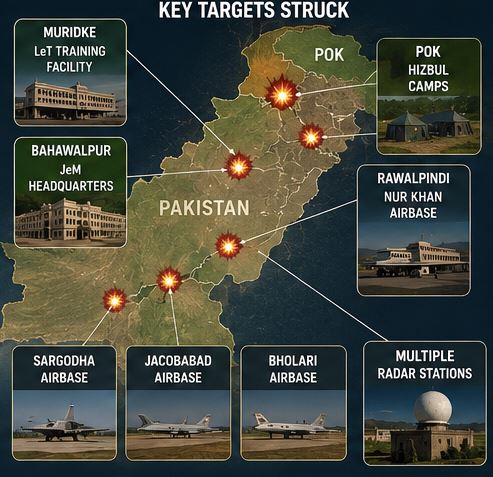
Key Targets Struck — What Was Destroyed
| Target | Location | Organisation | Significance |
|---|---|---|---|
| JeM Headquarters | Bahawalpur | Jaish-e-Mohammed | Primary command and control centre of JeM — the group behind the Pulwama Attack and multiple attacks; struck by BrahMos + SCALP |
| LeT Training Facility | Muridke | Lashkar-e-Taiba | Main training ground for LeT; used to train attackers involved in the 2008 Mumbai Attacks; struck by SCALP + Crystal Maze |
| Hizbul Mujahideen Camps | Pakistan-occupied Kashmir | Hizbul Mujahideen | Multiple launchpad camps in PoK targeting Jammu & Kashmir |
| Nur Khan Airbase | Rawalpindi | Pakistan Air Force | Strategic airbase; struck in counter-escalation phase after Pakistan hit Indian targets |
| Sargodha Airbase | Sargodha | Pakistan Air Force | Key PAF fighter base; satellite imagery showed extensive damage |
| Jacobabad Airbase | Jacobabad | Pakistan Air Force | Forward operating base; radar and command infrastructure struck |
| Bholari Airbase | Sindh | Pakistan Air Force | Air defence node; degraded Pakistani radar coverage in the south |
| Multiple Radar Stations | Pakistan | Pakistan Armed Forces | Systematically targeted by Harop, Harpy, and PALM loitering munitions to degrade Pakistan’s “see-coordinate-respond” capability |
India’s New Security Doctrine — Strategic Significance
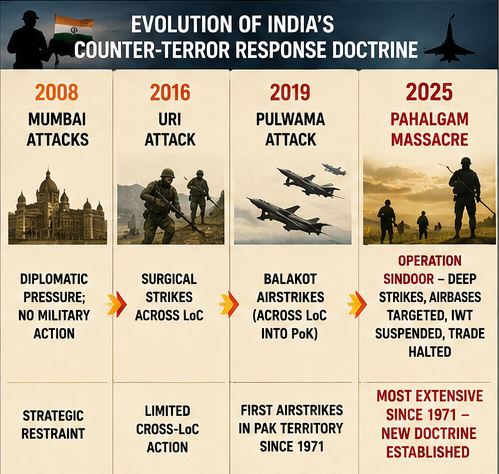
Operation Sindoor represents a watershed shift in India’s national security doctrine. For decades, India’s response to Pakistan-backed terrorism followed a policy of strategic restraint — absorbing provocations, pursuing diplomatic channels, and occasionally conducting limited covert operations. Operation Sindoor broke this pattern decisively.
| Event | Year | India’s Response | Depth of Response |
|---|---|---|---|
| 2008 Mumbai Attacks | 2008 | Diplomatic pressure; no military action | Strategic restraint |
| Uri Attack | 2016 | Surgical strikes across LoC | Limited cross-LoC action |
| Pulwama Attack | 2019 | Balakot airstrikes (across LoC into PoK) | First airstrikes in Pakistani territory since 1971 |
| Pahalgam Massacre | 2025 | Operation Sindoor — deep strikes into mainland Pakistan, Pakistani airbases targeted, Indus Waters Treaty suspended, trade halted | Most extensive since 1971 — new doctrine established |
The “New Normal” — What Has Changed
- Nuclear deterrence threshold redefined— India “called Pakistan’s nuclear bluff” (Vice Admiral AN Pramod) by striking deep inside Pakistani territory despite the nuclear overhang, demonstrating that conventional escalation can be managed below the nuclear threshold
- Water as a strategic instrument— the Indus Waters Treaty (1960), which survived three wars and multiple crises over 65 years, is now conditionally suspended; India’s PM declared “blood and water cannot flow together”
- Air superiority achieved within 72 hours— US experts assessed India had established air dominance over Pakistan within three days, a capability benchmark India publicly demonstrated
- Indigenous defence vindicated— Akashteer, IACCS, Akash, NavIC, and BrahMos all performed under combat conditions, validating Aatmanirbhar Bharat’s defence manufacturing push
- Multi-domain, tri-service operations— seamless coordination of Army (Akashteer), Air Force (IACCS, Rafale, Su-30MKI), Navy (positioned in Arabian Sea), and Space/Intelligence (ISRO, NTRO, NavIC)
The Indus Waters Treaty — Water as a New Dimension
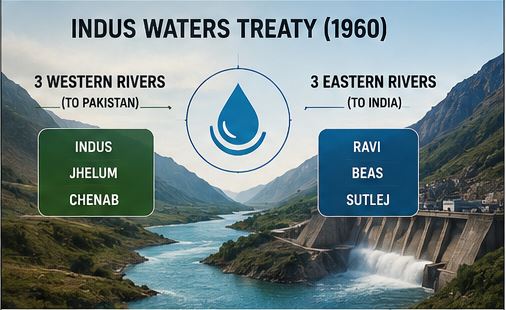
TheIndus Waters Treaty (IWT) of 1960, brokered by the World Bank between India and Pakistan, is one of the most durable water-sharing agreements in the world — having survived the 1965 war, the 1971 war, and the 1999 Kargil conflict. India’s decision to put it “in abeyance” after the Pahalgam attack marks the most consequential use of water as a diplomatic instrument in the India-Pakistan relationship.
| Feature | Detail |
|---|---|
| Treaty signed | Indus Waters Treaty signed in 1960; brokered by the World Bank; allocated 3 western rivers — Indus River, Jhelum River, and Chenab River — to Pakistan and 3 eastern rivers — Ravi River, Beas River, and Sutlej River — to India |
| Why unfair to India | India given control of only ~19.48% of the Indus system water; Pakistan received 80%+ despite being downstream; India’s hydropower projects on western rivers repeatedly obstructed |
| When suspended | April 23, 2025 — immediately after the Pahalgam Massacre; Baglihar Dam gates on the Chenab shut |
| Current status (May 2026) | Still in abeyance; Ministry of External Affairs reaffirmed on anniversary that the treaty remains suspended “until Pakistan credibly and irrevocably ends support for cross-border terrorism” |
| India’s leverage | Kiru Hydroelectric Project, Kwar Hydroelectric Project, Baglihar Dam, and Dul Hasti Hydroelectric Plant projects on western rivers; increased water storage and diversion now possible without treaty constraints |
| Pakistan’s vulnerability | Pakistan heavily depends on the Indus basin for agriculture; over 90% of food-crop irrigation relies on the river system; prolonged suspension affects Punjab and Sindh harvests |
| PM Modi’s phrase | Narendra Modi stated: “Blood and water cannot flow together” during the 2025 Independence Day speech — symbolising India’s linkage of water-sharing with terrorism policy |
Diplomatic and International Dimension
Prelims Question
1. Operation Sindoor was launched in response to the Pahalgam terror attack on April 22, 2025, in which 26 civilians were killed on the basis of their religion.
2. The operation marked India’s first use of airstrikes inside Pakistani territory since the Bangladesh Liberation War of 1971.
3. India’s S-400 Triumf air defence system recorded the world’s longest-range surface-to-air missile kill in combat during the operation.
4. The Indus Waters Treaty (1960) was permanently abrogated by India after the Pahalgam attack as part of Operation Sindoor’s diplomatic component.
Which of the statements given above are correct?
Statement 1 is CORRECT. The Pahalgam massacre occurred on April 22, 2025, at Baisaran meadow in Jammu & Kashmir. Pakistan-backed TRF (The Resistance Front — a shadow outfit of Lashkar-e-Taiba) gunmen identified and executed 26 civilians on the basis of their religion in a calculated attempt to incite communal violence in India. One Nepali national was also among those killed.
Statement 2 is CORRECT. The Balakot airstrikes of 2019 (post-Pulwama) entered PoK/Pakistani-controlled territory, but the targets were in Khyber Pakhtunkhwa — some classify this as crossing into Pakistan. Operation Sindoor, however, unambiguously struck deep into mainland Pakistan — Bahawalpur (Punjab province, ~1,000 km from LoC) and Muridke (near Lahore) — making it the most extensive and deepest airstrikes in Pakistani territory since 1971 by broad strategic consensus.
Statement 3 is CORRECT. During Operation Sindoor, India’s S-400 Triumf system recorded a combat intercept of a Pakistan Air Force AEW&C (Airborne Early Warning and Control) aircraft at approximately 314 km range — assessed by defence analysts as the world’s longest-range surface-to-air missile kill in recorded combat history. This was the S-400’s combat debut in Indian service.
Statement 4 is INCORRECT. The Indus Waters Treaty was NOT abrogated (permanently cancelled) — it was put “in abeyance” (temporarily suspended). This is a legally and diplomatically significant distinction. On the anniversary (May 7, 2026), India’s MEA confirmed the treaty remains suspended, conditional on Pakistan ending cross-border terrorism, but the treaty has not been formally terminated.
Mains Questions
“Operation Sindoor represents not merely a military operation but a fundamental recalibration of India’s national security doctrine — signalling an irreversible shift from strategic restraint to proactive, technology-driven punitive retaliation.” Critically examine this assessment with reference to the evolution of India’s counter-terrorism strategy, the technologies deployed in the operation, and the lessons for India’s long-term defence preparedness.

- India’s Youth Unemployment and Education Crisis - August 5, 2026
- India’s Sports Infrastructure and the 2036 Olympics Ambition - August 5, 2026
- Critical Minerals: The Foundation of Strategic Power - August 4, 2026

No Comments