


11 May Governor’s Role in Government Formation — Powers & Controversies
This article covers “Daily Current Affairs”
SYLLABUS MAPPING : GS Paper 2 : Polity and Governance.
FOR PRELIMS : Constitutional Framework , Key Judgments , Hung Assembly
FOR MAINS : “The recurring controversies over Governors’ conduct in hung Assemblies — from Goa and Manipur in 2017 to Karnataka in 2018 and Maharashtra in 2019 — reveal a structural tension at the heart of India’s quasi-federal system: the Governor as constitutional head vs. the Governor as agent of the Centre.” Critically evaluate this tension and suggest measures to restore the credibility of the Gubernatorial office. (15 M)
Why in News?
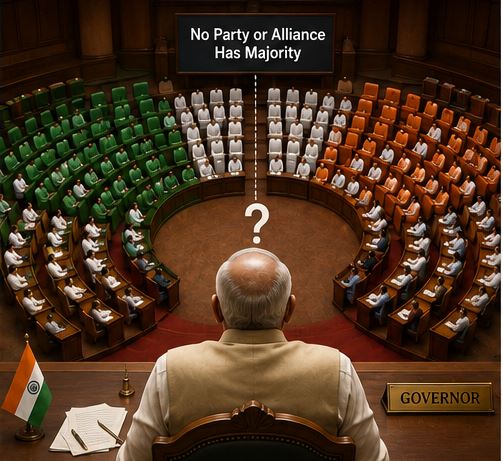
The Tamilaga Vettri Kazhagam (TVK), led by actor-politician Vijay, secured 108 seats in the recently concluded Tamil Nadu Assembly elections — 10 short of the 118-seat majority mark in the 234-member House, resulting in the state’s first-ever hung Assembly. With hectic parleys underway and letters of support from 120 members eventually submitted to the Governor, the constitutional spotlight has turned sharply on Tamil Nadu Governor Rajendra Arlekar — and the crucial question of when, how, and in what order a Governor may exercise discretionary power to invite a party to form the government. This episode has revived a longstanding constitutional debate about the scope, limits, and accountability of Gubernatorial discretion in government formation.
The Constitutional Framework — Key Articles
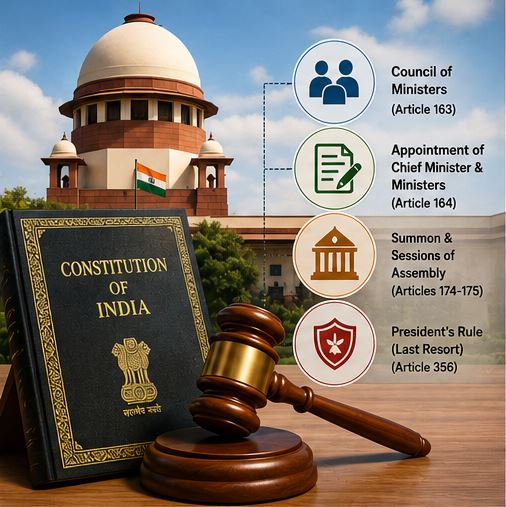
The Governor’s role in government formation is governed by a cluster of constitutional provisions, none of which explicitly defines the procedure for a hung Assembly. This “constitutional silence” — a phrase introduced by legal scholar H. Tribe — is precisely what makes the Governor’s discretion both necessary and contested.
Article 163(1): There shall be a Council of Ministers to aid and advise the Governor in the exercise of his functions, except in so far as he is required to exercise his functions or any of them in his discretion.
Article 163(2): If any question arises whether a matter falls within the Governor’s discretion, the Governor’s decision is final and cannot be called in question. This makes the Governor the sole judge of when he is acting in discretion — a clause that has generated significant judicial controversy.
“The Chief Minister shall be appointed by the Governor and the other Ministers shall be appointed by the Governor on the advice of the Chief Minister, and the Ministers shall hold office during the pleasure of the Governor.”
The Constitution does not prescribe the criteria for selecting the Chief Minister in a hung Assembly. It does not define “majority,” “largest party,” or “coalition” — leaving the Governor wide discretion. However, constitutional conventions, commission recommendations, and Supreme Court judgments have progressively built a binding rulebook around this discretion.
Article 174: Governor can summon, prorogue, or dissolve the Legislative Assembly.
Article 175: Governor can call for a special session — the constitutional basis for ordering a floor test.
Article 356: Governor can recommend President’s Rule if constitutional governance fails — but this is a last resort after all alternatives for government formation are exhausted.
Article 200: Governor’s assent to bills — a separate but related area of frequent Gubernatorial controversy.
What is a Hung Assembly?
A hung assembly arises when no single political party or pre-election alliance secures the majority of seats in a state Legislative Assembly. The Indian Constitution does not define the term — a gap that constitutional scholar Granville Austin attributed to the framers not foreseeing a scenario where no single party would achieve a majority, given the dominance of the Congress party at independence.
- The Governor steps in as the key constitutional officer to decide who receives the first invitation to form the government
- Unlike in a clear-majority situation (where the Governor must invite the leader of the majority party), in a hung Assembly the Governor exercises personal discretion guided by constitutional conventions
- A pro-tem Speaker is appointed — usually the most senior elected legislator — to administer the oath to MLAs and conduct a floor test if called
- The Governor fixes a time for the Chief Minister-designate’s oath of office, which is then followed by a floor test to confirm majority in the House
- If government formation fails, the Governor may recommend President’s Rule under Article 356 — but only as an absolute last resort after exhausting all options
The Sarkaria Commission Order of Priority (1988)
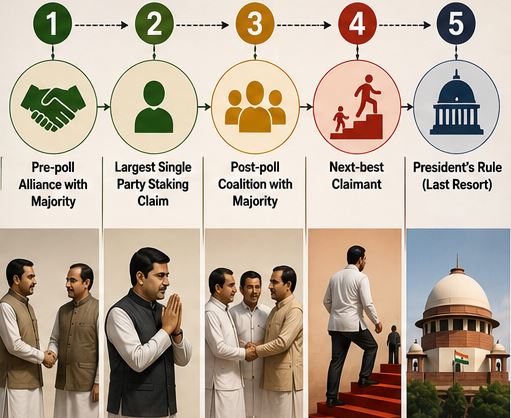
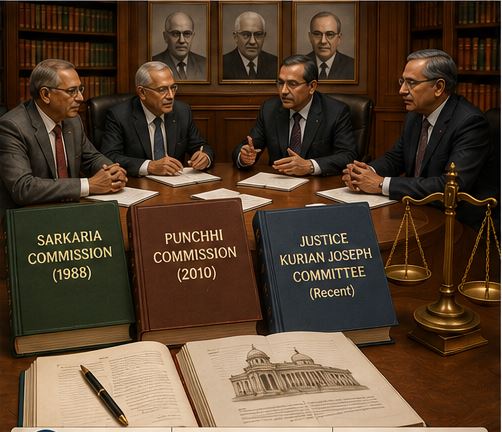
The Sarkaria Commission on Centre-State Relations (1988), headed by former Supreme Court judge RS Sarkaria, laid down a structured order of preference for Governors to follow in a hung Assembly. The Punchhi Commission (2010) broadly endorsed this order while adding that Governors must act with constitutional neutrality and not as political agents. This Sarkaria-Punchhi sequence is now treated as a binding rulebook by the Supreme Court.
Supreme Court’s Evolving Jurisprudence — Key Judgments
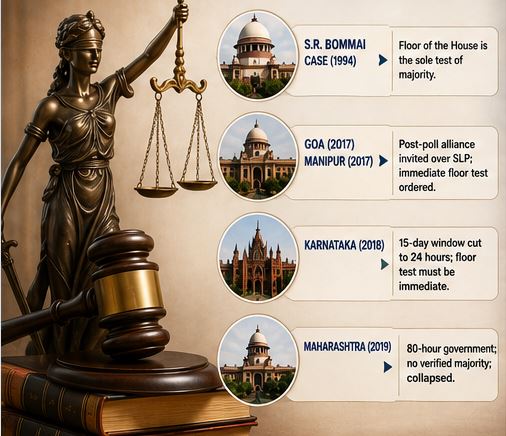
The Supreme Court categorically held that the “floor of the House” is the constitutionally ordained forum for testing a government’s majority support. The Governor cannot make a private assessment of legislative support — only the Assembly itself can determine whether a government enjoys the confidence of a majority. This judgment significantly curtailed arbitrary dismissal of state governments and misuse of Article 356. Reaffirmed in the Rameshwar Prasad case (2006).
The Congress won 17 of 40 seats (largest single party) but did not stake a claim. The BJP (13 seats) did — producing a post-poll arithmetic of 21 by bringing in MGP, Goa Forward Party, and two independents. The Governor invited the BJP. Congress moved the Supreme Court. The Court declined to stay the swearing-in but compressed the Governor’s 15-day window to a single-agenda floor test. Parrikar prevailed 22-16. The Court established: an invitation to a post-poll combine over the SLP is constitutionally valid — provided an immediate floor test follows.
Congress won 28 of 60 seats (largest party). BJP had 21. The Governor invited the BJP-led alliance, which had stitched together a post-poll coalition crossing the 31-seat mark. The Court again declined to interfere but ordered an immediate floor test. Same principle as Goa — post-poll alliance invited over the largest single party.
BJP won 104 of 224 seats (largest single party, short of 112-majority). Congress-JD(S) formed a post-poll alliance claiming 117 seats — clearly above majority. The Governor controversially invited BJP’s BS Yediyurappa and gave him 15 days to prove majority — despite a numerically stronger coalition already existing. The Supreme Court slashed this to 24 hours in a midnight hearing, describing the delay as constitutionally impermissible. Yediyurappa resigned before the floor test. Karnataka 2018 exposed the double standard — the identical logic used by Governors in Goa and Manipur (post-poll alliance over SLP) was reversed in Karnataka.
After results, the Shiv Sena-BJP alliance broke down. Governor Koshyari swore in BJP’s Devendra Fadnavis as CM and Ajit Pawar (NCP rebel) as Deputy CM in an early-morning ceremony — without verifying whether they commanded majority. The government collapsed within 80 hours. The episode reinforced two lessons: the Court will compress any timetable Raj Bhavan stretches, and where a first invitation collapses, the Sarkaria sequence resumes for the next claimant.
| State / Year | Total Seats (Majority Mark) | Single Largest Party (SLP) | Governor’s Action | Outcome / Supreme Court Response |
|---|---|---|---|---|
| Goa (2017) | 40 (21) | Congress – 17 | Invited BJP (13 seats) after post-poll alliance claimed support of 21 MLAs | SC upheld the invitation; floor test ordered within 1 day; BJP won trust vote 22–16 |
| Manipur (2017) | 60 (31) | Congress – 28 | Invited BJP (21 seats) after post-poll alliance crossed majority mark | SC declined to interfere with Governor’s discretion; immediate floor test ordered |
| Karnataka (2018) | 224 (112) | BJP – 104 | Invited BJP despite Congress–JDS alliance claiming support of 117 MLAs | SC held midnight hearing; reduced 15-day floor-test window to 24 hours; B.S. Yediyurappa resigned before vote |
| Maharashtra (2019) | 288 (145) | BJP – 105 | Swore in Devendra Fadnavis and Ajit Pawar without verified majority support | 80-hour government collapsed before floor test; SC ordered immediate trust vote |
| Tamil Nadu (2026) | 234 (118) | TVK – 108 | Letters of support from 120 MLAs reportedly submitted; Governor yet to decide | Situation under active constitutional scrutiny; Sarkaria Commission sequence likely to be relevant |
Commission Recommendations — A Comparative View
| Commission / Committee | Year | Key Recommendations on Government Formation & Governor’s Role | Binding Force / Status |
|---|---|---|---|
| Sarkaria Commission | 1988 | Proposed a 5-step order of priority for inviting a party/alliance to form government: (1) pre-poll alliance with majority, (2) single largest party with support, (3) post-poll coalition with majority, (4) post-electoral alliance, and finally (5) President’s Rule if no stable government possible. Recommended that Governors be eminent, politically neutral persons with no recent active political role. Also advised that Governors should not exercise powers unrelated to their constitutional duties. | Constitutional conventions only — not legally binding, but repeatedly endorsed by the Supreme Court |
| Punchhi Commission | 2010 | Broadly reaffirmed the Sarkaria framework. Emphasised that Governors must act with constitutional neutrality and not as agents of the Union government. Recommended mandatory and immediate floor tests in cases of doubt. Clarified that pre-poll alliances should receive preference over post-poll coalitions. Suggested incorporating these principles into a separate constitutional Schedule. | Recommendatory in nature — not binding law, though supported in later judicial reasoning |
| Justice Kurian Joseph Committee | Recent | Recommended codifying the Governor’s discretionary powers and government-formation rules into a constitutionally enforceable framework through a new Schedule to the Constitution. Aim: reduce arbitrariness, ensure judicial enforceability, and remove subjectivity in gubernatorial decisions. | Not enacted so far — remains a major pending constitutional reform proposal |
Tamil Nadu 2026 — Applying the Constitutional Rulebook
Tamil Nadu’s first-ever hung Assembly has provided a live case study in constitutional governance. The TVK’s 108 seats make it the single largest party — but short of the 118-seat majority. The DMK secured 59 seats, the AIADMK 47, and Congress 5. No pre-poll alliance commands a majority.
Why the Governor’s Conduct Has Raised Concerns
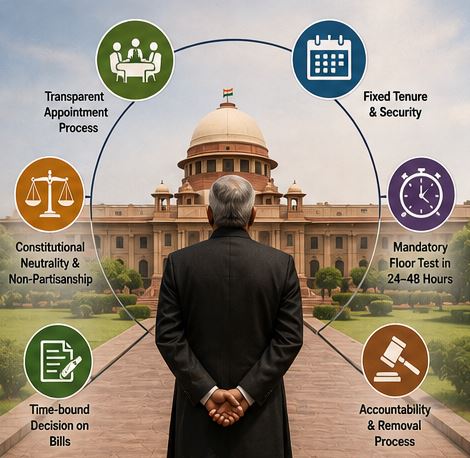
The use of discretionary powers by Governors has been subject to various court pronouncements. Nevertheless, judicial differences in interpretation have resulted in inconsistent application of constitutional principles, allowing critics to argue that Governors have repeatedly functioned as agents of the Central government rather than impartial constitutional heads.
- Partisan invitations:In Goa and Manipur (2017), Governors bypassed the SLP (Congress) to invite BJP-led post-poll alliances — then in Karnataka (2018), thesamelogic was reversed in BJP’s favour as the SLP. This double standard exposed political calculation, not constitutional principle
- Unverified swearing-in:Maharashtra 2019 — Fadnavis was sworn in without any verified floor majority. The Governor did not even ensure an immediate floor test, creating an unconstitutional fait accompli
- Delay in bill assent:Tamil Nadu Governor R.N. Ravi delayed assent to 12 bills; Punjab Governor withheld assent for two years — both triggering Supreme Court intervention (2023)
- Appointment without proper criteria:The Constitution prescribes no qualifications for Governor; appointments have frequently been seen as rewards for retired politicians or party loyalists, undermining the neutrality of the office
- Accountability deficit:Unlike the Chief Minister (accountable to the legislature), the Governor is accountable only to the President and can be removed at the Union government’s discretion under Article 156 — creating a structural bias toward the ruling party at the Centre.
Way Forward
Prelims Question
Q. With reference to the Governor’s role in government formation in a hung Assembly, consider the following statements:
1. Article 164(1) of the Constitution prescribes a specific order of priority that the Governor must follow in a hung Assembly for inviting parties to form the government.
2. The Sarkaria Commission (1988) recommended that in a hung Assembly, the Governor should first invite a pre-poll alliance commanding a majority, and only then the single largest party.
3. In S.R. Bommai v. Union of India (1994), the Supreme Court held that the floor of the House — not the Governor’s private assessment — is the constitutionally ordained forum to test majority support.
4. The Punchhi Commission (2010) recommended codifying the Governor’s discretionary powers in a new Schedule to the Constitution to make the rules judicially enforceable.
Which of the statements given above are correct?
Correct Answer: (b) 2, 3 and 4 only
Statement 1 is INCORRECT. Article 164(1) simply states that “the Chief Minister shall be appointed by the Governor” — it does NOT prescribe any specific order of priority for a hung Assembly. This is precisely the constitutional silence that political scientist K.V. Rao attributed to the framers’ assumption that a single party would always command a majority. The order of priority comes from the Sarkaria Commission recommendations and Supreme Court conventions — not from the Constitution itself.
Statement 2 is CORRECT. The Sarkaria Commission (1988) laid down a structured 5-step order: (1) pre-poll alliance with majority, (2) largest single party with declared support, (3) post-poll coalition with majority, (4) next-best claimant, (5) President’s Rule as last resort. This was endorsed and extended by the Punchhi Commission in 2010 and has been treated as a binding rulebook by the Supreme Court.
Statement 3 is CORRECT. SR Bommai v. Union of India (1994) is the landmark judgment that firmly established that the floor of the House — not any private assessment by the Governor — is the only constitutionally valid forum for testing a government’s majority. This judgment fundamentally curtailed the arbitrary dismissal of state governments under Article 356 and was reaffirmed in Rameshwar Prasad (2006).
Statement 4 is CORRECT. The Punchhi Commission (2010), headed by former Chief Justice MM Punchhi, recommended that the rules governing the Governor’s discretionary powers should be codified and incorporated into a new Schedule to the Constitution. This would convert the current conventions (which carry no binding legal force of their own) into constitutionally enforceable rules — a reform that remains pending and was further endorsed by the Justice Kurian Joseph Committee.
Mains Questions
“The Governor’s role in government formation in a hung Assembly represents one of the most constitutionally sensitive — and politically contested — exercises of discretion in India’s parliamentary democracy.” Examine the constitutional provisions governing this discretion, the guidelines provided by commissions and courts, and the reforms needed to depoliticise and codify the process. (15M)

- India’s Youth Unemployment and Education Crisis - August 5, 2026
- India’s Sports Infrastructure and the 2036 Olympics Ambition - August 5, 2026
- Critical Minerals: The Foundation of Strategic Power - August 4, 2026

No Comments