


12 May Mission Divyastra 2.0: India’s Agni-5 MIRV
This article covers “Daily Current Affairs”
SYLLABUS MAPPING : GS Paper 2,3 : S&T , Security , IR
FOR PRELIMS : Mission Divyastra , Agni Missiles Family , MIRV Technology
FOR MAINS : “The second successful test of Mission Divyastra represents not merely a technological achievement but a strategic recalibration — India is no longer content with a reactive nuclear posture, it is building a sophisticated, survivable, and multi-target strike capability.” Critically examine the technology behind MIRV, its strategic implications for India’s nuclear doctrine, and its impact on deterrence stability in the Indo-Pacific. (15 M)
Why in News?
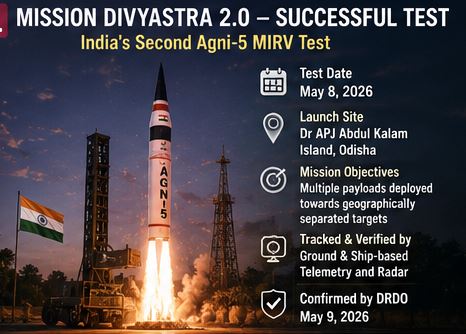
On May 8, 2026, India successfully conducted its second flight test of an advanced Agni missile equipped with MIRV (Multiple Independently Targetable Re-entry Vehicle) technology under Mission Divyastra, from Dr APJ Abdul Kalam Island, Odisha. The Defence Ministry confirmed that all mission objectives were achieved — multiple payloads were deployed toward geographically separated targets across a large area of the Indian Ocean Region, tracked and verified by ground- and ship-based telemetry and radar stations. Coming exactly one year after Operation Sindoor and amid China’s aggressive nuclear modernisation — including new silo fields in Xinjiang and expanded MIRV-capable ICBMs — the test carries enormous strategic significance. DRDO confirmed the success on May 9, 2026. Defence Minister Rajnath Singh linked the test to India’s “growing threat perceptions,” widely interpreted as pointing to China’s nuclear build-up. With two successful MIRV tests now completed, India is considered to be on the path to operationalising the MIRV-equipped Agni-5 with the Strategic Forces Command in the near future, joining the exclusive club of six nations — USA, Russia, China, France, UK, and now India — with proven operational MIRV capability.
What is MIRV Technology? — Explained Simply
The Core Concept
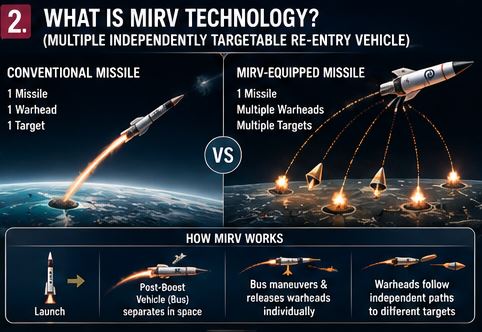
A conventional ballistic missile carries one warhead — it is launched, arcs through space, re-enters the atmosphere, and detonates at a single target. MIRV technology — Multiple Independently Targetable Re-entry Vehicle — allows a single missile to carry several warheads, each of which can be independently guided to a completely different target — separated by hundreds of kilometres. The missile launches once, reaches space, and then deploys its warheads one by one, each on its own trajectory to a distinct aim point. Think of it as one rocket delivering several precision packages to separate addresses simultaneously.
The Post-Boost Vehicle (PBV) — How MIRV Works Technically
A MIRV-equipped missile contains a special compartment called thePost-Boost Vehicle (PBV)or “Bus” — a manoeuvrable platform mounted atop the missile’s final stage. After the main rocket burns out and the missile arcs into space, the Bus fires small thrusters to adjust its trajectory before releasing each warhead one at a time at precisely calculated points in space. Each warhead then follows its ownindependent ballistic trajectoryto a separate target. The Bus can also releasedecoys— lightweight objects that mimic a real warhead on enemy radar, overwhelming and confusing missile defence systems.
Why MIRV technology is so difficult to develop
- Miniaturised warhead design:Each warhead must be made compact enough to fit multiple in one missile without exceeding weight limits — requiring advanced nuclear engineering and precision manufacturing
- High-accuracy guidance:Each re-entry vehicle needs its own precision inertial navigation and terminal guidance system — extremely difficult at hypersonic speeds of re-entry
- Bus engineering:The PBV must fire precise micro-thruster burns in the vacuum of space — a sophisticated feat of aerospace engineering
- Heat shield survivability:Warheads re-enter the atmosphere at extreme speeds (Mach 15–20+) generating temperatures of thousands of degrees — India usescarbon composite materialsto ensure the warhead survives re-entry without disintegrating
- Decoy integration:Developing lightweight decoys that convincingly mimic real warheads on enemy radar systems requires understanding of enemy sensor physics — a deeply classified science
- India’s ISRO advantage:MIRV guidance technology was quietly perfected on ISRO’s PSLV commercial launches — where a single rocket placed multiple satellites in separate orbits, the exact same technical challenge as guiding multiple warheads to separate targets
Agni-5 — Complete Technical Profile
| Parameter | Specification | Significance |
|---|---|---|
| Classification | Intermediate-range / ICBM-class ballistic missile | Officially classified IRBM by India; Chinese officials have always called it an ICBM (range exceeds 5,500 km ICBM threshold) |
| Developer | Defence Research and Development Organisation (DRDO) | Fully indigenously developed — Aatmanirbhar Bharat in strategic systems |
| Propulsion | Three-stage, solid-fuelled; composite motor casing in Stages 2 & 3 | Solid fuel = faster launch time (minutes, not hours); no liquid fuelling delay; canister-based for instant deployment |
| Range (base) | 5,400 km | Covers entire China — launched from central India, reaches all Chinese cities including Beijing |
| Range (extended) | 7,000+ km | Covers parts of Europe and Africa; qualifies as ICBM by most international definitions |
| Speed | Mach 24 (~29,400 km/h) | One of the fastest ballistic missiles in the world; essentially impossible to intercept with current BMD systems |
| MIRV capacity | 10–12 independently targetable warheads | Plus decoys; each warhead independently guided; overwhelms any missile defence system |
| Launch platform | Road-mobile, canisterised (Tatra truck) | Mobile = survivable; cannot be pre-empted by enemy first strike; canister = hermetically sealed, all-weather readiness |
| Navigation | Indigenous avionics; high-accuracy inertial navigation + sensor packages | Fully indigenous — no foreign guidance system dependency |
| Warhead material | Carbon composite re-entry vehicles | Survives temperatures of thousands of degrees during hypersonic re-entry |
| Deployment status | Base (single-warhead) variant: deployed with SFC since 2018; MIRV variant: under operational trials (2026) | 50+ Agni-5 launchers operational by 2026 |
| First test | April 19, 2012 — from Abdul Kalam Island | Maiden flight; 1,130 seconds total duration; demonstrated intercontinental range capability |
| First MIRV test | March 11, 2024 — Mission Divyastra | India became 6th nation with operational MIRV capability |
| Second MIRV test | May 8, 2026 — Mission Divyastra 2.0 | Validates and refines MIRV system; operationalisation expected imminently |
Mission Divyastra — Chronological History
Strategic Significance — Why MIRV Changes Everything
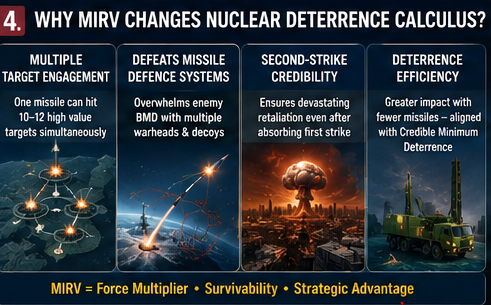
One Agni-5 missile can now simultaneously destroy 10–12 high-value targets — enemy command centres, airfields, missile silos, nuclear storage sites — distributed across hundreds of kilometres. Previously this required 10–12 separate missiles. Force multiplier effect: same strike capability with far fewer launches
Enemy BMD systems are designed to intercept a single incoming warhead. A MIRV missile releases multiple warheads simultaneously alongside decoys — overwhelming the tracking and interception capacity of any known defence system. China’s HQ-19 and Pakistan’s BMD systems cannot reliably intercept a MIRV salvo
Under India’s No First Use (NFU) doctrine, India must absorb an enemy nuclear first strike before retaliating. With fewer surviving missiles post-attack, each surviving MIRV-equipped missile inflicts 10x the damage of a single-warhead missile — dramatically strengthening the credibility of India’s retaliatory threat even after taking first-strike losses
India’s nuclear doctrine is Credible Minimum Deterrence — maintaining the smallest arsenal needed to deter adversaries. MIRV allows India to maintain this principle while maximising the strategic effect of a limited warhead inventory — fewer missiles needed to cover the same target set
India’s Nuclear Doctrine — Where MIRV Fits
| Doctrine pillar | What it means | How MIRV strengthens it |
|---|---|---|
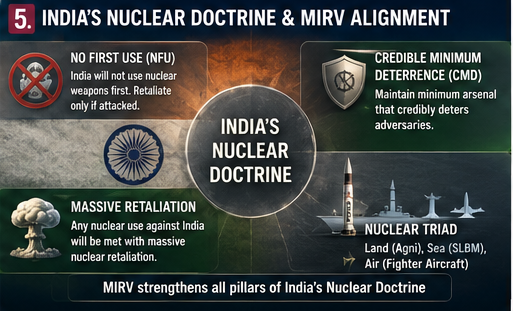
| No First Use (NFU) | India will not use nuclear weapons first; will only retaliate if struck with nuclear, biological, or chemical weapons | MIRV ensures that even a degraded second-strike force — after absorbing a first strike — can deliver devastating retaliation to multiple adversary cities and military sites simultaneously |
| Credible Minimum Deterrence (CMD) | Maintain the smallest arsenal that credibly deters adversaries — not a warhead-for-warhead arms race | MIRV maximises deterrence value per missile; fewer missiles are needed to cover the same target set — fully consistent with CMD philosophy |
| Massive Retaliation | Any nuclear use against India will be met with massive nuclear retaliation | A MIRV salvo from surviving missiles post-first-strike delivers the “massive” in massive retaliation — multiple cities and military infrastructure struck simultaneously |
| Nuclear Triad | Three delivery platforms: land (Agni missiles), sea (K-4 SLBM, INS Arihant class), air (Rafale, Jaguar) | MIRV currently integrated into the land-based leg; expected to expand to SLBM (K-4, K-6) — completing a survivable MIRV-capable triad |
| Civilian supremacy | Nuclear Command Authority (NCA) chaired by PM; political authorisation required for any nuclear use | Strategic Forces Command (SFC) operationalises NCA decisions; 50+ Agni-5 launchers under SFC control by 2026. |
Countries with this Technology
| Country | MIRV capability status | Key MIRV missile | Warheads per missile | Note |
|---|---|---|---|---|
| USA | Operational (1970s) | Minuteman III, Trident D5 | Up to 16 | Pioneer of MIRV; reduced warheads under arms control treaties |
| Russia | Operational (1970s) | RS-28 Sarmat, RS-24 Yars | Up to 16 | Most MIRV-capable warheads globally; hypersonic glide vehicles also being added |
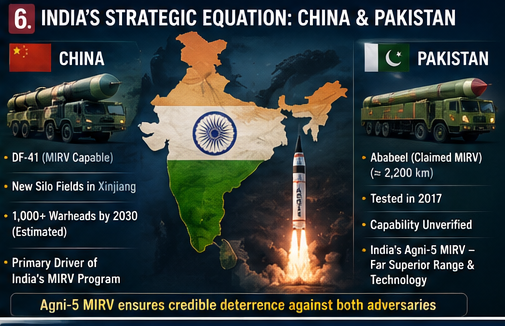
| China | Operational (expanding rapidly) | DF-41, DF-5B | 3–10 | Fastest-growing MIRV programme; new silo fields in Xinjiang; primary driver of India’s MIRV push |
| UK | Operational | Trident D5 (Vanguard class) | Up to 8 | Shares US Trident system; sea-based only |
| India | Operational trials (2024–2026) | Agni-5 (Mission Divyastra) | 10–12 (+ decoys) | 2nd test May 8, 2026; operationalisation imminent; 6th confirmed MIRV nation |
| Pakistan | Claimed (unverified) | Ababeel (~2,200 km) | Claimed; unverified | Tested 2017; programme maturity questioned by independent analysts |
| Turkey | Announced (in development) | Claimed ICBM 6,000 km range | Unknown | Announced May 2026; no operational confirmation yet |
Indian-made technologies that enabled Mission Divyastra
- Carbon composite re-entry vehicles: Indigenously developed heat-resistant carbon composite materials protect warheads during hypersonic re-entry — without this, the warhead disintegrates before reaching the target
- Electro-mechanical actuators (Stage 1): Replaced older, heavier hydraulic actuators in Agni-5’s first stage — reduces weight, eliminates oil leakage risks, and improves reliability; already used in Stages 2 and 3
- Indigenous avionics and Guidance System-on-Chip (SoC): MIRV guidance technology perfected domestically; no foreign guidance system; SoC tested covertly via PSLV-C20 multi-satellite launch in 2013
- Canister-based cold-launch system: The missile is stored in a hermetically sealed canister mounted on a Tatra truck — can be launched within minutes, in any weather, from multiple locations — mobile survivability
- Private sector integration: Tata Advanced Systems and L&T Defence supply composite components for Agni-5 — a key milestone in India’s defence privatisation under Aatmanirbhar Bharat
- ISRO technology transfer: PSLV multi-payload deployment technology directly informed the Bus/PBV engineering — India’s space programme has been a hidden strategic enabler of MIRV capability
Agni Family Developments
| Missile | Range | MIRV status | Development note |
|---|---|---|---|
| Agni Prime (Agni-P) | ~1,000–2,000 km | Planned — technology finalised on Agni-P first | Canisterised; lighter composite design; MIRV to be integrated after Agni-5 operationalisation |
| Agni-IV | ~4,000 km | Planned — post Agni-5 MIRV operationalisation | Will receive MIRV capability once Agni-5 MIRV is fully deployed |
| Agni-5 (MIRV) | 5,400–7,000+ km | Tested (2024, 2026); operationalisation imminent | 50+ launchers already with SFC; MIRV variant joining them soon |
| Agni-5 (Bunker buster) | 2,500–3,000 km | Under development (DRDO 2025) | Air-burst + deep-penetrating variants; Mach 8–20; targets hardened Chinese and Pakistani underground facilities |
| Agni-VI | 8,000–10,000+ km | No government proposal yet (2026) | Originally the planned MIRV carrier; government reprioritised to Agni-5 MIRV first; Agni-VI remains a future programme |
| K-4 / K-6 SLBM | 3,500 / 6,000+ km | K-4 tested; MIRV integration planned | Sea-based leg of nuclear triad (INS Arihant, INS Arighaat); MIRV-capable K-4 and future K-6 will complete survivable triad |
Prelims Question
1. MIRV (Multiple Independently Targetable Re-entry Vehicle) technology allows a single missile to carry multiple warheads, each capable of being directed to a completely different target, and can also carry decoys to defeat enemy missile defence systems.
2. With the first successful test of Mission Divyastra in March 2024, India became the fifth nation — after the USA, Russia, China, and the UK — to demonstrate operational MIRV capability.
3. The MIRV guidance technology used in India’s Agni-5 was indigenously developed, and was covertly tested using ISRO’s PSLV commercial multi-satellite launches.
4. India’s Agni-5 missile is classified as a submarine-launched ballistic missile (SLBM) and is deployed from INS Arihant-class nuclear submarines.
Which of the statements given above are correct?
Statement 1 is CORRECT. MIRV technology allows a single missile to release multiple independently guided warheads — each on a separate trajectory to a different target, separated by hundreds of kilometres. Critically, the system can also deploy decoys alongside real warheads, making it nearly impossible for enemy Ballistic Missile Defence (BMD) systems to distinguish and intercept all incoming objects. This is what makes MIRV the most sophisticated and destabilising advance in nuclear missile technology since the ICBMs themselves.
Statement 2 is INCORRECT. India became the sixth — not the fifth — nation to demonstrate operational MIRV capability. The five nations that preceded India are: the United States, Russia, China, the United Kingdom, and France. France (which possesses the M51 SLBM with up to 10 warheads) is the fifth, making India the sixth. This is a classic UPSC-style factual trap — the order matters.
Statement 3 is CORRECT. India’s MIRV guidance technology was developed indigenously, without foreign assistance. Defence analyst Bharat Karnad — who was involved in drafting India’s nuclear doctrine — has stated that the MIRV guidance System-on-Chip (SoC) was covertly tested during ISRO’s PSLV-C20 multi-satellite launch on February 25, 2013. The challenge of placing multiple satellites into separate orbits from a single rocket is technically identical to the challenge of releasing multiple MIRV warheads from a single missile — India leveraged its commercial space programme’s expertise for strategic purposes.
Statement 4 is INCORRECT. Agni-5 is emphatically not a submarine-launched ballistic missile. It is a land-based, road-mobile, canisterised ballistic missile — mounted on a Tatra truck. India’s submarine-launched ballistic missiles are the K-4 and future K-6 — deployed from INS Arihant-class nuclear submarines. The Agni-5 forms the land-based leg of India’s nuclear triad, not the sea-based leg.
Mains Questions

- India’s Youth Unemployment and Education Crisis - August 5, 2026
- India’s Sports Infrastructure and the 2036 Olympics Ambition - August 5, 2026
- Critical Minerals: The Foundation of Strategic Power - August 4, 2026

No Comments