


14 May Government Hikes Kharif MSP; Farmers Warn of ‘Disastrous’ Trade Deal Fallout
This article covers “Daily Current Affairs”
SYLLABUS MAPPING : GS Paper 3 : Agriculture , Economy
FOR PRELIMS : MSP Policy , Cost Formula , MSP Crops
FOR MAINS : “Farmer organisations’ warning that the India-US trade deal could have a ‘disastrous impact’ on Indian agriculture reflects a broader truth: India’s agricultural policy cannot be made in isolation from its trade and foreign policy. Free trade agreements and minimum support prices operate on contradictory logics.” Critically examine this contradiction and evaluate the options available to India. (15 M)
Why in News?
The Cabinet Committee on Economic Affairs (CCEA), chaired by Prime Minister Narendra Modi, on Wednesday, May 13, 2026, approved a hike in Minimum Support Prices (MSP) for 14 kharif crops for the Marketing Season 2026-27. The revised MSPs will ensure a return of at least 50% over the cost of production for all crops. For paddy (common variety), the MSP was hiked by ₹72 per quintal to ₹2,441, while for Grade A paddy, the revised MSP is ₹2,461 per quintal. The highest absolute hike went to sunflower seed (₹622/quintal), followed by cotton (₹557) and sesamum (₹500). The estimated payout to farmers in Kharif 2026-27 will be ₹2,60,000 crore on procurement of over 824 lakh metric tonnes. However, farmer organisations across states have sharply criticised the revision, saying the new rates do not factor in the potential “disastrous impact” of the India-US trade deal and other free trade agreements on the agriculture sector — a concern that has thrown the MSP announcement into political controversy even as it was being celebrated by the government.
What is MSP? — The Core Concept
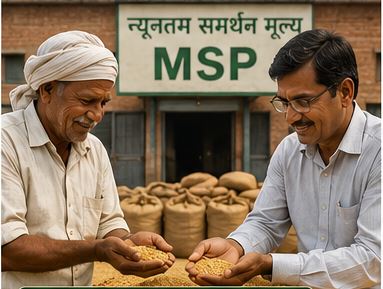
TheMinimum Support Price (MSP)is thefloor price guaranteed by the Government of Indiato farmers for specific agricultural commodities — a price below which the government pledges that the farmer’s produce will not be purchased. If market prices fall below MSP, government agencies step in to procure at the guaranteed rate. MSP is not a legal entitlement — it is an administrative policy decision — a fact that was at the heart of the prolonged farmer protests of 2020-21 which demanded a statutory legal guarantee for MSP.
Income protection:Shields farmers from price crashes in open markets
Crop diversification:Higher MSPs for pulses and oilseeds incentivise shift away from water-intensive paddy
Food security:Ensures procurement of strategic crops (paddy, wheat) for the National Food Security Act buffer stocks
Price signalling:Provides advance certainty to farmers before sowing — enabling rational crop planning
TheCabinet Committee on Economic Affairs (CCEA)— chaired by the PM — announces MSPs on the recommendation of theCommission for Agricultural Costs and Prices (CACP), a statutory body under the Ministry of Agriculture.
CACP prepares detailed price policy reports based on cost of production data from all states, weighing input costs, demand-supply balances, inter-crop price parity, and international price benchmarks before recommending MSPs
The Cost Formula — Understanding the 1.5x Benchmark
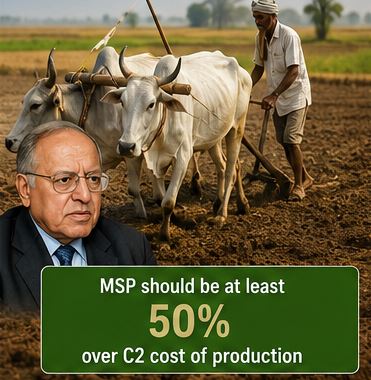
The Swaminathan Commission (National Commission on Farmers, 2006) had recommended that MSP should be fixed at at least 50% profit over the “C2 cost” of production — which includes the cost of owned resources (land, capital). The government in the Union Budget 2018-19 announced that MSPs would be fixed at at least 1.5 times the All-India Weighted Average Cost of Production — but used the A2+FL cost (not C2), a distinction that continues to be a major point of farmer contention.
| Cost Concept | What it Includes | Used in MSP Formula? |
|---|---|---|
| A2 | Actual paid-out costs — seeds, fertilisers, pesticides, hired labour, fuel, irrigation | Part of official formula |
| FL (Family Labour) | Imputed value of unpaid family labour on the farm | Part of official formula (A2 + FL) |
| B2 | A2 + FL + interest on owned capital (farm machinery, working capital) | Not included |
| C2 | B2 + imputed rental value of owned land (the full comprehensive cost) | Excluded; M. S. Swaminathan recommended this |
| Farmer Demand | MSP = C2 + 50% — full comprehensive cost plus 50% profit margin | Rejected by government; A2 + FL used instead |
The government claims the new MSPs ensure50% margin over A2+FL cost— but farmer organisations argue this understates the true cost of farming by excluding land rental and interest on owned capital. The gap between A2+FL and C2 can be as wide as30–40%for paddy in states like Punjab and Haryana — which is why ₹72/quintal is characterised as“barely covering expenses”by many paddy farmers.
Complete MSP Table — All 14 Kharif Crops 2026-27
| Crop | Category | MSP 2025–26 (₹/qtl) | MSP 2026–27 (₹/qtl) | Increase (₹) | Margin over Cost |
|---|---|---|---|---|---|
| Paddy (Common) | Cereal | 2,369 | 2,441 | 72 | ~50% |
| Paddy (Grade A) | Cereal | 2,389 | 2,461 | 72 | ~50% |
| Jowar (Hybrid) | Cereal / Shree Anna | 3,699 | 4,023 | 324 | ~50% |
| Bajra | Cereal / Shree Anna | 2,775 | 2,900 | 125 | 56% |
| Ragi | Cereal / Shree Anna | 4,886 | 5,205 | 319 | ~50% |
| Maize | Cereal | 2,400 | 2,410 | 10 | 56% |
| Tur / Arhar | Pulse | 8,000 | 8,450 | 450 | 54% |
| Moong | Pulse | 8,768 | 8,780 | 12 | 61% — highest |
| Urad | Pulse | 7,800 | 8,200 | 400 | ~50% |
| Groundnut | Oilseed | 7,263 | 7,517 | 254 | ~50% |
| Sunflower Seed | Oilseed | 7,721 | 8,343 | 622 — highest | ~50% |
| Soybean (Yellow) | Oilseed | 5,328 | 5,708 | 380 | ~50% |
| Sesamum | Oilseed | 9,846 | 10,346 | 500 | ~50% |
| Nigerseed | Oilseed | 9,537 | 10,052 | 515 | ~50% |
| Cotton (Medium Staple) | Fibre | 7,710 | 8,267 | 557 — 2nd highest | ~50% |
| Cotton (Long Staple) | Fibre | 8,110 | 8,667 | 557 — 2nd highest | ~50% |
Why Oilseeds and Pulses Got the Highest Hikes
The government’s deliberate strategy of offering relatively higher MSP increases for oilseeds and pulses compared to cereals reflects two chronic structural vulnerabilities in India’s food economy:
- Edible oil import dependence: India imports ~60% of its edible oil needs (palm oil from Indonesia/Malaysia; sunflower from Russia/Ukraine). The West Asia crisis has disrupted shipping routes and elevated edible oil prices globally. Higher MSP for sunflower seed, sesamum, soybean, groundnut, and nigerseed incentivises domestic oilseed cultivation — directly addressing PM Modi’s Guideline 5 on reducing edible oil consumption and import dependence
- Pulse import dependence: India imports over 25 lakh MT of pulses annually from Myanmar, Australia, Canada, and African countries. Domestic pulse production has stagnated while consumption has grown with rising protein awareness. Higher MSP for tur/arhar, urad, and moong encourages farmers to shift from paddy toward pulses — reducing import bill and improving nutritional security
- Crop diversification: Punjab, Haryana, and UP are locked into a paddy-wheat cycle that is environmentally unsustainable (depleting groundwater) and economically inefficient. Higher MSPs for alternative kharif crops create a financial incentive to diversify — a goal also supported by the National Food Security Mission (NFSM) and the Crop Diversification Programme (CDP)
- Shree Anna / Nutri-cereals: Jowar, bajra, and ragi (nutri-cereals) received significant hikes — aligning with India’s global advocacy for millets following the International Year of Millets 2023 declared by the UN on India’s proposal. Ragi at ₹5,205/quintal is the highest among all cereals
Farmer Organisations’ Objections — The Trade Deal Warning
Farmer organisations across India criticised the revised MSP rates, saying they do not factor in the potential “disastrous impact” of the India-US trade deal and other free trade agreements on the agriculture sector. Their specific concerns are as follows:
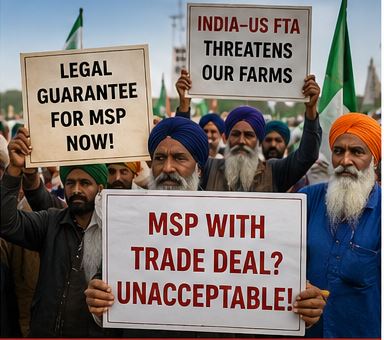
- India-US trade deal agriculture chapter:The India-US bilateral trade agreement under negotiation reportedly includes agricultural market access provisions — cheaper US farm commodities (corn, soybeans, cotton, dairy products) could flood the Indian market at prices below India’s MSP, making domestic procurement unsustainable
- MSP vs. FTA — the structural contradiction:If India commits to reducing import duties on agricultural goods as part of an FTA, foreign crops will enter at prices far below the domestic MSP — making the MSP effectively un-defensible in price competition terms. The MSP can guarantee a floor for domestically produced grain, but it cannot stop cheaper imports from depressing market prices
- Cotton specifically:The US is a major cotton exporter that provides its farmers with substantial domestic subsidies (Counter-Cyclical Payments, Agriculture Risk Coverage). US cotton exported to India at below-cost subsidised prices would directly undercut Indian cotton farmers even with the new ₹8,267–8,667 MSP
- C2 cost still excluded:Farmer groups reiterate that the 50% margin is calculated over A2+FL (paid-out cost + family labour) — not over C2 (which includes land rent and owned capital). If C2 is used, the MSPs announced would in many cases fall below even the break-even point
- Legal guarantee still absent:The 2020-21 farmer protests demanded a legally enforceable right to MSP for all farmers — not just those selling to government procurement agencies. Currently, MSP benefits primarily reach Punjab, Haryana, and MP farmers in the paddy-wheat belt; most farmers in Bihar, UP, and the Northeast sell below MSP in open markets
MSP Procurement Mechanism — How It Works
Key agencies and schemes involved in MSP implementation
- FCI (Food Corporation of India): The primary procurement agency for paddy and wheat — stores in central pool buffer stocks; manages PDS (Public Distribution System) supply chain
- NAFED (National Agricultural Cooperative Marketing Federation): Procures pulses and oilseeds under PM-AASHA and Price Stabilisation Fund; facilitates market interventions to control retail price volatility
- CCI (Cotton Corporation of India): Procures cotton under MSP when market prices fall below the support price; particularly active in Maharashtra and Telangana
- CACP (Commission for Agricultural Costs and Prices): Statutory body that recommends MSPs; prepares annual price policy reports covering A2, FL, B2, and C2 cost estimates for all states
- PM-AASHA scheme: Pradhan Mantri Annadata Aay Sanrakshan Abhiyan — umbrella scheme comprising PSS (Price Support Scheme), PDPS (Price Deficiency Payment Scheme), and PPPS (Pilot of Private Procurement and Stockist Scheme) — designed to extend MSP benefits beyond FCI-procured crops
Historical Evolution of MSP — Key Milestones
Prelims Question
1. The Cabinet Committee on Economic Affairs (CCEA), chaired by the Prime Minister, announces MSPs on the recommendation of the Commission for Agricultural Costs and Prices (CACP).
2. The Union Budget 2018-19 committed to fixing MSP at 1.5 times the All-India weighted average cost of production — calculated using the C2 cost formula, which includes imputed rental value of owned land.
3. In the MSP announced for Kharif 2026-27, the highest absolute increase per quintal has been recommended for sunflower seed, followed by cotton and sesamum respectively.
4. The PM-AASHA scheme comprises three components — Price Support Scheme (PSS), Price Deficiency Payment Scheme (PDPS), and a Pilot of Private Procurement and Stockist Scheme (PPPS) — to ensure farmers receive remunerative prices even when market prices fall below MSP.
Which of the statements given above are correct?
Statement 1 is CORRECT. The MSP announcement follows a well-defined institutional process: the Commission for Agricultural Costs and Prices (CACP) — a statutory advisory body under the Ministry of Agriculture and Farmers’ Welfare — prepares detailed annual price policy reports after studying A2, A2+FL, B2, and C2 costs for each crop across all states, and recommends MSPs. These recommendations are then considered and approved by the CCEA, chaired by the Prime Minister.
Statement 2 is INCORRECT. This is a critical and frequently tested distinction. The Budget 2018-19 commitment was to fix MSP at 1.5 times the All-India weighted average cost of production — but using the A2+FL cost formula, NOT the C2 formula. The C2 cost includes imputed rental value of owned land and interest on owned fixed capital — making it a more comprehensive and higher cost estimate. Farmer organisations have consistently demanded MSP based on C2+50%, as recommended by the Swaminathan Commission. The government’s use of A2+FL means the effective MSP is lower than what farmers demand, and the “50% margin” claim is contested.
Statement 3 is CORRECT. The highest absolute increase in MSP over the previous year has been recommended for Sunflower Seed (₹622 per quintal) followed by Cotton (₹557 per quintal), Nigerseed (₹515 per quintal) and Sesamum (₹500 per quintal) for Kharif Marketing Season 2026-27. Note that the question asks for the order: sunflower (₹622) → cotton (₹557) → sesamum (₹500) — and nigerseed (₹515) actually comes third before sesamum, but the statement’s mention of sunflower first and cotton second is correct.
Statement 4 is CORRECT. PM-AASHA (Pradhan Mantri Annadata Aay Sanrakshan Abhiyan) is the umbrella scheme announced in 2018 to ensure farmers receive MSP for their produce. It has three components: (1) Price Support Scheme (PSS) — government agencies directly procure oilseeds and pulses at MSP when market prices fall below; (2) Price Deficiency Payment Scheme (PDPS) — government pays farmers the difference between MSP and actual market price (without physical procurement); (3) Pilot of Private Procurement and Stockist Scheme (PPPS) — involves private players in procurement at MSP on a pilot basis. Together, these expand MSP benefits beyond FCI’s traditional paddy-wheat procurement.
Mains Questions

- India’s Youth Unemployment and Education Crisis - August 5, 2026
- India’s Sports Infrastructure and the 2036 Olympics Ambition - August 5, 2026
- Critical Minerals: The Foundation of Strategic Power - August 4, 2026

No Comments