PM Modi’s 5-Nation Tour — A Crisis-Era Diplomatic Masterstroke

PM Modi’s 5-Nation Tour — A Crisis-Era Diplomatic Masterstroke

This article cover“Daily Current Affairs”

SYLLABUS MAPPING  : GS Paper 2  : International Relations

FOR PRELIMS Important Bilateral Deals , ASML-TATA Semiconductor Deal

FOR MAINS : “The ASML-TATA agreement on semiconductor manufacturing equipment and the Cerebras AI chip gifted by the UAE mark India’s emergence as a trusted node in the Western technology supply chain — a positioning that is both economically transformative and geopolitically consequential.” Critically examine India’s semiconductor ambitions, the significance of ASML access, and the geopolitical implications of India’s technology alignment choices. (15 M)


Why in News?

Prime Minister Narendra Modi embarked on a five-nation diplomatic tour from May 15 to May 20, 2026 — covering the UAE (Abu Dhabi), the Netherlands (The Hague), Sweden (Stockholm/Gothenburg), Norway (Oslo), and Italy (Rome). The tour is being widely described as India’s most consequential multi-nation diplomatic sprint since the post-COVID resumption of in-person summitry — driven by the acute urgency of the West Asia crisis and the Strait of Hormuz blockade, which has simultaneously disrupted India’s energy supply, currency stability, and import bill. The tour secured critical deals across energy security (UAE strategic petroleum reserves), semiconductor manufacturing (ASML-Tata, Netherlands), green technology (Norway-Sweden), and AI supercomputing (Cerebras chip). PM Modi received his 31st international honour from Sweden (Royal Order of the Polar Star) and his 32nd from Norway (Grand Cross of the Royal Norwegian Order of Merit). The tour also produced two historic Strategic Partnership upgrades — with Sweden and Norway — and the return of the Anaimangalam Copper Plates from the Netherlands (see separate article).

Nations visited
5
UAE, Netherlands, Sweden, Norway, Italy — May 15–20, 2026
UAE investment secured
$5 Bn
Infrastructure + RBL Bank + Samman Capital
Strategic petroleum reserves
30 Mn bbl
UAE’s participation in India’s SPR increased
Strategic Partnerships
2 new
India-Sweden (Strategic Partnership) + India-Norway (Green Strategic Partnership)
PM Modi’s honours
31st + 32nd
Sweden: Polar Star; Norway: Grand Cross — both in one week
India-Sweden trade (2025)
$7.75 Bn
India-Norway trade $2.73 Bn (2024); both to be doubled

 The Strategic Context — Why This Tour, Why Now

This five-nation tour was not a routine diplomatic visit. It was a carefully designed crisis-response foreign policy sprint, with each destination addressing a specific vulnerability exposed by the US-Iran war and Strait of Hormuz blockade:

Country India’s primary crisis-related objective Secondary / long-term objective
United Arab Emirates Secure alternative/additional energy supply; shore up forex and investment flows; reassure Gulf partners Deepen Comprehensive Strategic Partnership; advance India-UAE CEPA implementation
Netherlands Unlock ASML semiconductor technology for India’s Dholera fab; recover Anaimangalam Copper Plates Green hydrogen, smart cities, water management cooperation; advanced tech manufacturing
Sweden Diversify supply chains; AI and green transition partnerships; reduce dependence on Chinese tech Elevate bilateral relationship to Strategic Partnership; India-Sweden trade to $10 Bn
Norway Diversify crude oil imports beyond Gulf (Norway = major non-Gulf producer); green hydrogen cooperation Elevate to Green Strategic Partnership; India-Nordic Summit; offshore wind technology
Italy G7 engagement; European support for India’s position on West Asia; post-Russia sanctions energy alternatives India-Italy bilateral trade; defence manufacturing; Mediterranean connectivity

All Visits Details

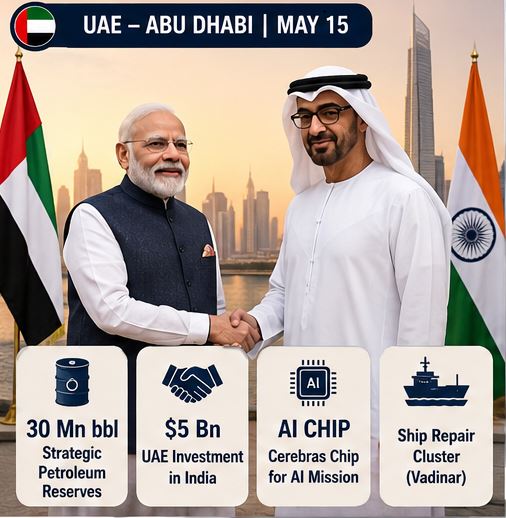
United Arab Emirates — Abu Dhabi
May 15, 2026 | PM Modi met President Sheikh Mohamed bin Zayed Al Nahyan (MBZ)

The tour’s first stop addressed India’s most acute crisis need — energy supply security and foreign exchange stabilisation. Abu Dhabi is both India’s largest Gulf energy partner and the most pro-India capital in the Arab world, making it the ideal first port of call as Hormuz remained blocked.

  1. Strategic Petroleum Reserves:A landmark agreement was signed toincrease UAE’s participation in India’s Strategic Petroleum Reserves to 30 million barrels— filling the Padur, Mangalore, and Vishakhapatnam underground caverns with UAE crude. This directly addresses India’s oil security gap exposed by the Hormuz blockade
  2. LPG Supply Agreement:A long-term LPG supply arrangement was finalised between India and the UAE — addressing India’s 45-day LPG buffer stockpile concerns and the domestic production ramp-up challenge
  3. $5 Billion UAE Investment:A total of $5 billion in UAE investments into India was announced — distributed across priority infrastructure projects,RBL Bank(financial sector), andSamman Capital(capital market platform). This directly supports India’s capital account stabilisation
  4. AI Cerebras Chip:In a standout tech diplomacy moment, UAE President MBZgifted PM Modi a Cerebras chip— a cutting-edge AI semiconductor that will power India’s upcoming8-exaflop supercomputing facilityunder theIndia AI Mission. This makes India one of the very few non-Western countries with Cerebras-class AI infrastructure
  5. Ship Repair Cluster (Vadinar):An MoU was signed to establish a Ship Repair Cluster at Vadinar — enhancing India’s maritime capabilities and reducing dependence on foreign ship repair hubs
  6. PM Modi condemned the targeting of the UAE during the West Asia conflict and praised the UAE’s restraint:“We condemned the attacks on the UAE. The way the UAE has been targeted is not acceptable, but the way the UAE has handled the current situation with restraint is praiseworthy.”


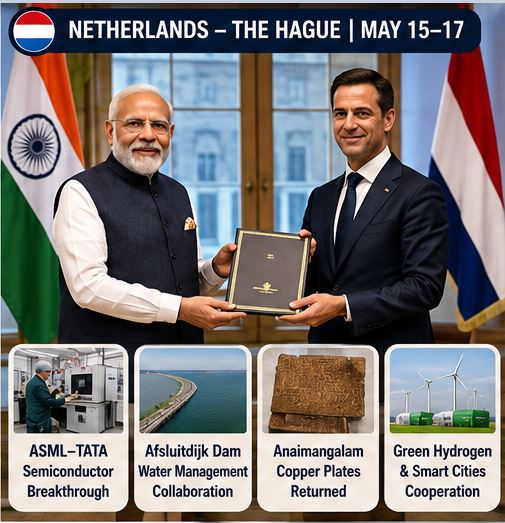
Netherlands — The Hague
May 15–17, 2026 | PM Modi met PM Rob Jetten + King Willem-Alexander

The Netherlands leg was the most technologically consequential stop — and also the most symbolically rich, given the return of the Anaimangalam Copper Plates. The meeting with Dutch PM Rob Jetten and King Willem-Alexander covered a remarkably broad agenda from semiconductor manufacturing to water management to cultural repatriation.

  1. Semiconductor Breakthrough — ASML-Tata:A landmark agreement was witnessed betweenTata ElectronicsandASML Netherlands— the world’s only manufacturer of Extreme Ultraviolet (EUV) lithography machines, without which modern chips cannot be made. ASML will supply advanced semiconductor manufacturing equipment for India’ssemiconductor fabrication plant in Dholera, Gujarat— part of India’s $10+ billion National Semiconductor Mission. This makes India one of only a handful of countries with access to ASML’s technology outside the US-EU-Japan-Korea-Taiwan corridor
  2. Afsluitdijk Dam Visit:PM Modi and Dutch PM Jetten visited the iconicAfsluitdijk Dam— the 32-km engineering marvel that seals the Zuiderzee and protects the Netherlands from the sea. Discussions focused on collaborative water management, flood protection for coastal Indian cities, and clean energy from tidal systems. India has 7,516 km of coastline and several cities (Mumbai, Kolkata, Chennai) at risk from rising sea levels — making Dutch expertise directly relevant
  3. Anaimangalam Copper Plates returned:The Netherlands formally handed over the 11th-century Chola dynasty copper plates — in Dutch custody for 325+ years — to PM Modi in a ceremony at The Hague. PM Modi described it as “a joyous moment for every Indian”
  4. Green Hydrogen & Smart Cities:Both sides discussed cooperation on green hydrogen production, sustainable agriculture (Netherlands is the world’s 2nd largest agricultural exporter), and smart city design — areas where Dutch technology can directly address India’s urbanisation challenges


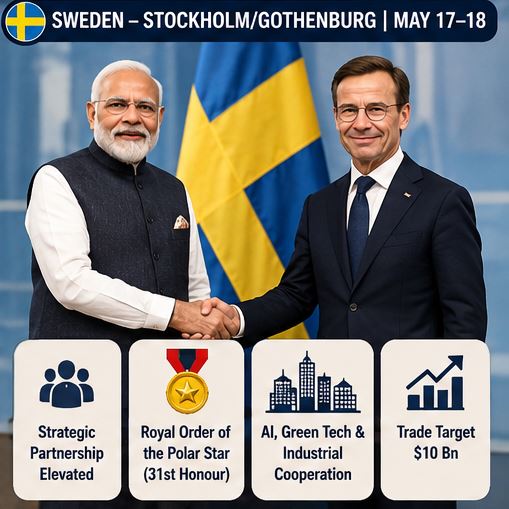
Sweden — Stockholm / Gothenburg
May 17–18, 2026 | PM Modi met PM Ulf Kristersson + business leaders

Sweden is home to global multinationals (IKEA, H&M, Volvo, Ericsson, ABB, AstraZeneca) and a world leader in AI, clean tech, and defence manufacturing. India-Sweden bilateral trade reached$7.75 billion in 2025. The visit elevated the bilateral relationship to a formalStrategic Partnership.

  1. Strategic Partnership Elevation:India and Sweden formally elevated bilateral relations to aStrategic Partnership— institutionalising cooperation across trade, technology, defence, and sustainability. This is a significant diplomatic upgrade from the previously informal engagement framework
  2. European Round Table (ERT) — CEO Engagement:PM Modi addressed the European Round Table for Industry in Gothenburg — a gathering of CEOs from Europe’s largest companies. Key discussions covered resilient supply chains (reducing over-dependence on any single supplier), artificial intelligence applications, and green industrial transition
  3. Bilateral Honours:Sweden conferred upon PM Modi theRoyal Order of the Polar Star, Commander Grand Cross— Sweden’s highest state honour for foreign Heads of Government. This was PM Modi’s 31st international honour
  4. Defence technology:Sweden’s Saab (Gripen jet) and BAES have previously engaged India; discussions at the ERT included advanced manufacturing PLI scheme collaboration and joint R&D for defence electronics
  5. India-Sweden trade target: both sides discussed doubling bilateral trade; Sweden’s expertise in circular economy, EV batteries (Northvolt), and 5G (Ericsson) directly complements India’s Aatmanirbhar push


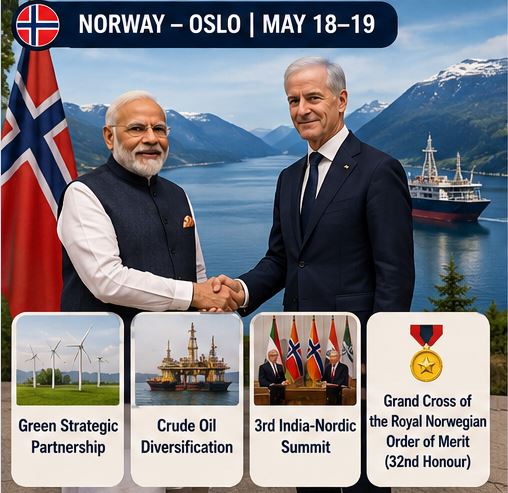
Norway — Oslo
May 18–19, 2026 | PM Modi met PM Jonas Gahr Støre + King Harald V + India-Nordic Summit

Norway’s visit was historically significant —the first Indian Prime Ministerial visit to Norway in 43 years, and PM Modi’s maiden visit. Norway is strategically vital as amajor non-Gulf crude oil producer— the 7th largest in the world — offering India the opportunity to diversify crude imports away from the disrupted Strait of Hormuz corridor.

  1. Green Strategic Partnership:India and Norway elevated bilateral relations to aGreen Strategic Partnership— with particular focus on offshore wind energy, green hydrogen, green ammonia, maritime technology, and sustainable fisheries. Norway has world-class offshore wind technology and India has 7,600 km of coastline available for offshore wind development
  2. Crude Oil Diversification:Norway is a major non-Gulf oil producer — producing approximately 2 million barrels/day. PM Modi discussed expanding India’s crude imports from Norway as an alternative to the blocked Hormuz route, reducing CAD vulnerability. PM Modi explicitly stated:“No issue can be resolved through military conflict alone”— referencing the West Asia crisis
  3. India-Nordic Summit (3rd edition):PM Modi attended the3rd India-Nordic Summit in Oslo on May 19— joined by PMs of Norway, Denmark, Finland, Iceland, and Sweden. Focus areas: technology, renewable energy, defence, sustainability, Arctic ties, and UNSC reform. India strongly backed UNSC reform
  4. India-Norway Business & Research Summit:PM Modi addressed CEOs and researchers from companies with a combined market cap and enterprise value of nearly$200 billion— from sectors including energy, offshore wind, maritime, fertilisers, food security, robotics, healthcare, and higher education
  5. Health Tech MoU:Norway-India signed an MoU on high-tech health services, digital health, AI in healthcare, research, and health technology — reflecting India’s growing medical technology sector
  6. Grand Cross of the Royal Norwegian Order of Merit:King Harald V personally presented PM Modi with Norway’s highest civilian honour for foreign Heads of Government — PM Modi’s 32nd international honour. Modi dedicated it to the people of India:“This honour is dedicated to the people of India and is a tribute to the enduring friendship between India and Norway.”
  7. Trade target: India-Norway todouble bilateral trade by 2030from current $2.73 billion

The ASML-Tata Semiconductor Deal — Explained

ASML (Advanced Semiconductor Materials Lithography) is a Dutch company that manufactures the world’s only Extreme Ultraviolet (EUV) lithography machines — the critical equipment that prints circuit patterns on silicon wafers to create modern chips (below 7nm process nodes). Without ASML, no advanced chip can be manufactured. The US has used ASML access as a geopolitical leverage tool — blocking ASML from selling EUV machines to China. India’s deal with ASML through Tata Electronics is therefore a landmark access to the most guarded technology in global manufacturing.

Why the ASML-Tata deal matters for India’s semiconductor mission
  1. What ASML does: ASML’s EUV machines use extreme ultraviolet light (wavelength 13.5 nm) to etch circuit patterns onto chips at sizes below 7nm — enabling smartphones, AI chips, and data centres. No other company makes EUV machines
  2. Dholera fab context: Tata Electronics + PowerChip Semiconductor Manufacturing Corp (PSMC, Taiwan) are building India’s first commercial fab at Dholera Special Investment Region (SIR), Gujarat — a $11 billion investment under the India Semiconductor Mission
  3. Why access was difficult: ASML requires Dutch and US government export licences for EUV sales; China has been denied access; India’s clearance reflects both its democratic credentials and its strategic alignment with the Western tech supply chain
  4. Geopolitical significance: India joining the EUV-access club (Taiwan, South Korea, Japan, USA, EU) signals that India is becoming a trusted node in the Western semiconductor supply chain — a strategic repositioning away from China-dependent manufacturing

Practice Questions

Q. With reference to PM Modi’s 5-nation tour (May 2026) and the agreements concluded therein, consider the following statements:

1. During the UAE leg, an agreement was reached to increase the UAE’s participation in India’s Strategic Petroleum Reserves to 30 million barrels — directly addressing the energy supply disruption caused by the Strait of Hormuz blockade.
2. The ASML-Tata Electronics agreement for India’s Dholera semiconductor fab is significant because ASML is the sole global manufacturer of Extreme Ultraviolet (EUV) lithography machines, which are essential for fabricating advanced chips below 7nm process nodes.
3. The Grand Cross of the Royal Norwegian Order of Merit, conferred upon PM Modi by King Harald V, was established by King Olav V in 1985, and India’s PM Modi became the first Asian Head of Government to receive this honour.
4. The 3rd India-Nordic Summit held in Oslo on May 19, 2026 was attended by PM Modi alongside the Prime Ministers of Norway, Denmark, Finland, Iceland, and Sweden — and focused on renewable energy, digital technology, Arctic ties, and UNSC reform.

Which of the statements given above are correct?
Correct Answer: (b) 1, 2 and 4 only

Statement 1 is CORRECT. A key outcome of PM Modi’s Abu Dhabi visit was an agreement to increase the UAE’s participation in India’s Strategic Petroleum Reserves to 30 million barrels. This directly addresses one of India’s most acute energy vulnerabilities — the disruption to crude supply caused by the IRGC’s closure of the Strait of Hormuz since March 2026. India’s SPR is stored in underground rock cavern facilities at Vishakhapatnam, Mangalore, and Padur, with a combined capacity of approximately 5.33 million tonnes. The UAE SPR arrangement supplements India’s own stockpiling effort by allowing UAE crude to pre-position in these caverns.

Statement 2 is CORRECT. ASML (Advanced Semiconductor Materials Lithography), headquartered in Eindhoven, Netherlands, is literally the only company in the world that manufactures Extreme Ultraviolet (EUV) lithography machines. These machines use light with a wavelength of 13.5 nanometres to etch sub-7nm circuit patterns onto silicon wafers — without which modern chips (used in AI, smartphones, data centres, and military systems) cannot be produced. The US has used ASML export licences as a geopolitical tool to restrict China’s access to EUV technology. India’s Tata Electronics-ASML agreement for the Dholera fab signals India’s formal inclusion in the Western semiconductor supply chain — a major strategic development.

Statement 3 is INCORRECT. The statement that PM Modi was the “first Asian Head of Government” to receive the Grand Cross of the Royal Norwegian Order of Merit is NOT confirmed by any official source. While PM Modi is the 32nd international honour recipient during his tenure, and this is his first such honour from Norway, the Order has been awarded to foreign nationals — including from various countries — since its establishment in 1985. The statement inserts an unverified superlative that is not part of the official announcement. The key verifiable facts are: the Order was established by King Olav V in 1985, it represents the highest grade of the Order, and it was personally presented by King Harald V to PM Modi in Oslo on May 18, 2026.

Statement 4 is CORRECT. The 3rd India-Nordic Summit took place in Oslo on May 19, 2026. It was attended by PM Modi alongside the Prime Ministers of all five Nordic nations — Norway (Jonas Gahr Støre), Denmark, Finland, Iceland, and Sweden (Ulf Kristersson, who was also present for the bilateral visit). The summit focused on technology, renewable energy, defence, sustainability, Arctic ties, and UNSC reform — with India consistently advocating for a permanent seat on a reformed UN Security Council. This was the third edition of the India-Nordic Summit, building on the first (Stockholm, 2018) and second (Berlin/Copenhagen, 2022) editions.

    Mains Questions

“PM Modi’s 5-nation tour in May 2026 — spanning the UAE, the Netherlands, Sweden, Norway, and Italy — is best understood not as a diplomatic exercise but as a strategic crisis-management operation: each stop addressed a specific vulnerability exposed by the West Asia conflict.” Critically examine the objectives, outcomes, and strategic significance of this tour for India’s foreign policy and national interest. ( 15 M )
No Comments

Post A Comment