


19 May PM Modi’s 5-Nation Tour — A Crisis-Era Diplomatic Masterstroke
This article covers “Daily Current Affairs”
SYLLABUS MAPPING : GS Paper 2 : International Relations
FOR PRELIMS : Important Bilateral Deals , ASML-TATA Semiconductor Deal
FOR MAINS : “The ASML-TATA agreement on semiconductor manufacturing equipment and the Cerebras AI chip gifted by the UAE mark India’s emergence as a trusted node in the Western technology supply chain — a positioning that is both economically transformative and geopolitically consequential.” Critically examine India’s semiconductor ambitions, the significance of ASML access, and the geopolitical implications of India’s technology alignment choices. (15 M)
Why in News?
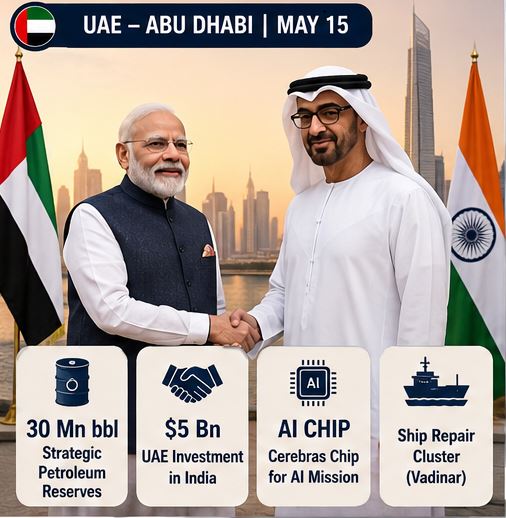
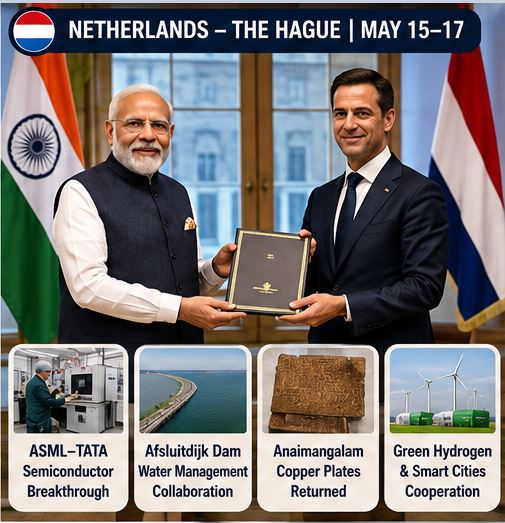
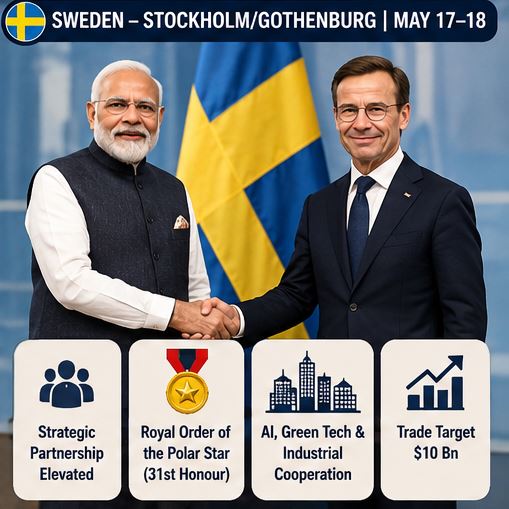
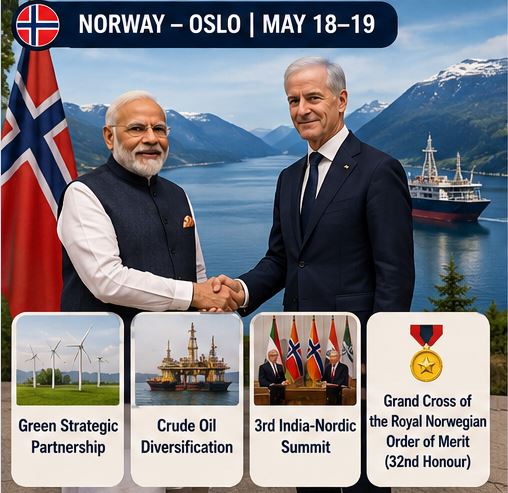
Prime Minister Narendra Modi embarked on a five-nation diplomatic tour from May 15 to May 20, 2026 — covering the UAE (Abu Dhabi), the Netherlands (The Hague), Sweden (Stockholm/Gothenburg), Norway (Oslo), and Italy (Rome). The tour is being widely described as India’s most consequential multi-nation diplomatic sprint since the post-COVID resumption of in-person summitry — driven by the acute urgency of the West Asia crisis and the Strait of Hormuz blockade, which has simultaneously disrupted India’s energy supply, currency stability, and import bill. The tour secured critical deals across energy security (UAE strategic petroleum reserves), semiconductor manufacturing (ASML-Tata, Netherlands), green technology (Norway-Sweden), and AI supercomputing (Cerebras chip). PM Modi received his 31st international honour from Sweden (Royal Order of the Polar Star) and his 32nd from Norway (Grand Cross of the Royal Norwegian Order of Merit). The tour also produced two historic Strategic Partnership upgrades — with Sweden and Norway — and the return of the Anaimangalam Copper Plates from the Netherlands (see separate article).
The Strategic Context — Why This Tour, Why Now
This five-nation tour was not a routine diplomatic visit. It was a carefully designed crisis-response foreign policy sprint, with each destination addressing a specific vulnerability exposed by the US-Iran war and Strait of Hormuz blockade:
| Country | India’s primary crisis-related objective | Secondary / long-term objective |
|---|---|---|
| United Arab Emirates | Secure alternative/additional energy supply; shore up forex and investment flows; reassure Gulf partners | Deepen Comprehensive Strategic Partnership; advance India-UAE CEPA implementation |
| Netherlands | Unlock ASML semiconductor technology for India’s Dholera fab; recover Anaimangalam Copper Plates | Green hydrogen, smart cities, water management cooperation; advanced tech manufacturing |
| Sweden | Diversify supply chains; AI and green transition partnerships; reduce dependence on Chinese tech | Elevate bilateral relationship to Strategic Partnership; India-Sweden trade to $10 Bn |
| Norway | Diversify crude oil imports beyond Gulf (Norway = major non-Gulf producer); green hydrogen cooperation | Elevate to Green Strategic Partnership; India-Nordic Summit; offshore wind technology |
| Italy | G7 engagement; European support for India’s position on West Asia; post-Russia sanctions energy alternatives | India-Italy bilateral trade; defence manufacturing; Mediterranean connectivity |
All Visits Details
The ASML-Tata Semiconductor Deal — Explained
ASML (Advanced Semiconductor Materials Lithography) is a Dutch company that manufactures the world’s only Extreme Ultraviolet (EUV) lithography machines — the critical equipment that prints circuit patterns on silicon wafers to create modern chips (below 7nm process nodes). Without ASML, no advanced chip can be manufactured. The US has used ASML access as a geopolitical leverage tool — blocking ASML from selling EUV machines to China. India’s deal with ASML through Tata Electronics is therefore a landmark access to the most guarded technology in global manufacturing.
- What ASML does: ASML’s EUV machines use extreme ultraviolet light (wavelength 13.5 nm) to etch circuit patterns onto chips at sizes below 7nm — enabling smartphones, AI chips, and data centres. No other company makes EUV machines
- Dholera fab context: Tata Electronics + PowerChip Semiconductor Manufacturing Corp (PSMC, Taiwan) are building India’s first commercial fab at Dholera Special Investment Region (SIR), Gujarat — a $11 billion investment under the India Semiconductor Mission
- Why access was difficult: ASML requires Dutch and US government export licences for EUV sales; China has been denied access; India’s clearance reflects both its democratic credentials and its strategic alignment with the Western tech supply chain
- Geopolitical significance: India joining the EUV-access club (Taiwan, South Korea, Japan, USA, EU) signals that India is becoming a trusted node in the Western semiconductor supply chain — a strategic repositioning away from China-dependent manufacturing
Practice Questions
1. During the UAE leg, an agreement was reached to increase the UAE’s participation in India’s Strategic Petroleum Reserves to 30 million barrels — directly addressing the energy supply disruption caused by the Strait of Hormuz blockade.
2. The ASML-Tata Electronics agreement for India’s Dholera semiconductor fab is significant because ASML is the sole global manufacturer of Extreme Ultraviolet (EUV) lithography machines, which are essential for fabricating advanced chips below 7nm process nodes.
3. The Grand Cross of the Royal Norwegian Order of Merit, conferred upon PM Modi by King Harald V, was established by King Olav V in 1985, and India’s PM Modi became the first Asian Head of Government to receive this honour.
4. The 3rd India-Nordic Summit held in Oslo on May 19, 2026 was attended by PM Modi alongside the Prime Ministers of Norway, Denmark, Finland, Iceland, and Sweden — and focused on renewable energy, digital technology, Arctic ties, and UNSC reform.
Which of the statements given above are correct?
Statement 1 is CORRECT. A key outcome of PM Modi’s Abu Dhabi visit was an agreement to increase the UAE’s participation in India’s Strategic Petroleum Reserves to 30 million barrels. This directly addresses one of India’s most acute energy vulnerabilities — the disruption to crude supply caused by the IRGC’s closure of the Strait of Hormuz since March 2026. India’s SPR is stored in underground rock cavern facilities at Vishakhapatnam, Mangalore, and Padur, with a combined capacity of approximately 5.33 million tonnes. The UAE SPR arrangement supplements India’s own stockpiling effort by allowing UAE crude to pre-position in these caverns.
Statement 2 is CORRECT. ASML (Advanced Semiconductor Materials Lithography), headquartered in Eindhoven, Netherlands, is literally the only company in the world that manufactures Extreme Ultraviolet (EUV) lithography machines. These machines use light with a wavelength of 13.5 nanometres to etch sub-7nm circuit patterns onto silicon wafers — without which modern chips (used in AI, smartphones, data centres, and military systems) cannot be produced. The US has used ASML export licences as a geopolitical tool to restrict China’s access to EUV technology. India’s Tata Electronics-ASML agreement for the Dholera fab signals India’s formal inclusion in the Western semiconductor supply chain — a major strategic development.
Statement 3 is INCORRECT. The statement that PM Modi was the “first Asian Head of Government” to receive the Grand Cross of the Royal Norwegian Order of Merit is NOT confirmed by any official source. While PM Modi is the 32nd international honour recipient during his tenure, and this is his first such honour from Norway, the Order has been awarded to foreign nationals — including from various countries — since its establishment in 1985. The statement inserts an unverified superlative that is not part of the official announcement. The key verifiable facts are: the Order was established by King Olav V in 1985, it represents the highest grade of the Order, and it was personally presented by King Harald V to PM Modi in Oslo on May 18, 2026.
Statement 4 is CORRECT. The 3rd India-Nordic Summit took place in Oslo on May 19, 2026. It was attended by PM Modi alongside the Prime Ministers of all five Nordic nations — Norway (Jonas Gahr Støre), Denmark, Finland, Iceland, and Sweden (Ulf Kristersson, who was also present for the bilateral visit). The summit focused on technology, renewable energy, defence, sustainability, Arctic ties, and UNSC reform — with India consistently advocating for a permanent seat on a reformed UN Security Council. This was the third edition of the India-Nordic Summit, building on the first (Stockholm, 2018) and second (Berlin/Copenhagen, 2022) editions.
Mains Questions

- India’s Youth Unemployment and Education Crisis - August 5, 2026
- India’s Sports Infrastructure and the 2036 Olympics Ambition - August 5, 2026
- Critical Minerals: The Foundation of Strategic Power - August 4, 2026

No Comments