


10 Jul India, Australia Move to Deepen Cooperation in the Indo-Pacific
QUAD INDO-PACIFIC IORA AUSINDEX ECTA UNCLOS SAGAR CRITICAL MINERALS
① Why Is This In News?
India and Australia have agreed to significantly deepen their Comprehensive Strategic Partnership by adopting a new roadmap focused on defence, maritime security, critical minerals, clean energy, civil nuclear cooperation, supply-chain resilience, and a free, open and rules-based Indo-Pacific. The leaders also emphasised greater cooperation in the Indian Ocean and the wider Indo-Pacific region.
|
🎯 High-Yield Prelims Trigger ● This single news item links Comprehensive Strategic Partnership + Quad + IORA + Critical Minerals + Civil Nuclear Cooperation — a favourite UPSC combination for factual/matching questions. |
② What Happened — Key Outcomes of the Summit
● New Defence and Security Declaration
● Greater military interoperability and joint exercises
● Maritime Security Collaboration Roadmap
● Enhanced intelligence and information sharing
● Cooperation in critical minerals
● Expansion of civil nuclear cooperation, including uranium supply
● Strengthening resilient supply chains
● Collaboration in emerging technologies, cyber security and AI
● Greater coordination through regional institutions like IORA and the Quad
③ India–Australia Relations at a Glance
|
Area |
Details |
|
Diplomatic Relations |
Established in 1941 |
|
Comprehensive Strategic Partnership |
2020 |
|
Economic Cooperation & Trade Agreement (ECTA) |
2022 |
|
Quad Membership |
India, Australia, Japan & USA |
|
Major Defence Exercise |
AUSINDEX (Naval Exercise) |
|
Regional Forums |
IORA, East Asia Summit, ASEAN-led mechanisms |
📌 Important Data Points for UPSC
● Australia is among India’s most important strategic partners in the Indo-Pacific
● Bilateral trade has expanded rapidly after the India–Australia ECTA (2022)
● Australia possesses some of the world’s largest reserves of critical minerals and uranium
● Nearly one million people of Indian origin live in Australia — a major diaspora bridge
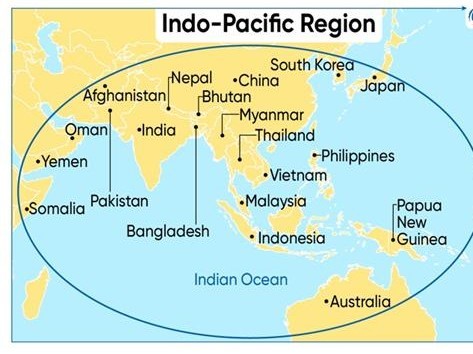
④ What Is the Indo-Pacific?
The Indo-Pacific refers to the integrated strategic region stretching from:
● Eastern coast of Africa
● Indian Ocean
● Southeast Asia
● Western and Central Pacific Ocean
|
🌍 Why the Indo-Pacific Matters — Memorise These Facts ● Around 60% of global GDP originates in this region ● A major share of global maritime trade passes through it ● It contains critical Sea Lines of Communication (SLOCs) ● It is central to strategic competition among major powers |
⑤ Why Is Australia Important for India?
1. Maritime Security
● Freedom of Navigation
● Rules-based maritime order
● Secure sea lanes
● Countering illegal maritime activities
2. Defence Cooperation
● AUSINDEX
● Malabar Exercise (through Quad)
● Joint military training
● Logistics cooperation
3. Critical Minerals
Australia supplies:
● Lithium
● Cobalt
● Nickel
● Rare Earth Elements
These are essential for:
● EV batteries
● Solar panels
● Defence manufacturing
● Semiconductors
4. Civil Nuclear Cooperation
Australia possesses one of the world’s largest uranium reserves. India requires uranium for:
● Clean energy transition
● Expansion of nuclear power
● Net Zero targets
5. Indo-Pacific Strategy
● Free and Open Indo-Pacific
● ASEAN Centrality
● Rule of Law
● UNCLOS (1982)
● Peaceful dispute resolution
⑥ Why Is the Indo-Pacific Important for India?
● Energy Security
● Maritime Trade
● Blue Economy
● Counter-piracy
● Disaster Relief
● Strategic Balance
● Protection of Indian Ocean Region
⑦ Strategic Significance of the Partnership
The partnership helps India to:
● Reduce dependence on single-country supply chains
● Diversify critical mineral imports
● Strengthen naval capabilities
● Improve defence technology cooperation
● Enhance maritime domain awareness
● Build resilient economic partnerships
● Strengthen India’s Act East Policy
● Promote SAGAR (Security and Growth for All in the Region)
⑧ Challenges
|
⚠ Key Challenges to Remember ● China’s growing influence in the Indo-Pacific ● Strategic competition among major powers ● Supply-chain disruptions ● Maritime disputes in the South China Sea ● Balancing strategic autonomy with partnerships ● Climate change affecting island nations |
⑨ Relevance for UPSC Prelims
Quad Indo-Pacific IORA AUSINDEX ECTA UNCLOS SAGAR Critical Minerals Maritime Domain Awareness SLOCs
⑩ Relevance for UPSC Mains
GS Paper II
● India–Australia Bilateral Relations
● Indo-Pacific Strategy
● Act East Policy
● Quad
GS Paper III
● Maritime Security
● Defence Cooperation
● Energy Security
● Critical Minerals
● Supply Chain Resilience
⑪ Value Addition
Important Organisations
|
Organisation |
Importance |
|
QUAD |
Strategic partnership among India, Australia, Japan and USA |
|
IORA |
Cooperation in Indian Ocean Region |
|
ASEAN |
Regional stability |
|
East Asia Summit |
Strategic dialogue |
|
Indian Ocean Naval Symposium |
Maritime cooperation |
Keywords for Mains
Free and Open Indo-Pacific (FOIP) Rules-Based Order Strategic Autonomy Maritime Security Blue Economy Critical Minerals Supply Chain Resilience Defence Interoperability Indo-Pacific Oceans Initiative (IPOI) SAGAR
Previous UPSC Themes Repeatedly Tested
Questions have repeatedly appeared on:
● QUAD
● Indo-Pacific
● South China Sea
● UNCLOS
● Maritime Security
● India’s Act East Policy
● India–Australia Relations
⑫ UPSC Prelims Practice Questions
|
PRELIMS PRACTICE — QUESTION 1 |
|
With reference to the Quad, consider the following statements: ● 1. It is a formal military alliance. ● 2. India, Australia, Japan and the United States are its members. ● 3. One of its major objectives is promoting a free and open Indo-Pacific. ● Which of the statements given above is/are correct? ● (a) 2 and 3 only (b) 1 and 2 only (c) 1 and 3 only (d) 1, 2 and 3
|
|
✔ Correct Answer: (a) 2 and 3 only Explanation: ● Statement 1 is incorrect — the Quad is not a formal military alliance. ● Statement 2 is correct. ● Statement 3 is correct — the grouping promotes a free, open and rules-based Indo-Pacific. |
|
PRELIMS PRACTICE — QUESTION 2 |
|
Australia is strategically important to India primarily because: ● 1. It possesses significant reserves of critical minerals. ● 2. It is an important partner in the Quad. ● 3. It plays an important role in India’s civil nuclear cooperation. ● Select the correct answer. ● (a) 1 only (b) 2 and 3 only (c) 1 and 2 only (d) 1, 2 and 3
|
|
✔ Correct Answer: (d) 1, 2 and 3 Explanation: ● All three statements are correct. ● Australia is an important supplier of critical minerals, a Quad partner, and a key partner in civil nuclear energy cooperation through uranium exports and broader clean-energy collaboration. |
⑬ UPSC Mains Practice Question
|
MAINS PRACTICE QUESTION — GS PAPER II “India–Australia relations have evolved from a limited bilateral engagement to a comprehensive strategic partnership driven by shared interests in the Indo-Pacific.” Discuss the strategic significance of this partnership in ensuring regional security, resilient supply chains, and a rules-based maritime order. (250 words) |
⑭ UPSC 2027 Exam Takeaway
|
🏆 Why This Topic Is High-Priority ● India–Australia Bilateral Relations ● Indo-Pacific Strategy ● QUAD ● Maritime Security ● Critical Minerals ● Civil Nuclear Cooperation ● Supply Chain Resilience ● Act East Policy & SAGAR |
A question in either Prelims (Quad, IORA, ECTA, Critical Minerals) or GS Paper II Mains (India–Australia relations and Indo-Pacific strategy) is a strong possibility based on this topic.

- RBI’s Shrinking Real-Rate Cushion Amid Rising Inflation and Strong Demand - September 21, 2026
- India’s NGOs at a New Funding Crossroads - September 21, 2026
- Deep-Sea Discovery, Environmental Responsibility - September 19, 2026

No Comments