


14 Jul India–Australia Uranium Supplies Agreement : A New Pillar of Strategic Energy Partnership
GS PAPER II GS PAPER III PRELIMS MAINS CURRENT AFFAIRS
|
★ QUICK SNAPSHOT — WHY IN THE NEWS |
|
✔ India and Australia finalized administrative arrangements enabling commercial export of Australian uranium to India for peaceful civilian nuclear energy. ✔ The move operationalizes the 2014 Civil Nuclear Cooperation Agreement after years of negotiation and safeguards discussions. ✔ Announced alongside PM Modi’s Australia visit, coinciding with agreements on defence, critical minerals, maritime security and green technologies. |
1. WHAT IS THE INDIA–AUSTRALIA URANIUM SUPPLIES AGREEMENT?
The agreement allows Australia to export uranium exclusively for India’s civilian nuclear reactors, operating strictly under the safeguards of the International Atomic Energy Agency (IAEA).
Key Features
● Peaceful Use: Uranium supplied will be used only for peaceful, civilian purposes
● IAEA Oversight: All supplies will be monitored under IAEA safeguards
● Implementation: The arrangement implements the 2014 Civil Nuclear Cooperation Agreement
● Fuel Security: It strengthens India’s long-term nuclear fuel security
● Synergy: It complements cooperation in critical minerals, green hydrogen and renewable energy, and defence
2. BACKGROUND — WHY WAS THE AGREEMENT DELAYED?
Australia traditionally restricted uranium exports only to countries that had signed the Nuclear Non-Proliferation Treaty (NPT). India is not a signatory to the NPT, as it considers the treaty discriminatory in nature.
Following the landmark 2008 India–US Civil Nuclear Agreement and the accompanying Nuclear Suppliers Group (NSG) waiver, Australia progressively revised its policy stance — culminating in the 2014 bilateral nuclear agreement. The present administrative arrangement finally operationalizes commercial uranium exports.
3. IMPORTANT FACTS FOR UPSC (MUST MEMORISE)
|
Fact |
Details |
|
Australia’s uranium reserves |
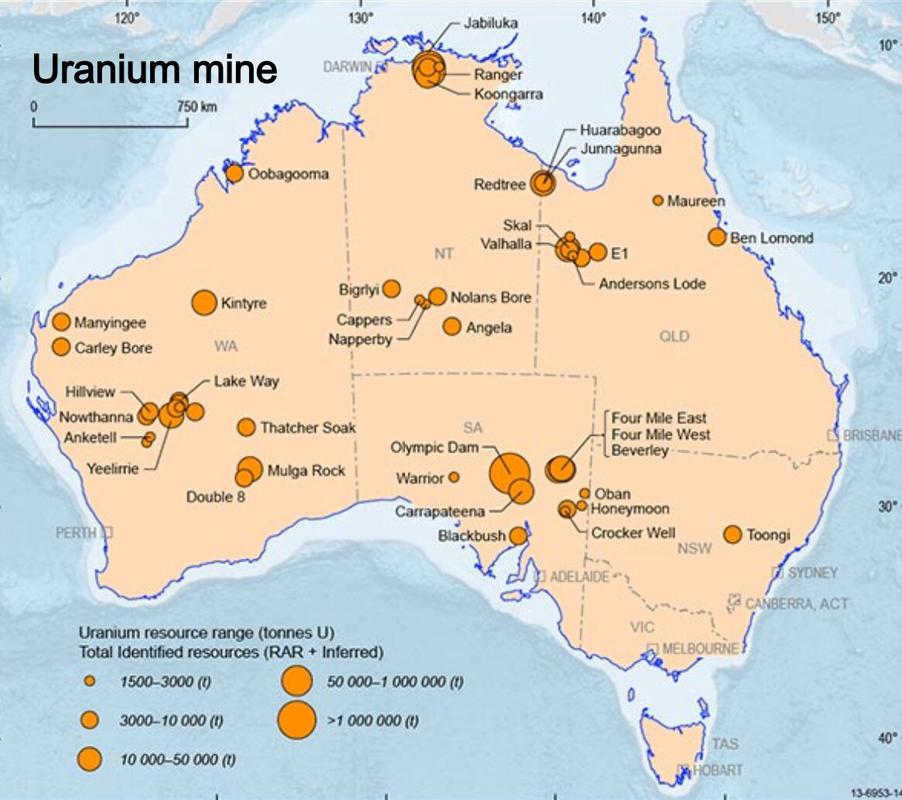
≈30% of world’s known recoverable uranium resources |
|
India’s nuclear electricity share |
≈3% of total electricity generation |
|
India’s long-term nuclear goal |
100 GW nuclear capacity by 2047 |
|
Safeguard agency |
International Atomic Energy Agency (IAEA) |
|
Agreement signed (Civil Nuclear Cooperation) |
2014 |
|
Administrative arrangement operationalized |
2026 |
4. WHY IS URANIUM IMPORTANT FOR INDIA?
Rising Electricity Demand Driven By:
● Industrialisation
● Electric vehicles
● AI and data centres
● Urbanisation
● Manufacturing expansion
Nuclear Energy Provides:
● Low-carbon electricity
● Stable base-load power
● Reduced dependence on coal
● Improved energy security
Imported uranium ensures uninterrupted fuel supply for India’s Pressurised Heavy Water Reactors (PHWRs) and supports future nuclear expansion, including Small Modular Reactors (SMRs).
5. SIGNIFICANCE OF THE AGREEMENT
① Energy Security
● Australia becomes a reliable, long-term supplier of nuclear fuel
● India reduces dependence on a limited number of uranium suppliers
② Clean Energy Transition
● Supports India’s Net Zero by 2070 commitment
● Advances non-fossil fuel capacity targets
● Helps reduce overall carbon emissions
③ Strategic Partnership
● Deepens defence cooperation
● Strengthens maritime security ties
● Boosts Indo-Pacific collaboration
● Enhances supply-chain resilience
④ Diversification of Supply Chains
Australia is also a major global source of lithium, cobalt, rare earth elements, and other critical minerals — all essential for India’s energy transition and advanced manufacturing base.
⑤ Indo-Pacific Stability
● QUAD cooperation
● Free and Open Indo-Pacific vision
● Maritime security collaboration
● Supply-chain resilience initiatives
6. CHALLENGES
● High capital costs of nuclear energy projects
● Radioactive waste management remains a concern
● Public opposition and safety concerns around nuclear plants
● India remains outside the NPT framework
● Persistent delays in reactor construction
7. INDIA–AUSTRALIA RELATIONS AT A GLANCE
|
Dimension |
Key Elements |
|
Strategic |
Comprehensive Strategic Partnership (2020); QUAD partners; Defence exercises (AUSINDEX) |
|
Economic |
Economic Cooperation and Trade Agreement (ECTA); Critical minerals cooperation; Investment & education |
|
Technology |
Green hydrogen; Renewable energy; Critical minerals; Cyber security; Emerging technologies |
8. CHRONOLOGY — PREVIOUS MILESTONES
|
Year |
Event |
|
2008 |
NSG waiver granted for India |
|
2012 |
Australia lifted its ban on uranium exports to India |
|
2014 |
Civil Nuclear Cooperation Agreement signed |
|
2020 |
Comprehensive Strategic Partnership established |
|
2022 |
India–Australia ECTA signed |
|
2026 |
Administrative arrangements finalized for uranium exports |
9. CONCEPTUAL FLOW (VISUAL MEMORY AID)
AUSTRALIAN URANIUM
↓
FUEL SUPPLY
↓
INDIAN NUCLEAR REACTORS
↓
MORE CLEAN ELECTRICITY
↓
LOWER CARBON EMISSIONS
↓
ENERGY SECURITY
↓
NET ZERO 2070
10. RELEVANCE FOR UPSC PRELIMS
|
★ MUST-REMEMBER PRELIMS POINTERS |
|
✔ Australia possesses one of the world’s largest uranium reserves (~30% of global recoverable resources). ✔ Uranium exports to India are strictly for peaceful, civilian purposes. ✔ IAEA safeguards apply to all uranium supplies under this agreement. ✔ India is NOT a member of the Nuclear Non-Proliferation Treaty (NPT). ✔ The 2008 NSG waiver enabled global civil nuclear commerce with India. ✔ Australia is also a key global supplier of critical minerals (lithium, cobalt, rare earths). |
11. RELEVANCE FOR UPSC MAINS
GS Paper II
● India–Australia bilateral relations
● Indo-Pacific strategy
● QUAD grouping
● India’s strategic partnerships
GS Paper III
● Nuclear energy policy
● Energy security
● Clean energy transition
● Climate change commitments
● Critical minerals strategy
12. VALUE ADDITION — KEY TERMS TO KNOW
|
★ IMPORTANT TERMINOLOGY |
|
✔ Civil Nuclear Cooperation ✔ Uranium Fuel Cycle ✔ Nuclear Suppliers Group (NSG) ✔ International Atomic Energy Agency (IAEA) ✔ Nuclear Non-Proliferation Treaty (NPT) ✔ Pressurised Heavy Water Reactor (PHWR) ✔ Small Modular Reactor (SMR) |
13. UPSC PRELIMS PRACTICE QUESTIONS
Question 1
With reference to the India–Australia Uranium Supplies Agreement, consider the following statements:
▸ 1. Australia will supply uranium only for India’s civilian nuclear programme under international safeguards.
▸ 2. India is a signatory to the Nuclear Non-Proliferation Treaty (NPT).
▸ 3. The agreement operationalizes the Civil Nuclear Cooperation Agreement signed in 2014.
Which of the statements given above are correct?
● (a) 1 only
● (b) 1 and 2 only
● (c) 1 and 3 only
● (d) 1, 2 and 3
|
★ ANSWER & EXPLANATION — Q1: (c) 1 and 3 only |
|
✔ Statement 1 is correct — exports are restricted to peaceful civilian use under safeguards. ✔ Statement 2 is incorrect — India has not signed the NPT. ✔ Statement 3 is correct — the 2026 arrangement operationalizes the 2014 agreement. |
Question 2
Which of the following objectives can be achieved through greater uranium imports by India?
▸ 1. Energy security
▸ 2. Reduction in carbon emissions
▸ 3. Expansion of nuclear power generation
▸ 4. Diversification of critical mineral partnerships
Select the correct answer using the code below.
● (a) 1 and 2 only
● (b) 2, 3 and 4 only
● (c) 1, 2 and 3 only
● (d) 1, 2, 3 and 4
|
★ ANSWER & EXPLANATION — Q2: (d) 1, 2, 3 and 4 |
|
✔ All four objectives are associated with deeper India–Australia cooperation. ✔ Uranium imports strengthen energy security and nuclear generation capacity. ✔ The broader partnership also includes collaboration on critical minerals essential for clean energy technologies. |
14. UPSC MAINS PRACTICE QUESTION
|
“The India–Australia Uranium Supplies Agreement reflects the growing convergence of energy security, clean energy transition and Indo-Pacific strategic cooperation.” Discuss. (250 words) |
Suggested Structure for Answer Writing
● Intro: Introduction: Briefly introduce the agreement and its 2026 operationalization
● Body 1: Energy security dimension — reduced import dependency, PHWR/SMR fuel assurance
● Body 2: Clean energy transition — Net Zero 2070, non-fossil capacity targets
● Body 3: Indo-Pacific strategic cooperation — QUAD, defence, maritime security, critical minerals
● Body 4: Challenges — capital costs, waste management, NPT status, public opposition
● Conclusion: Balanced conclusion emphasizing a holistic energy-security-diplomacy nexus

- India–Australia Uranium Supplies Agreement : A New Pillar of Strategic Energy Partnership - July 14, 2026
- US DECLARES ITSELF ‘GUARDIAN OF HORMUZ’ : Plans 20% Safe-Passage Charge on Ships Transiting the Strait - July 14, 2026
- Delhi Government Finalises Criteria for Monthly Aid Scheme for Women - July 14, 2026

No Comments