


14 Jul US DECLARES ITSELF ‘GUARDIAN OF HORMUZ’ : Plans 20% Safe-Passage Charge on Ships Transiting the Strait
SUBJECT RELEVANCE MAP
|
Category |
Focus Areas |
|
GS Paper II |
International Relations |
|
GS Paper III |
Economy (Energy Security), Internal Security |
|
Prelims |
World Geography, International Organisations, Important Sea Routes |
|
Mains |
Maritime Security, India’s Energy Security, India–West Asia Relations |
① WHY IS THIS IN NEWS?
US President Donald Trump announced that the United States would act as the “Guardian of the Strait of Hormuz”, reinstate a naval blockade on Iranian ports, and impose a 20% charge on commercial cargo transiting the Strait, claiming it is compensation for US efforts to secure one of the world’s busiest energy corridors.
Iran has rejected the claim, stating that no foreign power has authority over the Strait. The announcement has heightened geopolitical tensions and raised concerns over global energy prices and shipping costs.
② ABOUT THE STRAIT OF HORMUZ
|
Feature |
Details |
|
Location |
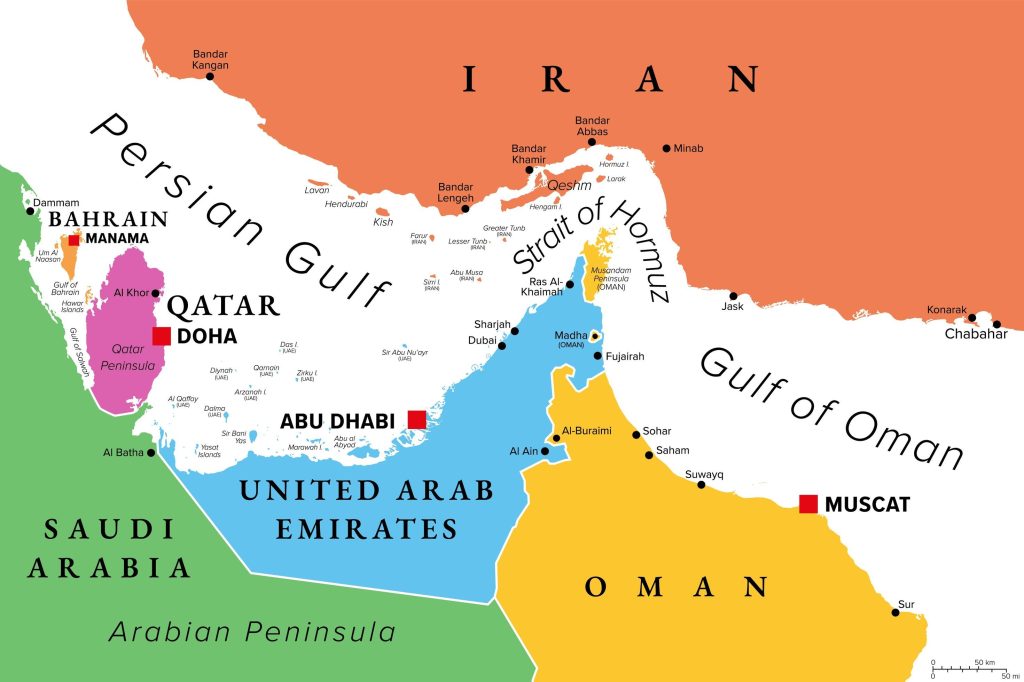
Connects the Persian Gulf with the Gulf of Oman and Arabian Sea |
|
Borders |
Iran (North), Oman & UAE (South) |
|
Width |
About 39 km at its narrowest point |
|
Navigation Channel |
Around 3 km wide in each direction |
|
Importance |
World’s most important oil transit chokepoint |
|
★ UPSC FACT — MUST REMEMBER Nearly 20% of global oil consumption moves through the Strait of Hormuz. It is also a major route for Liquefied Natural Gas (LNG) exports, especially from Qatar. Major exporters using this route include Saudi Arabia, Iraq, UAE, Kuwait, and Qatar. |
③ WHY IS THE STRAIT OF HORMUZ IMPORTANT?
1. Global Energy Lifeline
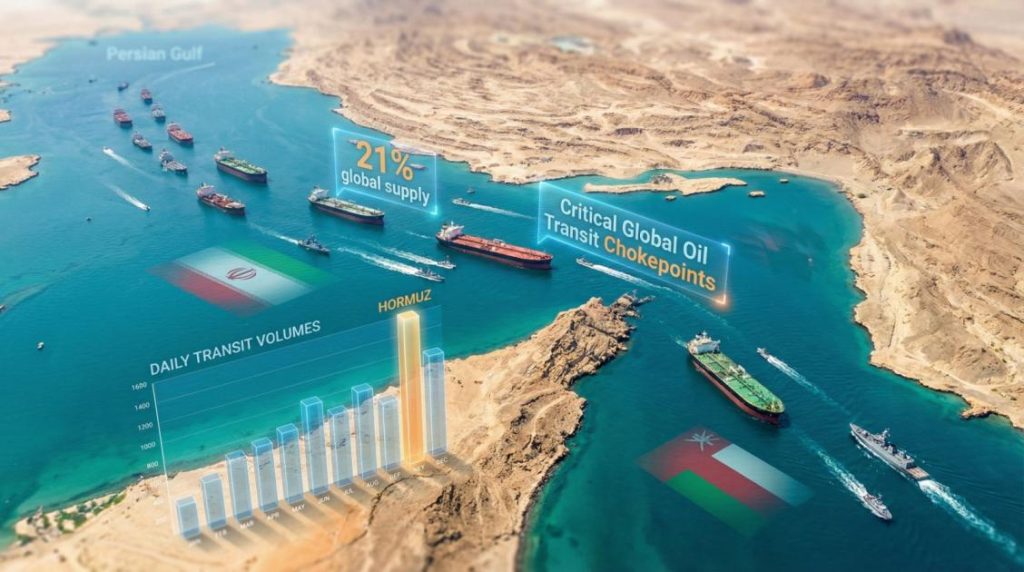
● Around one-fifth of globally traded crude oil passes through this narrow waterway.
● Any disruption immediately affects global crude prices.
2. Strategic Maritime Chokepoint
● Considered one of the world’s most critical maritime chokepoints because there are very few viable alternatives for Gulf oil exports.
3. Economic Importance — Disruptions Increase:
● Shipping insurance premiums
● Freight charges
● Import costs
● Inflation worldwide
④ WHY IS IT IMPORTANT FOR INDIA?
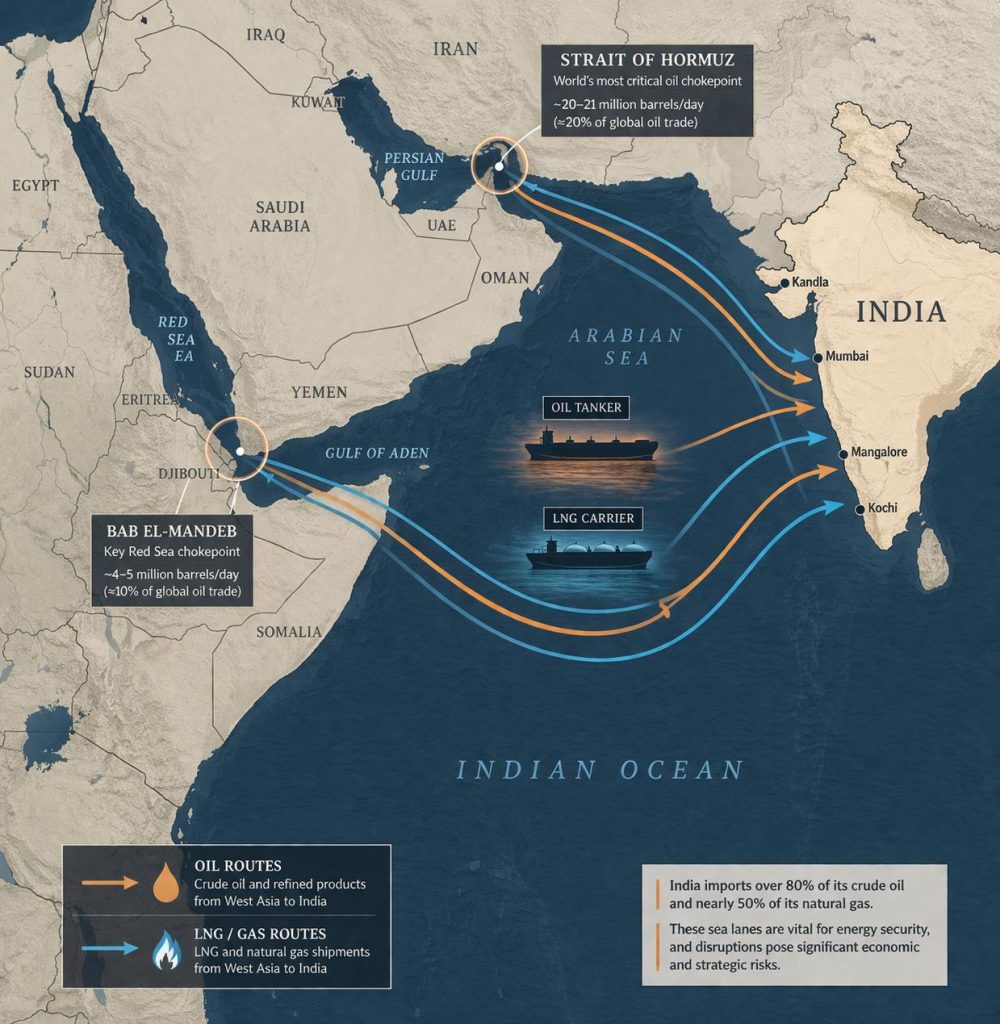
India is among the largest importers of crude oil, and a substantial share of its crude imports from Gulf producers passes through the Strait of Hormuz. Any disruption or additional transit cost can raise India’s oil import bill, fuel prices, inflationary pressures, and current account deficit.
India’s Key Concerns:
● Rising crude oil prices
● Higher LPG and fuel prices
● Increased fertilizer costs
● Pressure on Current Account Deficit (CAD)
● Shipping delays
● Increased marine insurance costs
⑤ STRATEGIC IMPORTANCE FOR UPSC
A. Maritime Security
The Strait demonstrates why maritime chokepoints remain central to global security. Key examples include:
|
Chokepoint |
Strategic Importance |
|
Strait of Hormuz |
Global oil trade — nearly 20% of world oil consumption transits here |
|
Malacca Strait |
India–East Asia trade corridor |
|
Bab-el-Mandeb |
Gateway to the Red Sea |
|
Suez Canal |
Shortest Europe–Asia trade link |
|
Panama Canal |
Atlantic–Pacific connectivity |
B. Energy Security — India’s Energy Security Depends On:
● Diversification of oil sources
● Strategic Petroleum Reserves (SPR)
● Renewable Energy
● Green Hydrogen Mission
● Long-term LNG contracts
C. Blue Economy — Safe Sea Lanes of Communication (SLOCs) are Essential For:
● International trade
● Energy transportation
● Economic growth
● Blue Economy initiatives
D. International Law Angle
The Strait of Hormuz is an international strait used for global navigation. Relevant convention: United Nations Convention on the Law of the Sea (UNCLOS), 1982.
● It recognizes the principle of transit passage through international straits, meaning navigation should generally remain open and not be arbitrarily obstructed.
● The current dispute has revived debates over maritime rights and freedom of navigation.
⑥ SIGNIFICANCE OF THE NEWS
Global Significance
● Increase in geopolitical tensions
● Rising oil market volatility
● Potential disruption of global supply chains
● Higher shipping and insurance costs
For India
● Inflationary pressures
● Increase in import bill
● Pressure on the rupee
● Fiscal challenges if fuel subsidies rise
● Need for diversified energy sourcing
For International Relations
● Intensifies US–Iran rivalry
● Affects Gulf security architecture
● Impacts relations among Gulf states, major energy importers, and maritime powers
⑦ RELEVANCE FOR UPSC PRELIMS & MAINS
🎯 Prelims — Possible Areas to Revise
● Strait of Hormuz location
● Gulf countries
● Maritime chokepoints
● UNCLOS
● Sea Lanes of Communication (SLOCs)
● India’s Strategic Petroleum Reserve
● Energy security
🎯 Mains — GS-II
● India’s relations with West Asia
● International maritime governance
● Global strategic competition
🎯 Mains — GS-III
● Energy Security
● Economic impact of oil shocks
● Maritime security
● Supply chain resilience
● Blue Economy
⑧ VALUE ADDITION — IMPORTANT MARITIME CHOKEPOINTS
|
Chokepoint |
Strategic Importance |
|
Strait of Hormuz |
Global oil trade — nearly 20% of world oil consumption transits here |
|
Malacca Strait |
India–East Asia trade corridor |
|
Bab-el-Mandeb |
Gateway to the Red Sea |
|
Suez Canal |
Shortest Europe–Asia trade link |
|
Panama Canal |
Atlantic–Pacific connectivity |
⑨ PREVIOUS UPSC LINKAGES
Questions have previously been asked on the following themes — high-probability repeat areas:
● Strait of Hormuz
● UNCLOS
● Freedom of Navigation
● Indian Ocean Region
● Maritime Security
● Blue Economy
● Energy Security
⑩ UPSC PRELIMS PRACTICE QUESTIONS
Question 1
With reference to the Strait of Hormuz, consider the following statements:
1. It connects the Persian Gulf with the Gulf of Oman.
2. It is bordered by Iran to the north and Oman to the south.
3. More than half of global crude oil trade passes through this Strait.
Which of the statements given above is/are correct?
A. 1 and 2 only
B. 2 and 3 only
C. 1 and 3 only
D. 1, 2 and 3
Answer: A
Statement 1 is correct.
Statement 2 is correct.
Statement 3 is incorrect because the commonly cited figure is around one-fifth (about 20%) of global oil consumption/trade, not more than half.
Question 2
Which of the following are regarded as major maritime chokepoints for global trade?
4. Strait of Hormuz
5. Malacca Strait
6. Bab-el-Mandeb
7. Suez Canal
Which of the statements given above is/are correct?
A. 1 and 2 only
B. 1, 2 and 3 only
C. 2, 3 and 4 only
D. 1, 2, 3 and 4
Answer: D
All four are strategically important maritime chokepoints that facilitate global trade and energy transportation and frequently feature in UPSC examinations.
⑪ UPSC MAINS PRACTICE QUESTION
|
MAINS QUESTION (250 words) “The security of maritime chokepoints has become central to global geopolitics and India’s energy security.” Discuss in the context of recent developments in the Strait of Hormuz. |


- India–Australia Uranium Supplies Agreement : A New Pillar of Strategic Energy Partnership - July 14, 2026
- US DECLARES ITSELF ‘GUARDIAN OF HORMUZ’ : Plans 20% Safe-Passage Charge on Ships Transiting the Strait - July 14, 2026
- Delhi Government Finalises Criteria for Monthly Aid Scheme for Women - July 14, 2026

No Comments