


15 Jul KVIC Chairman Inaugurates Khadi India Pavilion at Bharat Tex 2026
Subject Relevance — Where This Topic Fits
- GS Paper I — Indian Heritage and Culture, Social Empowerment | GS Paper II — Government Policies and Interventions for Development in various sectors | GS Paper III — Indian Economy and Issues Relating to Planning, Mobilization of Resources, Growth, Development and Employment; Inclusive Growth; Industrial Policy
- Prelims: Khadi and Village Industries Commission (KVIC), Bharat Tex 2026, Khadi India Pavilion, Vocal for Local, Atmanirbhar Bharat, Rural Livelihoods, Sustainable Development, MSME Sector, Jamdani Weaving, Centre of Excellence for Khadi
- Essay: Khadi: Weaving the Fabric of Atmanirbhar Bharat and Sustainable Development, From Tradition to Trend: How Khadi is Redefining India’s Economic and Cultural Narrative
Quick Revision: Khadi, once a symbol of independence, is now being redefined as ‘New India’s New Khadi’ — a dynamic force for rural empowerment, sustainable development, and global brand recognition, driven by innovation and modern design.
Why is this in the news?
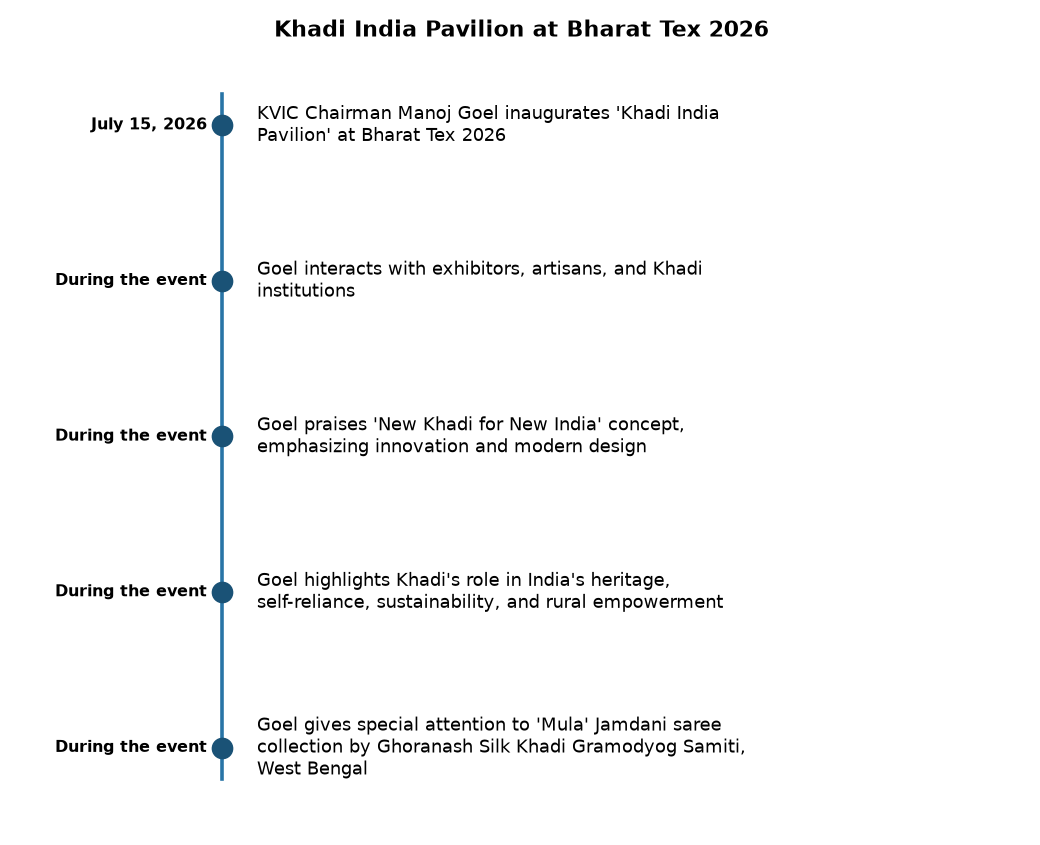
The Khadi and Village Industries Commission (KVIC) Chairman, Shri Manoj Goyal, inaugurated the ‘Khadi India Pavilion’ at Bharat Tex 2026, India’s largest global textile event. This event highlighted Khadi’s evolution from a traditional fabric to a powerful symbol of India’s rich heritage, self-reliance, sustainability, and rural empowerment, showcasing innovative designs and modern applications under the theme ‘New India’s New Khadi’.
Background
- Khadi, hand-spun and hand-woven cloth, holds immense historical significance in India, deeply associated with Mahatma Gandhi’s Swadeshi movement and the struggle for independence.
- The Khadi and Village Industries Commission (KVIC) was established by the Government of India under the Khadi and Village Industries Commission Act, 1956, to plan, promote, facilitate, organise and assist in the establishment and development of Khadi and village industries in the rural areas.
- Bharat Tex is a premier global textile event, bringing together stakeholders from across the textile value chain, showcasing India’s capabilities and potential in the global textile industry.
- The ‘Vocal for Local’ initiative, championed by Prime Minister Shri Narendra Modi, encourages domestic production and consumption, with Khadi being a prime example of a local product with global potential.
- The ‘Atmanirbhar Bharat’ (Self-Reliant India) vision aims to make India a self-reliant nation across various sectors, where Khadi plays a crucial role in promoting indigenous industries and rural employment.
- The Khadi sector has witnessed significant growth in recent years, with a reported turnover exceeding ₹1.87 lakh crore and providing employment to over 2.04 crore people in FY 2025-26, demonstrating its economic vitality and social impact.
What is Khadi and Village Industries Commission (KVIC)?
- KVIC is a statutory body formed by the Government of India under the ‘Khadi and Village Industries Commission Act of 1956’.
- It functions under the Ministry of Micro, Small and Medium Enterprises (MSME).
- The primary objective of KVIC is to promote and develop Khadi and village industries for providing employment opportunities in rural areas.
- It aims to foster self-reliance among the rural populace and contribute to the overall economic development of the country.
- KVIC undertakes various activities including training, research, marketing, and financial assistance to Khadi and village industry institutions.
- It is instrumental in preserving traditional crafts and skills while also encouraging innovation and modernization in the sector.
- KVIC’s mandate extends to ensuring the welfare of artisans and weavers associated with Khadi and village industries.
- The Commission plays a vital role in implementing government schemes and policies related to the promotion of Khadi and rural entrepreneurship.
Key Features
| Feature | Significance |
|---|---|
| Traditional Craftsmanship | Preserves India’s rich cultural heritage and age-old weaving techniques, providing a unique identity to Khadi products. |
| Rural Employment Generation | Provides sustainable livelihoods to millions of artisans and weavers, particularly in rural and remote areas, combating unemployment. |
| Eco-Friendly Production | Employs manual processes with minimal environmental impact, aligning with sustainable development goals and promoting green practices. |
| Symbol of Self-Reliance | Embodies the spirit of ‘Swadeshi’ and ‘Atmanirbhar Bharat’, promoting indigenous production and reducing dependence on foreign goods. |
| Versatility and Innovation | Adapts to modern fashion trends and lifestyle products, expanding its market appeal beyond traditional attire to home decor and contemporary wear. |
| Decentralized Production | Operates through a network of institutions and cooperatives, fostering community participation and equitable distribution of economic benefits. |
Why it Matters
Economic Empowerment
- Khadi provides direct and indirect employment to a vast number of rural artisans, particularly women, contributing significantly to their economic upliftment.
- The sector’s substantial turnover (₹1.87 lakh crore in FY 2025-26) demonstrates its potential to drive rural economic growth and wealth creation.
- It supports micro-enterprises and small-scale industries, fostering local entrepreneurship and strengthening the grassroots economy.
Cultural Preservation and Promotion
- Khadi acts as a custodian of India’s traditional weaving techniques, such as Jamdani, ensuring the continuity of invaluable indigenous crafts.
- It symbolizes India’s unique cultural identity on global platforms, showcasing the nation’s rich heritage and artistic prowess.
- The ‘New India’s New Khadi’ theme bridges tradition with modernity, making cultural heritage relevant and appealing to younger generations.
Sustainable Development and Environmental Stewardship
- The production process of Khadi is inherently eco-friendly, consuming minimal energy and water, and relying on natural fibers.
- It promotes a circular economy model by utilizing local resources and minimizing waste, aligning with global sustainability goals.
- Khadi’s emphasis on handcrafting reduces carbon footprint compared to industrial textile production, contributing to environmental conservation.
Social Inclusion and Equity
- Khadi industries often operate in remote and underdeveloped regions, bringing economic opportunities to marginalized communities.
- It empowers vulnerable sections of society by providing skill development and stable income, reducing regional disparities.
- The cooperative structure of many Khadi institutions fosters community ownership and collective welfare among artisans.
Brand India and Global Recognition
- Khadi’s presence at international events like Bharat Tex elevates its global profile, positioning it as a premium Indian brand.
- Innovation in design and product diversification helps Khadi penetrate global markets, enhancing India’s soft power and export potential.
- The narrative of Khadi as a symbol of ‘Atmanirbhar Bharat’ resonates with international consumers seeking ethical and sustainable products.
Challenges
1. Competition from Machine-Made Textiles
- Khadi faces stiff competition from mass-produced, cheaper machine-made textiles, which often have lower production costs and faster turnaround times.
- The perception of Khadi as a premium or niche product can limit its mass market appeal, especially among price-sensitive consumers.
UPSC Link: GS Paper III — Industrial Policy, Challenges to MSMEs
2. Marketing and Brand Building
- Despite recent efforts, Khadi still needs stronger marketing strategies to appeal to a wider, younger demographic and compete with established fashion brands.
- Ensuring consistent quality and timely delivery across a vast network of Khadi institutions remains a logistical challenge for brand credibility.
UPSC Link: GS Paper III — Marketing, Supply Chain Management
3. Skill Upgradation and Modernization
- Many traditional artisans may lack access to modern design techniques, technology, and market trends, hindering product innovation.
- The aging workforce in some traditional craft clusters poses a challenge for skill transfer and attracting younger generations to the profession.
UPSC Link: GS Paper II — Skill Development, Education
4. Supply Chain and Infrastructure Gaps
- Challenges exist in ensuring a smooth and efficient supply chain for raw materials, production, and distribution, especially in remote areas.
- Lack of adequate infrastructure, including modern weaving equipment and processing units, can limit production capacity and efficiency.
UPSC Link: GS Paper III — Infrastructure, Logistics
5. Financial Viability of Artisans
- Artisans often face challenges in securing fair wages and adequate financial support, making the profession less attractive.
- Access to credit and working capital for small Khadi units and individual artisans can be limited, impacting their growth potential.
UPSC Link: GS Paper III — Inclusive Growth, Financial Inclusion
Challenges — UPSC Perspective
| Issue | Concern |
|---|---|
| Price Competitiveness | Higher production costs of hand-spun Khadi compared to machine-made textiles. |
| Market Access | Limited reach to urban and international markets for many rural Khadi units. |
| Design Innovation | Need for continuous evolution in designs to cater to contemporary fashion sensibilities. |
| Quality Control | Maintaining uniform quality standards across diverse Khadi institutions and products. |
| Artisan Welfare | Ensuring fair wages, social security, and attractive working conditions for weavers. |
| Technological Adoption | Integrating appropriate modern technology without compromising the hand-spun essence. |
Government Initiatives — Must-Memorise for Prelims
- Market Promotion and Development Scheme (MPDS)
- Interest Subsidy Eligibility Certificate (ISEC) Scheme
- Scheme of Fund for Regeneration of Traditional Industries (SFURTI)
- Prime Minister’s Employment Generation Programme (PMEGP)
- Khadi Karigar Janashree Bima Yojana
- Khadi Reform and Development Programme (KRDP)
- Gramodyog Vikas Yojana
- Aam Admi Bima Yojana (AABY) for Khadi Artisans
- Marketing Assistance Scheme (MAS)
- Ease of Doing Business for Khadi Institutions
Way Forward
- Strengthen research and design capabilities, potentially through collaborations with fashion institutes, to ensure Khadi remains contemporary and globally competitive.
- Enhance marketing and branding efforts, leveraging digital platforms and e-commerce, to reach a wider and younger consumer base, both domestically and internationally.
- Invest in skill development and training programs for artisans, focusing on modern techniques, quality control, and entrepreneurship, while preserving traditional skills.
- Improve supply chain efficiency and infrastructure, including access to raw materials, processing units, and logistics, to reduce costs and improve market responsiveness.
- Promote Khadi as a sustainable and ethical fashion choice, highlighting its environmental benefits and social impact to appeal to conscious consumers.
- Foster public-private partnerships and collaborations with large retailers and designers to expand Khadi’s market presence and product diversification.
- Ensure robust financial support and social security measures for artisans to make Khadi a more attractive and viable livelihood option.
- Leverage events like Bharat Tex to showcase Khadi’s innovation and potential, facilitating networking and business opportunities for Khadi institutions.
UPSC Value Addition
Keywords for Mains Answer-Writing
Khadi Renaissance · Rural Livelihood Empowerment · Sustainable Textile Economy · Cultural Heritage Preservation · Atmanirbhar Bharat · Vocal for Local · Inclusive Growth · MSME Sector Development · Design-led Innovation · Global Market Integration · Ethical Fashion · Circular Economy
Constitutional & Policy Linkages
- Article 43: Promotion of Cottage Industries
- Directive Principles of State Policy: Social Justice
- Khadi and Village Industries Commission Act, 1956: Statutory Body
- MSME Development Act, 2006: Micro, Small, Medium Enterprises
- National Textile Policy: Sectoral Growth Strategy
Concept Flow
Government Initiatives (e.g., Vocal for Local) → Increased Support for KVIC → Enhanced Innovation & Design in Khadi → Wider Market Appeal & Global Presence (e.g., Bharat Tex) → Increased Sales & Production → Greater Rural Employment & Livelihood Empowerment → Contribution to Atmanirbhar Bharat & Sustainable Development
Prelims Practice Questions
Q1. Consider the following statements regarding the Khadi and Village Industries Commission (KVIC):
1. KVIC is a statutory body established under the Ministry of Textiles.
2. Its primary objective is to plan, promote, facilitate, organise and assist in the establishment and development of Khadi and village industries in urban areas.
3. The ‘Interest Subsidy Eligibility Certificate (ISEC) Scheme’ is one of the initiatives implemented by KVIC.
- A. 1 and 2 only
- B. 3 only
- C. 2 and 3 only
- D. 1, 2 and 3
Answer: B. 3 only — Statement 1 is incorrect: KVIC is a statutory body established under the Ministry of Micro, Small and Medium Enterprises (MSME), not the Ministry of Textiles. Statement 2 is incorrect: Its primary objective is to promote Khadi and village industries in rural areas, not urban areas. Statement 3 is correct: The ISEC Scheme is indeed an initiative by KVIC to provide interest subsidies to Khadi institutions.
Q2. Which of the following statements best describes the significance of ‘New India’s New Khadi’ as highlighted at Bharat Tex 2026?
(A) It emphasizes Khadi’s role solely as a traditional attire for political leaders.
(B) It focuses on replacing all machine-made textiles with hand-spun Khadi products.
(C) It showcases Khadi’s evolution beyond traditional identity to encompass modern designs, lifestyle products, and global market appeal, symbolizing self-reliance and sustainability.
(D) It primarily aims to reduce the price of Khadi to compete with synthetic fabrics.
- A
- B
- C
- D
Answer: C — Option (C) accurately captures the essence of ‘New India’s New Khadi’ by highlighting its evolution to include modern designs, lifestyle products, and global market appeal, while symbolizing self-reliance and sustainability, as articulated by the KVIC Chairman. Options (A), (B), and (D) present narrow or incorrect interpretations of the initiative.
Mains Practice Question
✍ The recent showcasing of ‘New India’s New Khadi’ at Bharat Tex 2026 signifies a paradigm shift in Khadi’s role from a mere fabric to a powerful symbol of economic empowerment, cultural preservation, and sustainable development. Discuss the multi-faceted significance of this transformation and analyze the challenges that persist in realizing Khadi’s full potential as a global brand. (250 words)
Approach: Begin by introducing Khadi’s historical context and its recent resurgence as highlighted by the KVIC Chairman. In the first part, elaborate on the ‘multi-faceted significance’ by discussing its contributions to economic empowerment (rural livelihoods, MSME growth), cultural preservation (traditional crafts, Jamdani), and sustainable development (eco-friendly production, circular economy). In the second part, analyze the ‘challenges’ such as competition from machine-made textiles, marketing and branding gaps, skill upgradation needs, and supply chain inefficiencies. Conclude with a forward-looking statement on strategic interventions required for Khadi to achieve its global brand potential, aligning with ‘Atmanirbhar Bharat’ and ‘Vocal for Local’ visions.
Source: PIB (Press Information Bureau)

- बॉम्बे हाईकोर्ट ने मुंबई में वर्सोवा-माध कनेक्टर पुल निर्माण को हरी झंडी, 1237 मैंग्रोव वृक्षों की कटाई को मंजूरी - September 18, 2026
- Bombay HC Clears Versova-Madh Bridge: Mangroves Felling Approved for Traffic Relief - September 18, 2026
- वर्तमान वित्त वर्ष में राजस्व प्राप्तियां अनुमानों से काफी कम: राज्यों की स्थिति खराब - September 18, 2026

No Comments