


15 Jul AIM Dialogue 2026: North East’s Role in India’s Innovation & Viksit Bharat @2047
Subject Relevance — Where This Topic Fits
- GS Paper II — Government Policies and Interventions for Development in various sectors and issues arising out of their design and implementation; Development processes and the development industry — the role of NGOs, SHGs, various groups and associations, donors, charities, institutional and other stakeholders. | GS Paper III — Indian Economy and issues relating to Planning, Mobilization of Resources, Growth, Development and Employment; Science and Technology- Developments and their applications and effects in everyday life; Indigenization of technology and developing new technology.
- Prelims: Atal Innovation Mission (AIM), NITI Aayog, North Eastern Region (NER), Viksit Bharat @2047, Act East Policy, Innovation Ecosystem, Bamboo Resources, Aatmanirbhar Bharat, Regional Innovation, Startup India
- Essay: Innovation as a Cornerstone for Regional Development and National Prosperity: The North East’s Journey towards Viksit Bharat., Leveraging India’s Demographic Dividend and Regional Strengths for a Knowledge-Based Economy.
Quick Revision: The AIM Dialogue in the North East Chapter 2026 underscores the region’s pivotal role as ‘Ashta Lakshmi’ and India’s gateway to Southeast Asia, driving innovation and entrepreneurship for ‘Viksit Bharat @2047’ by leveraging its unique bio-resources and cultural heritage.
Why is this in the news?
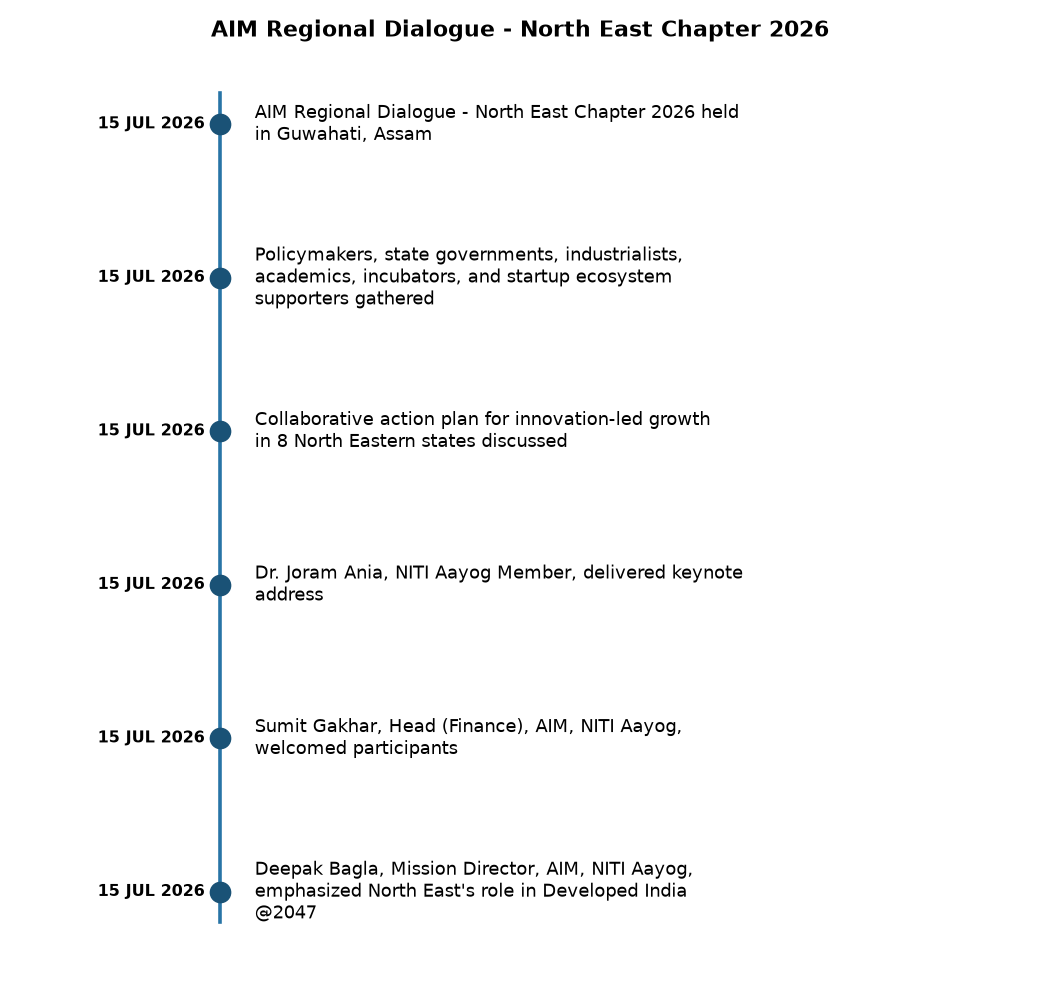
The Atal Innovation Mission (AIM), NITI Aayog, recently organised the regional AIM Dialogue – North East Chapter 2026 in Guwahati, Assam. This significant event brought together policymakers, state governments, industry leaders, academicians, incubators, and startup ecosystem enablers from all eight North Eastern States to formulate a collaborative action plan for innovation-led growth. The dialogue underscored the region’s strategic importance as India’s gateway to Southeast Asia and its potential to contribute significantly to the ‘Viksit Bharat @2047’ vision.
Background
- The North Eastern Region (NER) comprises eight states: Arunachal Pradesh, Assam, Manipur, Meghalaya, Mizoram, Nagaland, Sikkim, and Tripura, characterised by unique geographical, cultural, and socio-economic attributes.
- Historically, the NER has faced challenges related to connectivity, infrastructure, and economic integration, leading to developmental disparities.
- The Government of India has placed unprecedented focus on the NER, viewing it as ‘Ashta Lakshmi’ – eight states with immense potential to contribute to India’s growth.
- The ‘Act East Policy’ (formerly Look East Policy) positions the NER as a crucial bridge for India’s engagement with Southeast Asian nations, enhancing its geopolitical and geoeconomic significance.
- NITI Aayog, through its various initiatives like AIM, aims to foster a culture of innovation and entrepreneurship across all regions, including the NER, to achieve the vision of a developed India by 2047.
- The dialogue specifically highlighted the NER’s rich biodiversity, vibrant cultural heritage, abundant bamboo resources, traditional crafts, and a burgeoning entrepreneurial ecosystem as key strengths for innovation-led development.
What is the Atal Innovation Mission (AIM)?
- Atal Innovation Mission (AIM) is a flagship initiative set up by NITI Aayog to promote a culture of innovation and entrepreneurship across the length and breadth of our country.
- Its objective is to create and promote an ecosystem of innovation and entrepreneurship across the country at school, university, research institutions, MSME and corporate levels.
- AIM’s initiatives include establishing Atal Tinkering Labs (ATLs) in schools to foster curiosity and creativity among young minds.
- It supports Atal Incubation Centres (AICs) and Atal Community Innovation Centres (ACICs) to provide necessary infrastructure and mentorship to startups and innovators.
- The Atal New India Challenges (ANIC) and Aatmanirbhar Bharat ARISE-ANIC programs aim to promote technology-based innovation in various sectors.
- AIM also focuses on creating a network of mentors and partners to support innovators and entrepreneurs, fostering a ‘Sabka Prayas’ (collective effort) approach.
- The mission plays a crucial role in aligning regional innovation efforts with national developmental goals, such as ‘Viksit Bharat @2047’.
Key Features
| Feature of AIM Dialogue (NER Chapter) | Significance |
|---|---|
| Collaborative Platform | Brought together diverse stakeholders (policymakers, industry, academia, startups) to foster synergy and shared vision for NER’s innovation ecosystem. |
| Focus on Regional Strengths | Emphasised leveraging NER’s unique assets like biodiversity, bamboo resources, traditional crafts, and cultural heritage for innovation-led growth. |
| Alignment with ‘Viksit Bharat @2047’ | Positioned NER as an indispensable contributor to India’s developed nation goal, moving beyond a recipient of aid to a driver of growth. |
| Emphasis on ‘Act East to Act Fast’ | Highlighted NER’s role as a gateway to Southeast Asia, promoting economic integration and cross-border innovation opportunities. |
| PM’s ‘Ashta Lakshmi’ Vision | Reiterated the Prime Minister’s perspective of the eight NER states as having unique potential, guiding focused developmental efforts. |
| Roundtable Discussions | Facilitated active participation from state councils and central departments (DST, DBT) to streamline national initiatives with regional aspirations. |
Why it Matters
Strategic and Geopolitical Significance
- Reinforces NER’s role as India’s ‘gateway to Southeast Asia’, strengthening the ‘Act East Policy’ and fostering regional economic integration.
- Enhances India’s strategic presence in the Indo-Pacific region by developing a robust and connected border region.
- Contributes to national security by promoting socio-economic development and addressing root causes of unrest in border areas.
Economic Development and ‘Viksit Bharat @2047’
- Unlocks the NER’s immense potential in sectors like bamboo, bio-resources, tourism, and traditional crafts, creating new value chains and employment opportunities.
- Fosters a vibrant startup ecosystem, attracting investment and promoting indigenous innovation tailored to local needs and global markets.
- Reduces regional disparities by integrating the NER into the national economic mainstream, contributing to India’s overall GDP growth and the ‘Viksit Bharat’ vision.
Social and Cultural Empowerment
- Preserves and promotes the rich cultural heritage and traditional knowledge systems of the indigenous communities through innovation and entrepreneurship.
- Empowers local youth and women by providing opportunities for skill development, entrepreneurship, and participation in the innovation economy.
- Enhances the quality of life through technology-driven solutions in healthcare, education, and public services, addressing specific regional challenges.
Environmental Sustainability
- Promotes sustainable utilisation of the NER’s rich biodiversity and natural resources through eco-friendly innovations and green technologies.
- Encourages research and development in areas like bamboo-based industries, organic farming, and renewable energy, aligning with climate action goals.
- Fosters a model of development that balances economic growth with ecological preservation, crucial for a biodiversity hotspot like the NER.
Challenges
1. Inadequate Infrastructure
- Poor road, rail, and air connectivity within the region and with the rest of India hampers logistics and market access for entrepreneurs.
- Limited access to reliable electricity and high-speed internet connectivity impedes digital transformation and the growth of tech-based startups.
UPSC Link: GS Paper III — Infrastructure
2. Limited Access to Capital and Markets
- Startups often struggle to secure funding from venture capitalists and angel investors due to perceived higher risks and geographical distance.
- Small local markets and challenges in reaching national/international markets limit scalability and profitability for many enterprises.
UPSC Link: GS Paper III — Mobilization of Resources
3. Human Capital and Skill Gaps
- Lack of adequate technical and entrepreneurial skills among the youth, coupled with brain drain, affects the availability of a skilled workforce.
- Limited access to quality education and research institutions, particularly in advanced technological fields, hinders innovation capacity.
UPSC Link: GS Paper II — Human Resources
4. Policy Implementation and Coordination
- Challenges in effective implementation of central and state schemes due to bureaucratic hurdles, capacity constraints, and lack of inter-state coordination.
- Ensuring policy continuity and adapting national frameworks to the unique socio-economic and cultural contexts of the NER requires sustained effort.
UPSC Link: GS Paper II — Governance
5. Geographical and Environmental Vulnerabilities
- The region’s susceptibility to natural disasters (floods, earthquakes) and difficult terrain increases operational costs and risks for businesses.
- Maintaining ecological balance while pursuing economic development requires careful planning and sustainable practices.
UPSC Link: GS Paper I — Geography; GS Paper III — Environment
Challenges — UPSC Perspective
| Issue | Concern |
|---|---|
| Connectivity Deficit | Hinders movement of goods, services, and people, isolating markets and talent. |
| Funding Gap for Startups | Limited access to early-stage capital stifles growth and innovation. |
| Skill Mismatch | Lack of industry-relevant skills limits employability and entrepreneurial success. |
| Institutional Weaknesses | Capacity gaps in governance and implementation of development programs. |
| Brain Drain | Talented youth migrate to other regions for better opportunities, depleting local human capital. |
| Market Linkages | Difficulty in connecting local products and innovations to larger national and international markets. |
Government Initiatives — Must-Memorise for Prelims
- Atal Innovation Mission (AIM)
- North East Industrial Development Scheme (NEIDS)
- North Eastern Council (NEC)
- Startup India Initiative
- Pradhan Mantri Kaushal Vikas Yojana (PMKVY)
- National Bamboo Mission (NBM)
- Scheme for Promotion of Culture and Tourism in North East Region (SPCTNER)
- Connectivity Projects under Bharatmala Pariyojana and Sagarmala Pariyojana
- Vibrant Villages Programme
- Special Accelerated Road Development Programme in North East (SARDP-NE)
Way Forward
- Strengthen physical and digital infrastructure, including roads, railways, airports, and high-speed internet, to improve connectivity and market access.
- Establish more Atal Incubation Centres (AICs) and Atal Community Innovation Centres (ACICs) with sector-specific focus, particularly in bio-resources, bamboo, and tourism.
- Facilitate access to early-stage funding for startups through dedicated NER-focused venture capital funds, angel networks, and government grants.
- Develop skill development programs tailored to the region’s unique strengths and emerging industries, in collaboration with local educational institutions and industry.
- Promote cross-border collaborations and market linkages with Southeast Asian countries under the ‘Act East Policy’ to leverage the NER’s strategic location.
- Encourage research and development in traditional knowledge systems and bio-resources, integrating them with modern scientific approaches for sustainable innovation.
- Streamline policy implementation and foster greater coordination among central ministries, state governments, and local bodies for effective program delivery.
- Launch awareness campaigns and mentorship programs to cultivate an entrepreneurial mindset among the youth and celebrate local innovators.
UPSC Value Addition
Keywords for Mains Answer-Writing
Atal Innovation Mission · North East Region Development · Viksit Bharat @2047 · Innovation Ecosystem · Entrepreneurship · Act East Policy · Regional Disparities · Sustainable Development · Bio-resources · Bamboo Economy · Skill Development · Collaborative Governance
Constitutional & Policy Linkages
- Article 371B: Special provision with respect to the State of Assam.
- Article 371C: Special provision with respect to the State of Manipur.
- Article 371F: Special provision with respect to the State of Sikkim.
- Article 371G: Special provision with respect to the State of Mizoram.
- Article 371H: Special provision with respect to the State of Arunachal Pradesh.
- Article 371I: Special provision with respect to the State of Goa (not NER, but part of special provisions).
- Seventh Schedule (Union List, State List, Concurrent List): Defines legislative powers for development.
- Directive Principles of State Policy (DPSP): Promote welfare of the people, reduce inequalities.
Concept Flow
Government Focus on NER (Ashta Lakshmi Vision) → AIM Dialogue & Collaborative Action Plan → Strengthening Regional Innovation Ecosystem → Leveraging NER’s Unique Strengths (Bio-resources, Culture) → Innovation-led Growth & Entrepreneurship → Contribution to Viksit Bharat @2047 & Act East Policy
Prelims Practice Questions
Q1. With reference to the Atal Innovation Mission (AIM), consider the following statements:
1. It is a flagship initiative of the Ministry of Science and Technology.
2. It aims to promote a culture of innovation and entrepreneurship across the country.
3. Atal Tinkering Labs (ATLs) are established under AIM to foster curiosity and creativity among school children.
Which of the statements given above is/are correct?
- A. 1 and 2 only
- B. 2 and 3 only
- C. 3 only
- D. 1, 2 and 3
Answer: B. 2 and 3 only — Statement 1 is incorrect: AIM is a flagship initiative of NITI Aayog, not the Ministry of Science and Technology. Statement 2 is correct: Its primary objective is to promote a culture of innovation and entrepreneurship. Statement 3 is correct: ATLs are a key component of AIM, focusing on school-level innovation.
Q2. Which of the following initiatives are part of the Atal Innovation Mission (AIM)?
1. Atal Tinkering Labs (ATLs)
2. Atal Incubation Centres (AICs)
3. Atal Community Innovation Centres (ACICs)
4. Atal New India Challenges (ANIC)
Select the correct answer using the code given below:
- A. 1 and 2 only
- B. 2, 3 and 4 only
- C. 1, 2, 3 and 4
- D. 1, 3 and 4 only
Answer: C. 1, 2, 3 and 4 — All four initiatives listed – Atal Tinkering Labs (ATLs), Atal Incubation Centres (AICs), Atal Community Innovation Centres (ACICs), and Atal New India Challenges (ANIC) – are integral components of the Atal Innovation Mission (AIM) to foster innovation and entrepreneurship at various levels.
Mains Practice Question
✍ The North Eastern Region (NER) is envisioned as ‘Ashta Lakshmi’ and a critical gateway for India’s ‘Act East Policy’. In light of the recent AIM Dialogue, critically examine the potential of innovation and entrepreneurship to transform the NER into a growth engine for ‘Viksit Bharat @2047’, while also discussing the persistent challenges that need to be addressed. (250 words)
Approach: Begin by introducing the strategic importance of the NER and the ‘Ashta Lakshmi’ vision. Discuss how initiatives like AIM Dialogue are leveraging the region’s unique strengths (biodiversity, culture, bamboo) to foster innovation and entrepreneurship, linking it to the ‘Viksit Bharat @2047’ goal and the ‘Act East Policy’. Subsequently, delve into the persistent challenges such as infrastructure deficits, funding gaps, skill shortages, and policy implementation issues. Conclude with a forward-looking perspective, emphasising the need for sustained collaborative efforts, targeted policy interventions, and leveraging regional strengths to overcome these challenges and realise the NER’s full potential.
Source: PIB (Press Information Bureau)


No Comments