


15 Jul Cabinet Approves National Investment Policy for Urea-2026 (NIPU-2026)
Subject Relevance — Where This Topic Fits
- GS Paper III — Indian Economy and issues relating to planning, mobilization of resources, growth, development and employment. | GS Paper III — Major crops – cropping patterns in various parts of the country, different types of irrigation and irrigation systems storage, transport and marketing of agricultural produce and issues and related constraints; e-technology in the aid of farmers. | GS Paper III — Infrastructure: Energy, Ports, Roads, Airports, Railways etc. | GS Paper II — Government Policies and Interventions for Development in various sectors and Issues arising out of their Design and Implementation.
- Prelims: NIPU-2026, Urea production, Gas-based urea plants, Aatmanirbhar Bharat, Fertiliser subsidy, Return on Equity (RoE), Fixed and Variable Costs, Brownfield and Greenfield projects, Department of Fertilizers, Cabinet Committee on Economic Affairs
- Essay: The pursuit of self-reliance: A critical examination of India’s journey towards Aatmanirbhar Bharat in key sectors., Balancing economic growth with environmental sustainability: The role of policy in promoting efficient resource utilization and reducing import dependence.
Quick Revision: NIPU-2026 aims to boost domestic gas-based urea production, reduce import dependence, and foster ‘Aatmanirbhar Bharat’ in the fertiliser sector through transparent investment incentives and risk mitigation.
Why is this in the news?
The Cabinet Committee on Economic Affairs (CCEA), chaired by the Prime Minister, has approved the Department of Fertilizers’ proposal for the National Investment Policy for Urea-2026 (NIPU-2026). This policy aims to attract new investments in the urea sector, specifically for establishing gas-based urea manufacturing units, thereby bolstering domestic production and reducing India’s reliance on imported urea, aligning with the broader ‘Aatmanirbhar Bharat’ initiative.
Background
- India’s agricultural sector is heavily dependent on fertilisers, with urea being the most consumed nitrogenous fertiliser.
- Despite significant domestic production, there remains a persistent demand-supply gap, necessitating substantial imports of urea.
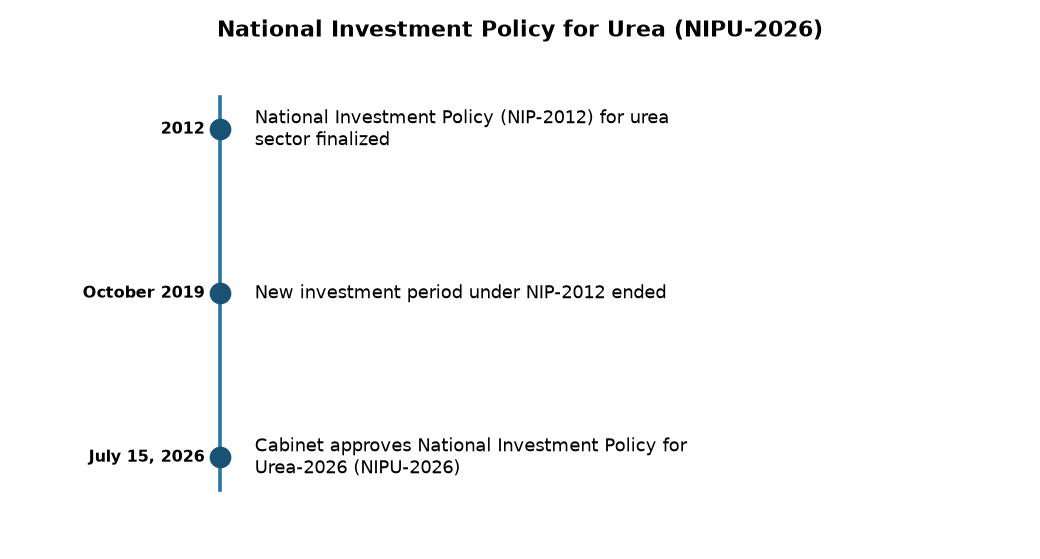
- To attract investments and boost domestic urea production, the Department of Fertilizers had formulated the New Investment Policy (NIP)-2012.
- Under NIP-2012, six new urea units were established, including four by Joint Venture Companies (JVCs) of Public Sector Undertakings (PSUs) and two by private companies.
- The investment window under NIP-2012 concluded in October 2019, and currently, 33 operational urea manufacturing units contribute to a total reassessed/installed capacity of 269.42 LMT.
- The increasing demand and the strategic imperative of self-reliance have necessitated a renewed policy framework to encourage further investments in the urea manufacturing sector.
What is the National Investment Policy for Urea-2026 (NIPU-2026)?
- NIPU-2026 is a new policy framework approved by the Cabinet Committee on Economic Affairs to stimulate fresh investments in the urea manufacturing sector in India.
- Its primary objective is to promote the establishment of new gas-based urea manufacturing units within the country.
- The policy is designed to enhance domestic urea production, thereby reducing import dependence and contributing to the ‘Aatmanirbhar Bharat’ goal.
- A key change from the previous NIP-2012 is the unbundling of fixed and variable costs, aimed at increasing transparency in the cost structure.
- It introduces a viable Return on Equity (RoE) band, with a floor of 12% and a ceiling of 16%, to ensure attractive and predictable returns for investors.
- The policy also incorporates measures to mitigate foreign exchange risk by converting fixed costs into INR after four years, based on prevailing exchange rates.
- These policy refinements are projected to result in savings of over ₹250 crore per plant compared to NIP-2012.
- The policy will cover the establishment of all new urea manufacturing units initiated under its framework.
Key Features
| Feature | Significance |
|---|---|
| Promotion of Gas-Based Units | Encourages cleaner production methods and leverages India’s expanding natural gas infrastructure for more efficient urea synthesis. |
| Separation of Fixed and Variable Costs | Enhances transparency in pricing mechanisms, enabling better cost control and more predictable returns for investors. |
| Viable Return on Equity (RoE) Band (12-16%) | Provides a clear and attractive return framework, incentivizing private and public sector investments by ensuring financial viability. |
| Mitigation of Foreign Exchange Risk | Conversion of fixed costs to INR after four years reduces exposure to currency fluctuations, making investments more secure for domestic and international players. |
| Estimated Savings of ₹250 Cr/Plant | Improved policy design and cost efficiency measures are expected to reduce project costs, making new plants more competitive and viable. |
| Coverage for New Urea Manufacturing Units | Ensures that all new projects receive the benefits and support outlined in the policy, streamlining the investment process. |
Why it Matters
Economic Significance
- <b>Reduced Import Bill:</b> Increased domestic production will significantly cut down on urea imports, saving valuable foreign exchange reserves.
- <b>Investment Promotion:</b> The policy’s attractive RoE band and risk mitigation measures are expected to draw substantial investments into the fertiliser sector, stimulating economic activity.
- <b>Job Creation:</b> Establishment of new manufacturing units will lead to direct and indirect employment opportunities in construction, manufacturing, logistics, and allied services.
- <b>Cost Efficiency:</b> Projected savings per plant will lead to more competitive domestic production, potentially stabilizing fertiliser prices for farmers in the long run.
Strategic Significance
- <b>Aatmanirbhar Bharat:</b> Directly contributes to the government’s vision of self-reliance by strengthening a critical input sector for agriculture.
- <b>Food Security:</b> Assured domestic supply of urea is crucial for maintaining agricultural productivity and ensuring national food security.
- <b>Supply Chain Resilience:</b> Reduces vulnerability to global supply chain disruptions and geopolitical events that can impact fertiliser availability and prices.
- <b>Energy Security:</b> Promotes the use of natural gas, a cleaner fuel, aligning with India’s energy transition goals and reducing reliance on other fossil fuels for fertiliser production.
Agricultural Significance
- <b>Assured Fertiliser Availability:</b> A stable domestic supply ensures timely and adequate availability of urea for farmers, crucial for crop yield and agricultural productivity.
- <b>Reduced Price Volatility:</b> Less dependence on international markets can help insulate domestic fertiliser prices from global fluctuations, benefiting farmers.
- <b>Farmer Welfare:</b> Consistent availability and potentially stable prices of urea contribute to the economic well-being and planning certainty for farmers.
Challenges
1. Raw Material Security
- Ensuring a consistent and affordable supply of natural gas, which is the primary feedstock for gas-based urea plants, remains a challenge.
- India’s domestic gas production is not sufficient to meet all demands, leading to reliance on imported LNG, which is subject to international price volatility.
UPSC Link: GS Paper III — Infrastructure (Energy)
2. Environmental Concerns
- While gas-based plants are cleaner than coal-based ones, their operation still involves emissions and requires adherence to stringent environmental norms.
- Managing industrial waste and ensuring sustainable practices are crucial for new units.
UPSC Link: GS Paper III — Environmental Pollution & Degradation
3. Investment Mobilisation and Project Execution
- Despite policy incentives, attracting large-scale investments for greenfield projects can be challenging due to high capital expenditure and long gestation periods.
- Efficient project execution, including land acquisition, regulatory clearances, and infrastructure development, is critical for timely commissioning.
UPSC Link: GS Paper III — Investment Models
4. Technological Upgradation
- New plants need to incorporate state-of-the-art technology to ensure energy efficiency and lower emissions, which requires access to global best practices and R&D.
- Maintaining competitiveness with international manufacturers necessitates continuous technological advancements.
UPSC Link: GS Paper III — Science and Technology
5. Market Dynamics and Subsidy Regime
- The heavily subsidized nature of urea in India can distort market signals and create challenges for new private players in terms of pricing and profitability.
- Balancing farmer welfare with the financial health of manufacturers under the subsidy regime is a complex task.
UPSC Link: GS Paper III — Subsidies
Challenges — UPSC Perspective
| Issue | Concern |
|---|---|
| Dependence on Imported Gas | Vulnerability to global energy price fluctuations and supply disruptions affecting production costs. |
| High Capital Expenditure | Large initial investment required for new greenfield urea plants, potentially deterring some investors despite RoE incentives. |
| Environmental Clearances | Lengthy and complex environmental impact assessment and clearance processes can delay project implementation. |
| Logistics and Infrastructure | Ensuring adequate infrastructure for gas supply, water, and efficient transportation of finished products to agricultural hubs. |
| Subsidy Burden and Fiscal Health | The substantial government subsidy on urea impacts fiscal health and requires careful management to ensure policy sustainability. |
| Technological Obsolescence | Risk of new plants becoming technologically outdated if not designed with future advancements and efficiency in mind. |
Government Initiatives — Must-Memorise for Prelims
- Neem Coated Urea (NCU) Scheme
- New Investment Policy (NIP)-2012
- Pradhan Mantri Kisan Samman Nidhi (PM-KISAN)
- Pradhan Mantri Fasal Bima Yojana (PMFBY)
- Soil Health Card Scheme
- National Mission for Sustainable Agriculture (NMSA)
- Urea Policy 2015
- Gas Price Pooling Mechanism
- Modified New Pricing Scheme (NPS) for Urea Units
- Aatmanirbhar Bharat Abhiyan
Way Forward
- <b>Strengthening Domestic Gas Infrastructure:</b> Invest in expanding natural gas pipeline networks and explore domestic gas reserves to reduce reliance on imports.
- <b>Diversifying Feedstock:</b> Explore alternative feedstocks for urea production, such as coal gasification or biomass, to enhance energy security and reduce dependence on natural gas.
- <b>Streamlining Regulatory Clearances:</b> Establish a single-window clearance mechanism for new fertiliser projects to expedite approvals and reduce project gestation periods.
- <b>Promoting R&D and Innovation:</b> Encourage research and development in energy-efficient technologies and cleaner production processes for urea manufacturing.
- <b>Rationalizing Fertiliser Subsidies:</b> Gradually move towards a more targeted and efficient subsidy distribution mechanism, possibly through Direct Benefit Transfer (DBT) to farmers, to reduce fiscal burden and market distortions.
- <b>Skill Development:</b> Invest in training and skill development programs to create a skilled workforce for the operation and maintenance of advanced urea manufacturing units.
- <b>Public-Private Partnerships:</b> Foster strong collaborations between public sector entities and private investors to leverage expertise, capital, and technology for new projects.
- <b>Environmental Stewardship:</b> Implement robust environmental monitoring and compliance mechanisms, promoting circular economy principles in fertiliser production.
UPSC Value Addition
Keywords for Mains Answer-Writing
Aatmanirbhar Bharat · Urea Sector Investment · Gas-based Fertiliser Production · Import Substitution · Economic Self-reliance · Agricultural Productivity · Foreign Exchange Savings · Return on Equity (RoE) · Fiscal Sustainability · Supply Chain Resilience · Greenfield Projects · Energy Security · Farmer Welfare · Policy Transparency · Sustainable Agriculture
Constitutional & Policy Linkages
- <b>Article 38:</b> State to secure a social order for the promotion of welfare of the people (DPSP, linked to farmer welfare).
- <b>Article 39:</b> Certain principles of policy to be followed by the State (DPSP, equitable distribution of material resources).
- <b>Seventh Schedule (Union List, Entry 52):</b> Industries, the control of which by the Union is declared by Parliament by law to be expedient in the public interest (Fertiliser industry).
- <b>Seventh Schedule (Union List, Entry 53):</b> Regulation and development of oilfields and mineral oil resources; petroleum and petroleum products; other liquids and substances declared by Parliament by law to be dangerously inflammable (Natural gas).
- <b>Fertilizer (Control) Order, 1985:</b> Regulates the quality, prices, and distribution of fertilisers.
- <b>National Policy on Fertilizers (NPF):</b> Broad policy framework for the sector.
Concept Flow
Demand-supply gap in urea → Need for domestic production boost → NIPU-2026 policy approval → New investments in gas-based plants → Increased domestic urea production → Reduced import dependence → Achieving Aatmanirbhar Bharat in urea
Prelims Practice Questions
Q1. Consider the following statements regarding the National Investment Policy for Urea-2026 (NIPU-2026):
1. The policy aims to promote the establishment of new coal-based urea manufacturing units in India.
2. It introduces a viable Return on Equity (RoE) band with a floor of 12% and a ceiling of 16%.
3. The policy seeks to mitigate foreign exchange risk by converting fixed costs into INR after four years.
Which of the statements given above is/are correct?
- A. 1 and 2 only
- B. 2 and 3 only
- C. 1 and 3 only
- D. 1, 2 and 3
Answer: B. 2 and 3 only — Statement 1 is incorrect. NIPU-2026 specifically aims to promote ‘gas-based’ urea manufacturing units, not coal-based. Statement 2 is correct, as the policy introduces an RoE band of 12-16%. Statement 3 is also correct, as a measure to reduce foreign exchange risk.
Q2. Which of the following is NOT a primary objective of the National Investment Policy for Urea-2026 (NIPU-2026)?
- A. To reduce India’s dependence on imported urea.
- B. To attract new investments in the domestic urea sector.
- C. To promote the export of domestically produced urea.
- D. To enhance the transparency of cost structures in urea manufacturing.
Answer: C. To promote the export of domestically produced urea. — Options A, B, and D are explicitly stated or implied objectives of NIPU-2026, focusing on self-reliance, investment, and transparency. Option C, promoting export, is not a primary objective; the immediate goal is to meet domestic demand and reduce imports.
Mains Practice Question
✍ The National Investment Policy for Urea-2026 (NIPU-2026) is a significant step towards achieving ‘Aatmanirbhar Bharat’ in the fertiliser sector. Critically analyse the key features and potential benefits of this policy, while also discussing the challenges that might impede its successful implementation. (250 words)
Approach: Begin by introducing NIPU-2026 and its context within ‘Aatmanirbhar Bharat’. Detail the key features such as promotion of gas-based units, RoE band, and risk mitigation. Subsequently, discuss the potential benefits, including reduced import dependence, economic growth, and farmer welfare. Conclude by outlining the challenges like raw material security, environmental concerns, and investment mobilization, offering a balanced perspective on the policy’s prospects.
Source: PIB (Press Information Bureau)

- India-Australia AUSTRAHIND 2026 Exercise: Key Highlights for UPSC & State PCS - October 22, 2026
- एससीओ बैठक में भारत का आतंकवाद विरोध: क्षेत्रीय सहयोग पर जोर - October 22, 2026
- SEC Directs Strict SC Order Compliance for Andhra ULB Polls - October 22, 2026

No Comments