


15 Jul केंद्रीय मंत्रिमंडल ने यूरिया-2026 राष्ट्रीय निवेश नीति को दी मंजूरी
Subject Relevance — Where This Topic Fits
- GS Paper I — Industrial Location Factors, Resource Distribution | GS Paper III — Indian Economy and Issues Relating to Planning, Mobilization of Resources, Growth, Development and Employment; Government Budgeting; Infrastructure: Energy, Ports, Roads, Airports, Railways etc.; Investment Models; Effects of Liberalization on the Economy, Changes in Industrial Policy and their Effects on Industrial Growth; Food Processing and Related Industries in India— Scope and Significance, Location, Upstream and Downstream Requirements, Supply Chain Management; Major Crops—Cropping Patterns in various parts of the Country, Different Types of Irrigation and Irrigation Systems Storage, Transport and Marketing of Agricultural Produce and Issues and Related Constraints; E-technology in the aid of farmers; Issues related to Direct and Indirect Farm Subsidies and Minimum Support Prices; Public Distribution System— Objectives, Functioning, Limitations, Revamp; Issues of Buffer Stocks and Food Security; Technology Missions; Economics of Animal-Rearing.
- Prelims: NIPU-2026, Urea Manufacturing, Gas-based Plants, Atmanirbhar Bharat, Fertiliser Subsidies, Return on Equity (RoE), Fixed and Variable Costs, Brownfield/Greenfield Projects, Department of Fertilisers, Cabinet Committee on Economic Affairs (CCEA)
- Essay: India’s Journey Towards Self-Reliance: The Role of Strategic Sectoral Policies., Balancing Economic Growth with Environmental Sustainability: The Case of the Fertiliser Industry.
Quick Revision: NIPU-2026 aims to boost domestic gas-based urea production under ‘Atmanirbhar Bharat’ by offering transparent investment incentives and mitigating financial risks, thereby reducing import dependence and strengthening food security.
Why is this in the news?
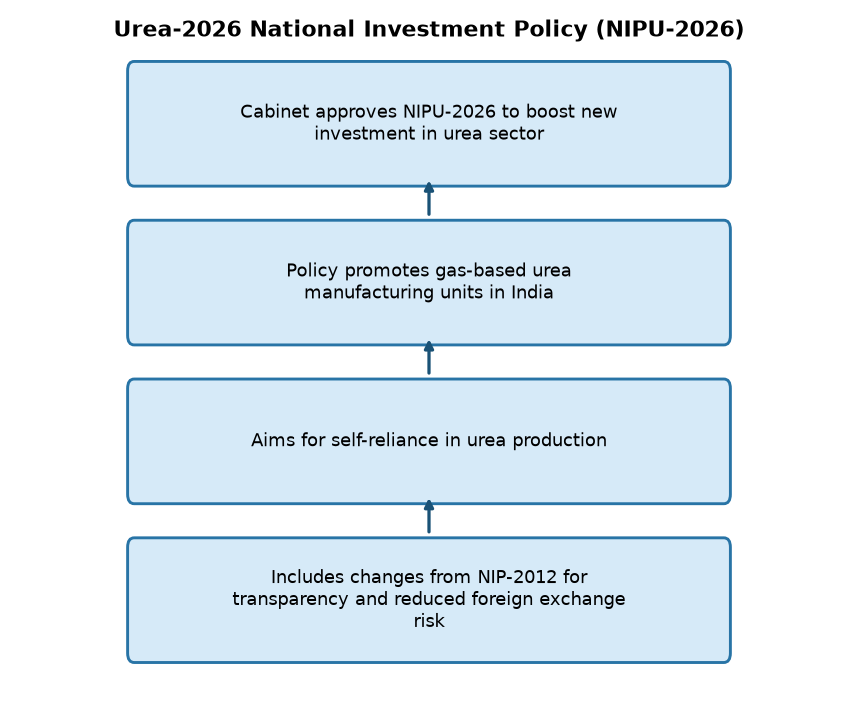
The Cabinet Committee on Economic Affairs (CCEA), chaired by the Prime Minister, has approved the National Investment Policy for Urea-2026 (NIPU-2026) for ‘Atmanirbhar Bharat’. This policy aims to incentivise new investments in the urea sector, particularly for establishing gas-based manufacturing units, thereby reducing India’s reliance on imported urea and bolstering domestic production capacity.
Background
- India faces a persistent demand-supply gap in urea, necessitating significant imports to meet agricultural requirements.
- The Department of Fertilisers had previously formulated the New Investment Policy (NIP)-2012 to attract investments in the urea sector, covering revival, expansion, brownfield, and greenfield projects.
- Under NIP-2012, six new urea units were established, including four by Joint Venture Companies (JVCs) of Public Sector Undertakings (PSUs) and two by private companies.
- The investment period under NIP-2012 concluded in October 2019, leading to the need for a revised policy framework.
- Currently, 33 operational urea manufacturing units exist in India, with a total reassessed/installed capacity of 269.42 Lakh Metric Tonnes (LMT).
- Despite existing capacity, the gap between indigenous production and demand continues, prompting the need for enhanced domestic manufacturing capabilities.
What is the National Investment Policy for Urea-2026 (NIPU-2026)?
- NIPU-2026 is a strategic policy approved by the Cabinet Committee on Economic Affairs (CCEA) to promote new investments in the urea manufacturing sector in India.
- Its primary objective is to encourage the establishment of new gas-based urea manufacturing units, aligning with the ‘Atmanirbhar Bharat’ initiative.
- The policy introduces significant changes from its predecessor, NIP-2012, to enhance transparency and financial viability for investors.
- Key features include the segregation of fixed and variable costs, a viable Return on Equity (RoE) band, and measures to mitigate foreign exchange risks.
- It aims to bridge the demand-supply gap in urea, thereby reducing India’s dependence on imports and strengthening the country’s self-sufficiency in fertilisers.
- The policy is projected to result in substantial savings, estimated at over ₹250 crore per plant, compared to NIP-2012, due to its improved financial framework.
- It covers the establishment of new urea manufacturing units, including both greenfield (entirely new) and brownfield (expansion of existing) projects.
- The Department of Fertilisers is the nodal agency responsible for the implementation and oversight of NIPU-2026.
Key Features
| Feature | Significance |
|---|---|
| Promotion of Gas-Based Units | Encourages cleaner production methods and leverages India’s expanding gas infrastructure, reducing reliance on other feedstocks. |
| Segregation of Fixed and Variable Costs | Enhances transparency in cost structures, providing clarity for investors and facilitating more accurate subsidy calculations. |
| Viable Return on Equity (RoE) Band (12% floor, 16% ceiling) | Offers a predictable and attractive return for investors, de-risking investments and encouraging capital flow into the sector. |
| Mitigation of Foreign Exchange Risk | Conversion of fixed costs to INR after four years based on existing exchange rates reduces exposure to currency fluctuations for investors. |
| Estimated Savings of ₹250+ Crore per Plant | Improved policy framework leads to greater efficiency and financial benefits for new manufacturing units compared to NIP-2012. |
| Focus on ‘Atmanirbhar Bharat’ | Directly contributes to self-reliance in a critical agricultural input, reducing import dependence and strengthening national food security. |
Why it Matters
Economic Significance
- **Reduced Import Bill:** By increasing domestic production, NIPU-2026 will significantly cut down India’s urea import bill, saving valuable foreign exchange.
- **Investment Promotion:** The policy’s attractive RoE band and transparent cost structure will draw substantial private and public investment into the fertiliser sector, stimulating economic activity.
- **Job Creation:** Establishment of new manufacturing units will lead to direct and indirect employment generation in construction, manufacturing, and ancillary industries.
- **Cost Efficiency:** The projected savings of over ₹250 crore per plant indicate improved operational efficiency and potentially lower production costs over the long term.
Strategic Significance
- **Food Security:** Enhanced domestic urea production is crucial for ensuring the availability of essential fertilisers for agriculture, directly impacting food security and farmer livelihoods.
- **Atmanirbhar Bharat:** The policy is a concrete step towards achieving self-reliance in a critical input sector, reducing strategic vulnerabilities associated with import dependence.
- **Energy Security:** Promotion of gas-based units aligns with India’s push towards a gas-based economy, contributing to cleaner energy use in industrial processes.
- **Regional Development:** New plant locations can spur industrial growth and infrastructure development in various regions, fostering balanced economic development.
Environmental Significance
- **Cleaner Production:** Gas-based urea plants generally have a lower carbon footprint compared to those using other feedstocks, contributing to environmental sustainability.
- **Resource Optimization:** Efficient and modern manufacturing processes encouraged by the policy can lead to better resource utilization and reduced waste.
Agricultural Significance
- **Assured Fertiliser Supply:** Stable domestic production ensures a consistent and timely supply of urea to farmers, crucial for agricultural productivity.
- **Farmer Welfare:** Reduced reliance on imports can potentially stabilize fertiliser prices, benefiting farmers by ensuring affordability and predictability of input costs.
Challenges
1. Feedstock Availability and Pricing
- Ensuring a consistent and affordable supply of natural gas for new units remains a critical challenge, given India’s import dependence for gas.
- Fluctuations in international gas prices can impact the viability and operational costs of gas-based urea plants, despite domestic pricing mechanisms.
UPSC Link: GS Paper III — Infrastructure: Energy; Investment Models
2. Land Acquisition and Environmental Clearances
- Acquiring suitable land for large-scale industrial projects like fertiliser plants can be time-consuming and fraught with socio-political challenges.
- Navigating stringent environmental impact assessment (EIA) processes and obtaining timely clearances are crucial for project implementation.
UPSC Link: GS Paper III — Infrastructure; Environmental Pollution and Degradation
3. Technological Upgradation and Skill Development
- Adopting advanced, energy-efficient urea manufacturing technologies requires significant capital investment and skilled human resources.
- Developing a workforce capable of operating and maintaining modern gas-based plants is essential for long-term sustainability.
UPSC Link: GS Paper III — Science and Technology; Skill Development
4. Market Dynamics and Subsidy Management
- Balancing domestic production with import parity prices and managing the fertiliser subsidy burden on the exchequer is a complex task.
- Ensuring that the benefits of increased domestic production translate into stable and affordable prices for farmers without distorting market dynamics.
UPSC Link: GS Paper III — Government Budgeting; Issues related to Direct and Indirect Farm Subsidies
5. Logistics and Infrastructure
- Developing robust logistics infrastructure for the efficient transportation of raw materials (gas) to plants and finished products (urea) to agricultural regions.
- Ensuring last-mile connectivity and storage facilities to prevent supply chain bottlenecks.
UPSC Link: GS Paper III — Infrastructure: Roads, Railways, Ports etc.
Challenges — UPSC Perspective
| Issue | Concern |
|---|---|
| Natural Gas Supply Volatility | Dependence on imported LNG and global price fluctuations can impact the cost-effectiveness of gas-based units. |
| Capital Intensive Nature | Setting up new fertiliser plants requires significant upfront capital, posing challenges for attracting sufficient investment. |
| Regulatory Hurdles | Complex and multi-layered regulatory approval processes can delay project execution and increase costs. |
| Environmental Compliance | Adhering to strict environmental norms for industrial emissions and waste management requires continuous investment and monitoring. |
| Global Market Competition | Domestic producers must remain competitive against international urea suppliers, especially during periods of low global prices. |
| Subsidy Policy Rationalization | Need for a sustainable and transparent fertiliser subsidy regime that supports both producers and farmers without undue fiscal strain. |
Government Initiatives — Must-Memorise for Prelims
- Neem Coated Urea (NCU) Scheme
- New Urea Policy (NUP) 2015
- Pradhan Mantri Kisan Samman Nidhi (PM-KISAN)
- Pradhan Mantri Fasal Bima Yojana (PMFBY)
- Soil Health Card Scheme
- Paramparagat Krishi Vikas Yojana (PKVY)
- National Mission for Sustainable Agriculture (NMSA)
- Gas Pipeline Infrastructure Development
- City Gas Distribution (CGD) Network Expansion
- Atmanirbhar Bharat Abhiyan
Way Forward
- **Diversification of Feedstock:** While promoting gas-based units, explore viable alternatives like coal gasification (for syngas) in regions with abundant coal reserves to reduce over-reliance on a single feedstock.
- **Streamlined Approvals:** Implement a single-window clearance mechanism for land acquisition, environmental, and other regulatory approvals to expedite project implementation.
- **R&D and Technology Adoption:** Invest in research and development for advanced, energy-efficient, and environmentally friendly urea production technologies, including carbon capture and utilization.
- **Skill Development Initiatives:** Launch targeted skill development programs in collaboration with industry to create a trained workforce for modern fertiliser plants.
- **Sustainable Subsidy Regime:** Evolve a transparent, targeted, and fiscally sustainable fertiliser subsidy policy that incentivizes efficient production and rational use by farmers.
- **Infrastructure Enhancement:** Prioritize investment in gas pipeline networks, rail connectivity, and port infrastructure to ensure seamless supply chain management for raw materials and finished products.
- **Public-Private Partnerships:** Encourage robust Public-Private Partnership (PPP) models for setting up new units, leveraging private sector efficiency and public sector support.
- **International Collaboration:** Explore collaborations with countries possessing advanced fertiliser manufacturing technologies and expertise to facilitate knowledge transfer and investment.
UPSC Value Addition
Keywords for Mains Answer-Writing
Atmanirbhar Bharat · Fertiliser Security · Gas-based Economy · Investment Climate · Return on Equity · Import Substitution · Food Security · Sustainable Agriculture · Industrial Policy · Supply Chain Resilience · Greenfield Projects · Fiscal Sustainability
Constitutional & Policy Linkages
- Seventh Schedule (List I – Union List): Industries (Entry 52)
- Article 38 (DPSP): State to secure a social order for the promotion of welfare of the people
- Article 39 (DPSP): State to direct its policy towards securing adequate means of livelihood
- Article 48 (DPSP): Organisation of agriculture and animal husbandry
- Fertiliser (Control) Order, 1985: Regulates fertiliser quality, pricing, and distribution
- Industries (Development and Regulation) Act, 1951: Provides for the development and regulation of certain industries
Concept Flow
Demand-supply gap in urea → NIPU-2026 Policy Approval → Incentivises new gas-based urea plants → Increased domestic urea production → Reduced import dependence & foreign exchange savings → Enhanced food security & farmer welfare → Contribution to Atmanirbhar Bharat
Prelims Practice Questions
Q1. With reference to the National Investment Policy for Urea-2026 (NIPU-2026), consider the following statements:
1. The policy aims to promote the establishment of new coal-based urea manufacturing units.
2. It introduces a viable Return on Equity (RoE) band with a floor of 12% and a ceiling of 16%.
3. The policy seeks to reduce foreign exchange risk by converting fixed costs to INR after four years.
Which of the statements given above is/are correct?
- A. 1 and 2 only
- B. 2 and 3 only
- C. 1 and 3 only
- D. 1, 2 and 3
Answer: B. 2 and 3 only — Statement 1 is incorrect: The policy specifically aims to promote ‘gas-based’ urea manufacturing units, not coal-based. Statement 2 is correct: NIPU-2026 introduces a viable RoE band of 12% to 16%. Statement 3 is correct: The policy includes a provision to reduce foreign exchange risk by converting fixed costs to INR after four years based on existing exchange rates.
Q2. Which of the following bodies approved the National Investment Policy for Urea-2026 (NIPU-2026)?
- A. Ministry of Agriculture and Farmers Welfare
- B. NITI Aayog
- C. Cabinet Committee on Economic Affairs (CCEA)
- D. Department of Fertilisers
Answer: C. Cabinet Committee on Economic Affairs (CCEA) — The National Investment Policy for Urea-2026 (NIPU-2026) was approved by the Cabinet Committee on Economic Affairs (CCEA), chaired by the Prime Minister, as stated in the news.
Mains Practice Question
✍ Critically examine the objectives and key features of the National Investment Policy for Urea-2026 (NIPU-2026) in the context of India’s ‘Atmanirbhar Bharat’ initiative. Discuss the potential benefits and challenges associated with its implementation, suggesting a way forward for sustainable growth in the fertiliser sector. (250 words)
Approach: Begin by introducing NIPU-2026 and its approval by the CCEA, linking it to the ‘Atmanirbhar Bharat’ vision. Elucidate its primary objective of promoting gas-based urea manufacturing and detail key features like RoE band, cost segregation, and forex risk mitigation. Discuss benefits such as reduced import dependence, enhanced food security, and economic growth. Subsequently, address challenges like feedstock availability, land acquisition, and subsidy management. Conclude with a comprehensive way forward, emphasizing feedstock diversification, streamlined approvals, R&D, and sustainable subsidy reforms for long-term sectoral growth.
Source: PIB (Press Information Bureau)

- UPSC Alert: India Launches National Action Plan for Inland Small Fisheries - October 24, 2026
- विशेष अभियान 6: कपड़ा आयुक्त कार्यालय ने सफाई और दक्षता में बढ़ाया योगदान - October 24, 2026
- Inter-Caste Marriage Scheme: UPSC Exam Polity & Governance Insight - October 24, 2026

No Comments