


15 Jul भारत-ईयू वस्त्र सहयोग हेतु रणनीतिक साझेदारी: प्रभाव और महत्व
Subject Relevance — Where This Topic Fits
- GS Paper II — International Relations: Bilateral, regional and global groupings and agreements involving India and/or affecting India’s interests | GS Paper III — Economy: Indian Economy and issues relating to planning, mobilization of resources, growth, development and employment; Industrial policy changes and their effects on industrial growth
- Prelims: India-EU Strategic Partnership, Textile Sector, Premier Vision Paris, Bharat Tex Trade Federation (BTTF), Free Trade Agreement (FTA), Global Value Chains (GVCs), Micro, Small & Medium Enterprises (MSMEs), Sustainable Textiles
- Essay: The Textile Sector as a Catalyst for India’s Economic Growth and Global Influence, International Collaborations: Paving the Way for Sustainable Development and Economic Resilience
Quick Revision: The India-EU textile collaboration, formalized through a Letter of Intent between BTTF and Premier Vision Paris, is a strategic move to establish India as a global textile sourcing hub, fostering innovation, sustainability, and market access for Indian enterprises within the integrated textile value chain.
Why is this in the news?
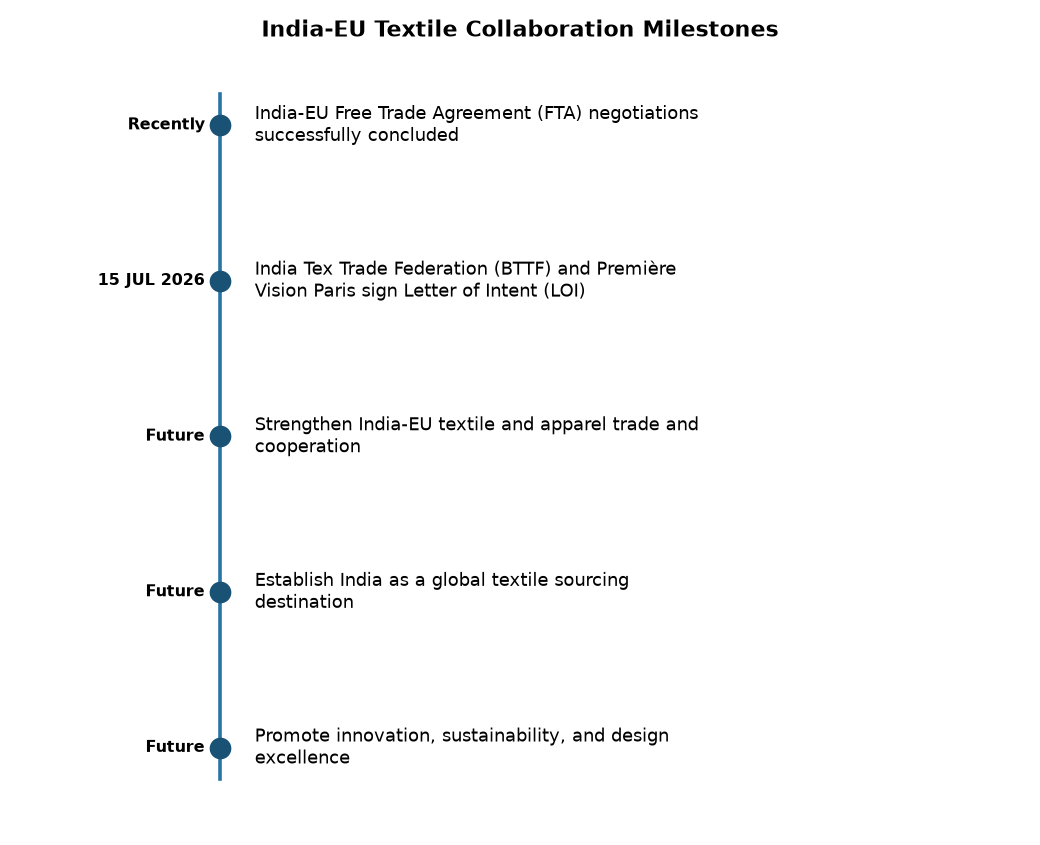
The Ministry of Textiles, Government of India, in collaboration with the Bharat Tex Trade Federation (BTTF) and Premier Vision Paris, has initiated a strategic partnership to deepen India-EU textile cooperation. This collaboration, marked by the signing of a Letter of Intent (LoI) in the presence of the Union Minister of Textiles, aims to position India as a premier global textile sourcing destination, strengthen bilateral trade, and foster innovation, sustainability, and design excellence within the textile value chain.
Background
- India’s textile and apparel industry is one of the oldest and largest sectors, contributing significantly to the nation’s GDP, industrial production, and employment.
- The European Union (EU) is a critical market for Indian textiles and apparel, representing a major export destination for various textile products.
- Premier Vision Paris is globally recognized as a leading textile and fashion sourcing exhibition, providing a crucial platform for trend forecasting, innovation, and design excellence.
- The ongoing negotiations for an India-EU Free Trade Agreement (FTA) are expected to further enhance market access and competitiveness for Indian textile and apparel exporters.
- There is a growing global emphasis on sustainable and ethical practices within the textile value chain, driven by consumer demand and regulatory pressures.
- The ‘Bharat Tex’ initiative aims to establish a comprehensive global platform showcasing India’s integrated textile value chain from ‘Farm to Fashion’.
Understanding the India-EU Textile Strategic Partnership
- This partnership is a formal Letter of Intent (LoI) signed between the Bharat Tex Trade Federation (BTTF) and Premier Vision S.A.’s Fashion Division.
- It seeks to strengthen institutional cooperation between India and France (representing the EU) in the textile and apparel value chain.
- The core objective is to establish India as a global textile sourcing destination, leveraging its diverse and competitive industry.
- It aims to facilitate greater market access for Indian manufacturers, exporters, and designers to global brands, buyers, and fashion houses.
- The collaboration will promote innovation, sustainability, design excellence, trend insights, and global sourcing across the textile value chain.
- It provides Indian MSMEs and emerging brands a globally recognized platform (Premier Vision Paris) to showcase premium textiles, apparel, accessories, technical textiles, and sustainable materials.
- Conversely, it offers Premier Vision and its global network enhanced access to India’s integrated textile value chain through platforms like Bharat Tex.
- The partnership is expected to foster mutual participation in both Bharat Tex and Premier Vision Paris, strengthening buyer-seller relationships and facilitating knowledge exchange on trends and design.
Key Features
| Feature | Significance |
|---|---|
| LoI between BTTF and Premier Vision | Formalizes institutional cooperation, providing a structured framework for bilateral engagement. |
| Global Sourcing Destination Focus | Elevates India’s position in the global textile value chain, attracting international buyers and investments. |
| Promotion of Innovation & Sustainability | Encourages adoption of advanced technologies and eco-friendly practices, aligning with global trends. |
| Market Access for Indian MSMEs | Provides a crucial global platform for small and medium enterprises, boosting their export potential and international exposure. |
| Access to India’s Integrated Value Chain | Offers Premier Vision’s global network comprehensive insights into India’s ‘Farm to Fashion’ capabilities, fostering new partnerships. |
| Mutual Participation in Exhibitions | Strengthens buyer-seller linkages and facilitates knowledge transfer, enhancing competitiveness and trend awareness. |
Why it Matters
Economic Significance
- Boosts India’s textile and apparel exports to the EU, a major market, contributing to foreign exchange earnings and trade balance.
- Generates employment opportunities across the textile value chain, from raw material production to manufacturing and design.
- Attracts foreign direct investment (FDI) into the Indian textile sector, fostering infrastructure development and technological upgrades.
- Enhances the competitiveness of Indian textiles by promoting innovation, design excellence, and adherence to international quality standards.
- Supports the growth of Micro, Small & Medium Enterprises (MSMEs) by providing access to global markets and buyer networks.
Strategic Significance
- Strengthens India-EU bilateral relations, particularly in the economic and trade spheres, aligning with broader strategic partnership goals.
- Positions India as a reliable and sustainable partner in the global textile value chain, diversifying global sourcing options.
- Enhances India’s soft power through the promotion of Indian design, craftsmanship, and cultural heritage on international platforms.
- Contributes to India’s ‘Make in India’ and ‘Vocal for Local’ initiatives by promoting domestic manufacturing and global outreach.
- Leverages the ongoing India-EU FTA negotiations, creating a conducive environment for deeper economic integration.
Sectoral Significance
- Facilitates technology transfer and knowledge exchange in areas like sustainable manufacturing, technical textiles, and advanced materials.
- Encourages the adoption of best practices in environmental and social compliance, crucial for accessing EU markets.
- Provides Indian designers and manufacturers with critical trend insights and forecasting from Premier Vision, enhancing product development.
- Showcases India’s integrated textile value chain, from raw materials to finished products, establishing its comprehensive capabilities.
- Promotes diversification into high-value segments like technical textiles and sustainable fashion, moving beyond traditional apparel.
Challenges
1. Compliance with EU Regulations
- Strict EU environmental, social, and chemical regulations (e.g., REACH, Ecotex standards) pose compliance challenges for Indian manufacturers.
- Ensuring traceability and transparency across the supply chain to meet EU due diligence requirements can be complex for MSMEs.
UPSC Link: GS Paper III — Industrial Policy
2. Infrastructure and Logistics Gaps
- Inadequate infrastructure, including port connectivity, warehousing, and cold chain facilities, can increase logistics costs and lead times.
- Efficient and cost-effective transportation networks are crucial for timely delivery to European markets.
UPSC Link: GS Paper III — Infrastructure
3. Skill Development and Technology Upgradation
- A persistent skill gap in advanced manufacturing techniques, design, and sustainable practices limits competitiveness.
- Access to and adoption of cutting-edge textile machinery and digital technologies remain a challenge for many units.
UPSC Link: GS Paper III — Skill Development
4. Competition from Other Sourcing Hubs
- India faces intense competition from established textile manufacturing hubs like Bangladesh, Vietnam, and China, which often offer lower costs or specialized capabilities.
- Maintaining cost-competitiveness while adhering to quality and sustainability standards is a continuous challenge.
UPSC Link: GS Paper III — Global Economy
5. Market Access Barriers (Non-Tariff)
- Despite FTA prospects, non-tariff barriers such as complex customs procedures, technical standards, and certification requirements can hinder market entry.
- Perceptions regarding quality or ethical sourcing can also act as subtle barriers.
UPSC Link: GS Paper II — International Trade
Challenges — UPSC Perspective
| Issue | Concern |
|---|---|
| Regulatory Compliance | Meeting stringent EU environmental, social, and chemical standards (e.g., REACH, Ecotex). |
| Logistics & Infrastructure | High transportation costs and delays due to inadequate infrastructure and supply chain inefficiencies. |
| Skill & Technology Gap | Lack of skilled workforce in advanced manufacturing and slow adoption of modern textile technologies. |
| Global Competition | Intense price and quality competition from other major textile exporting nations. |
| Non-Tariff Barriers | Complex technical standards, certification processes, and customs procedures in the EU market. |
| Sustainability Implementation | Scaling up sustainable production practices across the diverse and fragmented Indian textile industry. |
Government Initiatives — Must-Memorise for Prelims
- Production Linked Incentive (PLI) Scheme for Textiles
- PM MITRA Parks Scheme (Mega Integrated Textile Region and Apparel)
- National Technical Textiles Mission (NTTM)
- Scheme for Capacity Building in Textile Sector (Samarth)
- Amended Technology Upgradation Fund Scheme (ATUFS)
- Scheme for Integrated Textile Parks (SITP)
- National Handloom Development Programme
- National Handicraft Development Programme
- Silk Samagra
- Jute ICARE
Way Forward
- Expedite the conclusion of the India-EU Free Trade Agreement (FTA) to provide preferential market access and reduce tariff barriers.
- Invest in modernizing textile infrastructure, including logistics, port facilities, and dedicated textile parks, to enhance efficiency.
- Promote skill development programs focused on sustainable manufacturing, digital textile technologies, and advanced design capabilities.
- Facilitate technology transfer and adoption of Industry 4.0 solutions (AI, IoT, automation) to improve productivity and quality.
- Establish a robust framework for environmental and social compliance, offering support and incentives for MSMEs to meet international standards.
- Strengthen branding and marketing efforts to showcase India’s unique design heritage, craftsmanship, and sustainable textile offerings.
- Foster greater collaboration between industry, academia, and research institutions to drive innovation and product diversification.
- Develop a comprehensive strategy for circular economy principles in textiles, including recycling, waste reduction, and sustainable material sourcing.
UPSC Value Addition
Keywords for Mains Answer-Writing
Textile Value Chain · Global Sourcing Destination · Sustainable Textiles · Circular Economy · Technical Textiles · MSME Empowerment · Market Access · Non-Tariff Barriers · Skill Development · Innovation Ecosystem · Bilateral Trade · Strategic Partnership
Constitutional & Policy Linkages
- Article 246 (Seventh Schedule): Union List (Entry 42 – Inter-State Trade and Commerce)
- Article 301: Freedom of Trade, Commerce, and Intercourse
- Foreign Trade (Development and Regulation) Act, 1992: Governs foreign trade policy
- MSME Development Act, 2006: Defines and promotes MSMEs
- Environmental Protection Act, 1986: Regulates environmental standards in industries
- Factories Act, 1948: Ensures worker safety and welfare
Concept Flow
Strategic Partnership (BTTF-Premier Vision) → Enhanced Market Access & Global Visibility → Increased Exports & FDI in Textiles → Innovation & Sustainability Adoption → Strengthened India-EU Economic Ties → India as Global Textile Hub
Prelims Practice Questions
Q1. With reference to the recent India-EU textile collaboration, consider the following statements:
1. The partnership aims to establish India as a global textile sourcing destination.
2. Premier Vision Paris is a leading global exhibition for textile and fashion sourcing.
3. The collaboration is expected to provide enhanced market access for Indian MSMEs to European buyers.
Which of the statements given above are correct?
- A. 1 and 2 only
- B. 2 and 3 only
- C. 1 and 3 only
- D. 1, 2 and 3
Answer: D. 1, 2 and 3 — Statement 1 is correct: The press release explicitly states the aim to establish India as a global textile sourcing destination. Statement 2 is correct: Premier Vision Paris is indeed recognized as a leading global exhibition for trend forecasting, innovation, and design. Statement 3 is correct: The partnership specifically mentions helping Indian MSMEs connect with major European buyers and showcase their products globally.
Q2. Which of the following government schemes is NOT primarily focused on the textile sector in India?
- A. PM MITRA Parks Scheme
- B. National Technical Textiles Mission
- C. Production Linked Incentive (PLI) Scheme for Textiles
- D. Pradhan Mantri Kisan Sampada Yojana
Answer: D. Pradhan Mantri Kisan Sampada Yojana — PM MITRA Parks Scheme, National Technical Textiles Mission, and PLI Scheme for Textiles are all directly related to the textile sector. Pradhan Mantri Kisan Sampada Yojana (PMKSY) is a comprehensive package for the creation of modern infrastructure with efficient supply chain management from farm gate to retail outlet for the food processing sector.
Mains Practice Question
✍ Examine the strategic significance of the recent India-EU textile collaboration in positioning India as a global textile hub. Discuss the potential benefits for the Indian textile industry and outline the key challenges that need to be addressed for its successful implementation. (250 words)
Approach: Begin by briefly introducing the India-EU textile collaboration and its context. In the first part, elaborate on the strategic significance, touching upon aspects like strengthening bilateral ties, enhancing India’s global value chain presence, and promoting ‘Make in India’. In the second part, detail the potential benefits for the Indian textile industry, focusing on market access, MSME growth, innovation, and sustainability. Conclude by outlining critical challenges such as compliance with EU regulations, infrastructure gaps, skill development, and global competition, suggesting a holistic approach for effective implementation.
Source: PIB (Press Information Bureau)

- पेरियार टाइगर रिजर्व में 6 नई प्रजातियाँ खोजी गईं, जानिए क्या हैं विशेषताएँ - September 22, 2026
- Six New Species Discovered in Periyar Tiger Reserve: UPSC & PCS Key Biodiversity Insights - September 22, 2026
- तमिलनाडु में बस किराए में संशोधन: सरकार को चार सप्ताह और समय मिला, उच्च न्यायालय का फैसला - September 22, 2026

No Comments