


15 Jul PLFS June 2026: Labour Force Indicators Stable, Urban LFPR Improves
Relevance for UPSC & State PCS: Economy/Governance
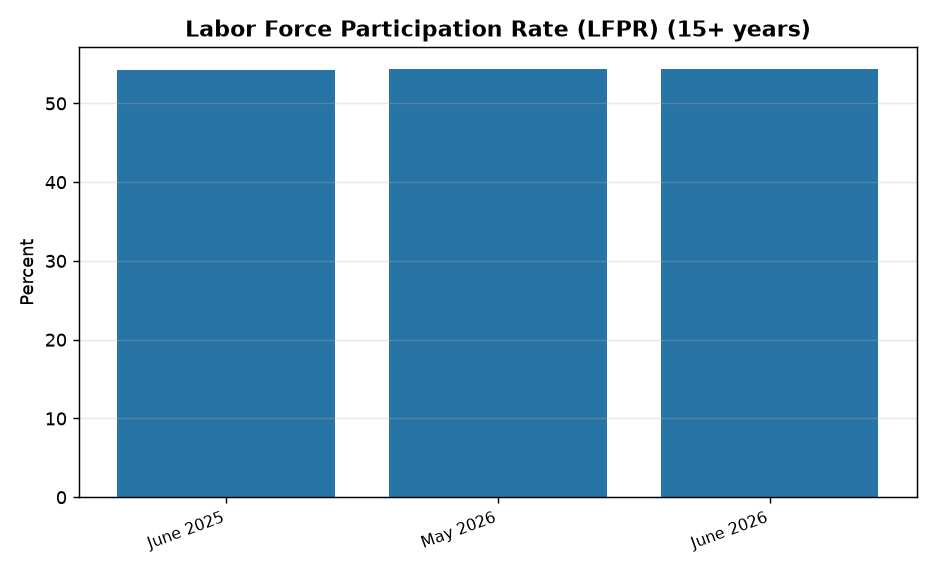
The Periodic Labour Force Survey (PLFS) Monthly Bulletin for June 2026, released by the National Statistical Office (NSO) under the Ministry of Statistics and Programme Implementation, provides crucial insights into India’s labour market dynamics. Overall, the Labour Force Participation Rate (LFPR) for individuals aged 15 years and above remained stable at 54.4 percent in June 2026, unchanged from May 2026, though showing a slight increase from 54.2 percent in June 2025. The Worker Population Ratio (WPR) also held steady at 51.4 percent compared to the previous month, marking a 0.2 percentage point rise from June 2025. The Unemployment Rate (UR) remained consistent at 5.5 percent, mirroring both the previous month and the previous year’s figures. These indicators, derived from a revised survey methodology implemented since January 2025, offer a current weekly status perspective on employment and unemployment, making them vital for understanding the nation’s economic health.
A deeper look reveals nuanced trends across different demographics and regions. While the overall LFPR and WPR remained largely unchanged, urban areas witnessed a marginal improvement in both LFPR, rising from 49.8 percent in May 2026 to 50.1 percent in June 2026, and WPR, increasing from 46.6 percent to 46.8 percent over the same period. Conversely, the rural labour market experienced a slight softening. Female LFPR for those aged 15 and above stood at 32.7 percent in June 2026, a marginal decrease from 32.8 percent in May 2026, yet a notable 0.7 percentage point increase from June 2025. The male WPR, however, saw an improvement, rising from 72.5 percent in May 2026 to 72.9 percent in June 2026. The rural male unemployment rate, after continuous increases since February 2026, recorded a decline in June 2026, falling below the level observed in the corresponding month of the previous year.
For UPSC and State PCS aspirants, these PLFS monthly bulletins are indispensable for both the Economy and Governance segments of their syllabus. The consistent tracking of LFPR, WPR, and UR provides real-time data for analyzing employment trends, assessing the effectiveness of government policies aimed at job creation, and understanding the structural changes in the labour market. Questions on demographic dividends, gender-specific employment challenges, and the rural-urban divide in economic opportunities can be directly addressed using these statistics. Furthermore, the methodology of the PLFS, including the shift to monthly and quarterly estimates and the Current Weekly Status (CWS) approach, is itself a
Source: PIB (Press Information Bureau)
Practice Questions
Q1. Which organization is responsible for conducting the Periodic Labour Force Survey (PLFS) in India?
- National Sample Survey Office (NSSO)
- Ministry of Finance
- Reserve Bank of India (RBI)
- NITI Aayog
Answer
National Sample Survey Office (NSSO) — The Periodic Labour Force Survey (PLFS) is conducted by the National Sample Survey Office (NSSO) under the Ministry of Statistics and Programme Implementation. It is a key source of data on employment and unemployment in India.
Q2. What is the primary objective of the Periodic Labour Force Survey (PLFS)?
- To estimate the key employment and unemployment indicators in both urban and rural areas.
- To measure the Gross Domestic Product (GDP) of India.
- To assess the inflation rate in the country.
- To track foreign direct investment (FDI) inflows.
Answer
To estimate the key employment and unemployment indicators in both urban and rural areas. — The PLFS aims to estimate key employment and unemployment indicators such as the Labour Force Participation Rate (LFPR), Worker Population Ratio (WPR), and Unemployment Rate (UR) in both urban and rural areas, providing crucial insights into the labor market dynamics.
Generated by AanyaAi for educational purpose.


No Comments