


17 Jul Revised UDAN Scheme: Boosting India’s Regional Aviation Network
Subject Relevance — Where This Topic Fits
- GS Paper I — Geography (Transport) | GS Paper II — Government Policies and Interventions, Development Processes | GS Paper III — Indian Economy (Infrastructure, Aviation Sector), Growth and Development
- Prelims: UDAN Scheme, Regional Connectivity Scheme (RCS), Viability Gap Funding (VGF), National Civil Aviation Policy 2016, Airport Authority of India (AAI), Airports, Heliports, Water Aerodromes, Civil Aviation Sector Growth, Last-mile connectivity
- Essay: Infrastructure as a Catalyst for Inclusive Growth: The Indian Experience, Connecting India: Bridging Geographical Divides for Socio-Economic Equity
Quick Revision: The Revised UDAN Scheme, with a 10-year vision and significant outlay, aims to further democratize air travel and strengthen regional connectivity, driving inclusive growth across India by connecting unserved and underserved areas.
Why is this in the news?
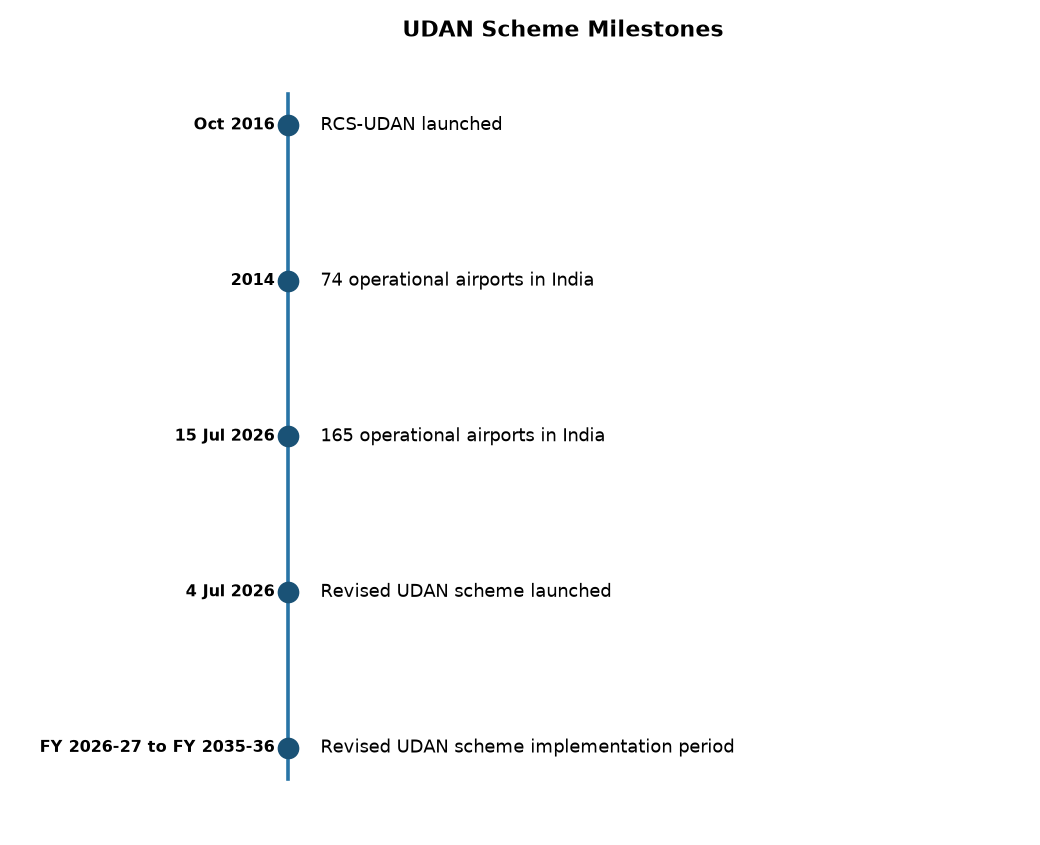
The Ministry of Civil Aviation recently announced the launch of the Revised UDAN Scheme, effective from Financial Year 2026-27 to 2035-36, with a substantial outlay of ₹28,840 crore. This significant development, building upon the successes of the original UDAN scheme, aims to further strengthen India’s regional aviation network, enhance last-mile air connectivity, and foster a more inclusive and balanced aviation ecosystem across the nation.
Background
- India’s civil aviation sector has witnessed remarkable growth, transforming from 74 operational airports in 2014 to 165 by July 15, 2026, making it the world’s third-largest domestic civil aviation market.
- Historically, air connectivity in India was largely concentrated in metropolitan and major cities, leaving numerous smaller towns and remote regions underserved.
- The need for accessible and widespread air connectivity for the common citizen, coupled with the imperative to expand regional air travel, led to the launch of the Regional Connectivity Scheme (RCS) – UDAN (Ude Desh ka Aam Nagrik) in October 2016.
- UDAN’s primary objective was to make air travel affordable and accessible, stimulating economic growth and employment generation in regional areas.
- Over the past nine years, UDAN has operationalized 679 regional routes, connecting 95 airports, heliports, and water aerodromes, facilitating air travel for over 1.68 crore passengers through 3.58 lakh flights.
- The recent inauguration of the new terminal building at Jodhpur Airport exemplifies India’s commitment to developing world-class civil aviation infrastructure, further bolstering the sector’s capabilities.
What is the UDAN Scheme?
- UDAN (Ude Desh ka Aam Nagrik) is a flagship initiative of the Government of India under the Ministry of Civil Aviation, launched in October 2016 as a key component of the National Civil Aviation Policy (NCAP) 2016.
- It is a market-driven scheme that aims to stimulate regional air connectivity by making air travel affordable and economically viable for airlines on specific regional routes.
- The scheme operates on a demand-driven model, where interested airlines submit proposals for routes they wish to operate, and the government provides incentives to bridge the viability gap.
- Key incentives include Viability Gap Funding (VGF) to cover operational losses, exemptions from airport charges, reduced excise duty on Aviation Turbine Fuel (ATF), and state government support.
- UDAN seeks to connect unserved and underserved airports, heliports, and water aerodromes, thereby expanding the reach of the national civil aviation network.
- A cap on airfares for a certain percentage of seats on UDAN flights ensures affordability for the common citizen.
- The scheme also focuses on upgrading existing infrastructure and developing new regional airports to support increased air traffic.
- The Revised UDAN Scheme (FY 2026-27 to FY 2035-36) aims to further expand airport infrastructure, strengthen operational support, and create a more conducive ecosystem for operators in smaller markets.
Key Features
| Feature | Significance |
|---|---|
| Viability Gap Funding (VGF) | Crucial financial support to airlines for operating on unprofitable regional routes, ensuring sustainability of operations. |
| Capped Airfares | Ensures affordability for the common citizen, making air travel accessible to a wider demographic. |
| Focus on Unserved/Underserved Airports | Expands the national aviation network, bringing remote regions into the mainstream economic and social fabric. |
| Infrastructure Development | Includes development of 100 new airports and 200 modern helipads, enhancing capacity and last-mile connectivity. |
| Concessions from Stakeholders | Reduced excise duty on ATF, exemption from airport charges, and state government support lower operational costs for airlines. |
| Long-term Vision (Revised UDAN) | 10-year implementation (FY 2026-27 to 2035-36) with ₹28,840 crore outlay, demonstrating sustained commitment to regional connectivity. |
Why it Matters
Economic Development
- Boosts regional economies by connecting production centers to markets, facilitating trade and commerce.
- Attracts investment and promotes tourism in previously inaccessible or less-connected areas, creating new revenue streams.
- Generates employment opportunities directly in the aviation sector and indirectly in allied industries like hospitality, logistics, and ground services.
Social Inclusion and Equity
- Makes air travel affordable and accessible for the ‘aam nagrik’, bridging the gap between different socio-economic strata.
- Reduces travel time significantly for people in remote areas, enhancing access to essential services like healthcare, education, and administrative centers.
- Fosters national integration by bringing diverse regions closer, promoting cultural exchange and understanding.
Strategic Importance
- Enhances connectivity to border areas and strategically important regions, bolstering national security and disaster response capabilities.
- Strengthens India’s position as a global aviation hub by expanding its domestic network and increasing overall air traffic.
- Supports the ‘Act East’ and ‘Look North-East’ policies by improving connectivity to the North-Eastern states and other peripheral regions.
Infrastructure Development
- Drives the modernization and expansion of airport infrastructure, including new terminals, runways, and air traffic control systems.
- Promotes the development of allied infrastructure such as roads, railways, and logistics hubs around airports, creating multi-modal transport networks.
- Encourages technological advancements and skill development in the aviation sector, contributing to overall national progress.
Challenges
1. Sustainability of VGF Model
- Reliance on Viability Gap Funding (VGF) can be a long-term fiscal burden if routes do not become self-sustaining.
- Balancing VGF allocation with the need for market-driven growth remains a challenge.
UPSC Link: GS Paper III — Government Budgeting
2. Infrastructure Bottlenecks
- Development and operationalization of new airports, heliports, and water aerodromes require significant land acquisition, environmental clearances, and capital investment.
- Maintaining and upgrading existing infrastructure to meet growing demand and safety standards is an ongoing challenge.
UPSC Link: GS Paper III — Infrastructure
3. Airline Participation and Viability
- Attracting and retaining airlines to operate on less profitable regional routes, even with VGF, can be difficult due to operational complexities and fleet limitations.
- Ensuring adequate passenger load factors on all UDAN routes for long-term commercial viability.
UPSC Link: GS Paper III — Indian Economy
4. Last-Mile Connectivity
- While air connectivity is provided, effective last-mile surface transport to and from regional airports remains crucial for passenger convenience and overall scheme success.
- Challenging geographical conditions in many regions necessitate specialized aircraft and heliport access, increasing operational costs.
UPSC Link: GS Paper I — Geography; GS Paper III — Infrastructure
5. Regulatory and Operational Hurdles
- Streamlining regulatory processes for new route approvals, aircraft induction, and pilot training.
- Ensuring robust safety and security standards across all regional operations, including smaller airports and heliports.
UPSC Link: GS Paper II — Government Policies
Challenges — UPSC Perspective
| Issue | Concern |
|---|---|
| Financial Viability | Over-reliance on VGF without routes becoming self-sustaining can strain public finances. |
| Infrastructure Gaps | Pace of airport/heliport development and modernization needs to match demand; land acquisition issues. |
| Airline Engagement | Attracting sufficient airline participation for all awarded routes, especially in remote areas. |
| Operational Constraints | Weather dependency, limited night landing facilities, and specialized aircraft requirements for challenging terrains. |
| Intermodal Integration | Lack of seamless connectivity between regional airports and other modes of transport (road, rail). |
| Skill Development | Need for trained personnel (pilots, ATC, ground staff) to support the expanding regional network. |
Government Initiatives — Must-Memorise for Prelims
- National Civil Aviation Policy (NCAP) 2016
- Regional Connectivity Scheme (RCS) – UDAN
- Krishi UDAN Scheme
- International UDAN Scheme
- DigiYatra Policy
- National Logistics Policy
- PM Gati Shakti National Master Plan
- Bharatmala Pariyojana
- Sagarmala Programme
- National Infrastructure Pipeline
Way Forward
- Prioritize sustainable VGF models, transitioning routes towards commercial viability through increased passenger traffic and diversified revenue streams.
- Accelerate infrastructure development, including greenfield and brownfield airports, heliports, and water aerodromes, with streamlined clearances.
- Encourage private sector investment and Public-Private Partnerships (PPPs) in airport development and operations to share financial burdens and leverage expertise.
- Promote indigenous aircraft manufacturing and maintenance, repair, and overhaul (MRO) facilities to reduce operational costs for regional airlines.
- Strengthen intermodal connectivity by integrating regional airports with existing road, rail, and waterway networks for seamless last-mile access.
- Invest in skill development and training programs for pilots, air traffic controllers, and ground staff to meet the growing demands of the regional aviation sector.
- Leverage technology for efficient operations, passenger experience, and enhanced safety, including advanced air traffic management systems and digital solutions.
- Focus on environmental sustainability in airport development and operations, adopting green technologies and practices.
UPSC Value Addition
Keywords for Mains Answer-Writing
Regional Connectivity Scheme · UDAN Scheme · Inclusive Growth · Economic Multiplier · Last-Mile Connectivity · Viability Gap Funding · Infrastructure Development · Aviation Ecosystem · Socio-Economic Equity · National Integration · Sustainable Aviation · Intermodal Transport
Constitutional & Policy Linkages
- Seventh Schedule, List I (Union List) — Entry 29: Airways, aircraft and air navigation
- Article 282 — Union and States grants for public purposes
- National Civil Aviation Policy 2016 — Policy framework for aviation sector
- Aircraft Act, 1934 — Regulation of manufacture, possession, use, operation, sale, import and export of aircraft
- Aircraft Rules, 1937 — Detailed rules for civil aviation operations
Concept Flow
Limited Air Connectivity in Tier-2/3 Cities → Need for Affordable Regional Air Travel → UDAN Scheme (RCS) Launched with VGF → Increased Regional Routes & Passenger Traffic → Enhanced Economic Activity & Tourism → Social Inclusion & National Integration → Revised UDAN Scheme for Sustained Growth
Prelims Practice Questions
Q1. Consider the following statements regarding the UDAN Scheme:
1. It was launched under the National Civil Aviation Policy 2016.
2. It aims to connect only unserved airports, excluding heliports and water aerodromes.
3. Viability Gap Funding (VGF) is a key component to support airlines operating on regional routes.
Which of the statements given above is/are correct?
- A. 1 only
- B. 1 and 3 only
- C. 2 and 3 only
- D. 1, 2 and 3
Answer: B. 1 and 3 only — Statement 1 is correct: UDAN was indeed launched as part of the National Civil Aviation Policy 2016. Statement 2 is incorrect: UDAN aims to connect unserved and underserved airports, heliports, and water aerodromes. Statement 3 is correct: VGF is a critical financial incentive provided to airlines under the scheme.
Q2. The recently announced Revised UDAN Scheme is set to be implemented for a period of:
- A. 5 years
- B. 7 years
- C. 10 years
- D. 15 years
Answer: C. 10 years — The Revised UDAN Scheme is slated for implementation over a 10-year period, from Financial Year 2026-27 to Financial Year 2035-36, with a total outlay of ₹28,840 crore.
Mains Practice Question
✍ The UDAN scheme has been instrumental in democratizing air travel in India. Critically examine its impact on regional economic development and social inclusion, while also highlighting the challenges that need to be addressed for its long-term sustainability. (250 words)
Approach: Begin by introducing the UDAN scheme’s objective of enhancing regional air connectivity and affordability. Discuss its positive impact on regional economic development, citing examples like increased tourism, trade, and investment. Elaborate on its role in social inclusion by making air travel accessible to the common citizen and reducing geographical disparities. Subsequently, critically analyze the challenges, such as the sustainability of the VGF model, infrastructure bottlenecks, airline participation issues, and last-mile connectivity. Conclude with forward-looking suggestions for ensuring the scheme’s long-term viability and maximizing its socio-economic benefits.
Source: PIB (Press Information Bureau)
Generated by AanyaAi for educational purpose.

- Inflation’s Second-Round Effects: RBI Policy & Economic Impact Analysis - October 24, 2026
- ISRO का NVS-03 उपग्रह: NavIC को पुनः सक्रिय करेगा, जानिए कैसे? - October 24, 2026
- UPSC Alert: India Launches National Action Plan for Inland Small Fisheries - October 24, 2026

No Comments