


17 Jul PM Unveils Hydrogen Train, ₹14K Cr Projects in Haryana’s Jind
Subject Relevance — Where This Topic Fits
- GS Paper I — Geography (Infrastructure) | GS Paper II — Government Policies and Interventions for Development in various sectors | GS Paper III — Infrastructure (Energy, Railways, Roads), Environment (Conservation, Pollution), Science and Technology (Developments and their applications and effects in everyday life)
- Prelims: Hydrogen Fuel Cell Technology, Green Hydrogen, Indian Railways Modernisation, National Hydrogen Mission, Sustainable Transport, Zero-emission mobility, Double Engine Government, Medical Colleges Infrastructure, Swachhata Abhiyan, Public-Private Partnership
- Essay: Technological Innovation as a Catalyst for Sustainable Development in India, The Role of Infrastructure in Driving Economic Growth and Social Equity
Quick Revision: India’s first hydrogen train, launched from Jind, Haryana, signifies a pivotal step towards decarbonising railways, enhancing energy security, and fostering a green hydrogen economy in line with the National Green Hydrogen Mission.
Why is this in the news?
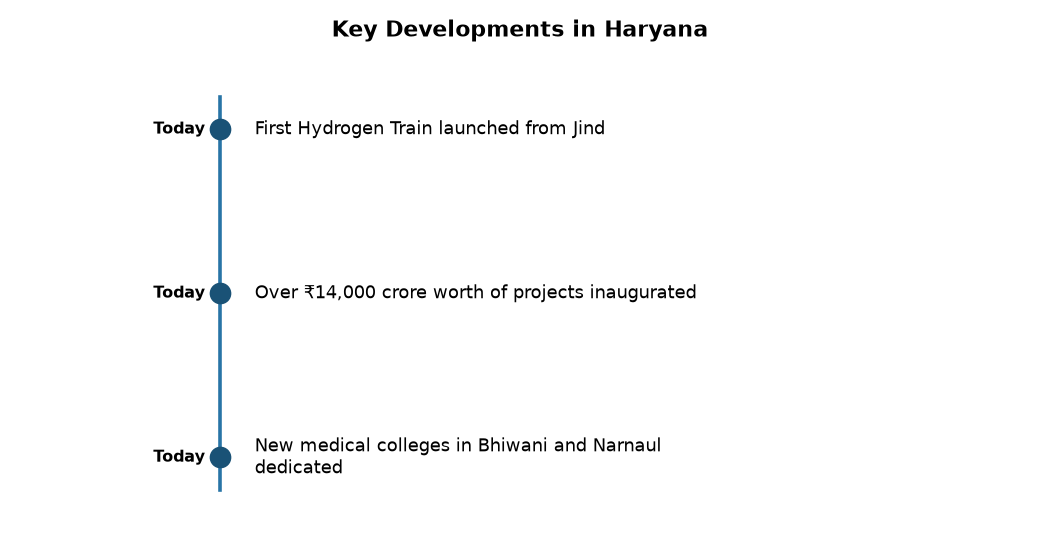
The Prime Minister recently inaugurated several development projects in Jind, Haryana, marking a significant milestone with the launch of India’s first hydrogen train. This event, alongside the dedication of over ₹14,000 crore worth of projects including railway and highway infrastructure, medical colleges, and heritage-related initiatives, underscores the government’s commitment to modernising infrastructure, promoting sustainable development, and enhancing public services across the nation, particularly in Haryana.
Background
- The inauguration in Jind, Haryana, by the Prime Minister included the launch of India’s first hydrogen train, positioning Jind and Sonipat as pioneers in future hydrogen-powered mobility.
- The projects, valued at over ₹14,000 crore, encompass diverse sectors such as railways, national highways, heritage preservation, and healthcare infrastructure.
- Two new medical colleges, Pandit Nekiram Sharma Medical College in Bhiwani and Maharishi Chyawan Medical College and Rao Tularam Hospital in Narnaul, were dedicated to enhance healthcare services and medical education.
- The Prime Minister lauded the ‘Swachhata Se Swagat’ initiative, highlighting the community’s proactive engagement in cleanliness drives, aligning with the broader Swachh Bharat Abhiyan.
- The ‘Double Engine Government’ model (referring to the same party ruling at both state and centre) was cited as a key enabler for accelerated development and efficient project implementation in Haryana.
- The event also evoked nostalgic sentiments, with the Prime Minister recalling his past association with Jind and appreciating the region’s cultural and historical significance.
What are Hydrogen Trains and their Significance?
- Hydrogen trains, also known as Hydrail, are railway vehicles that use hydrogen as their primary fuel source, typically through fuel cells that convert hydrogen into electricity to power electric motors.
- These trains produce zero tailpipe emissions, emitting only water vapor and warm air, making them a crucial component of sustainable transportation solutions.
- They offer a viable alternative to traditional diesel trains, especially on non-electrified routes, without the need for extensive overhead electrification infrastructure.
- The fuel cell technology in hydrogen trains combines hydrogen and oxygen to generate electricity, making them highly efficient and quiet in operation.
- India’s first hydrogen train, launched from Jind, signifies a major leap towards decarbonising the railway sector and achieving national climate goals.
- The ‘Vande Metro’ concept, which these hydrogen trains are part of, aims to provide rapid, eco-friendly connectivity for short-distance intercity travel.
- The adoption of hydrogen trains aligns with India’s broader National Green Hydrogen Mission, promoting the production and utilisation of green hydrogen across various sectors.
- This initiative is expected to reduce India’s reliance on fossil fuels, enhance energy security, and contribute to global efforts in combating climate change.
Key Features
| Feature | Significance |
|---|---|
| Zero Emissions | Eliminates greenhouse gas emissions and air pollutants, contributing to cleaner air and climate change mitigation. |
| Energy Efficiency | Fuel cells are highly efficient in converting chemical energy into electrical energy, leading to lower operational costs over time. |
| Reduced Noise Pollution | Operate significantly quieter than diesel trains, enhancing passenger comfort and reducing noise impact on surrounding communities. |
| Operational Flexibility | Can operate on non-electrified routes without the need for costly and time-consuming electrification, offering versatility in network expansion. |
| Indigenous Development | Promotes ‘Make in India’ initiative, fostering domestic manufacturing capabilities and technological self-reliance in advanced rail systems. |
| Alignment with Green Hydrogen Mission | Directly supports national strategic goals for green hydrogen production and utilisation, diversifying India’s energy mix. |
Why it Matters
Economic Development and Energy Security
- Reduces India’s dependence on imported fossil fuels, leading to substantial foreign exchange savings and enhanced energy security.
- Fosters the growth of a domestic hydrogen economy, creating new industries, jobs, and investment opportunities in manufacturing and infrastructure.
- The development of indigenous hydrogen train technology boosts India’s position as a leader in sustainable transportation innovation.
Technological Advancement and Infrastructure Modernisation
- Marks a significant leap in Indian Railways’ modernisation efforts, showcasing the adoption of cutting-edge green technology.
- The integration of hydrogen fuel cell technology into the railway network positions India at the forefront of global rail innovation.
- Complements existing electrification projects, offering a flexible and sustainable solution for diverse railway routes, particularly those not yet electrified.
Healthcare and Social Upliftment
- The inauguration of new medical colleges directly addresses the shortage of healthcare professionals and improves access to quality medical education.
- Enhanced healthcare infrastructure in regions like Bhiwani and Narnaul will significantly improve public health outcomes and reduce regional disparities.
- The focus on ‘Swachhata’ (cleanliness) initiatives promotes public health and civic responsibility, fostering a cleaner and healthier environment for all citizens.
Challenges
1. Hydrogen Production and Storage
- Ensuring the availability of green hydrogen at scale, which requires significant investment in renewable energy infrastructure and electrolysers.
- Developing safe, efficient, and cost-effective methods for hydrogen storage and transportation, given its low volumetric energy density.
UPSC Link: GS Paper III — Infrastructure (Energy); Science and Technology
2. Refuelling Infrastructure
- Establishing a robust network of hydrogen refuelling stations along railway routes, which is a capital-intensive and time-consuming endeavor.
- Standardisation of refuelling protocols and equipment to ensure interoperability and efficiency across the network.
UPSC Link: GS Paper III — Infrastructure (Railways, Energy)
3. Cost and Economic Viability
- The initial capital expenditure for hydrogen trains and associated infrastructure is higher compared to conventional diesel or electric trains.
- Achieving cost competitiveness with existing technologies requires economies of scale in hydrogen production and technological advancements.
UPSC Link: GS Paper III — Economy; Infrastructure
4. Safety Concerns
- Addressing public perception and ensuring stringent safety standards for handling and operating hydrogen, which is a highly flammable gas.
- Developing comprehensive regulatory frameworks and training for personnel involved in hydrogen train operations and maintenance.
UPSC Link: GS Paper III — Science and Technology; Disaster Management
5. Technological Integration and Maintenance
- Integrating complex fuel cell systems with existing railway infrastructure and ensuring seamless operation.
- Developing skilled manpower for the maintenance and repair of advanced hydrogen-powered railway systems.
UPSC Link: GS Paper III — Science and Technology; Infrastructure
Challenges — UPSC Perspective
| Issue | Concern |
|---|---|
| Green Hydrogen Supply Chain | Scaling up renewable energy generation and electrolyser manufacturing to meet the demand for green hydrogen. |
| Infrastructure Development | High upfront costs and time required for establishing hydrogen production, storage, and refuelling facilities. |
| Technological Maturity | Further research and development needed to enhance the efficiency, durability, and cost-effectiveness of fuel cell technology for heavy-duty applications. |
| Regulatory Framework | Absence of comprehensive standards and regulations for hydrogen transportation, storage, and safety in the railway sector. |
| Public Acceptance and Awareness | Addressing misconceptions and building public confidence regarding the safety and reliability of hydrogen-powered transport. |
| Skilled Workforce | Need for extensive training and skill development programs for operating and maintaining hydrogen train systems. |
Government Initiatives — Must-Memorise for Prelims
- National Green Hydrogen Mission
- Swachh Bharat Abhiyan
- PM Gati Shakti National Master Plan
- National Rail Plan for India (2030)
- Make in India
- Ayushman Bharat Pradhan Mantri Jan Arogya Yojana (AB-PMJAY)
- Pradhan Mantri Gram Sadak Yojana (PMGSY)
- National Health Mission (NHM)
- Jal Jeevan Mission
- Startup India
Way Forward
- Accelerate investment in green hydrogen production infrastructure, including renewable energy projects and electrolyser manufacturing, to ensure a sustainable supply.
- Develop a comprehensive national strategy for hydrogen refuelling infrastructure along key railway corridors, potentially through Public-Private Partnerships (PPPs).
- Incentivise research and development in fuel cell technology to improve efficiency, reduce costs, and enhance the lifespan of hydrogen train components.
- Establish robust safety standards, regulatory frameworks, and certification processes for hydrogen trains and associated infrastructure.
- Launch extensive skill development programs to train engineers, technicians, and operational staff in hydrogen technology and railway systems.
- Promote public awareness campaigns to educate citizens about the benefits and safety aspects of hydrogen-powered transportation.
- Explore international collaborations for technology transfer, best practices, and joint research initiatives in hydrogen mobility.
- Integrate hydrogen train deployment with broader smart city and sustainable urban mobility plans to create a holistic green transportation ecosystem.
UPSC Value Addition
Keywords for Mains Answer-Writing
Green Hydrogen Economy · Sustainable Mobility · Decarbonisation of Railways · Fuel Cell Technology · National Green Hydrogen Mission · Infrastructure Modernisation · Energy Security · Climate Action · Double Engine Growth · Public Health Infrastructure · Make in India · Circular Economy
Constitutional & Policy Linkages
- Article 21: Right to Life (implicitly linked to clean environment and health)
- Directive Principles of State Policy (Article 48A: Protection and improvement of environment)
- Seventh Schedule: Union List (Entry 22: Railways), State List (Entry 6: Public health and sanitation)
- Environment (Protection) Act, 1986: Framework for environmental protection
- National Policy on Biofuels, 2018: Promotes alternative fuels
- National Health Policy, 2017: Focus on strengthening healthcare infrastructure
Concept Flow
Government Policy (National Green Hydrogen Mission) → Investment in Renewable Energy & Electrolysers → Production of Green Hydrogen → Development of Hydrogen Fuel Cell Technology for Railways → Deployment of Hydrogen Trains (e.g., Jind Launch) → Reduced Carbon Emissions & Air Pollution → Enhanced Energy Security & Sustainable Transportation
Prelims Practice Questions
Q1. Consider the following statements regarding Hydrogen Trains:
1. They primarily use hydrogen fuel cells to generate electricity, emitting only water vapor.
2. They are suitable only for fully electrified railway routes.
3. India’s first hydrogen train was launched from Jind, Haryana.
Which of the statements given above is/are correct?
- A. 1 only
- B. 1 and 2 only
- C. 1 and 3 only
- D. 1, 2 and 3
Answer: C. 1 and 3 only — Statement 1 is correct: Hydrogen trains use fuel cells to convert hydrogen into electricity, with water vapor as the only emission. Statement 2 is incorrect: Hydrogen trains are particularly advantageous for non-electrified routes, as they do not require overhead electrification. Statement 3 is correct: The Prime Minister launched India’s first hydrogen train from Jind, Haryana.
Q2. The ‘Double Engine Government’ model, often referred to in the context of Indian governance, primarily signifies:
- A. A government with two strong leaders at the helm.
- B. The simultaneous operation of both central and state government schemes.
- C. The same political party ruling at both the Centre and the State level.
- D. A system where both the executive and judiciary work in tandem for development.
Answer: C. The same political party ruling at both the Centre and the State level. — The ‘Double Engine Government’ model refers to a scenario where the same political party or alliance is in power at both the central and state levels. This is often highlighted by political leaders to suggest better coordination, faster decision-making, and accelerated development due to alignment in policy and implementation between the two tiers of government.
Mains Practice Question
✍ The launch of India’s first hydrogen train marks a significant stride towards sustainable transportation and energy security. Discuss the potential benefits and challenges associated with the widespread adoption of hydrogen trains in India, in light of the National Green Hydrogen Mission. (250 words)
Approach: Begin by briefly introducing the significance of the hydrogen train launch in Jind and its alignment with India’s climate goals. In the first part, elaborate on the potential benefits, such as environmental sustainability (zero emissions), energy security (reduced fossil fuel dependence), economic growth (new industries, job creation), and technological advancement. In the second part, critically analyse the challenges, including the need for green hydrogen production at scale, refuelling infrastructure development, high initial costs, safety concerns, and technological integration. Conclude by suggesting a balanced way forward, emphasising policy support, R&D, public-private partnerships, and skill development to overcome these hurdles and realise the full potential of hydrogen mobility in India.
Source: PIB (Press Information Bureau)
Generated by AanyaAi for educational purpose.


No Comments