


17 Jul Samadhan Portal 2.0: Digital Governance for Trade Union Empowerment
Subject Relevance — Where This Topic Fits
- GS Paper II — Governance, Social Justice, Welfare Schemes | GS Paper III — Indian Economy, Technology Missions, Digital India
- Prelims: Samadhan Portal 2.0, Ministry of Labour & Employment, Industrial Disputes Act, Labour Codes, Trade Unions, Digital Governance, Grievance Redressal, e-governance initiatives, Central Chief Labour Commissioner, Labour Welfare
- Essay: The Digital Imperative: Transforming Governance for Inclusive Growth, Labour Reforms in India: Balancing Economic Growth with Social Justice
Quick Revision: Samadhan Portal 2.0, an initiative of the Ministry of Labour & Employment, is a digital governance platform designed to empower trade unions and workers by streamlining online industrial dispute filing, claim submission under modern labour codes, and real-time application monitoring, thereby enhancing transparency and efficiency in labour grievance redressal.
Why is this in the news?
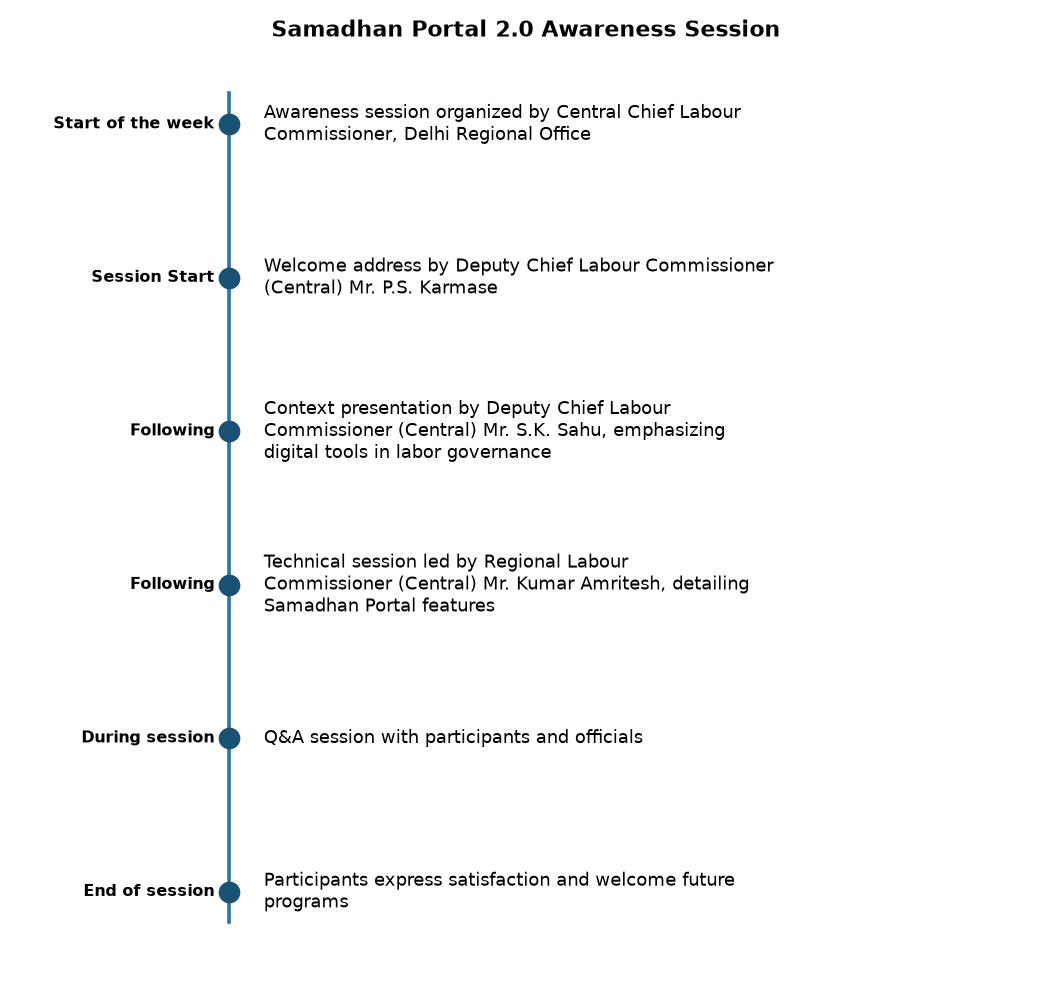
The Ministry of Labour & Employment, through its Delhi regional office of the Central Chief Labour Commissioner, recently organised a comprehensive awareness session for representatives of various trade unions on the advanced phase of the Samadhan Portal 2.0. Held at the Shramev Jayate Bhawan, New Delhi, the session highlighted the portal’s enhanced features for online industrial dispute filing, claim submission under modern labour codes, and real-time application monitoring, underscoring the critical role of digital tools in modern labour governance and worker rights protection.
Background
- India’s labour landscape is vast and complex, characterised by a large informal sector, diverse employment practices, and a significant workforce.
- Historically, industrial relations and grievance redressal mechanisms have often been time-consuming, opaque, and reliant on manual processes, leading to delays and inefficiencies.
- The advent of the Digital India initiative has spurred various government departments to leverage technology for improved service delivery, transparency, and accountability.
- The Ministry of Labour & Employment has been at the forefront of labour reforms, including the consolidation of various labour laws into four comprehensive Labour Codes, aimed at simplifying regulations and enhancing ease of doing business while protecting workers’ rights.
- Trade unions play a crucial role in advocating for workers’ rights, negotiating collective bargaining agreements, and representing workers in dispute resolution, making their engagement with digital platforms vital for effective labour governance.
- The Samadhan Portal, initially launched as a platform for online grievance redressal, has been upgraded to version 2.0, integrating new functionalities aligned with the modern labour codes and digital governance principles.
What is the Samadhan Portal 2.0?
- The Samadhan Portal 2.0 is an advanced digital platform developed by the Ministry of Labour & Employment, Government of India.
- It serves as a comprehensive online grievance redressal and dispute resolution mechanism for industrial relations and labour-related matters.
- The portal facilitates the online filing of industrial disputes, a significant departure from traditional manual processes, enhancing accessibility and efficiency.
- It allows for the submission of various claims under the modern Labour Codes, ensuring compliance with contemporary labour legislation.
- A key feature is its real-time application monitoring system, which provides stakeholders with updates on the status of their applications, promoting transparency.
- The portal aims to empower workers, employers, and trade unions by providing a user-friendly interface for resolving labour issues, thereby strengthening industrial harmony.
- It represents a significant step towards digital governance in the labour sector, aligning with the broader vision of ‘Minimum Government, Maximum Governance’.
- The initiative underscores the government’s commitment to leveraging technology for efficient, transparent, and accountable public service delivery in the realm of labour administration.
Key Features
| Feature | Significance |
|---|---|
| Online Industrial Dispute Filing | Streamlines the process, reduces paperwork, enhances accessibility for workers and unions, and expedites dispute initiation. |
| Claim Submission under Labour Codes | Facilitates compliance with new labour legislation, ensures claims are processed according to modern legal frameworks, and simplifies the process for beneficiaries. |
| Real-time Application Monitoring | Increases transparency and accountability by allowing stakeholders to track the status of their applications, reducing information asymmetry and potential delays. |
| User-Friendly Interface | Promotes ease of use, encourages wider adoption among diverse user groups, including those with limited digital literacy, and reduces barriers to access. |
| Stakeholder Empowerment | Provides a direct channel for workers and unions to voice grievances and seek redressal, strengthening their position in industrial relations. |
| Integration with Digital Governance | Aligns with the Digital India vision, promoting paperless governance, efficiency, and a more responsive administrative system in the labour sector. |
Why it Matters
Enhancing Transparency and Accountability
- The real-time monitoring and online filing features of Samadhan Portal 2.0 significantly reduce discretionary powers and manual interventions, fostering a more transparent system.
- It ensures that all stakeholders, including workers, unions, and employers, have clear visibility into the status of their grievances and disputes, promoting accountability from the administration.
Strengthening Industrial Relations and Social Justice
- By providing an accessible and efficient mechanism for dispute resolution, the portal helps in fostering industrial harmony and reducing the incidence of prolonged labour disputes.
- It empowers workers, especially those in vulnerable positions, to seek timely redressal for their grievances, thereby upholding principles of social justice and protecting labour rights.
- The inclusion of claims under modern labour codes ensures that the resolution process is aligned with contemporary legal frameworks designed for worker welfare.
Promoting Digital Governance and Efficiency
- The initiative is a testament to India’s commitment to digital transformation in governance, aligning with the ‘Digital India’ and ‘Minimum Government, Maximum Governance’ ethos.
- It streamlines administrative processes, reduces paperwork, and saves time and resources for both the government and the public, leading to greater operational efficiency.
- The portal serves as a model for other government departments to adopt technology for improved public service delivery and grievance redressal.
Empowering Trade Unions
- The awareness sessions and the portal itself equip trade unions with modern tools to more effectively represent their members’ interests and expedite dispute resolution.
- By simplifying the process of filing disputes and monitoring claims, unions can dedicate more resources to advocacy and welfare activities rather than procedural complexities.
Challenges
1. Digital Divide and Literacy
- A significant portion of India’s workforce, particularly in the informal sector and rural areas, may lack access to digital devices or possess limited digital literacy.
- This can hinder their ability to effectively utilise the online portal without assistance, potentially excluding the most vulnerable sections.
UPSC Link: GS Paper II — Social Justice, Governance
2. Infrastructure and Connectivity
- Reliable internet connectivity and adequate digital infrastructure are not uniformly available across the country, especially in remote regions.
- This can create bottlenecks in accessing and using the portal, leading to frustration and disengagement among users.
UPSC Link: GS Paper III — Infrastructure, Digital India
3. Resistance to Change and Adoption
- Some traditional stakeholders, including certain union representatives or employers, may be resistant to adopting new digital platforms, preferring established manual methods.
- Overcoming this inertia requires continuous awareness campaigns, training, and demonstrating tangible benefits.
UPSC Link: GS Paper II — Governance, Public Administration
4. Data Security and Privacy Concerns
- Online platforms handling sensitive personal and industrial data are susceptible to cyber threats and data breaches.
- Ensuring robust cybersecurity measures and adherence to data privacy regulations is crucial to build trust and prevent misuse of information.
UPSC Link: GS Paper III — Cyber Security, IT Act
5. Interoperability and Integration
- The effectiveness of Samadhan Portal 2.0 depends on its seamless integration with other labour-related databases and government services.
- Lack of interoperability can lead to data silos and hinder comprehensive grievance redressal.
UPSC Link: GS Paper II — e-governance, Public Policy
Challenges — UPSC Perspective
| Issue | Concern |
|---|---|
| Accessibility for Unorganised Sector | Workers in the informal economy often lack digital access, literacy, and formal representation, making portal usage challenging. |
| Technical Glitches and User Support | Potential for technical issues, server downtime, or lack of prompt technical support can deter users and undermine confidence in the system. |
| Verification and Authenticity of Claims | Ensuring the veracity of online claims and documents, and preventing fraudulent submissions, requires robust verification mechanisms. |
| Capacity Building for Labour Officials | Labour department officials need continuous training and resources to effectively manage and resolve disputes through the digital platform. |
| Language Barriers | While the portal may offer multiple languages, ensuring comprehensive linguistic support for all regional languages is critical for pan-India accessibility. |
| Ensuring Impartiality and Trust | Maintaining public trust in the impartiality and fairness of the digital redressal mechanism is paramount for its long-term success. |
Government Initiatives — Must-Memorise for Prelims
- Digital India Programme
- e-Shram Portal
- Pradhan Mantri Shram Yogi Maan-Dhan Yojana (PM-SYM)
- Atal Beemit Vyakti Kalyan Yojana (ABVKY)
- National Career Service (NCS) Portal
- Skill India Mission
- Pradhan Mantri Rojgar Protsahan Yojana (PMRPY)
- Unified Shram Suvidha Portal
- Aatmanirbhar Bharat Rojgar Yojana (ABRY)
- National Social Security Fund for Unorganised Workers
Way Forward
- Conduct extensive and continuous awareness campaigns, especially in regional languages, reaching out to grassroots levels and the unorganised sector.
- Establish dedicated digital literacy and assistance centres, possibly in collaboration with Common Service Centres (CSCs) and trade unions, to help workers access and use the portal.
- Invest in strengthening digital infrastructure and internet connectivity in remote and rural areas to bridge the existing digital divide.
- Develop a robust, multi-lingual technical support system to address user queries and resolve technical glitches promptly.
- Implement stringent data security protocols and adhere to global best practices for data privacy to build and maintain user trust.
- Ensure regular training and capacity building for labour department officials to effectively manage and resolve disputes through the digital platform.
- Incorporate feedback mechanisms from all stakeholders, especially trade unions and workers, for continuous improvement and user-centric enhancements of the portal.
- Explore integration with other relevant government portals and databases to create a seamless and comprehensive ecosystem for labour welfare and grievance redressal.
UPSC Value Addition
Keywords for Mains Answer-Writing
Digital Governance · Labour Reforms · Industrial Relations · Grievance Redressal · Trade Union Empowerment · Social Justice · Transparency · Accountability · Ease of Doing Business · Worker Welfare · Digital Divide · Cybersecurity · Inclusive Growth · Public Service Delivery
Constitutional & Policy Linkages
- Article 38: State to secure a social order for the promotion of welfare of the people.
- Article 39: Certain principles of policy to be followed by the State (e.g., adequate means of livelihood, equal pay for equal work).
- Article 41: Right to work, to education and to public assistance in certain cases.
- Article 42: Provision for just and humane conditions of work and maternity relief.
- Article 43: Living wage, etc., for workers.
- Industrial Disputes Act, 1947: Framework for investigation and settlement of industrial disputes.
- Code on Industrial Relations, 2020: Consolidated law governing trade unions, industrial employment, and dispute resolution.
- Information Technology Act, 2000: Legal framework for e-governance and cyber security.
Concept Flow
Traditional manual grievance redressal -> Inefficiency & delays → Digital India push -> Need for e-governance in labour → Samadhan Portal 2.0 launch -> Online dispute filing & monitoring → Trade Union awareness sessions -> Stakeholder engagement & adoption → Enhanced transparency & efficiency -> Improved industrial relations → Worker empowerment & social justice -> Holistic labour welfare
Prelims Practice Questions
Q1. With reference to the Samadhan Portal 2.0, consider the following statements:
1. It is an initiative of the Ministry of Electronics and Information Technology.
2. It facilitates online filing of industrial disputes and claims under modern labour codes.
3. It incorporates a real-time application monitoring mechanism for stakeholders.
- A. 1 and 2 only
- B. 2 and 3 only
- C. 1 and 3 only
- D. 1, 2 and 3
Answer: B. 2 and 3 only — Statement 1 is incorrect: The Samadhan Portal 2.0 is an initiative of the Ministry of Labour & Employment. Statements 2 and 3 are correct, as the portal’s key features include online dispute filing, claim submission under labour codes, and real-time monitoring.
Q2. Which of the following are key objectives of leveraging digital governance tools like Samadhan Portal 2.0 in the labour sector?
1. Enhancing transparency and accountability.
2. Reducing the digital divide among workers.
3. Streamlining grievance redressal mechanisms.
4. Promoting ease of doing business for employers.
- A. 1, 2 and 3 only
- B. 1, 3 and 4 only
- C. 2, 3 and 4 only
- D. 1, 2, 3 and 4
Answer: D. 1, 2, 3 and 4 — Statements 1, 3, and 4 are direct objectives and outcomes of such digital initiatives. While reducing the digital divide (Statement 2) is a broader challenge to be addressed for effective implementation, it is not a direct ‘objective’ of the portal’s design but rather a prerequisite for its equitable access. However, in the context of broader digital governance, it is an overarching goal. Considering the options, all four aspects are relevant to the comprehensive impact and intent behind such initiatives. The question asks for ‘key objectives’, and all four are indeed key. Therefore, option D is the most appropriate.
Mains Practice Question
✍ Critically examine the role of digital governance initiatives like the Samadhan Portal 2.0 in transforming industrial relations and promoting social justice in India. Discuss the opportunities presented and the challenges that must be addressed for their effective and inclusive implementation. (250 words)
Approach: Introduce Samadhan Portal 2.0 as a key digital governance initiative in the labour sector. Discuss its opportunities by highlighting how it enhances transparency, efficiency, worker empowerment, and ease of dispute resolution, thereby contributing to social justice and harmonious industrial relations. Subsequently, critically analyse the challenges, such as the digital divide, infrastructure limitations, data security concerns, and resistance to change. Conclude by suggesting a comprehensive way forward, emphasising inclusive implementation, capacity building, and continuous improvement to fully leverage the potential of such digital platforms.
Source: PIB (Press Information Bureau)
Generated by AanyaAi for educational purpose.

- झारखंड का 1.36 लाख करोड़ का बकाया खत्म! केंद्र बनाम राज्य अब सुप्रीम कोर्ट में - September 14, 2026
- Jharkhand’s ₹1.36 Lakh Crore Dues: Supreme Court Battle Over MMDRA Amendment - September 14, 2026
- गुजरात में स्थापित होंगे भारत के 12 सेमीकंडक्टर संयंत्रों में से 6, जानिए कैसे? - September 14, 2026

No Comments