


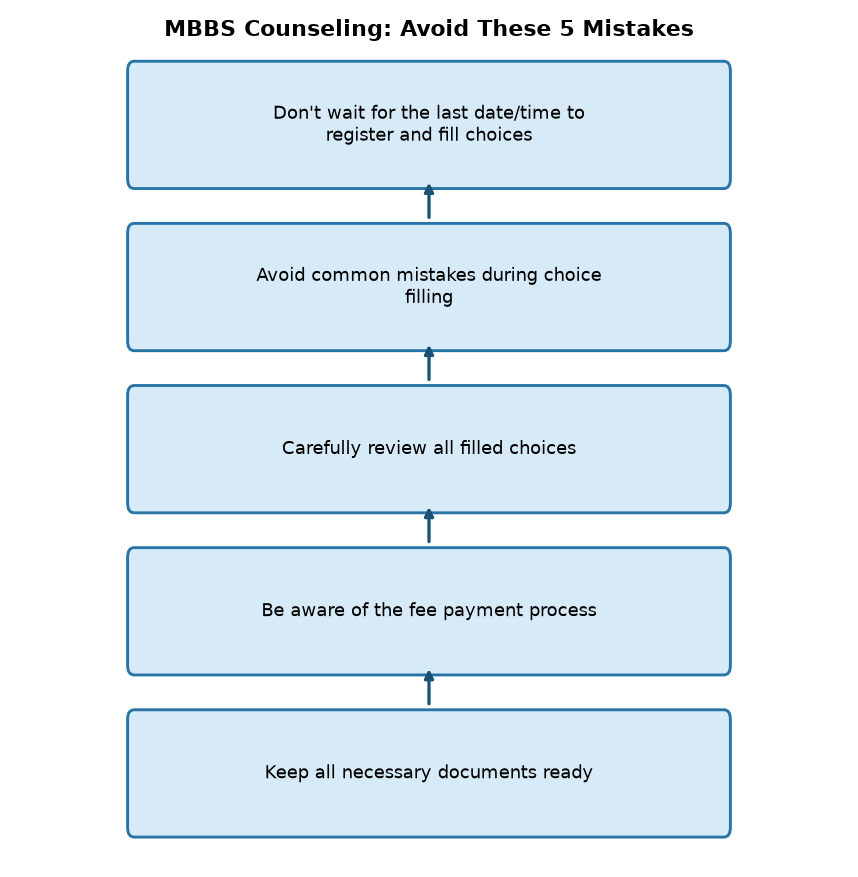
19 Jul NEET UG Counseling 2026: Avoid 5 Mistakes for MBBS Admission
Subject Relevance — Where This Topic Fits
- GS Paper II — Social Justice: Issues relating to development and management of Social Sector/Services relating to Health, Education, Human Resources. | GS Paper II — Governance: Government policies and interventions for development in various sectors and issues arising out of their design and implementation.
- Prelims: NEET UG, MBBS/BDS Admissions, Medical Council of India (MCI), National Medical Commission (NMC), All India Quota (AIQ), State Quota, Reservation Policies, Counselling Process, Choice Filling, Document Verification
- Essay: The pursuit of equitable healthcare access: Challenges and opportunities in medical education., Technology, transparency, and accountability: Reforming India’s higher education admission systems.
Quick Revision: Meticulous preparation, timely action, and informed decision-making are paramount for navigating the complex NEET UG counselling process to secure a medical seat, underscoring the need for systemic improvements in transparency and support.
Why is this in the news?
The recent news highlighting common pitfalls in NEET UG counselling for MBBS admissions in 2026 underscores the critical importance of a meticulous and informed approach to the admission process. With the NEET UG results declared, aspirants and their parents are keenly focused on securing coveted medical seats. The article serves as a timely reminder of the procedural intricacies and potential errors that can jeopardise years of hard work, thereby necessitating a deeper examination of the entire medical admission ecosystem in India.
Background
- NEET (National Eligibility cum Entrance Test) was introduced in 2013 as a single entrance examination for admission to MBBS and BDS courses across India, replacing multiple state and national-level entrance exams.
- The primary objective was to standardise the admission process, reduce the burden on students, and ensure merit-based admissions.
- The Medical Council of India (MCI), now replaced by the National Medical Commission (NMC), was the regulatory body overseeing medical education and admissions.
- Admissions are broadly categorised into All India Quota (AIQ) seats (15%) and State Quota seats (85%), with specific reservation policies applicable to both.
- The counselling process, conducted by the Medical Counselling Committee (MCC) for AIQ and respective state authorities for state quota, involves registration, choice filling, seat allotment, and document verification.
- Despite its intent, the NEET and subsequent counselling process often present administrative and logistical challenges for aspirants, leading to stress and potential errors.
Understanding NEET UG and the Counselling Process
- NEET UG is a national-level entrance examination conducted by the National Testing Agency (NTA) for admission to undergraduate medical and dental courses (MBBS/BDS) in India.
- It is a single-window examination, aiming to streamline admissions and ensure a uniform standard for entry into medical colleges.
- The counselling process commences after the declaration of NEET UG results and involves multiple rounds for seat allocation.
- The Medical Counselling Committee (MCC) conducts counselling for 15% All India Quota (AIQ) seats, deemed universities, central universities, ESIC, AFMC, and AIIMS/JIPMER institutions.
- State counselling authorities manage admissions for the remaining 85% state quota seats in government medical colleges and all seats in private medical/dental colleges within their respective states.
- Key stages include online registration, payment of fees, choice filling (prioritising colleges), choice locking, seat allotment based on merit and preferences, and document verification at the allotted institution.
- Reservation policies for Scheduled Castes (SC), Scheduled Tribes (ST), Other Backward Classes (OBC-NCL), Economically Weaker Sections (EWS), and Persons with Benchmark Disabilities (PwBD) are integral to the seat allocation.
- The process is highly time-sensitive, with strict deadlines for each stage, and requires meticulous attention to detail from applicants.
Key Features
| Feature | Significance |
|---|---|
| Single Entrance Exam (NEET) | Standardises entry, reduces burden of multiple exams, promotes meritocracy. |
| All India Quota (AIQ) | Ensures national mobility for students, promotes equitable distribution of talent across states. |
| Online Counselling System | Enhances transparency, accessibility, and efficiency in seat allocation. |
| Choice Filling & Locking | Allows students to prioritise preferred institutions, crucial for securing desired seats. |
| Document Verification | Ensures authenticity of applicant details and eligibility criteria, prevents fraudulent admissions. |
| Reservation Policies | Aims to promote social equity and representation for historically disadvantaged groups in medical education. |
Why it Matters
Enhancing Equity and Access
- NEET, coupled with reservation policies, aims to democratise access to medical education, ensuring opportunities for students from diverse socio-economic backgrounds.
- The AIQ allows meritorious students from any state to pursue education in premier institutions across the country, fostering national integration.
Standardisation and Quality Control
- A single entrance test ensures a uniform benchmark for assessing candidates’ aptitude, potentially leading to a higher quality of medical professionals.
- The regulatory oversight by NMC aims to maintain and improve standards of medical education and practice in India.
Streamlining Admissions
- The online counselling process, despite its complexities, has largely replaced cumbersome manual systems, making the process more efficient and transparent.
- It reduces the scope for malpractices and ensures that admissions are based on merit and declared preferences.
Impact on Human Resources for Health
- The efficiency and fairness of the admission process directly influence the pipeline of future doctors, which is crucial for addressing India’s healthcare needs, especially in rural and underserved areas.
- A robust system ensures that deserving candidates are not denied opportunities due to procedural lapses.
Challenges
1. Technical Glitches and Server Overload
- High traffic during peak counselling periods often leads to website slowdowns, server crashes, and payment gateway failures.
- This disproportionately affects students in remote areas with limited internet access or those who wait until the last minute, as highlighted in the news.
UPSC Link: GS Paper II — Governance; e-governance challenges
2. Document-Related Discrepancies
- Errors in caste certificates, domicile certificates, or discrepancies in name spellings on mark sheets can lead to cancellation of candidature.
- Lack of awareness about specific state-level document requirements further complicates matters for aspirants.
UPSC Link: GS Paper II — Social Justice; administrative hurdles
3. Complex Choice Filling Strategy
- Students often make uninformed choices based on incomplete data or peer pressure, leading to suboptimal seat allocation.
- Balancing preferred location, college reputation, fee structure, and chances of allotment requires careful research and strategic thinking.
UPSC Link: GS Paper II — Education; informed decision-making
4. Information Asymmetry and Misinformation
- The sheer volume of information, coupled with unofficial sources, can confuse aspirants, leading to critical errors.
- Lack of clear, consolidated, and timely communication from official channels exacerbates the problem.
UPSC Link: GS Paper II — Governance; transparency and accountability
5. Mental Stress and Anxiety
- The high stakes involved, combined with procedural complexities and the competitive nature of admissions, impose significant psychological stress on students and their families.
- The fear of making a mistake and losing a seat can be overwhelming.
UPSC Link: GS Paper II — Social Justice; mental health
Challenges — UPSC Perspective
| Issue | Concern |
|---|---|
| Last-minute application rush | Server overload, payment failures, missed deadlines. |
| Incomplete/Incorrect documents | Candidature cancellation, delays in verification. |
| Suboptimal choice filling | Loss of preferred seat despite good rank, regret over college allocation. |
| Lack of awareness on rules | Procedural errors, missing crucial steps, disqualification. |
| Cyber security threats | Phishing attempts, data breaches, fraudulent counselling sites. |
| Regional disparities in medical seats | Uneven distribution of healthcare professionals, brain drain from underserved areas. |
Government Initiatives — Must-Memorise for Prelims
- National Medical Commission (NMC) Act, 2019
- National Health Policy (NHP) 2017
- Pradhan Mantri Jan Arogya Yojana (PMJAY)
- Ayushman Bharat Digital Mission (ABDM)
- National Rural Health Mission (NRHM)
- National Urban Health Mission (NUHM)
- Scheme for Strengthening of Government Medical Colleges (Centrally Sponsored)
- Eklavya Model Residential Schools (EMRS) – indirectly aiding tribal students for competitive exams
- PM-DAKSH (Pradhan Mantri Dakshta Aur Kushalta Sampann Hitgrahi) Yojana
- National Scholarship Portal
Way Forward
- Strengthening IT Infrastructure: Invest in robust, scalable server infrastructure and dedicated technical support to handle peak loads during counselling.
- Proactive Information Dissemination: Launch comprehensive awareness campaigns well in advance, utilising multiple media channels (print, digital, regional languages) to educate aspirants on procedures and common pitfalls.
- Simplified Document Verification: Implement a phased or digital verification system to reduce last-minute rushes and allow for pre-verification of common documents.
- Interactive Counselling Portals: Develop user-friendly portals with AI-powered chatbots or FAQs to address common queries and provide real-time assistance.
- Mock Counselling Rounds: Introduce optional mock counselling rounds to familiarise students with the choice filling and locking process without real-world consequences.
- Counselling Workshops and Helplines: Organise state-level workshops and establish dedicated, multi-lingual helplines to provide personalised guidance to aspirants.
- Feedback Mechanism: Implement a robust feedback mechanism to continuously improve the counselling process based on user experiences and identified challenges.
- Promoting Digital Literacy: Conduct targeted campaigns to enhance digital literacy among students and parents, especially in rural areas, to navigate online processes effectively.
UPSC Value Addition
Keywords for Mains Answer-Writing
Medical Education Reform · Equitable Access · Human Resources for Health · E-governance Challenges · Social Justice Imperative · Standardisation of Admissions · Transparency and Accountability · Digital Divide · Procedural Efficacy · Healthcare Infrastructure · Youth Empowerment · Policy Implementation
Constitutional & Policy Linkages
- Article 14: Equality before law (ensuring fair admission process)
- Article 15: Prohibition of discrimination (basis for reservation policies)
- Article 16: Equality of opportunity in public employment (indirectly relevant to professional education)
- Article 21: Protection of life and personal liberty (right to health, necessitating adequate doctors)
- Article 41: Right to work, to education and to public assistance (Directive Principle)
- Article 47: Duty of the State to raise the level of nutrition and the standard of living and to improve public health (Directive Principle)
- National Medical Commission Act, 2019: Replaced MCI, regulates medical education and practice.
Concept Flow
NEET UG Exam Conducted by NTA → Results Declaration & Merit List Preparation → Counselling Registration & Fee Payment → Choice Filling & Locking by Aspirants → Seat Allotment (Merit + Preferences + Reservations) → Document Verification & Admission at Allotted College → Commencement of MBBS/BDS Course
Prelims Practice Questions
Q1. With reference to the National Eligibility cum Entrance Test (NEET) UG, consider the following statements:
1. NEET UG is conducted by the Medical Counselling Committee (MCC) for admission to all undergraduate medical courses in India.
2. The All India Quota (AIQ) for MBBS/BDS seats constitutes 15% of the total seats in government medical colleges.
3. The National Medical Commission (NMC) is the apex body responsible for regulating medical education and medical professionals in India.
- A. 1 and 2 only
- B. 2 and 3 only
- C. 1 and 3 only
- D. 1, 2 and 3
Answer: B. 2 and 3 only — Statement 1 is incorrect: NEET UG is conducted by the National Testing Agency (NTA), not MCC. MCC conducts the counselling for AIQ seats. Statement 2 is correct: AIQ is 15% of the total seats in government medical colleges. Statement 3 is correct: NMC is indeed the apex regulatory body for medical education and professionals in India, having replaced the MCI.
Q2. Which of the following bodies is primarily responsible for conducting the counselling for 15% All India Quota (AIQ) seats in government medical colleges and deemed universities for MBBS/BDS admissions?
- A. National Testing Agency (NTA)
- B. National Medical Commission (NMC)
- C. Medical Counselling Committee (MCC)
- D. Directorate General of Health Services (DGHS)
Answer: C. Medical Counselling Committee (MCC) — The Medical Counselling Committee (MCC) under the Directorate General of Health Services (DGHS), Ministry of Health & Family Welfare, Government of India, is responsible for conducting the counselling for 15% AIQ seats, deemed universities, central universities, ESIC, AFMC, and AIIMS/JIPMER institutions. NTA conducts the exam, and NMC is the regulatory body.
Mains Practice Question
✍ The NEET UG counselling process, while aiming for transparency and meritocracy, often presents significant administrative and psychological challenges for aspirants. Critically analyse these challenges and suggest comprehensive measures to enhance the efficiency, equity, and user-friendliness of medical admissions in India. (250 words)
Approach: Begin by briefly acknowledging the objective of NEET and its counselling process. Then, delve into the administrative challenges such as technical glitches, document verification issues, and the complexity of choice filling. Subsequently, discuss the psychological burden on students and the issue of information asymmetry. In the latter part, propose actionable solutions focusing on robust IT infrastructure, proactive information dissemination, simplified procedures, introduction of mock rounds, and dedicated support systems. Conclude by emphasising the importance of a holistic approach to ensure equitable and stress-free access to medical education.
Source: amarujala.com
Generated by AanyaAi for educational purpose.

- Harivansh Leads India at 153rd IPU Assembly in Tanzania - October 3, 2026
- अमेरिका में व्यापार मिशन: भारत की बड़ी योजना, जानिए क्या है सरकार की रणनीति - October 3, 2026
- Nasha Mukt Bharat: Youth Role in Polity & Governance for UPSC & PCS - October 3, 2026

No Comments