


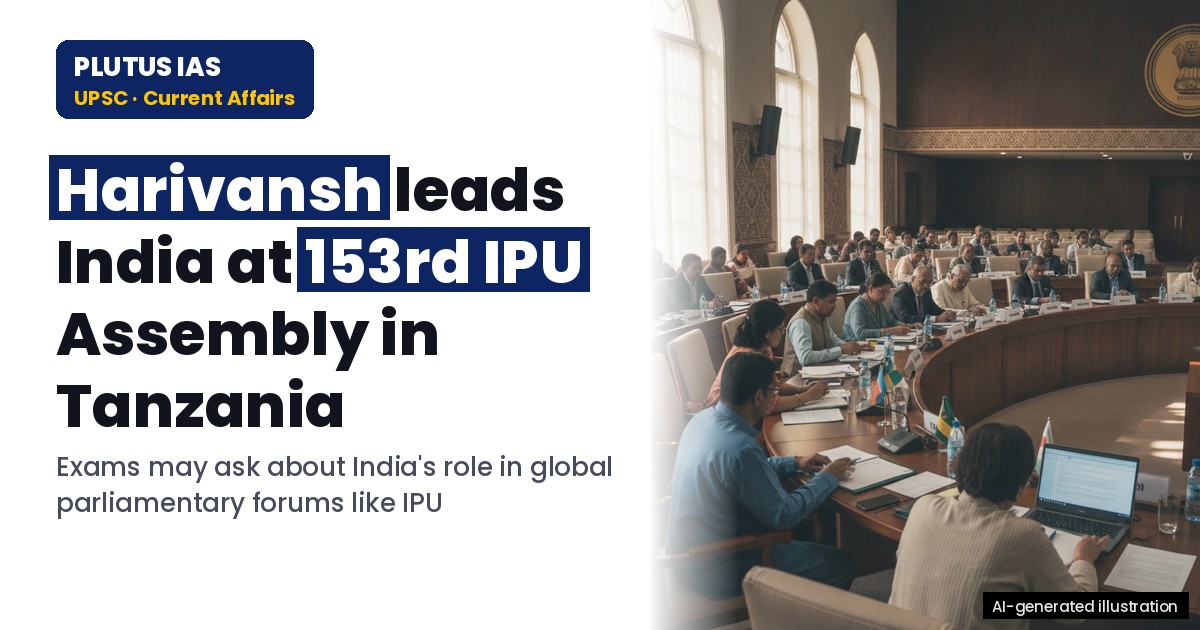
03 Oct Harivansh Leads India at 153rd IPU Assembly in Tanzania
✎ The Inter-Parliamentary Union (IPU) is the global organization of national parliaments, established in 1889, that facilitates inter-parliamentary dialogue and promotes democratic governance through multilateral engagement.
Subject Relevance — Where This Topic Fits
- GS Paper II — International Organisations, Parliament and State Legislatures — Structure, Functioning, Conduct of Business, Powers & Privileges and Issues Arising out of these | GS Paper II — Bilateral, Regional and Global Groupings and Agreements involving India and/or affecting India’s interests
- Prelims: Inter-Parliamentary Union (IPU), Parliamentary Diplomacy, Harivansh Narayan Singh, Rajya Sabha, Tanzania, 153rd IPU Assembly, Speaker of Lok Sabha, Speaker of Rajya Sabha, Parliamentary Delegation
- Essay: The evolving architecture of global parliamentary engagement: Strengthening democratic pluralism and multilateralism
Quick Revision: The Inter-Parliamentary Union (IPU) is the global organization of national parliaments, established in 1889, that facilitates inter-parliamentary dialogue and promotes democratic governance through multilateral engagement.
Why is this in the news?
The participation of Shri Harivansh Narayan Singh, Deputy Chairman of the Rajya Sabha, leading the Indian Parliamentary Delegation to the 153rd Assembly of the Inter-Parliamentary Union (IPU) in Tanzania, underscores India’s sustained engagement with multilateral parliamentary platforms. This event is significant as it provides an opportunity for Indian parliamentarians to deliberate on global parliamentary priorities, strengthen inter-parliamentary cooperation, and contribute to shaping international norms on issues such as sustainable development, gender equality, and democratic governance. The IPU, as the global organization of national parliaments, plays a pivotal role in fostering dialogue among legislatures across continents.
Background
- The Inter-Parliamentary Union (IPU) was established in 1889 as the first permanent forum for political multilateral negotiations, predating the United Nations by nearly four decades.
- The IPU serves as a platform for parliamentarians to exchange best practices, discuss global challenges, and advocate for parliamentary solutions to international issues.
- The 153rd IPU Assembly in Tanzania is expected to focus on themes such as sustainable development, gender equality, youth participation in democracy, and the role of parliaments in addressing global crises.
- India’s leadership in parliamentary forums aligns with its broader foreign policy objectives of promoting a rules-based international order and strengthening South-South cooperation.
- The participation of senior Indian parliamentarians, including the Deputy Chairman of the Rajya Sabha, highlights the institutional importance attached to parliamentary diplomacy in India’s external engagement.
What is the Inter-Parliamentary Union (IPU)?
- The Inter-Parliamentary Union (IPU) is a global organization of national parliaments, established in 1889 to promote peace and cooperation through parliamentary diplomacy.
- It is the only international organization with a direct mandate to work with parliaments and parliamentarians, serving as a bridge between national legislatures and the global community.
- The IPU has 179 member parliaments and 14 associate members, representing nearly all the world’s nations and territories.
- Its primary functions include facilitating inter-parliamentary dialogue, promoting democratic governance, and addressing global challenges through parliamentary action.
- The IPU Assembly, held twice a year, is the principal decision-making body, where parliamentarians discuss and adopt resolutions on international issues.
- The IPU Secretariat, headquartered in Geneva, Switzerland, supports the organization’s activities, including research, capacity-building, and coordination of parliamentary initiatives.
- The IPU also works closely with the United Nations and other international organizations to integrate parliamentary perspectives into global policy frameworks.
- India’s engagement with the IPU reflects its commitment to multilateralism and the promotion of democratic values in international relations.
Key Features
| Feature | Significance |
|---|---|
| Leadership of Indian Parliamentary Delegation | Demonstrates India’s active engagement in multilateral parliamentary diplomacy, enhancing its global diplomatic footprint. |
| Participation in 153rd IPU Assembly | Provides a platform for India to engage with global peers on parliamentary governance, human rights, and sustainable development. |
| Role of Rajya Sabha Deputy Chairman | Highlights the institutional importance of the Rajya Sabha in India’s parliamentary system and its representation in international forums. |
| Focus on Global Parliamentary Cooperation | Reinforces India’s commitment to fostering international parliamentary dialogue and consensus-building. |
Why it Matters
Diplomatic and Strategic
- Enhances India’s visibility and influence in multilateral forums like the Inter-Parliamentary Union (IPU), a key platform for parliamentary diplomacy.
- Strengthens bilateral and multilateral ties with African nations, particularly Tanzania, through high-level parliamentary exchanges.
- Demonstrates India’s commitment to global governance frameworks, aligning with its ‘Vasudhaiva Kutumbakam’ (World is One Family) philosophy.
- Provides an opportunity to advocate for India’s priorities in global forums, including climate action, sustainable development, and human rights.
Parliamentary Governance
- Reaffirms the role of the Indian Parliament in shaping global parliamentary discourse and policy-making.
- Showcases the Rajya Sabha’s institutional capacity to represent India in international parliamentary bodies.
- Facilitates knowledge-sharing and best practices in parliamentary governance, transparency, and accountability with global peers.
Sustainable Development and Human Rights
- Provides a platform to discuss global challenges such as climate change, poverty eradication, and gender equality, aligning with the Sustainable Development Goals (SDGs).
- Enables India to highlight its initiatives in human rights, social justice, and inclusive development on a global stage.
Challenges
1. Balancing Domestic and International Priorities
- Ensuring that India’s participation in international forums does not dilute its focus on domestic governance and policy implementation.
- Managing resource allocation for international delegations while addressing pressing domestic challenges.
UPSC Link: GS-II: Parliament and State Legislatures
2. Ensuring Effective Parliamentary Diplomacy
- Maintaining consistency and coherence in India’s messaging across multilateral forums to avoid conflicting narratives.
- Leveraging parliamentary diplomacy to achieve tangible outcomes, such as trade agreements or technical collaborations.
UPSC Link: GS-II: International Relations
3. Addressing Global Inequalities in Participation
- Ensuring equitable representation of developing nations in global parliamentary forums to address power imbalances.
- Promoting South-South cooperation to amplify the voices of Global South countries in multilateral decision-making.
UPSC Link: GS-II: Global Groupings
4. Sustainability of Parliamentary Engagement
- Developing long-term strategies for sustained parliamentary engagement beyond episodic participation in forums like the IPU.
- Building institutional capacity within the Parliament to handle multilateral engagements effectively.
UPSC Link: GS-II: Parliament and State Legislatures
Challenges — UPSC Perspective
| Issue | Concern |
|---|---|
| Resource Allocation | Balancing budgetary constraints with the need for international parliamentary engagements. |
| Policy Coherence | Ensuring that India’s domestic policies align with its international commitments and messaging. |
| Global Representation | Addressing disparities in representation and influence among member states in multilateral forums. |
| Outcome Measurement | Evaluating the tangible benefits of parliamentary diplomacy for India’s national interests. |
| Institutional Capacity | Strengthening the Parliament’s ability to handle multilateral engagements efficiently. |
Way Forward
- Strengthen institutional mechanisms within the Parliament to facilitate sustained engagement in multilateral forums.
- Develop a long-term strategy for parliamentary diplomacy, aligning it with India’s foreign policy objectives.
- Enhance capacity-building initiatives for parliamentarians to participate effectively in global parliamentary forums.
- Promote South-South cooperation by collaborating with African and other developing nations in multilateral platforms.
- Leverage parliamentary diplomacy to advocate for India’s priorities in global governance, including climate action and sustainable development.
- Establish a feedback mechanism to assess the impact of parliamentary engagements on domestic and international outcomes.
- Foster partnerships with international parliamentary bodies to address global challenges collaboratively.
UPSC Value Addition
Keywords for Mains Answer-Writing
Indian Parliamentary Delegation · Inter-Parliamentary Union Assembly · Tanzania · Speaker of the Rajya Sabha · Parliamentary diplomacy · International parliamentary engagement · Role of the Rajya Sabha Chairman · Multilateral parliamentary forums · India’s soft power through parliamentary exchanges · Institutional mechanisms for parliamentary diplomacy
Constitutional & Policy Linkages
- [“Article 80 – Rajya Sabha’s Composition”, ‘Institutional representation in parliamentary diplomacy.’]
- [“Article 81 – Lok Sabha’s Composition”, ‘Ensuring democratic representation in global forums.’]
- [‘Article 266 – Consolidated Fund of India’, ‘Financial implications of international engagements.’]
Concept Flow
India’s participation in the IPU Assembly → Strengthening parliamentary diplomacy → Enhancing global engagement → Advocating for India’s priorities → Fostering multilateral cooperation → Addressing global challenges collaboratively.
Prelims Practice Questions
Q1. Consider the following statements regarding the Inter-Parliamentary Union (IPU):
1. The IPU is a global organisation of national parliaments.
2. It was established in 1889 and is headquartered in Geneva, Switzerland.
3. The IPU Assembly is the supreme decision-making body of the organisation.
4. The IPU Secretariat is headed by a Secretary-General appointed by the United Nations.
How many of the above statements are correct?
- Only one
- Only two
- Only three
- All four
Answer: Only three — Statements 1, 2, and 3 are correct. The IPU is indeed a global organisation of national parliaments, was established in 1889, and its Assembly is the supreme decision-making body. Statement 4 is incorrect as the Secretary-General is appointed by the IPU Governing Council, not the UN.
Q2. Assertion (A): The Speaker of the Rajya Sabha, as the ex-officio Chairman of the Conference of Chairpersons of Legislative Bodies, plays a pivotal role in India’s parliamentary diplomacy.
Reason (R): The Rajya Sabha Chairman’s participation in international parliamentary forums like the IPU Assembly enhances India’s soft power and fosters inter-parliamentary cooperation.
In the context of the above two statements, which one of the following is correct?
- Both A and R are true, and R is the correct explanation of A
- Both A and R are true, but R is not the correct explanation of A
- A is true, but R is false
- A is false, but R is true
Answer: Both A and R are true, and R is the correct explanation of A — The Speaker of the Rajya Sabha, as the ex-officio Chairman of the Conference of Chairpersons of Legislative Bodies, indeed plays a pivotal role in India’s parliamentary diplomacy. The participation of the Rajya Sabha Chairman in international forums like the IPU Assembly is aimed at enhancing India’s soft power and fostering inter-parliamentary cooperation. Thus, both statements are true, and R correctly explains A.
Q3. Which of the following is NOT a function of the Inter-Parliamentary Union (IPU)?
- Promoting peace and cooperation among nations through parliamentary diplomacy
- Facilitating the exchange of parliamentary best practices and experiences
- Conducting military operations in conflict zones to maintain global peace
- Adopting resolutions on global issues of concern to parliaments
Answer: Conducting military operations in conflict zones to maintain global peace — The IPU does not conduct military operations. Its functions include promoting peace and cooperation through parliamentary diplomacy, facilitating the exchange of best practices, and adopting resolutions on global issues.
Mains Practice Question
✍ The role of the Speaker of the Rajya Sabha in leading parliamentary delegations to international forums such as the Inter-Parliamentary Union (IPU) Assembly is often viewed as a critical instrument of India’s parliamentary diplomacy. Critically examine the constitutional, institutional, and political dimensions of this role. Also, analyse how such engagements contribute to India’s soft power and global standing. (15 Marks)
Approach: MODEL-ANSWER SKELETON:
1. **Constitutional and Institutional Framework** (4 Points):
– Article 98 of the Constitution: Role of the Chairman of the Rajya Sabha (ex-officio Speaker).
– Parliamentary diplomacy as an extension of the Rajya Sabha’s constitutional mandate.
– The Speaker’s role as the ex-officio Chairman of the Conference of Chairpersons of Legislative Bodies.
– Institutional mechanisms: Ministry of External Affairs (MEA) and the Parliament Secretariat’s coordination.
2. **Political and Diplomatic Dimensions** (4 Points):
– Enhancing inter-parliamentary cooperation and fostering goodwill.
– Addressing global challenges through parliamentary resolutions and debates.
– Representing India’s pluralistic democracy and secular ethos in international forums.
– Balancing domestic political narratives with international diplomatic objectives.
3. **Contribution to Soft Power and Global Standing** (4 Points):
– India’s historical engagement with the IPU since its inception in 1889.
– Showcasing India’s democratic resilience and institutional strengths.
– Leveraging parliamentary diplomacy to strengthen bilateral and multilateral relations.
– Examples of recent engagements and their outcomes (e.g., climate change, SDGs, gender equality).
4. **Challenges and Limitations** (3 Points):
– Constraints of parliamentary diplomacy in addressing geopolitical conflicts.
– The need for sustained follow-up and implementation of resolutions.
– Balancing sovereignty with international commitments.
Source: PIB (Press Information Bureau)
Generated by AanyaAi for educational purpose.
Related guides on our sites
- Anthropology VS PSIR
- Best PSIR optional coaching
- Best PSIR optional coaching online
- Best PSIR optional teacher

- Harivansh Leads India at 153rd IPU Assembly in Tanzania - October 3, 2026
- अमेरिका में व्यापार मिशन: भारत की बड़ी योजना, जानिए क्या है सरकार की रणनीति - October 3, 2026
- Nasha Mukt Bharat: Youth Role in Polity & Governance for UPSC & PCS - October 3, 2026

No Comments