


20 Jul CPI(M) Challenges Vande Mataram Bill: Unconstitutional Move?
Subject Relevance — Where This Topic Fits
- GS Paper II — Indian Constitution — Historical Underpinnings, Evolution, Features, Amendments, Significant Provisions and Basic Structure | GS Paper II — Parliament and State Legislatures — Structure, Functioning, Conduct of Business, Powers & Privileges and Issues Arising Out of these | GS Paper II — Fundamental Rights and Fundamental Duties
- Prelims: Vande Mataram, National Song, National Anthem, Prevention of Insults to National Honour Act, 1971, Constituent Assembly, Fundamental Duties, Article 51A(a), Bijoe Emmanuel v. State of Kerala
- Essay: Balancing national symbols with fundamental rights in a democratic society, The evolving interpretation of constitutional provisions regarding national identity
Quick Revision: The proposed Prevention of Insults to National Honour (Amendment) Bill, 2026, aims to grant statutory and penal protection to Vande Mataram, a status consciously withheld by the Constituent Assembly and distinct from the National Anthem’s constitutional standing.
Why is this in the news?
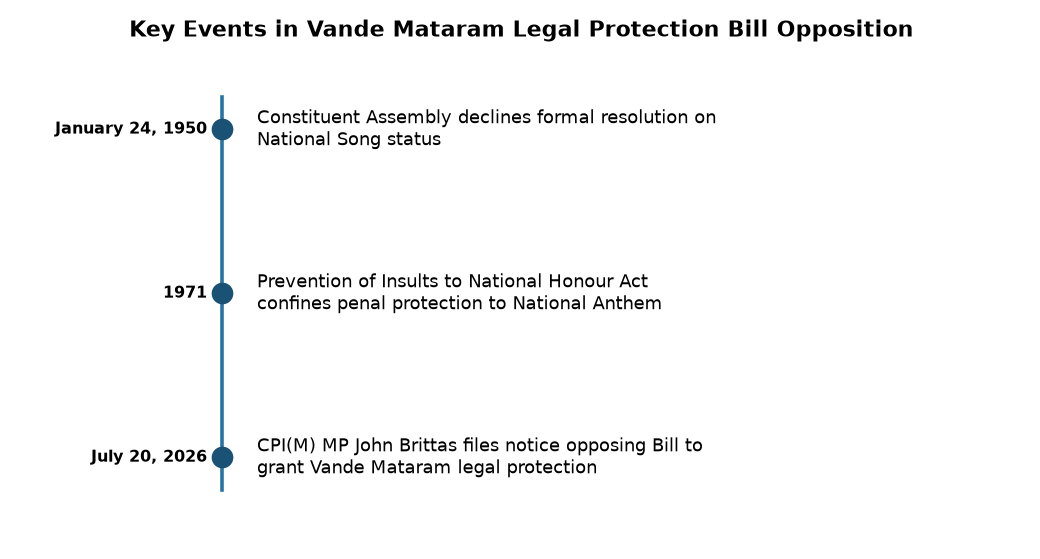
The Prevention of Insults to National Honour (Amendment) Bill, 2026, which seeks to accord statutory status and penal protection to the National Song, Vande Mataram, has faced opposition in the Rajya Sabha. A Member of Parliament filed a notice under Rule 67, arguing that the Bill is unconstitutional as it attempts to alter the conscious decision of the Constituent Assembly to not place the National Song and National Anthem on equal constitutional footing, and that it infringes upon fundamental rights.
Background
- Vande Mataram, composed by Bankim Chandra Chattopadhyay, played a significant role in the Indian independence movement and was adopted as the National Song.
- On January 24, 1950, Dr. Rajendra Prasad, the President of the Constituent Assembly, made a statement regarding the status of Vande Mataram, noting its historical significance and equating it with the National Anthem in terms of honour, but without a formal resolution.
- The Constituent Assembly, despite extensive deliberations over nearly three years, consciously chose not to grant the National Song the same constitutional status and penal protection as the National Anthem.
- The Prevention of Insults to National Honour Act, 1971, currently provides penal protection only to the National Anthem and the National Flag under Section 3.
- Article 51A(a) of the Constitution lists respect for the Constitution, the National Flag, and the National Anthem as a Fundamental Duty, but does not include the National Song.
- The Supreme Court, in Bijoe Emmanuel v. State of Kerala (1986), upheld the right to freedom of speech and conscience, even concerning national symbols, ruling that no person can be compelled to sing the National Anthem if it violates their religious beliefs, provided they show due respect.
The Prevention of Insults to National Honour Act, 1971
- The Prevention of Insults to National Honour Act, 1971, is an Act of the Parliament of India that prohibits desecration of or insult to the country’s national symbols.
- Section 2 of the Act deals with insults to the Indian National Flag and the Constitution of India.
- Section 3 specifically addresses insults to the National Anthem, making it a punishable offence to intentionally prevent the singing of the National Anthem or cause disturbance to any assembly engaged in such singing.
- The Act aims to safeguard the dignity and respect associated with India’s national symbols.
- The current Bill proposes an amendment to this Act to extend similar statutory status and penal protection to the National Song, Vande Mataram.
- The Act does not currently provide penal consequences for disrespect towards the National Song, Vande Mataram.
Key Features
| Feature | Significance |
|---|---|
| Prevention of Insults to National Honour (Amendment) Bill, 2026 | Seeks to extend statutory status and penal protection to ‘Vande Mataram’, the National Song, by amending the Prevention of Insults to National Honour Act, 1971. |
| Rule 67 of Rajya Sabha | Allows a Member of Parliament to object to the introduction of a Bill, providing an opportunity for legislative scrutiny and debate at an early stage. |
| Constituent Assembly’s Deliberation | The Constituent Assembly consciously chose not to accord the National Song the same constitutional footing as the National Anthem, a decision highlighted in the opposition to the Bill. |
| Dr. Rajendra Prasad’s Statement (January 24, 1950) | Acknowledged the National Song’s historical significance but did not confer constitutional force or equal status with the National Anthem, as per the Constituent Assembly’s decision. |
| Limitation to First Two Stanzas | Historical consensus limits the official use of ‘Vande Mataram’ to its first two stanzas, a nuance the proposed Bill potentially overlooks by seeking blanket penal protection. |
Why it Matters
Constitutional Significance
- The debate underscores the delicate balance between national symbols and constitutional principles, particularly concerning fundamental rights and the separation of powers.
- It highlights the importance of adhering to the original intent and deliberations of the Constituent Assembly regarding the status of national symbols.
- Raises questions about the scope of legislative power to alter established constitutional settlements through ordinary law, potentially impacting the foundational structure.
Legal Significance
- The Bill’s introduction and opposition bring into focus the interpretation and application of existing laws, such as the Prevention of Insults to National Honour Act, 1971.
- It necessitates a re-examination of judicial precedents, particularly the Supreme Court’s stance on the enforceability of national symbols and the limits of penal consequences.
- The proposed criminalisation of conduct related to the National Song could set a new legal precedent, expanding the ambit of penal statutes concerning national honour.
Socio-Political Significance
- The controversy reflects ongoing societal debates regarding nationalism, patriotism, and the extent to which these sentiments should be legally enforced.
- It can potentially polarise public opinion, with implications for social cohesion and the exercise of individual freedoms.
- The legislative attempt to elevate the National Song’s status may be perceived as an effort to reshape national identity and cultural norms through statutory means.
Challenges
1. Constitutional Integrity
- The Bill attempts to alter a constitutional settlement regarding the National Song’s status, which was consciously withheld by the Constituent Assembly.
- It potentially undermines the constitutional hierarchy where the National Anthem holds a distinct position, while the National Song’s status is primarily symbolic without penal provisions.
UPSC Link: Indian Constitution: basic structure, amendments
2. Fundamental Rights Infringement
- Criminalising conduct related to the National Song could restrict freedom of speech and expression (Article 19(1)(a)), freedom of conscience, and religion (Article 25).
- The Supreme Court’s ruling in Bijoe Emmanuel v. State of Kerala affirmed the right not to sing the National Anthem if it violates religious beliefs, a principle potentially challenged by the Bill.
UPSC Link: Fundamental Rights: Articles 19, 21, 25
3. Legislative Overreach
- The Bill seeks to achieve through ordinary legislation what the Constituent Assembly deliberately chose not to do, raising concerns about legislative competence and respect for constitutional history.
- It could be seen as an attempt to bypass the rigorous process of constitutional amendment for matters of profound national significance.
UPSC Link: Parliament: legislative procedure, powers
4. Judicial Precedent Disregard
- The Bill potentially contradicts the spirit of judicial pronouncements, such as the Supreme Court’s non-intervention on protocol orders lacking penal consequences, by introducing criminal penalties.
- It could lead to further litigation, challenging the constitutionality of the penal provisions based on established legal principles.
UPSC Link: Judicial review, Supreme Court judgments
Challenges — UPSC Perspective
| Issue | Concern |
|---|---|
| Constitutional Status of National Song | The Bill seeks to elevate ‘Vande Mataram’ to a statutory status with penal protection, which the Constituent Assembly deliberately avoided. |
| Conflict with Fundamental Duties | Article 51A(a) lists respect for the Constitution, National Flag, and National Anthem, but not the National Song, raising questions about selective enforcement. |
| Freedom of Speech and Expression | Criminalising insults to the National Song could unduly restrict Article 19(1)(a), impacting artistic expression, dissent, and critical commentary. |
| Freedom of Conscience and Religion | Penal provisions might infringe upon Article 25, particularly for individuals whose religious or conscientious beliefs preclude participation or reverence in specific forms. |
| Equality Before Law | The Bill’s potential for arbitrary application or disproportionate penalties could raise concerns under Article 14, challenging the principle of equality. |
Way Forward
- Prioritise comprehensive parliamentary debate to thoroughly examine the historical context, constitutional implications, and potential societal impact of the proposed Bill.
- Conduct a detailed legal review to ensure the Bill aligns with existing constitutional provisions, fundamental rights, and established judicial precedents.
- Engage with legal experts, constitutional scholars, and civil society organisations to gather diverse perspectives and inform legislative decisions.
- Consider alternative approaches, such as promoting respect for national symbols through educational initiatives and public awareness campaigns, rather than solely through penal measures.
- Ensure that any legislation concerning national symbols maintains a clear distinction between the National Anthem and the National Song, respecting the Constituent Assembly’s original intent.
- Uphold the principles of freedom of speech, expression, conscience, and religion, ensuring that any new law does not unduly restrict these fundamental rights.
- Explore the possibility of referring the Bill to a select committee for in-depth scrutiny and stakeholder consultation before proceeding with its passage.
UPSC Value Addition
Keywords for Mains Answer-Writing
National Song Vande Mataram · Constitutional status of National Song · Prevention of Insults to National Honour Act, 1971 · Fundamental Duties Article 51A(a) · Freedom of Speech and Expression Article 19(1)(a) · Freedom of Conscience and Religion Article 25 · Bijoe Emmanuel v. State of Kerala · Constituent Assembly debates · Parliamentary procedure Rule 67 · Judicial review of legislation
Constitutional & Policy Linkages
- Article 14: Equality before law
- Article 19(1)(a): Freedom of speech and expression
- Article 21: Protection of life and personal liberty
- Article 25: Freedom of conscience and religion
- Article 51A(a): Fundamental Duty to respect National Anthem
Concept Flow
Proposed Bill seeks penal protection for National Song. → Opposition cites Constituent Assembly’s deliberate omission. → Concerns raised over infringement of fundamental rights. → Bill potentially alters constitutional settlement. → Judicial precedents like Bijoe Emmanuel case are invoked. → Debate highlights balance between national symbols and liberties.
Prelims Practice Questions
Q1. With reference to the National Song ‘Vande Mataram’, consider the following statements:
1. The Constituent Assembly formally adopted a resolution granting ‘Vande Mataram’ equal constitutional footing with the National Anthem.
2. The Prevention of Insults to National Honour Act, 1971, explicitly provides penal protection for insults to ‘Vande Mataram’.
3. Article 51A(a) of the Constitution lists respect for the National Song as a Fundamental Duty.
- 1 only
- 2 and 3 only
- None of the above
- All of the above
Answer: None of the above — Statement 1 is incorrect: The Constituent Assembly did not adopt a formal resolution placing the National Song and National Anthem on equal constitutional footing. Statement 2 is incorrect: The Prevention of Insults to National Honour Act, 1971, confined penal protection under Section 3 to the National Anthem alone. Statement 3 is incorrect: Article 51A(a) lists respect for the Constitution, the National Flag, and the National Anthem as Fundamental Duties, but does not mention the National Song.
Q2. Which of the following Supreme Court judgments is relevant to the issue of mandatory singing of the National Anthem or National Song, particularly concerning individual freedoms?
- Minerva Mills v. Union of India
- Kesavananda Bharati v. State of Kerala
- Bijoe Emmanuel v. State of Kerala
- S.R. Bommai v. Union of India
Answer: Bijoe Emmanuel v. State of Kerala — Bijoe Emmanuel v. State of Kerala (1986) is a landmark judgment where the Supreme Court upheld the right of three children, belonging to the Jehovah’s Witnesses sect, not to sing the National Anthem, citing their freedom of speech and expression and freedom of conscience and religion, even though they stood respectfully during its rendition. This case is often cited in discussions regarding mandatory participation in national symbols.
Mains Practice Question
✍ Critically examine the constitutional implications of a legislative attempt to extend statutory status and penal protection to the National Song, ‘Vande Mataram’. Discuss how such a move might interact with fundamental rights and the existing legal framework concerning national symbols. (250 words)
Approach: The answer should begin by outlining the current constitutional and legal status of ‘Vande Mataram’, distinguishing it from the National Anthem. Subsequently, it should analyze the potential conflicts with fundamental rights such as freedom of speech and expression (Article 19(1)(a)), freedom of conscience and religion (Article 25), and the right to life and personal liberty (Article 21), referencing relevant Supreme Court judgments like Bijoe Emmanuel v. State of Kerala. The discussion should also address the implications for Article 51A(a) (Fundamental Duties) and the Prevention of Insults to National Honour Act, 1971, highlighting the Constituent Assembly’s original intent regarding the National Song’s status. Conclude by evaluating the broader constitutional settlement and parliamentary sovereignty in altering established norms.
Source: The Hindu
Generated by AanyaAi for educational purpose.

- AI का वादा और खतरा: क्या मानवता के लिए खतरा है कृत्रिम बुद्धिमत्ता? - September 15, 2026
- AI’s Dual Role: Promise vs Peril in UPSC Mains 2026-27 - September 15, 2026
- दिल्ली में 99% पीजी में नहीं है फायर एनओसी, 30% को नहीं मिला लेआउट अप्रूवल: एमसीडी सर्वे - September 15, 2026

No Comments