


20 Jul UPSC Focus: 15,870 MW Pump Storage Projects Under Construction in India
Subject Relevance — Where This Topic Fits
- GS Paper II — Government Policies and Interventions for Development in various sectors | GS Paper III — Infrastructure: Energy, Ports, Roads, Airports, Railways etc. | GS Paper III — Environmental Pollution and Degradation, Environmental Impact Assessment | GS Paper III — Renewable Energy
- Prelims: Pumped Storage Hydropower (PSH), Renewable Energy Integration, Energy Storage Systems, Inter-State Transmission System (ISTS), Central Electricity Authority (CEA), Central Electricity Regulatory Commission (CERC), Environmental Impact Assessment (EIA), Forest Clearance, Renewable Purchase Obligation (RPO), Grid Stability and Black Start Capacity
- Essay: Energy Security and Sustainability: The Role of Storage Technologies in India’s Renewable Energy Transition, Balancing Economic Growth with Environmental Conservation: A Case Study of Hydropower Projects in India
Quick Revision: Pump Storage Projects (PSPs) are critical for India’s energy transition, offering long-duration storage, grid stability, and renewable energy integration, with regulatory reforms reducing approval timelines and incentivising private participation.
Why is this in the news?
The Press Information Bureau (PIB), Ministry of Power, released an official update on 20 July 2026 regarding the current status of Pump Storage Projects (PSPs) in India. The release highlights the progress of under-construction and approved PSPs, regulatory measures to expedite clearances, and incentives to promote private sector participation. This development is significant as PSPs are critical for integrating intermittent renewable energy, ensuring grid stability, and supporting India’s decarbonisation goals under the National Electricity Policy and the Nationally Determined Contributions (NDCs).
Background
- Pump Storage Hydropower (PSH) is a mature and widely deployed form of long-duration energy storage, with global capacity exceeding 160 GW as of 2023.
- The Central Electricity Authority (CEA) is the nodal agency for technical approvals, while the Ministry of Environment, Forest and Climate Change (MoEFCC) regulates environmental and forest clearances.
- The Electricity Act, 2003, and the National Tariff Policy provide the legal framework for renewable energy procurement and storage integration.
- The Union Budget announced enhanced budgetary support for infrastructure development, including transmission lines and access roads for PSPs, to reduce project gestation periods.
What are Pump Storage Projects (PSPs)?
- Pump Storage Hydropower (PSH) is a type of hydroelectric energy storage used by electric power systems for load balancing, grid stability, and renewable energy integration.
- PSPs operate in two modes: during low-demand periods (typically at night), excess electricity is used to pump water from a lower reservoir to an upper reservoir; during peak demand, water is released back to generate hydroelectric power.
- PSPs provide long-duration energy storage (typically 6–20 hours), unlike battery storage systems which are better suited for short-duration applications.
- Key technical functions include frequency regulation, voltage support, black start capability, and ancillary services to maintain grid reliability.
- PSPs are classified into two types: (a) Conventional (Open-loop) PSPs, which use natural water bodies or rivers, and (b) Closed-loop PSPs, which operate in isolated reservoirs without continuous water inflow.
- The round-trip efficiency of PSPs ranges between 70–85%, making them one of the most efficient large-scale storage technologies available.
- Globally, countries like the USA, China, Japan, and Germany have deployed PSPs extensively; China alone accounts for over 40% of global PSP capacity.
- In India, PSPs are categorised as ‘hydroelectric projects’ under the Electricity Act, 2003, and are eligible for renewable energy incentives under the Renewable Purchase Obligation (RPO) framework.
Key Features
| Feature | Significance |
|---|---|
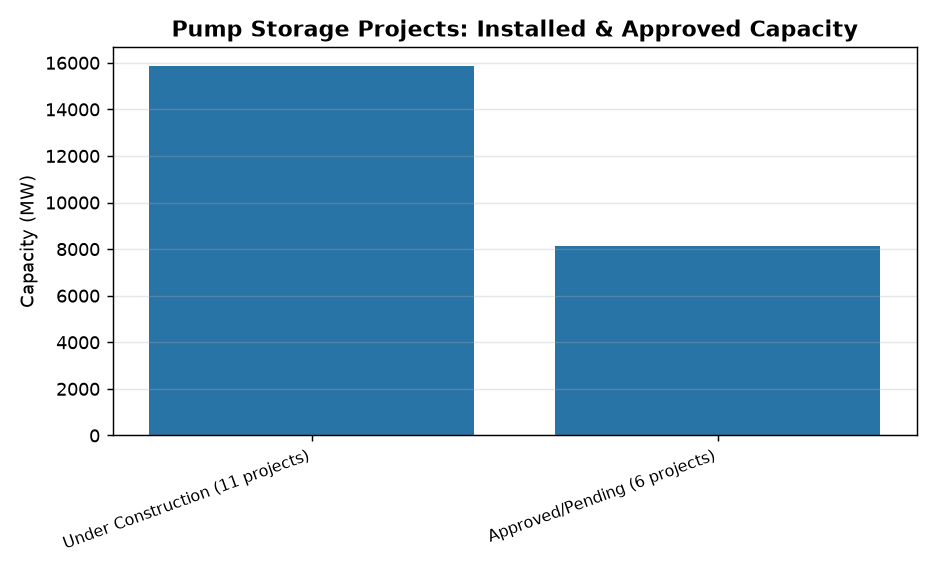
| Construction pipeline (15,870 MW across 11 PSPs) | Accelerates India’s energy storage capacity, aligning with the National Electricity Plan’s target of 74 GW of pumped storage by 2032. |
| Approved but not yet commissioned (8,140 MW across 6 PSPs) | Demonstrates forward planning in grid-scale storage, reducing lead time for future capacity additions. |
| Streamlined environmental clearance (MoEFCC notifications of 18.05.2023, 14.08.2023, 20.08.2024, 10.09.2025) | Reduces bureaucratic delays for B2-category PSPs while ensuring ecological safeguards through baseline data requirements. |
| Revised CEA guidelines for DPR approval (90 days → 50 days) | Expedites project preparation, enhancing investor confidence in pumped storage as a viable storage solution. |
| Capital expenditure threshold revision (₹3,000 crore for hydro projects) | Encourages private sector participation by lowering entry barriers for large-scale storage investments. |
Why it Matters
Grid Stability and Renewable Integration
- Enables high renewable energy penetration by storing surplus solar/wind energy during off-peak hours and dispatching during peak demand, thus addressing the intermittency challenge of variable renewable sources.
- Provides ancillary services such as frequency regulation, voltage support, and black-start capability, critical for maintaining grid resilience in a decarbonising power system.
- Reduces curtailment of renewable energy by absorbing excess generation, thereby improving the economic viability of solar and wind projects.
Economic and Industrial Development
- Stimulates employment and local infrastructure development in remote hilly regions where PSPs are typically located, aligning with the Atmanirbhar Bharat initiative.
- Lowers the cost of long-duration energy storage compared to battery alternatives, offering a sustainable solution for India’s 500 GW non-fossil fuel target by 2030.
- Attracts private investment through transparent bidding frameworks (e.g., Tariff-Based Competitive Bidding guidelines of 06.02.2025) and 100% ISTS fee waivers for 25 years.
Policy and Regulatory Synergy
- Demonstrates inter-ministerial coordination between MoP, MoEFCC, and CEA to fast-track PSP development while balancing environmental and technical standards.
- Aligns with the National Energy Storage Mission (NESM) 2023, which prioritises pumped storage as a key enabler for India’s energy transition.
- Supports the Electricity (Amendment) Rules, 2024, by ensuring grid-scale storage solutions to meet peak demand without compromising reliability.
Challenges
1. Land and Forest Clearances
- PSPs require large reservoirs, often in ecologically sensitive hilly terrains, leading to prolonged delays due to forest clearance under the Forest (Conservation) Act, 1980.
- Baseline data collection (e.g., monsoon and pre-monsoon surveys) adds to pre-construction timelines, increasing project costs.
- Compensatory afforestation requirements under MoEFCC’s 20.08.2024 notification may face implementation challenges in hilly states.
UPSC Link: Forest Rights Act 2006
2. Financial Viability and Risk Allocation
- High upfront capital costs (₹5–7 crore per MW) deter private players despite incentives, as revenue streams depend on time-of-day tariffs and ancillary service markets.
- Lack of a dedicated market for ancillary services in India limits monetisation of PSPs’ grid-support functions.
- Currency and interest rate risks for foreign investors in large-scale PSP projects remain unaddressed in current policy frameworks.
UPSC Link: PPP in Infrastructure
3. Inter-State Coordination and Transmission Bottlenecks
- PSPs are often located in one state but serve demand centres in another, requiring multi-state agreements for water-sharing and transmission access.
- Grid congestion in renewable-rich states (e.g., Rajasthan, Gujarat) may hinder the evacuation of stored energy, necessitating dedicated transmission corridors.
- Delays in obtaining CEA’s technical clearance for inter-state aspects (though exempted post-01.08.2025) can still create bottlenecks.
UPSC Link: Inter-State River Water Disputes Act
4. Technological and Ecological Trade-offs
- Open-loop PSPs (e.g., Tehri) have higher environmental impacts due to river diversion, while closed-loop systems (e.g., Kundah) are less disruptive but require higher initial investment.
- Sedimentation in reservoirs reduces efficiency over time, necessitating periodic dredging and increasing operational costs.
- Climate change-induced variability in rainfall patterns may affect PSP operations, particularly in monsoon-dependent systems.
UPSC Link: Environmental Impact Assessment 2006
5. Skill Gaps and Institutional Capacity
- Limited domestic expertise in designing and operating large-scale PSPs, necessitating reliance on foreign technology providers.
- State electricity boards (SEBs) often lack the technical and financial capacity to participate in PSP projects, leading to underutilisation of state-owned assets.
- Inadequate training infrastructure for operators in grid-scale storage systems, including simulation and emergency response protocols.
UPSC Link: Skill Development in Energy Sector
Challenges — UPSC Perspective
| Issue | Concern |
|---|---|
| Forest and land clearances | Delays due to MoEFCC’s baseline data requirements and compensatory afforestation mandates. |
| High capital expenditure | ₹5–7 crore per MW deters private investment despite policy incentives. |
| Inter-state water-sharing disputes | Requires multi-state agreements, complicating project siting and operation. |
| Grid congestion in renewable hubs | Limits evacuation of stored energy, reducing PSP economic viability. |
| Technological obsolescence risk | Sedimentation and climate variability threaten long-term efficiency. |
| Institutional capacity gaps | SEBs and state agencies lack expertise to manage PSP projects effectively. |
Government Initiatives — Must-Memorise for Prelims
- Guidelines for Development of Pump Storage Projects (10.04.2023)
Way Forward
- Accelerate forest and environmental clearances by leveraging MoEFCC’s streamlined processes for B2-category PSPs, while ensuring strict adherence to ecological safeguards.
- Develop a dedicated ancillary services market to monetise PSPs’ grid-support functions, including frequency regulation and black-start capability.
- Establish dedicated transmission corridors from PSP hubs to renewable-rich states to mitigate grid congestion and improve energy evacuation.
- Enhance private sector participation through viability gap funding (VGF) for closed-loop PSPs and risk-sharing mechanisms for open-loop projects.
- Strengthen state-level institutional capacity by training SEB engineers in PSP operations and grid integration, in collaboration with CEA and power utilities.
- Invest in R&D for sediment management technologies and climate-resilient PSP designs to address long-term operational challenges.
- Promote skill development in pumped storage technology through partnerships with IITs, NITs, and international institutions.
- Integrate PSPs with solar/wind hybrid projects to optimise land use and reduce transmission losses, aligning with the PM-KUSUM scheme’s objectives.
UPSC Value Addition
Keywords for Mains Answer-Writing
Pump Storage Projects (PSP) · Renewable Energy Integration · Grid Stability and Reliability · Environmental and Statutory Clearances · Central Electricity Authority (CEA) · Ministry of Environment, Forest and Climate Change (MoEFCC) · Inter-state Transmission System (ISTS) · Tariff-Based Competitive Bidding (TBCB) · Long-Term Energy Storage · Baseline Data Collection · Capital Expenditure (CAPEX) Threshold · Black Start Capability
Concept Flow
Rising renewable energy penetration → Intermittency challenges → Need for grid-scale storage → Pumped Storage Projects (PSPs) identified as optimal solution → Policy incentives (TBCB, ISTS waivers) → Private sector interest → Regulatory streamlining (CEA DPR guidelines) → Environmental clearances (MoEFCC notifications) → Project commissioning → Grid stabilisation and ancillary services provision → Enhanced renewable energy integration.
Prelims Practice Questions
Q1. With reference to Pump Storage Projects (PSP), consider the following statements: 1. PSPs store energy by pumping water from a lower reservoir to a higher reservoir during periods of low demand. 2. PSPs provide ancillary services such as frequency regulation and voltage support to the grid. 3. The Ministry of Environment, Forest and Climate Change has exempted all PSPs from obtaining environmental clearances. Which of the statements given above is/are correct?
- 1 and 2 only
- 2 and 3 only
- 1 and 3 only
- 1, 2 and 3
Answer: 1 and 2 only — Statement 1 is correct as PSPs operate on the principle of pumping water uphill during surplus energy and releasing it to generate power during peak demand. Statement 2 is correct as PSPs enhance grid stability by providing ancillary services. Statement 3 is incorrect as PSPs are subject to environmental clearances, though specific relaxations exist under defined conditions.
Q2. Which of the following measures has been taken by the Central Electricity Authority (CEA) to expedite the development of Pump Storage Projects (PSP)?
- Reducing the approval timeline for Detailed Project Reports (DPR) from 90 days to 50 days
- Exempting all PSPs from inter-state transmission charges
- Mandating a 100% capital subsidy for PSP development
- Imposing a ban on private sector participation in PSP projects
Answer: Reducing the approval timeline for Detailed Project Reports (DPR) from 90 days to 50 days — The CEA has revised guidelines to reduce the DPR approval timeline from 90 days to 50 days, thereby expediting project development. While inter-state transmission charges are exempted for PSPs, this is not a measure taken by the CEA but by the Central Electricity Regulatory Commission (CERC).
Q3. Consider the following statements regarding the role of Pump Storage Projects (PSP) in renewable energy integration: 1. PSPs facilitate the storage of excess renewable energy generated during off-peak hours. 2. PSPs help in balancing grid demand by supplying power during peak hours. 3. PSPs are primarily designed to replace conventional thermal power plants. Which of the statements given above is/are correct?
- 1 and 2 only
- 2 and 3 only
- 1 and 3 only
- 1, 2 and 3
Answer: 1 and 2 only — Statements 1 and 2 are correct as PSPs store excess renewable energy and supply power during peak demand, thereby balancing grid operations. Statement 3 is incorrect as PSPs are not designed to replace thermal plants but to complement renewable energy integration.
Mains Practice Question
✍ Critically examine the role of Pump Storage Projects (PSP) in enhancing grid stability and facilitating the integration of renewable energy in India. Assess the challenges in their development and the measures taken by the government to address these challenges.
Approach: Begin by defining PSPs and their operational mechanism. Discuss their significance in renewable energy integration, grid stability, and ancillary services. Highlight the challenges such as environmental clearances, inter-state coordination, and funding constraints. Evaluate the government’s measures, including expedited approvals, competitive bidding frameworks, and regulatory incentives, to mitigate these challenges. Conclude with a balanced assessment of the progress and the road ahead.
Source: PIB (Press Information Bureau)
Generated by AanyaAi for educational purpose.

- पेरियार टाइगर रिजर्व में 6 नई प्रजातियाँ खोजी गईं, जानिए क्या हैं विशेषताएँ - September 22, 2026
- Six New Species Discovered in Periyar Tiger Reserve: UPSC & PCS Key Biodiversity Insights - September 22, 2026
- तमिलनाडु में बस किराए में संशोधन: सरकार को चार सप्ताह और समय मिला, उच्च न्यायालय का फैसला - September 22, 2026

No Comments