


20 Jul RBI’s Swap Facility Boosts Forex Inflows: FCNR(B), ECB, OFCB Data Analysis for UPSC 2026
Subject Relevance — Where This Topic Fits
- GS Paper II — International Relations (Balance of Payments, Foreign Exchange Reserves) | GS Paper III — Economy (Foreign Exchange Management, Monetary Policy, Capital Account Convertibility)
- Prelims: Foreign Currency Non-Resident (FCNR) deposits, External Commercial Borrowings (ECBs), Overseas Foreign Currency Borrowings (OFCBs), RBI’s swap window, Balance of Payments (BoP) management, Capital Account Convertibility, Authorised Dealer Banks, Liquidity Adjustment Facility (LAF), Foreign Exchange Reserves (FER), Rupee-denominated bonds (Masala Bonds)
- Essay: India’s strategic approach to managing foreign exchange inflows in the context of global financial volatility, The role of monetary policy tools in stabilising the balance of payments and currency stability
Quick Revision: The RBI’s concessional swap facility for FCNR(B), ECBs, and OFCBs is a monetary policy tool aimed at attracting foreign exchange inflows by offering favourable exchange rate hedging, thereby strengthening India’s Balance of Payments without direct fiscal intervention.
Why is this in the news?
The Reserve Bank of India (RBI) has operationalised a concessional swap facility for Foreign Currency Non-Resident (FCNR(B)) deposits, Overseas Foreign Currency Borrowings (OFCBs), and External Commercial Borrowings (ECBs) to attract foreign exchange inflows and strengthen the Balance of Payments (BoP). This facility, announced on June 5, 2026, and operationalised from June 8, 2026, underscoring its immediate impact on India’s external sector resilience.
Background
- The RBI’s swap facility is part of a broader strategy to manage India’s Balance of Payments (BoP) amid global financial uncertainties, including geopolitical tensions and volatile capital flows.
- India’s foreign exchange reserves, while robust, face periodic pressures from current account deficits, import cover requirements, and currency volatility, necessitating proactive forex management tools.
- The FCNR(B) deposit scheme allows Non-Resident Indians (NRIs) to deposit foreign currency in Indian banks, providing a hedge against currency risk and contributing to forex reserves.
- External Commercial Borrowings (ECBs) and Overseas Foreign Currency Borrowings (OFCBs) are critical sources of foreign capital for Indian corporates, particularly in sectors with high import dependence or infrastructure financing needs.
- The concessional swap facility incentivises foreign investors by offering favourable exchange rate conditions, thereby reducing the cost of borrowing or depositing in foreign currency within India.
- This facility aligns with India’s gradual approach to capital account convertibility, balancing the need for foreign capital with macroeconomic stability.
What is the RBI’s Concessional Swap Facility for FCNR(B), ECBs, and OFCBs?
- The facility offers concessional foreign exchange swaps to banks and corporates mobilising FCNR(B) deposits, ECBs, or OFCBs, thereby reducing their hedging costs and enhancing the attractiveness of these instruments.
- The swap facility is structured to provide a fixed exchange rate for a specified tenor, shielding participants from adverse currency movements during the swap period.
- The facility is available for FCNR(B) deposits up to September 30, 2026, and for ECBs/OFCBs up to December 31, 2026, providing a defined window for capital mobilisation.
- Authorised Dealer Banks (ADBs) act as intermediaries, facilitating the swap transactions between the RBI and the entities availing the facility.
- The swap facility is designed to supplement India’s foreign exchange reserves without incurring additional fiscal burden, as it does not involve direct monetary outlays by the government.
- The facility is part of the RBI’s broader toolkit, which includes the Liquidity Adjustment Facility (LAF) and open market operations, to manage liquidity and forex stability.
- The incentive structure of the swap facility is calibrated to balance the RBI’s objectives of attracting capital inflows with the need to avoid excessive currency appreciation or speculative flows.
- The facility is temporary and targeted, reflecting the RBI’s preference for calibrated capital account liberalisation rather than permanent structural changes.
Key Features
| Feature | Significance |
|---|---|
| Concessional Swap Facility for FCNR(B) Deposits | Provides foreign exchange liquidity to banks at lower costs, incentivising non-resident Indians to deposit foreign currency in Indian banks, thereby augmenting foreign exchange reserves. |
| Operational Window for FCNR(B) Deposits | Available from June 8, 2026, to September 30, 2026, ensuring a defined period for capital inflows under the scheme. |
| Operational Window for ECBs and OFCBs | Available from June 8, 2026, to December 31, 2026, providing a longer duration for borrowings to support balance of payments. |
| Reporting Mechanism by Authorised Dealer Banks | Mandatory reporting of mobilised foreign exchange inflows to the Reserve Bank of India, enabling real-time monitoring and policy adjustments. |
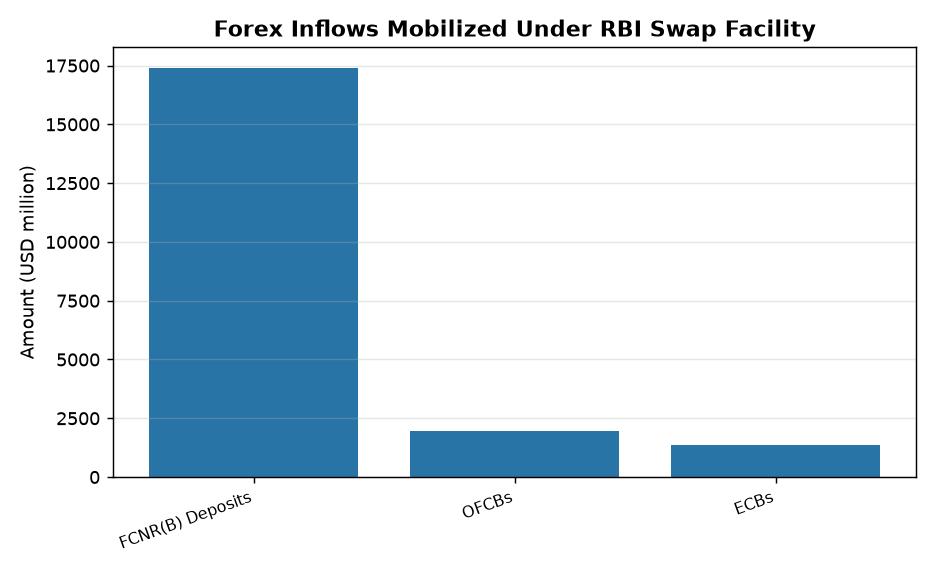
| Total Forex Inflows Mobilised (as of July 17, 2026) | USD 20,718 million, reflecting strong market response and confidence in the facility. |
Why it Matters
Balance of Payments Management
- Augments foreign exchange reserves by attracting capital inflows through structured incentives.
- Reduces pressure on the current account deficit by supplementing foreign currency liquidity.
- Enhances the stability of the rupee by diversifying sources of foreign exchange.
Capital Account Liberalisation
- Encourages non-resident investments in Indian financial instruments, deepening capital markets.
- Facilitates external commercial borrowings for Indian corporates at competitive rates.
- Promotes the use of overseas foreign currency borrowings for infrastructure and strategic sectors.
Monetary Policy Transmission
- Concessional swap facility aligns with RBI’s liquidity management objectives, ensuring smoother transmission of monetary policy.
- Reduces the cost of foreign exchange for banks, enabling better credit delivery in domestic markets.
- Supports the RBI’s objective of maintaining orderly market conditions in foreign exchange.
Macroeconomic Stability
- Strengthens India’s external sector resilience by diversifying funding sources.
- Mitigates risks of sudden capital outflows by providing structured foreign exchange buffers.
- Contributes to India’s sovereign credit rating by demonstrating proactive forex management.
Challenges
1. Exchange Rate Volatility
- Sudden appreciation or depreciation of the rupee could erode the benefits of the swap facility.
- RBI must balance the facility’s incentives with the need to prevent excessive currency volatility.
UPSC Link: GS-III: Exchange Rate Management
2. Capital Flight Risks
- Non-resident deposits may be withdrawn prematurely, leading to sudden outflows.
- RBI must monitor the maturity profile of FCNR(B) deposits to prevent liquidity mismatches.
UPSC Link: GS-III: Capital Account Convertibility
3. Regulatory Compliance Burden
- Authorised Dealer Banks face increased reporting and compliance requirements under the facility.
- Ensuring adherence to RBI guidelines across multiple banking entities poses operational challenges.
UPSC Link: GS-III: Financial Sector Regulations
4. Interest Rate Differential Risks
- Concessional swap rates may create arbitrage opportunities, distorting market pricing.
- Banks may face challenges in managing interest rate risks associated with foreign currency liabilities.
UPSC Link: GS-III: Monetary Policy and Inflation
5. Global Economic Uncertainty
- Geopolitical tensions or global financial crises could dampen investor confidence in the facility.
- RBI must remain agile in adjusting the facility’s terms to maintain its attractiveness.
UPSC Link: GS-III: Global Economic Developments
Challenges — UPSC Perspective
| Issue | Concern |
|---|---|
| Premature Withdrawal of FCNR(B) Deposits | Risk of sudden outflows affecting forex reserves and liquidity management. |
| Currency Mismatch in ECBs/OFCBs | Potential for exchange rate losses if borrowings are not hedged appropriately. |
| Compliance Overload for Banks | Increased administrative burden due to stringent reporting and monitoring requirements. |
| Market Distortions from Concessional Rates | Risk of mispricing of foreign currency assets and liabilities in the banking sector. |
| Global Risk Aversion Impact | Potential decline in investor appetite due to adverse global economic conditions. |
| Liquidity Management Challenges | Need for RBI to sterilise inflows to prevent excess liquidity in domestic markets. |
Government Initiatives — Must-Memorise for Prelims
- Foreign Currency Non-Resident (FCNR) Deposits Scheme
- External Commercial Borrowings (ECB) Policy
- Overseas Foreign Currency Borrowings (OFCB) Framework
Way Forward
- Monitor the maturity profile of mobilised foreign exchange inflows to prevent liquidity mismatches.
- Assess the impact of the facility on rupee volatility and adjust swap rates if necessary.
- Enhance coordination between RBI and Authorised Dealer Banks to streamline reporting mechanisms.
- Evaluate the long-term sustainability of the facility in maintaining capital account stability.
- Strengthen hedging mechanisms for borrowers under ECBs and OFCBs to mitigate exchange rate risks.
- Conduct periodic reviews of the facility’s effectiveness in achieving balance of payments objectives.
- Explore avenues to diversify the investor base for FCNR(B) deposits beyond traditional non-resident Indian segments.
- Integrate the facility’s outcomes with broader forex reserve management strategies to ensure macroeconomic stability.
UPSC Value Addition
Keywords for Mains Answer-Writing
Foreign Currency Non-Resident (FCNR) deposits · External Commercial Borrowings (ECBs) · Overseas Foreign Currency Borrowings (OFCBs) · Balance of Payments (BoP) · Foreign Exchange Reserves · RBI Swap Facility · Capital Account Convertibility · Forex Inflows · Monetary Policy Tools · Capital Controls · Liquidity Management · Foreign Exchange Management Act (FEMA) · Rupee-Dollar Swap · Currency Hedging · Macro-Economic Stability
Concept Flow
Announcement of Swap Facility (June 5, 2026) → Operationalisation (June 8, 2026) → Mobilisation of Forex Inflows → Reporting by Authorised Dealer Banks → RBI Monitoring → Impact on Forex Reserves → Balance of Payments Stabilisation → Macroeconomic Stability
Prelims Practice Questions
Q1. Which of the following instruments is NOT eligible for the concessional swap facility announced by the RBI in June 2026 to attract foreign exchange inflows?
- A. FCNR(B) Deposits
- B. Non-Resident External (NRE) Deposits
- C. Overseas Foreign Currency Borrowings (OFCBs)
- D. External Commercial Borrowings (ECBs)
Answer: B. Non-Resident External (NRE) Deposits — The RBI’s June 2026 swap facility specifically targets FCNR(B) deposits, OFCBs, and ECBs. NRE deposits are not included in this facility, as they are already subject to different regulatory norms under FEMA.
Q2. The RBI’s swap facility for foreign currency inflows aims primarily at:
- A. Reducing the fiscal deficit
- B. Strengthening the Balance of Payments (BoP)
- C. Increasing the repo rate
- D. Devaluing the domestic currency
Answer: B. Strengthening the Balance of Payments (BoP) — The primary objective of the RBI’s swap facility is to bolster the Balance of Payments by incentivising capital inflows, thereby enhancing foreign exchange reserves.
Q3. Under the RBI’s swap facility, the concessional swap rate is applicable for fresh inflows until which of the following dates?
- A. 30 September 2026 for FCNR(B) deposits and 31 December 2026 for OFCBs and ECBs
- B. 31 December 2026 for all instruments
- C. 31 March 2027 for all instruments
- D. 30 June 2026 for FCNR(B) deposits only
Answer: A. 30 September 2026 for FCNR(B) deposits and 31 December 2026 for OFCBs and ECBs — The RBI’s swap facility is available until 30 September 2026 for FCNR(B) deposits and until 31 December 2026 for OFCBs and ECBs, as explicitly stated in the press release.
Mains Practice Question
✍ Analyse the significance of the RBI’s swap facility for FCNR(B) deposits, ECBs, and OFCBs in the context of India’s Balance of Payments (BoP) management. How does this facility align with the broader objectives of monetary policy and exchange rate stability? (250 words)
Approach: Begin by defining the BoP and its components, highlighting the role of capital account transactions. Explain the RBI’s swap facility as a monetary policy tool aimed at attracting foreign exchange inflows to bolster reserves. Discuss how this facility incentivises non-resident deposits and foreign borrowings by offering concessional swap rates, thereby reducing the cost of hedging against currency risk. Link this to the RBI’s objective of maintaining exchange rate stability and managing liquidity. Conclude by assessing the potential long-term impact on India’s BoP and macroeconomic stability, while acknowledging limitations such as dependency on global liquidity conditions.
Source: RBI
Generated by AanyaAi for educational purpose.

- Harivansh Leads India at 153rd IPU Assembly in Tanzania - October 3, 2026
- अमेरिका में व्यापार मिशन: भारत की बड़ी योजना, जानिए क्या है सरकार की रणनीति - October 3, 2026
- Nasha Mukt Bharat: Youth Role in Polity & Governance for UPSC & PCS - October 3, 2026

No Comments