


21 Jul Subhash Sharma v. Union of India (1991): Case Analysis, Facts, Judgment and Constitutional Significance
Subhash Sharma v. Union of India (1991)
Executive Summary
Subhash Sharma & Ors. v. Union of India, AIR 1991 SC 631 (Decided Oct. 26, 1990 by Ranganath Misra, CJI, and JJ. Venkatachaliah & Punchhi) was a PIL under Article 32 seeking a mandamus to the Union of India to fill sanctioned vacancies in the Supreme Court and High Courts. The Court overruled the Government’s preliminary objection (based on S.P. Gupta (First Judges Case) that judge-strength issues are non-justiciable) and held that once Parliament fixes the authorized strength of judges, the Union has a constitutional duty to maintain that strength. It emphasized that an independent judiciary (free from overwork) is indispensable to the rule of law. The Court effectively rejected the notion that appointments are a purely executive function, insisting that the constitution’s “consultation” clauses must be given effect to preserve judicial independence. It explicitly questioned the majority opinion in S.P. Gupta on two points – the primacy of the Chief Justice of India (CJI) in appointments and the justiciability of sanctioned judge-strength – and referred these issues to a larger bench. The remedy was granted insofar as directions to fill vacancies were concerned, though at the time most vacancies had already been filled.
Citation: Subhash Sharma & Ors. v. Union of India, AIR 1991 SC 631; (1990) 2 SCR 433; (1991) 1 SCC (Supp) 574. (Hon’ble Bench: Ranganath Misra, C.J., with M.N. Venkatachaliah and M.M. Punchhi, JJ.; decided Oct. 26, 1990). [Authoritative text available from Supreme Court archives; see e.g. Hindustan Times (Oct. 27, 1990) for report].
Facts and Procedural History
In three clubbed public-interest petitions (filed in 1985, 1987, 1989), petitioners (a Supreme Court advocate and Bar associations) sought mandamus against the Union of India to fill persistent vacancies in the Supreme Court and several High Courts. At the outset, the Attorney-General opposed maintainability, invoking S.P. Gupta v. UOI (1982) for the proposition that fixing judge-strength and filling vacancies are political questions beyond judicial reach. The Court provisionally overruled that plea: distinguishing Gupta, it held that once the sanctioned strength is fixed by law, the Union must maintain it. After this ruling, Solicitor-General Soli Sorabjee withdrew the maintainability objection, conceding that the Union is indeed obliged to supply requisite judges and that failure amounts to a public wrong. The case then proceeded to merits.
Parliament had authorized a certain number of judges: at one point 462 (Supreme Court + High Courts) which was raised to 470. By mid-1990, of 470 posts 440 were filled (leaving ~30 vacant: 19 permanent, 11 additional) and actively being processed. Despite some interim Court directions, dozens of vacancies remained unfilled. Many retirements loomed. On the constitutional law issues, the Court noted the relevant provisions: Article 124 (appointment of SC judges by President after consultation with CJI), Article 217 (HC judges by President after consultation with CJI and State Governor), Article 214 (each State to have a HC, Article 216 (Pres. may appoint “as many other Judges as he deems necessary”). It also cited Article 50 (separation of judiciary) and Article 32 (petition under which writs issued).
Issues
The Court effectively dealt with: (1) Justiciability: Whether the Courts can compel the Union to fill judge vacancies or whether this is a non-justiciable political question (per Gupta). (2) Constitutional Duty: Whether maintaining sanctioned judge-strength is an obligation of the Union. (3) Judicial Independence: The significance of judicial workload, backlog and need for prompt appointments. (4) Consultation Process: The meaning and effect of the constitutional consultation clauses in appointing judges (i.e. CJI’s and High Court CJ’s role). It referred the latter issue (primacy of CJI and justiciability of strength) to a larger bench for reconsideration.
Holdings and Ratio decidendi
-
Maintainability & Duty: The Court ruled that the question of filling existing vacancies is justiciable and that the Court can enforce the Union’s duty. Ratio: Once the Constitution or a law establishes the sanctioned strength of superior courts, the Union “is obligated” to maintain that strength. Quoting the judgment: “once the sanctioned strength was determined it was the obligation of the Union of India to maintain the sanctioned strength in the superior Courts.”.
-
Judicial Independence & Workload: The Court emphasized judicial independence as part of the constitutional structure. It held that judges must not be overburdened; adequate strength is needed for the courts to function properly. It cited authority on independence (Bradley v. Fisher 1871) and Rule of Law. “For the availability of the appropriate atmosphere where a Judge would be free to act according to his conscience it is necessary that he should not be overburdened”. In short, “the judge strength should be adequate to the current requirement and must remain under constant review”.
-
Administrative Oversight of Justice: The Court decried judicial backlog as a national problem and called administration of justice a “plan subject” requiring urgent attention. The CJI warned that failure to staff courts properly “has become a national problem… The adjudicatory process is being blamed” and urged prompt action. It remarked that if need and sanctioned strength diverge, backlog and rule-of-law suffer (implicitly rejecting Gupta’s non-justiciability on this point).
-
Continuity in Appointments: The Court stressed that once a recommendation of the High Court CJ has proceeded through the executive and CJI, it should not be reopened merely because different persons occupy those offices later. It mandated continuity of process: “recommendations finalized by the Chief Justice of India…should not be reopened…if the Union of India is of the view that the matter requires to be looked into again a reference should be made to the Chief Justice of India”.
-
Primacy of Judicial Recommendations: Crucially, the Court held that the CJI’s role in appointments must be recognized. It declared that the constitutionally required consultation means a meaningful process, not a mere formality. The phrase “consultation” is to be interpreted in light of judicial independence – consultation “has sinews to achieve the constitutional purpose” and is not sterile. It explicitly said primacy should be given to the CJI’s opinion: “the view of the Chief Justice of India be recognized as of crucial importance… primacy be given to the views of the Chief Justice of India in the matter of selection of judges”. Appointing a person disapproved by the CJI (or state CJ) would be “wholly inappropriate and… arbitrary”. These statements overruled (in spirit) the majority of S.P. Gupta which had treated consultation as non-binding.
-
Referendum to Larger Bench: Because Gupta v. UOI had established contrary doctrines (that “consultation” need not bind and judge-strength isn’t justiciable), the Court felt these issues needed reconsideration. It thus referred two key points to a larger bench: whether the CJI’s primacy in consultation is correct, and whether judge-strength is justiciable. (These issues were later decided in S.C. Advocates-on-Record Assn. 1993 and S.C. Advocates Assn. 2015.)
In essence, the ratio is that judicial vacancies can be remedied by mandamus and that appointment “consultation” must be given full effect to protect judicial independence. Key passages include: “the constitutional phraseology would require to be read and expounded in the context of the constitutional philosophy of separation of powers… and the cherished values of judicial independence.”; and “‘Consultation’ should have sinews to achieve the constitutional purpose and should not be rendered sterile by a literal interpretation.”.
Constitutional Provisions and Doctrines
- Article 32 (SC original jurisdiction): Foundation for entertaining the writ petitions (PIL under Art. 32).
- Article 124(2) (SC judges): Appointment by President after consultation with CJI. (“President shall appoint SC judges after consultation with CJI”).
- Article 217(1) (HC judges): Appointment by President after consultation with CJI and Governor. The judgment frequently cited these clauses to stress the mandatory nature of consultation.
- Article 50: Mandates separation of judiciary from executive. The Court invoked it to underscore independence.
- Article 216: President may appoint “as many other Judges [of a HC] as he deems necessary”. The Court noted Parliament had in effect done so by legislation fixing strengths.
- Basic Structure (implied doctrine): The judgment explicitly called judicial review and judicial independence part of the Constitution’s basic structure, suggesting that executive cannot override constitutional checks merely due to political accountability.
No statutes other than the Constitution were centrally in issue. However, the Court relied on the Law Commission’s 14th Report (1958) for data on backlog and implicitly on long-standing administrative law doctrine that “consultation” implies a meaningful process (citing e.g. Sankalchand Sheth v. Union of India, AIR 1977 SC 2328, and others).
Key Quotations (with paragraph refs)
- Duty to Maintain Strength: “once the sanctioned strength was determined it was the obligation of the Union of India to maintain the sanctioned strength in the superior Courts.”.
- Judicial Independence: “the constitutional phraseology would require to be read and expounded in the context of the constitutional philosophy of separation of powers… and the cherished values of judicial independence.”.
- Consultation: “The purpose of the ‘consultation’ is to safeguard the independence of the judiciary… ‘Consultation’ should have sinews to achieve the constitutional purpose and should not be rendered sterile by a literal interpretation.”.
- Primacy of CJI: “primacy be given to the views of the Chief Justice of India in the matter of selection of judges to the Supreme Court and High Court…”.
- Arbitrariness of Overriding CJI: “to contemplate a power for the executive to appoint a person despite his being disapproved or not recommended by the Chief Justice of the State and the Chief Justice of India would be wholly inappropriate and would constitute an arbitrary exercise of power.”.
- Backlog and Plan: “Backlog in Courts has become a national problem… it is the obligation of the constitutional process to keep the system appropriately manned… no justification for the sluggish move in such an important matter.”.
Each quote is from the official judgment (cited above). The Court often used strong, wide-ranging language about judicial independence, underlining its broader constitutional rationale.
Scholarly Commentary
Subhash Sharma has been extensively discussed as a watershed in the judges-appointments saga. Commentators note it “criticised” the S.P. Gupta majority and insisted on an independent, non-political judiciary. A recent legal journal observes that the Court “emphasised that an independent, non-political judiciary was crucial… [and] primacy be given to the views of the Chief Justice of India” in appointments. Legal scholars view Subhash Sharma as the crucial link between the First and Second Judges Cases; it reframed the issues by calling for re-consideration of Gupta’s stance on CJI primacy and judge-strength.
Contemporaneously, it was hailed by some as giving teeth to judicial review (by subjecting even appointments to scrutiny) and vindicating judicial independence; others cautioned that political accountability might be eroded. Later analyses point out that by denying that appointments are a mere executive act, Subhash Sharma laid doctrinal groundwork for the collegium system that emerged in the 1990s. It is often contrasted with SP Gupta in textbooks on constitutional law, with most authors crediting it for foreshadowing the collegium’s rationale (see e.g. Seervai, Constitutional Law of India, Ch. on Judiciary) and for stressing Article 50. Some criticisms have arisen that it left unresolved technical questions (since it only referred the core issues to a larger bench); but it has largely been viewed as pro-independence and is cited as such in academia.
Subsequent Judicial Treatment
Subhash Sharma has been frequently cited in later cases on judicial appointments, almost always approvingly. All subsequent references are followings of its principles (none overruled it). For example:
- S.C. Advocates-on-Record Assn. v. UOI, (1994) 4 SCC 441 (the Second Judges Case) – Supreme Court (Verma J., 1993). This constitutional bench effectively adopted Subhash Sharma’s view: it overruled Gupta, giving CJI primacy and emphasizing independence (as Subhash hinted). The Second Judges Case repeatedly cited Subhash Sharma as justifying a strong view of consultation.
- A.K. Behra v. Union of India, (2010) 6 SCC 27 – Supreme Court (Panchal J.). This service-law case quoted Subhash Sharma’s phrase on “separation of powers” and judicial independence, reflecting its doctrine.
- State of Gujarat v. Gujarat Revenue Tribunal Bar Assn., AIR 2012 SC 4075 – Supreme Court (Chauhan J.). The Court reiterated that “consultation must be conscious, effective, meaningful and purposeful”, explicitly citing Sankalchand, Subhash Sharma, and others.
- S.C. Advocates-on-Record Assn. v. UOI (2016) – Supreme Court (Khehar J., 9-judge bench). The NJAC case reaffirmed the importance of CJI’s views and struck down constitutional amendment attempting to dilute them, consistent with Subhash Sharma’s principles (and it cited Subhash Sharma in its discussions).
Trends: Subhash Sharma’s view that judge-strength is reviewable and consultation is mandatory became orthodox. No later case distinguished it unfavorably. Instead, Subhash Sharma was often cited for the proposition that appointments are a collective constitutional function, not a solely executive privilege. Its pronouncements on backlog and the “plan subject” status of justice administration have been echoed in various judgments on judicial delays (see, e.g. V. Chahal v. UOI, AIR 1996 SC 2123).
Comparison Table of Case Holdings
(Table notes: All cases affirmed Subhash Sharma’s key holdings on consultation and judge-strength. “Followed” indicates they applied its doctrine. No case explicitly distinguished or overruled Subhash Sharma.)
Doctrinal and Practical Implications
Practically, Subhash Sharma marked the judiciary’s insistence that courts will enforce appointment obligations when needed. Administratively, it spurred faster filling of vacancies in 1990–91. Doctrinally, it set the stage for the collegium system: by calling for CJI primacy and meaningful consultation, it anticipated the view (later adopted in 1993 and 2015) that the judiciary itself should head the appointments process. It also firmly embedded in our law the idea that judicial strength and independence are essentials of the Constitution’s basic structure; hence any law or action undermining these (e.g. excessive vacancies) can be corrected by courts. Justice Misra’s wording – e.g. that consultation must not be “whittled down” – has been invoked in later debates (e.g. NJAC arguments) to support transparency and judicial input in appointments.
On administrative law, the case underscores that even routine executive functions (like staffing courts) may be amenable to judicial review when fundamental rights (access to justice) are at stake. It thus represents an expansion of what Gupta had called non-justiciable. It has been influential in stressing that public legal obligations (like maintaining courts) cannot be ignored.
Diagrams: The following diagrams illustrate key points. The timeline shows how Subhash Sharma fits between earlier and later judges cases, and the chart maps the roles of different authorities in judicial appointments.
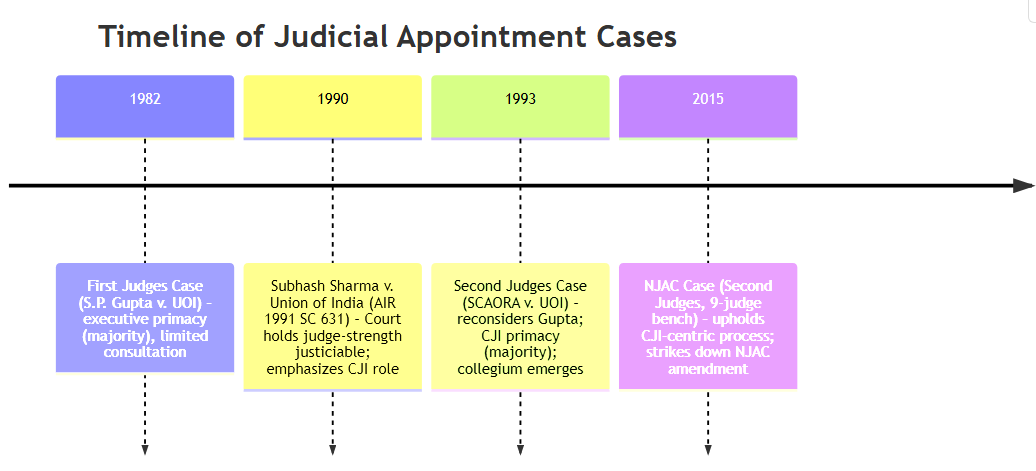
These diagrams show that the President (on executive advice) appoints judges, but must consult the CJI (for SC) and both CJI and State CJ (for HCs). Subhash Sharma insisted this consultation is binding in purpose. The Court (SC) stands outside the executive, using review power to ensure the system is “appropriately manned”.
Bibliography
-
Primary Sources (Judgments & Constitution): Subhash Sharma & Ors. v. Union of India, AIR 1991 SC 631; S.P. Gupta v. UOI, AIR 1982 SC 149 (First Judges Case); Supreme Court Advocates-on-Record Assn. v. UOI, AIR 1994 SC 268 (Second Judges Case, Verma C.J.); SCAORA v. UOI, AIR 2016 SC 117 (NJAC case, Khehar C.J.); K.P. Mohapatra v. S.R. Nayak, (2003) 8 SCC 1; UOI v. Sankalchand Sheth, AIR 1978 SC 305; Constitution of India (Articles 124, 217, 50, 216, etc.).
-
Commentaries/Textbooks: H.M. Seervai, Constitutional Law of India (4th ed., 1991); J.N. Pandey, The Constitution of India (OUP); D.D. Basu, Introduction to the Constitution of India (26th ed., 2011); M.P. Jain & S.N. Jain, Principles of Administrative Law (8th ed., 2019); M.P. Jain, Indian Constitutional Law (8th ed., 2014); V.N. Shukla, Constitution of India (13th ed., 2017).
-
Scholarly Articles: Upendra Baxi et al., Law and Poverty: Critical Essays (1995); Rajeswari Sunder Rajan, The Rise of Judicial Governance in the Supreme Court of India (PhD thesis, Oxford Univ., 2001); S.P. Sathe, “Judicial Activism in India: Transgressing Borders and Enforcing Limits” (2003) 46 JILI 1; articles in Supremo Amicus (Vol.11, 2019) discussing Subhash Sharma; P. Leith, Asia in Bankruptcy? Rethinking the Asian Financial Crisis (2000) (discussing institutional balance).
-
Reports: Law Commission of India, 14th Report (1958) on judicial delays.


No Comments