


21 Jul UPSC Alert: e-Gram Swaraj Portal in Fifth Schedule Areas Explained
Subject Relevance — Where This Topic Fits
- GS Paper II — Governance, Constitution and Polity | GS Paper III — Technology, Economic Development and Inclusive Growth
- Prelims: Fifth Schedule Areas, PESA Act 1996, e-Gram Swaraj Portal, Panchayat (Extension to Scheduled Areas) Act, Article 243M(4)(b), National Panchayat Awards, Rashtriya Gram Swaraj Abhiyan (RGSA), BharatNet
- Essay: Role of Digital Governance in Empowering Tribal Communities, Local Self-Governance in Fifth Schedule Areas: Challenges and Opportunities
Quick Revision: The e-Gram Swaraj portal, integrated with PESA provisions, is a critical digital governance tool for empowering Gram Sabhas in Fifth Schedule Areas to prepare inclusive and compliant Gram Panchayat Development Plans.
Why is this in the news?
The Press Information Bureau (PIB) released a press note on 21 July 2026 highlighting the integration of the e-Gram Swaraj portal with the Panchayat (Extension to Scheduled Areas) Act, 1996 (PESA) in Fifth Schedule areas. This initiative underscores the Ministry of Panchayati Raj’s efforts to strengthen digital governance in tribal-dominated regions through the e-Gram Swaraj portal, which facilitates the preparation, implementation, and monitoring of Gram Panchayat Development Plans (GPDPs) under PESA provisions. The move is part of a broader strategy to enhance local self-governance and ensure inclusive development in Scheduled Areas.
Background
- The PESA Act, 1996, was enacted under Article 243M(4)(b) of the Constitution to extend Part IX of the Constitution to Fifth Schedule Areas with certain exceptions and modifications, ensuring local self-governance in tribal regions.
- PESA empowers Gram Sabhas in Scheduled Areas to play a pivotal role in planning and decision-making, including the preparation of Gram Panchayat Development Plans (GPDPs).
- The e-Gram Swaraj portal, developed under the e-Panchayat Mission Mode Project (MMP), is a key digital governance tool for Panchayati Raj Institutions (PRIs) across India.
- The Ministry of Panchayati Raj monitors the implementation of e-Gram Swaraj and other digital applications through periodic reviews and a set of 10 PESA-specific indicators.
- The Rashtriya Gram Swaraj Abhiyan (RGSA), a centrally sponsored scheme, aims to strengthen the capacities of PRIs, including elected representatives and officials, in tribal and PESA areas.
- BharatNet, implemented by the Department of Telecommunications, seeks to provide broadband connectivity to Gram Panchayats, addressing digital infrastructure gaps in rural and tribal regions.
What is the e-Gram Swaraj Portal and its Integration with PESA?
- The e-Gram Swaraj portal is a digital governance platform designed to streamline the functioning of Panchayati Raj Institutions (PRIs) by enabling online preparation, monitoring, and auditing of Gram Panchayat Development Plans (GPDPs).
- Under PESA, the portal is being leveraged to ensure that Gram Sabhas in Fifth Schedule Areas prepare GPDPs that align with the provisions of the PESA Act, 1996, thereby enhancing local self-governance.
- The portal includes a dedicated PESA-GPDP module, launched to facilitate the preparation, implementation, and monitoring of development plans specific to PESA areas, ensuring compliance with the Act’s provisions.
- For the fiscal year 2026-27, the Ministry has integrated 42 PESA-specific activities into the e-Gram Swaraj portal as a separate subject category, mandating Gram Sabhas to include at least one PESA activity in their GPDPs.
- The portal serves as a repository for PESA-related data, including the number of PESA Panchayats, villages, and approved PESA master plans, enabling real-time monitoring and assessment by the Ministry.
- The integration of e-Gram Swaraj with PESA is part of the broader e-Panchayat Mission Mode Project (MMP), which aims to digitize Panchayati Raj governance across India.
- The portal also supports the auditing of Panchayat accounts through the AuditOnline application, ensuring transparency and accountability in the use of funds in PESA areas.
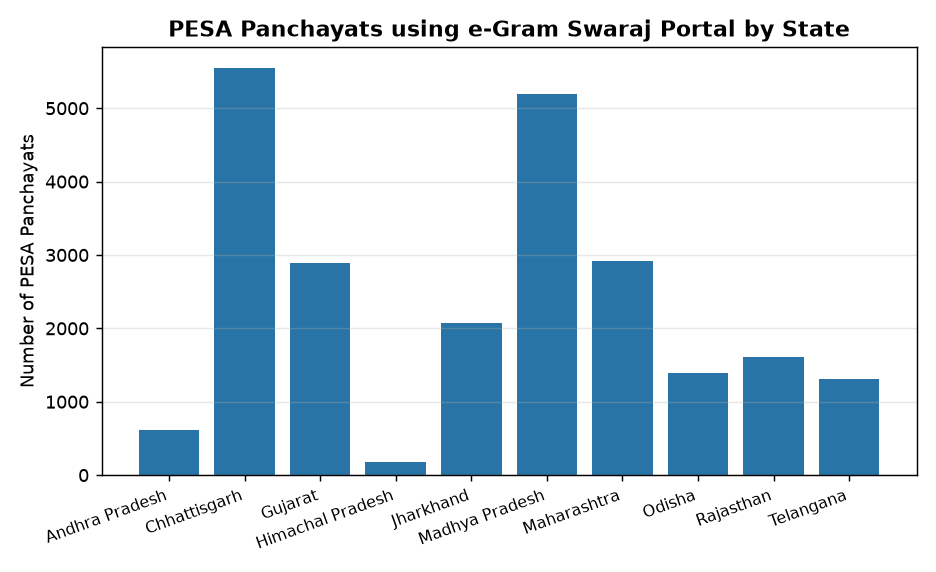
- State-wise data on the adoption of e-Gram Swaraj for uploading PESA GPDPs highlights the progress and challenges in digital governance across Fifth Schedule Areas, with states like Chhattisgarh, Madhya Pradesh, and Jharkhand leading in coverage.
Key Features
| Feature | Significance |
|---|---|
| e-Gram Swaraj Portal integration in PESA areas | Enables digital tracking of Gram Panchayat Development Plans (GPDPs) under the Panchayat (Extension to Scheduled Areas) Act, 1996 (PESA), ensuring transparency and accountability in tribal governance. |
| PESA-specific GPDP portal | Facilitates preparation, implementation, and monitoring of GPDPs in Fifth Schedule areas, aligning with PESA provisions for tribal self-governance. |
| PESA indicators (10 developed by Ministry) | Provides a standardized framework for states to assess PESA implementation, including e-Gram Swaraj portal usage for uploading GPDPs. |
| Capacity-building under RGSA (2022-23 onwards) | Strengthens governance capabilities of PRI representatives in tribal areas through targeted training, ensuring effective utilization of digital tools like e-Gram Swaraj. |
| BharatNet connectivity enhancement | Improves internet access in tribal panchayats, addressing digital infrastructure gaps that hinder adoption of e-governance applications. |
Why it Matters
Governance & Accountability
- Enhances transparency in fund utilization and project execution in tribal areas by mandating GPDP uploads on e-Gram Swaraj, reducing leakages and corruption risks.
- Strengthens local self-governance in Fifth Schedule areas by integrating PESA provisions with digital monitoring tools, ensuring compliance with constitutional mandates under Article 243M(4)(B).
- Promotes participatory planning by making GPDPs accessible to tribal communities, fostering grassroots democracy and inclusive development.
Legal & Constitutional
- Implements PESA Act, 1996, which extends Part IX of the Constitution to Fifth Schedule areas with specific modifications, ensuring tribal autonomy in local governance.
- Aligns with Article 243M(4)(B) of the Constitution, which empowers Parliament to extend panchayat provisions to Scheduled Areas with necessary adaptations.
- Supports the constitutional goal of tribal self-governance (Fifth Schedule) by digitizing administrative processes, reducing bureaucratic delays in tribal regions.
Digital Transformation
- Accelerates e-governance in remote tribal regions by leveraging e-Gram Swaraj and AuditOnline, reducing dependence on physical record-keeping and manual audits.
- Enables real-time monitoring of panchayat activities, improving service delivery and resource allocation in underserved tribal areas.
- Facilitates data-driven decision-making for PRI representatives, enhancing their ability to address local developmental challenges.
Inclusive Development
- Ensures tribal communities benefit from centrally sponsored schemes by improving access to GPDP-related information and fund tracking.
- Supports the integration of PESA-specific activities (42 identified) into GPDPs, ensuring tribal priorities are addressed in local development plans.
- Reduces digital divide in tribal areas by strengthening BharatNet connectivity, enabling broader participation in governance processes.
Challenges
1. Digital Infrastructure Deficits
- Inadequate broadband connectivity in remote tribal hamlets hampers real-time data uploads on e-Gram Swaraj, delaying GPDP processing.
- Limited technical literacy among PRI members and tribal communities restricts effective use of digital governance tools.
- Dependence on intermittent power supply disrupts online operations, particularly in hilly and forested Fifth Schedule areas.
UPSC Link: GS2: Governance, e-governance
2. Implementation Gaps in PESA
- State-level variations in PESA enforcement lead to inconsistent adoption of e-Gram Swaraj, with some states lagging in GPDP uploads.
- Lack of standardized training modules for PRI representatives on PESA provisions and digital tools creates operational inefficiencies.
- Delayed release of funds under RGSA and other schemes reduces the pace of capacity-building initiatives in tribal areas.
UPSC Link: GS2: Local Governance
3. Socio-Cultural Barriers
- Traditional tribal governance structures (e.g., Gram Sabhas) may resist digital integration, perceiving it as a threat to customary practices.
- Language barriers in tribal communities limit comprehension of digital portals, necessitating multilingual interfaces and localized training.
- Low digital awareness among tribal youth and women reduces their participation in e-governance processes.
UPSC Link: GS1: Tribal Issues
4. Monitoring & Evaluation Challenges
- Absence of a unified dashboard for tracking PESA indicators across states complicates comparative assessment of progress.
- Inadequate feedback mechanisms from tribal communities to PRI representatives hinder iterative improvements in GPDP planning.
- Over-reliance on manual audits in some states undermines the efficiency gains from AuditOnline.
UPSC Link: GS2: Governance
5. Resource Constraints
- Limited state budgets for upgrading digital infrastructure in tribal areas restrict the scalability of e-Gram Swaraj adoption.
- Shortage of IT professionals in rural panchayats delays troubleshooting and system maintenance.
- Competing priorities (e.g., healthcare, education) often divert funds from digital governance initiatives.
UPSC Link: GS3: Infrastructure
Challenges — UPSC Perspective
| Issue | Concern |
|---|---|
| Inconsistent state-wise adoption of e-Gram Swaraj | Leads to uneven implementation of PESA provisions, with some states failing to upload GPDPs despite mandates. |
| Low technical literacy among PRI members | Impedes effective use of digital tools, resulting in underutilization of e-Gram Swaraj for governance. |
| Intermittent internet connectivity in tribal areas | Disrupts real-time data entry and monitoring, delaying project approvals and fund disbursements. |
| Limited multilingual support in portals | Excludes non-Hindi-speaking tribal communities from accessing GPDP-related information. |
| Delayed fund release under RGSA | Reduces the pace of capacity-building programs, undermining PRI effectiveness in tribal governance. |
| Resistance to digital integration from traditional leaders | Threatens the sustainability of e-governance initiatives in Fifth Schedule areas. |
Government Initiatives — Must-Memorise for Prelims
- Revised National Gram Swaraj Abhiyan (RGSA) (2022-23 onwards)
- BharatNet Project (Department of Telecommunications)
- Panchayat (Extension to Scheduled Areas) Act, 1996 (PESA)
- e-Panchayat Mission Mode Project (MMP) (Ministry of Panchayati Raj)
Way Forward
- Conduct state-specific capacity-building workshops for PRI members on PESA provisions and e-Gram Swaraj usage, with a focus on tribal languages.
- Accelerate BharatNet rollout in Fifth Schedule areas to ensure 100% broadband connectivity by 2027, prioritizing remote tribal panchayats.
- Develop a unified PESA dashboard integrating all 10 indicators to enable real-time monitoring and comparative state assessments.
- Expand multilingual support in e-Gram Swaraj and PESA-GPDP portals, including tribal dialects like Gondi, Santhali, and Bhili.
- Strengthen feedback loops by establishing dedicated helplines and grievance redressal mechanisms for tribal communities.
- Increase budgetary allocations for digital infrastructure in tribal areas under RGSA and other centrally sponsored schemes.
- Promote public-private partnerships to deploy solar-powered Wi-Fi hotspots in remote tribal villages.
- Mandate annual PESA compliance reviews by state governments, with penalties for non-adherence to GPDP upload timelines.
UPSC Value Addition
Keywords for Mains Answer-Writing
PESA Act 1996 · Fifth Schedule Areas · e-Gram Swaraj Portal · Panchayati Raj Institutions (PRIs) · Gram Panchayat Development Plan (GPDP) · Digital Governance in Tribal Areas · Constitutional Provisions for Tribal Administration · Capacity Building under RGSA · Article 243M(4)(b) · Decentralized Planning in Tribal Regions
Constitutional & Policy Linkages
- Article 243M(4)(B) — Extension of Part IX to Scheduled Areas with modifications
- Fifth Schedule of the Constitution — Tribal self-governance framework
Concept Flow
Constitutional mandate (Article 243M(4)(B)) → PESA Act, 1996 → Extension of Part IX to Fifth Schedule areas → Need for digital governance tools → Launch of e-Gram Swaraj and PESA-GPDP portals → State-wise implementation challenges → Capacity-building under RGSA → BharatNet connectivity enhancement → Impact on tribal self-governance → Future: Standardized monitoring, multilingual support, and PPP-driven infrastructure upgrades
Prelims Practice Questions
Q1. Which constitutional provision empowers the extension of Part IX of the Constitution to the Fifth Schedule Areas with certain exceptions?
- Article 243A
- Article 243M(4)(b)
- Article 244(1)
- Article 338A
Answer: Article 243M(4)(b) — Article 243M(4)(b) of the Constitution empowers the Parliament to extend the provisions of Part IX to the Fifth Schedule Areas with exceptions and modifications, as per the PESA Act, 1996.
Q2. The e-Gram Swaraj Portal is an initiative under which of the following missions?
- Digital India Mission
- e-Panchayat Mission Mode Project (MMP)
- Ayushman Bharat Mission
- Make in India Mission
Answer: e-Panchayat Mission Mode Project (MMP) — The e-Gram Swaraj Portal is part of the e-Panchayat Mission Mode Project (MMP), launched by the Ministry of Panchayati Raj to facilitate digital governance in Panchayati Raj Institutions.
Q3. Which of the following states does NOT fall under the Fifth Schedule Areas as per the PESA Act, 1996?
- Chhattisgarh
- Gujarat
- Kerala
- Jharkhand
Answer: Kerala — Kerala is not listed among the states covered under the Fifth Schedule Areas as per the PESA Act, 1996. The Fifth Schedule Areas include states like Chhattisgarh, Gujarat, Jharkhand, and others.
Q4. The Gram Panchayat Development Plan (GPDP) under PESA is intended to integrate which of the following?
- Only agricultural development activities
- PESA-specific village development activities
- Urban infrastructure projects
- Industrial corridor development
Answer: PESA-specific village development activities — The Gram Panchayat Development Plan (GPDP) under PESA is designed to integrate PESA-specific village development activities, ensuring tribal-centric planning and implementation.
Mains Practice Question
✍ Critically examine the role of the e-Gram Swaraj Portal in enhancing digital governance within the Fifth Schedule Areas. How does it contribute to the effective implementation of the Panchayat (Extension to Scheduled Areas) Act, 1996 (PESA)? Substantiate your answer with constitutional provisions and recent initiatives.
Approach: Begin by outlining the constitutional framework of PESA and its significance in Fifth Schedule Areas. Discuss the e-Gram Swaraj Portal as a digital governance tool under the e-Panchayat MMP, highlighting its features such as GPDP integration and monitoring mechanisms. Analyze its impact on decentralized planning, capacity building, and transparency in tribal governance. Address challenges like digital infrastructure gaps and propose solutions, including the role of RGSA and BharatNet. Conclude by emphasizing the portal’s contribution to participatory democracy and tribal empowerment.
Source: PIB (Press Information Bureau)
Generated by AanyaAi for educational purpose.

- Kerala HC rules delay cannot quash Domestic Violence Act proceedings - September 20, 2026
- नासा-इसरो सहयोग: अंतरिक्ष अनुसंधान में नया मोड़, जानिए क्या है अगला कदम? - September 20, 2026
- NASA highlights ISRO partnership for future space missions in UPSC focus - September 20, 2026

No Comments