


22 Jul UN Report 2026: Global Hunger Declines but Africa Lags in SDG Progress
Subject Relevance — Where This Topic Fits
- GS Paper II — International Organisations and Global Groupings | GS Paper II — Effect of Policies and Politics of Developed and Developing Countries on India’s interests | GS Paper III — Food Security and Challenges Related to Buffer Stocks and Food Processing | GS Paper III — Issues Related to Direct and Indirect Farm Subsidies and Minimum Support Prices
- Prelims: SOFI 2026 report, SDG 2, FAO, IFAD, UNICEF, WFP, WHO, undernourishment, food insecurity, El Niño, Middle East conflict, food inflation, fertilizer prices, rural-urban divide in food security, gender gap in nutrition
- Essay: The Moral Imperative of Global Food Security: Bridging the Divide Between Progress and Persistent Hunger, Climate Change, Conflict, and Convergence: The Triad Shaping the Future of Global Nutrition
Quick Revision: The SOFI 2026 report reveals that while global hunger has declined for the third consecutive year, Africa remains the epicentre of undernourishment, with 309 million hungry people in 2025, and climate extremes, conflicts, and reduced development assistance threaten to reverse progress toward SDG 2.
Why is this in the news?
The UN’s State of Food Security and Nutrition in the World (SOFI) 2026 report, released on 21 July 2026, highlights that while global hunger levels have declined for the third consecutive year, the progress remains fragile, uneven, and insufficient to meet Sustainable Development Goal (SDG) 2 by 2030. The report underscores persistent regional disparities, particularly in Africa, and warns that ongoing conflicts, climate extremes, and reductions in development assistance threaten to reverse gains. This analysis is critical for UPSC aspirants as it intersects with India’s domestic food security policies, global nutrition governance, and the geopolitical dimensions of hunger mitigation.
Background
- The Sustainable Development Goal (SDG) 2 aims to end hunger, achieve food security, improve nutrition, and promote sustainable agriculture by 2030, with targets to halve the number of people suffering from hunger and ensure access to safe, nutritious, and sufficient food for all.
- The SOFI report is an annual publication by five UN agencies—FAO, IFAD, UNICEF, WFP, and WHO—providing a comprehensive assessment of global hunger, food insecurity, and malnutrition trends.
- The COVID-19 pandemic (2020–2022) exacerbated global hunger, with the number of undernourished people rising from 650 million in 2019 to 720–780 million in 2022, reversing a decade of progress.
- Regional disparities in hunger have deep historical roots, influenced by colonial legacies, structural inequalities, and differential access to agricultural technologies and markets.
- Climate change, including phenomena like El Niño, disrupts agricultural production, supply chains, and food prices, disproportionately affecting vulnerable populations in the Global South.
- Conflicts, such as the ongoing crisis in the Middle East, exacerbate food insecurity by disrupting supply chains, increasing food prices, and displacing populations, thereby undermining regional and global food systems.
What is the State of Food Security and Nutrition in the World (SOFI) Report?
- The SOFI report is a flagship publication of the United Nations, jointly produced by FAO, IFAD, UNICEF, WFP, and WHO, providing an annual assessment of global hunger, food insecurity, and malnutrition trends.
- It serves as the primary reference for tracking progress toward SDG 2 (Zero Hunger) and other nutrition-related targets, offering data-driven insights into the state of global food systems.
- The report evaluates three key metrics: (1) the prevalence of undernourishment (PoU), (2) the prevalence of moderate or severe food insecurity, and (3) the prevalence of child stunting, wasting, and overweight.
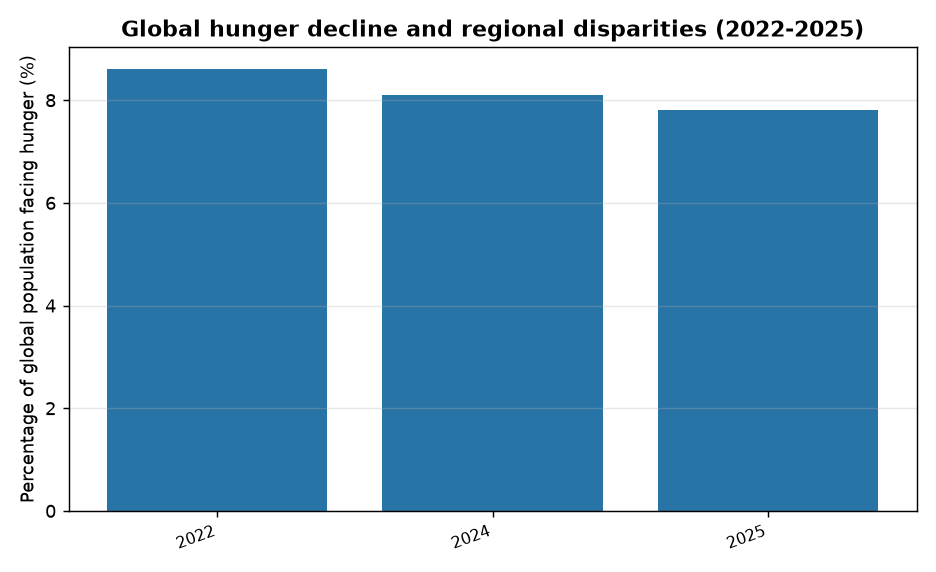
- SOFI 2026 highlights that while the global prevalence of undernourishment declined to 7.8% in 2025, the absolute number of hungry people remains unacceptably high at 645 million, reflecting population growth and persistent inequalities.
- SOFI 2026 includes an analysis of the cost of healthy diets, which has risen globally due to inflation, supply chain disruptions, and climate-related agricultural losses, further limiting access to nutritious food.
- SOFI underscores the disproportionate impact of hunger on rural populations, women, and conflict-affected regions, with Africa bearing the brunt of absolute hunger despite progress in Asia and Latin America.
- The report warns that without accelerated and targeted interventions, the world will fall short of achieving SDG 2 by 2030, with climate change, conflicts, and reduced development assistance acting as major impediments.
Key Features
| Feature | Significance |
|---|---|
| Global hunger decline (2022–2025) | Demonstrates a sustained but fragile reduction in undernourishment, with 7.8% of the global population facing hunger in 2025 (645 million people), down from 8.6% in 2022. |
| Regional disparities in hunger | Africa remains the most affected region in absolute terms (309 million hungry), while Asia and Latin America show steady improvements, highlighting uneven progress. |
| Moderate to severe food insecurity | 25.8% of the global population (2.1 billion) experienced food insecurity in 2025, down from 28.7% in 2020, but still above pre-pandemic levels. |
| Impact of Middle East conflict on hunger projections | The conflict may push global hunger numbers to 510–520 million by 2030, compared to a pre-conflict projection of 503 million, due to food inflation and supply disruptions. |
| Cost of healthy diets analysis | The report examines the affordability of nutritious diets, a critical factor in reducing hunger and malnutrition, particularly in low-income regions. |
Why it Matters
Economic Implications
- Reduction in global hunger indicates improved economic stability and productivity, as malnourishment directly impacts workforce efficiency and healthcare costs.
- Persistent regional disparities suggest that economic growth alone is insufficient; targeted policies are required to address structural inequities.
- Food inflation driven by geopolitical conflicts (e.g., Middle East) and supply chain disruptions (e.g., energy, fertilizers) threatens economic recovery and food security.
Strategic and Geopolitical
- The Middle East conflict’s impact on global hunger underscores the need for international cooperation in crisis management and humanitarian aid.
- Regional disparities in hunger highlight the strategic importance of South-South cooperation and regional food security alliances (e.g., African Union’s Agenda 2063).
- Climate-induced disruptions (e.g., El Niño) add a layer of unpredictability to food security strategies, necessitating adaptive governance frameworks.
Social and Demographic
- Women remain disproportionately affected by food insecurity, reflecting deep-rooted gender inequalities in access to resources and decision-making.
- Rural populations are more vulnerable to food insecurity than urban areas, emphasizing the need for rural development and infrastructure investment.
- Rapid population growth in Africa exacerbates hunger challenges, requiring integrated policies on education, healthcare, and sustainable agriculture.
Environmental and Agricultural
- Climate variability (e.g., El Niño) disrupts agricultural production, directly impacting food availability and prices.
- Over-reliance on energy-intensive agricultural inputs (e.g., fertilizers) increases vulnerability to global price shocks, necessitating sustainable farming practices.
- Biodiversity loss and land degradation reduce agricultural resilience, threatening long-term food security.
Challenges
1. Regional Disparities in Hunger
- Africa accounts for the highest absolute number of hungry people (309 million), despite a slight decline in hunger rates.
- Asia and Latin America show progress, but disparities persist within sub-regions (e.g., South Asia vs. East Asia).
- Urban-rural divide in food insecurity requires targeted interventions to bridge the gap.
UPSC Link: GS Paper 1: Global Hunger Index
2. Impact of Geopolitical Conflicts
- The Middle East conflict has disrupted food supply chains, leading to higher food inflation and reduced humanitarian aid access.
- Prolonged conflicts exacerbate food insecurity by displacing populations, destroying agricultural infrastructure, and increasing poverty.
- Geopolitical tensions (e.g., sanctions, trade restrictions) further strain global food systems.
UPSC Link: GS Paper 2: International Relations
3. Climate Change and Food Security
- Extreme weather events (e.g., El Niño) disrupt agricultural production, leading to food shortages and price volatility.
- Climate change exacerbates water scarcity, soil degradation, and crop failures, threatening food availability.
- Adaptation strategies (e.g., climate-smart agriculture) are critical but require significant investment and policy support.
UPSC Link: GS Paper 3: Climate Change
4. Affordability of Healthy Diets
- Rising costs of nutritious foods (e.g., fruits, vegetables, proteins) limit access for low-income populations.
- Food inflation driven by energy and fertilizer prices disproportionately affects vulnerable groups.
- Policy interventions (e.g., subsidies, food fortification) are needed to make healthy diets accessible.
UPSC Link: GS Paper 3: Food Processing and Nutrition
5. Gender Inequality in Food Security
- Women face higher rates of food insecurity due to lower income, limited land ownership, and cultural barriers to resource access.
- Gender gaps in nutrition persist despite slight improvements, requiring gender-sensitive policies in agriculture and social protection.
- Empowering women in agriculture (e.g., access to credit, training) can improve household food security.
UPSC Link: GS Paper 1: Gender and Development
6. Reduction in Development Assistance
- Decline in official development assistance (ODA) and humanitarian funding threatens food security programs in vulnerable regions.
- Reduced funding limits the capacity of international agencies (e.g., WFP, FAO) to respond to crises.
- Sustainable financing mechanisms (e.g., global solidarity levies) are needed to ensure long-term food security.
UPSC Link: GS Paper 2: International Organizations
Challenges — UPSC Perspective
| Issue | Concern |
|---|---|
| Africa’s hunger burden | High absolute numbers (309 million) despite slight rate decline; rapid population growth exacerbates challenges. |
| Middle East conflict | Disrupts food supply chains; increases food inflation; limits humanitarian aid access. |
| Climate variability (El Niño) | Disrupts agricultural production; increases food price volatility; threatens long-term food security. |
| Affordability of nutritious diets | Rising costs limit access to healthy foods; disproportionately affects low-income populations. |
| Gender disparities in food security | Women face higher rates of food insecurity; gender gaps persist despite slight improvements. |
| Decline in development assistance | Reduced funding limits food security programs; threatens crisis response capacity. |
Way Forward
- Strengthen regional food security alliances (e.g., African Union’s Agenda 2063) to address structural disparities in hunger.
- Enhance climate adaptation strategies in agriculture, including investments in climate-smart technologies and water management.
- Expand social protection programs (e.g., food subsidies, cash transfers) to improve access to nutritious diets for vulnerable populations.
- Increase funding for humanitarian aid and development assistance, with a focus on conflict-affected regions like the Middle East.
- Promote gender-sensitive policies in agriculture and nutrition, ensuring women’s equal access to resources and decision-making.
- Invest in sustainable agricultural practices to reduce reliance on energy-intensive inputs and mitigate climate risks.
- Develop adaptive governance frameworks to address the unpredictability of climate-induced disruptions (e.g., El Niño).
- Foster international cooperation to stabilize food supply chains and reduce geopolitical risks to food security.
UPSC Value Addition
Keywords for Mains Answer-Writing
Sustainable Development Goals (SDGs) · Global Hunger Index · Food Security and Nutrition · Regional Disparities in Hunger · Sustainable Development Goal 2 (Zero Hunger) · Food Inflation and Energy Prices · El Niño and Climate Change · Women and Food Security · Rural-Urban Divide in Hunger · Humanitarian Funding and Development Assistance · Middle East Conflict and Food Security · United Nations Agencies (FAO, IFAD, UNICEF, WFP, WHO)
Concept Flow
Global food systems disruption → Geopolitical conflicts (e.g., Middle East) → Supply chain disruptions → Food inflation → Increased hunger → Regional disparities (Africa vs. Asia) → Targeted policy interventions → Sustainable Development Goals (SDG 2) → Long-term food security
Prelims Practice Questions
Q1. Consider the following statements regarding The State of Food Security and Nutrition in the World (SOFI) 2026 report:
1. The report indicates a decline in global hunger for the third consecutive year in 2025.
2. Africa accounts for the highest number of hungry people in absolute terms.
3. The report projects that by 2030, approximately 510 to 520 million people may still face hunger due to the Middle East conflict.
Which of the statements given above is/are correct?
- 1 and 2 only
- 2 and 3 only
- 1 and 3 only
- 1, 2 and 3
Answer: 1, 2 and 3 — All three statements are correct. The SOFI 2026 report confirms a third consecutive year of decline in global hunger in 2025. Africa, despite a stabilizing trend, still has the highest absolute number of hungry people. The report also projects 510–520 million people may face hunger by 2030 due to the Middle East conflict.
Q2. Which of the following United Nations agencies is NOT a co-author of the SOFI 2026 report?
- Food and Agriculture Organization (FAO)
- International Monetary Fund (IMF)
- United Nations Children’s Fund (UNICEF)
- World Health Organization (WHO)
Answer: International Monetary Fund (IMF) — The SOFI 2026 report is co-authored by FAO, IFAD, UNICEF, WFP, and WHO. The International Monetary Fund (IMF) is not a co-author of this report.
Q3. According to the SOFI 2026 report, which region has the highest proportion of its population facing moderate or severe food insecurity in 2025?
- Asia
- Latin America and the Caribbean
- Africa
- Northern America and Europe
Answer: Africa — Africa has the highest proportion of its population facing moderate or severe food insecurity in 2025, at 56.6%, compared to other regions.
Mains Practice Question
✍ Analyse the key findings of the SOFI 2026 report regarding global hunger and food insecurity. In your response, highlight the regional disparities and the underlying factors contributing to these disparities. Also, discuss the implications of these findings for India’s efforts to achieve Sustainable Development Goal 2 (Zero Hunger).
Approach: Begin by summarising the global trends in hunger and food insecurity as per SOFI 2026, noting the third consecutive year of decline but the fragility of this progress. Highlight Africa’s disproportionate burden in absolute terms despite stabilization, and the stark regional disparities in food insecurity rates. Discuss the role of climate change (e.g., El Niño), conflicts (e.g., Middle East), and economic factors (e.g., food inflation driven by energy prices) in exacerbating disparities. Conclude by linking these global trends to India’s context, emphasizing the need for targeted policies addressing rural-urban divides, gender disparities, and climate resilience to achieve SDG 2.
Source: who.int
Generated by AanyaAi for educational purpose.

- हिमाचल में डिजिटल भुगतान क्रांति: बिलासपुर अव्वल, महिलाओं की भागीदारी 93% तक पहुंची - September 23, 2026
- Himachal Pradesh Leads in Digital Payments: Bilaspur Tops, Women’s Role Rises - September 23, 2026
- केरल लोक सेवा आयोग ने उच्च न्यायालय में दायर किया मामला, सदस्यों के खिलाफ मामला रद्द करने की मांग - September 23, 2026

No Comments