


22 Jul UPSC Alert: PM Yashasvi Scheme Boosts OBC, EBC & DNT Scholarships 2026
Subject Relevance — Where This Topic Fits
- GS Paper II — Social Justice and Governance | GS Paper III — Government Schemes and Policies
- Prelims: Pradhan Mantri Yashasvi Yojana, OBC, EBC, DNT communities, Pre-Matric and Post-Matric Scholarships, Non-Notified Nomadic and Semi-Nomadic Tribes
- Essay: Inclusive education as a tool for social equity, Role of scholarships in bridging socio-economic disparities
Quick Revision: Pradhan Mantri Yashasvi Yojana is a unified scholarship framework for OBC, EBC, and DNT students, ensuring financial support from pre-matric to higher education stages, thereby fostering inclusive and equitable educational opportunities.
Why is this in the news?
The Union Ministry of Social Justice and Empowerment reaffirmed the government’s commitment under the Pradhan Mantri Yashasvi Yojana to enhance educational opportunities for students belonging to Other Backward Classes (OBC), Economically Backward Classes (EBC), and De-notified, Nomadic, and Semi-Nomadic Tribes (DNT). This initiative aims to mitigate financial barriers and promote inclusive, equitable, and quality education for these historically marginalised communities.
Background
- The Pradhan Mantri Yashasvi Yojana is a centrally sponsored scholarship scheme launched to address educational disparities faced by socially and educationally disadvantaged groups.
- OBC, EBC, and DNT communities have historically encountered systemic barriers to accessing quality education due to socio-economic constraints.
- The scheme aligns with constitutional provisions under Articles 15(4) and 46, which mandate the state to promote educational opportunities for socially and educationally backward classes.
- Previously, scholarship schemes for these communities were fragmented, with limited coverage across educational stages.
- The Yashasvi Yojana consolidates multiple scholarship components into a unified framework, ensuring continuity from pre-matric to higher education.
- The scheme is administered by the Ministry of Social Justice and Empowerment, with financial outlays shared between the Centre and States.
What is the Pradhan Mantri Yashasvi Yojana?
- A centrally sponsored scholarship scheme designed to provide financial assistance to students from OBC, EBC, and DNT communities across all educational stages.
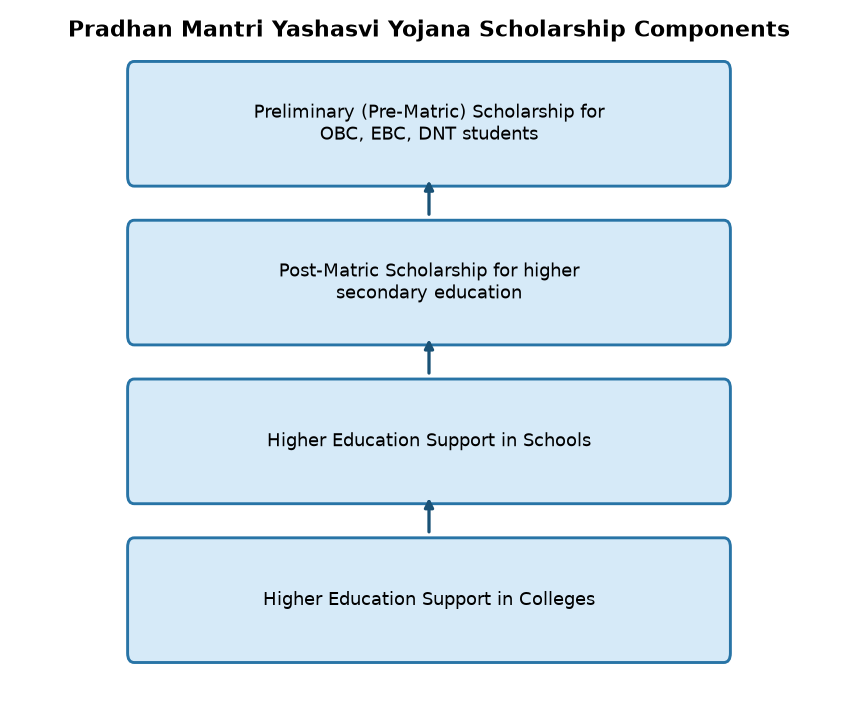
- The scheme comprises four key components: Pre-Matric Scholarship, Post-Matric Scholarship, Top-Class Education in Schools, and Top-Class Education in Colleges.
- Financial assistance is provided to cover tuition fees, maintenance allowances, and other academic expenses, thereby reducing dropout rates.
- Eligibility is determined based on income criteria, community classification, and academic performance, with a focus on inclusivity.
- The scheme prioritises students from marginalised backgrounds, including those from nomadic and semi-nomadic tribes who often face systemic exclusion.
- Implementation involves a digital portal for streamlined application and disbursement processes, ensuring transparency and efficiency.
- The scheme is aligned with the broader objectives of the National Education Policy (NEP) 2020, which emphasises equitable access to quality education.
- Monitoring mechanisms, including periodic reviews and grievance redressal systems, are in place to ensure effective delivery and impact assessment.
Key Features
| Feature | Significance |
|---|---|
| PRI-MATRIC SCHOLARSHIP | Provides financial support to OBC, EBC, and DNT students from Class I to X, ensuring uninterrupted schooling by covering tuition fees, maintenance allowance, and other incidental expenses. |
| POST-MATRIC SCHOLARSHIP | Extends financial assistance to students pursuing education beyond Class X, covering tuition, hostel charges, and other academic costs to prevent dropouts due to economic constraints. |
| HIGHER EDUCATION SCHEME FOR SCHOOLS | Targets meritorious students from Class XI to XII, offering scholarships to bridge the gap between secondary and higher secondary education, particularly for those in rural and underprivileged areas. |
| HIGHER EDUCATION SCHEME FOR COLLEGES | Supports undergraduate and postgraduate students in professional and non-professional courses, ensuring equitable access to higher education through direct financial aid and reimbursement of course fees. |
Why it Matters
SOCIAL INCLUSION
- Addresses historical educational disparities faced by OBC, EBC, and DNT communities by providing targeted financial support, thereby reducing dropout rates and promoting equitable participation in the education system.
- Aligns with the constitutional mandate of Article 46 (Directive Principles of State Policy) to promote the educational and economic interests of weaker sections of society.
- Contributes to the reduction of social stratification by enabling marginalised groups to access quality education, fostering intergenerational mobility and breaking cycles of poverty.
ECONOMIC EMPOWERMENT
- Mitigates financial barriers that impede educational attainment, thereby enhancing human capital formation and long-term economic productivity within beneficiary communities.
- Reduces the burden on families, particularly in low-income households, by covering direct and indirect educational expenses, allowing resources to be redirected toward livelihood enhancement.
- Supports the Government of India’s broader agenda of inclusive growth under the 15th Finance Commission recommendations and the Sustainable Development Goals (SDG 4: Quality Education).
EDUCATIONAL EQUITY
- Ensures parity in educational opportunities by providing scholarships that are proportionate to the financial needs of students across different stages of education, from pre-matric to higher education.
- Promotes gender parity within beneficiary communities by ensuring that scholarships are accessible to female students, thereby addressing intersectional barriers to education.
- Facilitates the transition from secondary to higher education, a critical juncture where economic constraints often lead to discontinuation of studies.
Challenges
1. IMPLEMENTATION GAPS
- Delayed disbursement of scholarships due to bureaucratic inefficiencies or procedural bottlenecks, leading to financial distress for students awaiting funds.
- Inadequate awareness among target beneficiaries regarding eligibility criteria, application processes, and deadlines, resulting in underutilisation of the scheme.
- Insufficient monitoring and grievance redressal mechanisms to address discrepancies in scholarship disbursement or rejections, particularly in remote and tribal regions.
UPSC Link: GS-II: Welfare schemes for vulnerable sections
2. FINANCIAL SUSTAINABILITY
- The scheme’s scalability is contingent on annual budgetary allocations, which may fluctuate due to competing fiscal priorities, potentially limiting coverage for new applicants.
- Inflationary pressures on educational costs (e.g., tuition fees, hostel charges) may erode the real value of fixed scholarship amounts over time, reducing their efficacy.
- Dependence on centralised funding models may disadvantage states with higher concentrations of beneficiary communities due to unequal distribution of resources.
UPSC Link: GS-III: Resource mobilisation and budgetary constraints
3. TARGETING ACCURACY
- Risk of exclusion errors where eligible students from marginalised communities are inadvertently left out due to stringent documentation requirements or income certification processes.
- Inclusion of non-target groups (e.g., students from affluent sections within OBC/EBC/DNT categories) due to loopholes in income verification, diluting the scheme’s impact.
- Difficulty in identifying and reaching DNT communities, which often lack formal documentation or reside in geographically isolated areas, leading to underrepresentation.
UPSC Link: GS-II: Issues relating to poverty and marginalisation
Challenges — UPSC Perspective
| Issue | Concern |
|---|---|
| Digital Divide | Limited internet access and digital literacy in rural and tribal areas hinder online application processes and awareness campaigns. |
| Language Barriers | Non-availability of scheme-related information in regional languages restricts participation among non-Hindi-speaking DNT communities. |
| Documentation Burden | Stringent requirements for caste certificates, income proofs, and academic records disproportionately affect students from illiterate or semi-literate backgrounds. |
| Corruption Risks | Intermediary involvement in scholarship disbursement may lead to leakages or diversion of funds, particularly in states with weak governance structures. |
Government Initiatives — Must-Memorise for Prelims
- Pradhan Mantri Yashasvi Yojana (PMYY)
- Pre-Matric Scholarship for OBC/EBC/DNT Students
- Post-Matric Scholarship for OBC/EBC/DNT Students
Way Forward
- Strengthen the Direct Benefit Transfer (DBT) mechanism to ensure timely and transparent disbursement of scholarships, leveraging Aadhaar-enabled payment systems.
- Launch multi-lingual awareness campaigns in collaboration with local NGOs and community leaders to disseminate information about eligibility and application processes.
- Simplify documentation requirements by introducing self-certification for income and caste status, with post-verification mechanisms to reduce bureaucratic delays.
- Establish a dedicated grievance redressal portal with real-time tracking of complaints and escalation protocols for unresolved issues.
- Conduct periodic impact assessments to evaluate the scheme’s effectiveness in reducing dropout rates and improving educational outcomes among beneficiary communities.
- Expand the scope of the scheme to include vocational training and skill development programs for students who opt out of formal education due to economic constraints.
- Enhance state-level coordination through the Inter-State Council to address regional disparities in implementation and ensure equitable distribution of resources.
UPSC Value Addition
Keywords for Mains Answer-Writing
Social Justice and Empowerment · OBC Reservation · Economically Weaker Sections (EWS) · De-notified Tribes (DNT) · Pre-Matric Scholarship · Post-Matric Scholarship · Inclusive Education · Financial Assistance for Education · Pradhan Mantri Yashasvi Yojana · Scheduled Caste and Scheduled Tribe Welfare · Education Policy · Equity in Education
Constitutional & Policy Linkages
- Article 46: Promotion of educational and economic interests of weaker sections
- Article 15(4): Special provisions for advancement of socially and educationally backward classes
Concept Flow
Historical educational marginalisation of OBC/EBC/DNT communities → Policy response: PMYY scheme → Targeted financial support via scholarships → Reduction in dropout rates → Enhanced human capital formation → Socio-economic mobility and inclusive growth → Economic barriers to education → Financial assistance under PMYY → Increased school retention rates → Improved literacy and numeracy outcomes → Empowerment of women and marginalised groups → Implementation challenges (digital divide, documentation) → Policy intervention: streamlined processes → Greater scheme accessibility → Higher participation rates → Sustainable educational equity → Centralised funding model → State-level disparities in resource allocation → Need for inter-state coordination → Equitable distribution of scholarships → Balanced regional development
Prelims Practice Questions
Q1. Consider the following statements regarding the Pradhan Mantri Yashasvi Yojana:
1. It provides scholarships exclusively to Scheduled Caste students.
2. The scheme includes financial assistance for pre-matric to higher education levels.
3. De-notified Tribes (DNT) are not covered under this scheme.
Which of the statements given above is/are correct?
- 1 only
- 2 only
- 1 and 3 only
- None
Answer: 2 only — Statement 1 is incorrect as the scheme covers OBC, EBC, and DNT students, not exclusively SC students. Statement 2 is correct as the scheme provides scholarships from pre-matric to higher education levels. Statement 3 is incorrect as DNT students are explicitly included in the scheme.
Q2. Which of the following is NOT a component of the Pradhan Mantri Yashasvi Yojana?
- Pre-Matric Scholarship Scheme
- Post-Matric Scholarship Scheme
- Merit-cum-Means Scholarship for Professional and Technical Courses
- Higher Education Scheme for Colleges
Answer: Merit-cum-Means Scholarship for Professional and Technical Courses — The Pradhan Mantri Yashasvi Yojana includes Pre-Matric, Post-Matric, and Higher Education Schemes for schools and colleges. The Merit-cum-Means Scholarship for Professional and Technical Courses is a separate scheme under the Ministry of Minority Affairs.
Mains Practice Question
✍ Critically examine the role of the Pradhan Mantri Yashasvi Yojana in addressing educational disparities faced by OBC, EBC, and DNT communities. How does this scheme align with the constitutional mandate of equality and social justice in education? Substantiate your answer with relevant provisions and challenges.
Approach: Begin by outlining the constitutional provisions (Articles 15(4), 16(4), 46) and the Right to Education Act, 2009, that mandate inclusive education and affirmative action. Discuss the scheme’s structure, including its four components (pre-matric, post-matric, higher education for schools and colleges), and its target beneficiaries (OBC, EBC, DNT). Analyze its potential impact in reducing financial barriers and promoting equity. Highlight challenges such as implementation gaps, awareness deficits among target groups, and the need for monitoring mechanisms. Conclude with suggestions for strengthening the scheme, such as integrating digital platforms for disbursement and expanding outreach programs.
Source: PIB (Press Information Bureau)
Generated by AanyaAi for educational purpose.

- Harivansh Leads India at 153rd IPU Assembly in Tanzania - October 3, 2026
- अमेरिका में व्यापार मिशन: भारत की बड़ी योजना, जानिए क्या है सरकार की रणनीति - October 3, 2026
- Nasha Mukt Bharat: Youth Role in Polity & Governance for UPSC & PCS - October 3, 2026

No Comments